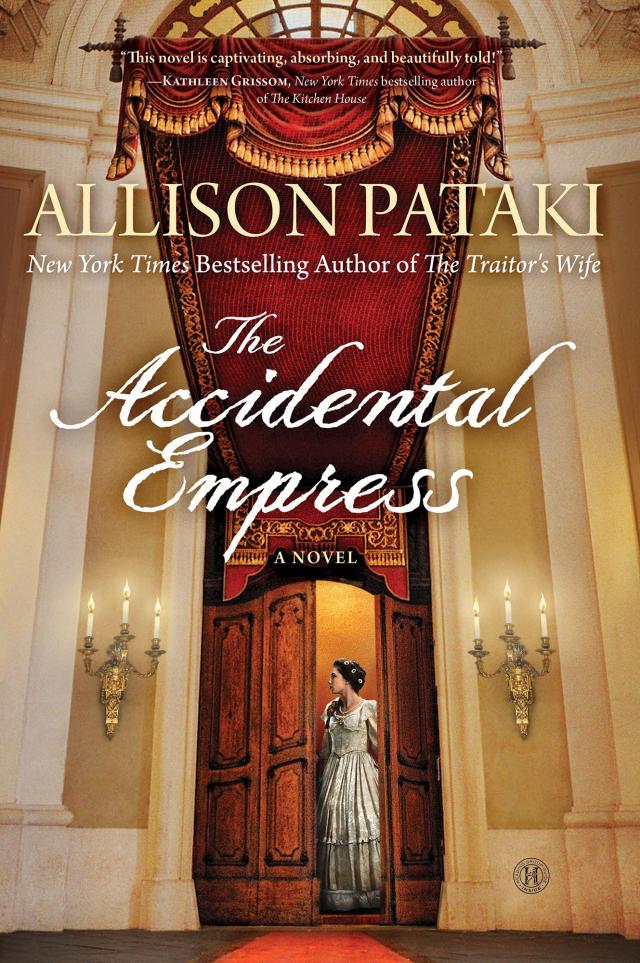
The Accidental Empress, page 52


Sisi smiled. “If I relocate here.”
“You must.”
“Just think of it. We would be together, at last.” She paused. “But won’t you tire of me, seeing me each day?”
“If you behave as you did last night, then yes, I might grow tired.”
She laughed at this, her hands still interwoven with his.
“No, my darling Sisi. On the contrary. I shall love you more each day.”
“Even as I . . .” She looked down toward her stomach, where the hint of a bump would continue to swell. “Grow big?” It was the first time they’d mentioned the baby since their quarrel.
Now Andrássy put his hand on her belly and spoke, his tone soft. “This baby is a part of you. I could never feel anything but love for it.”
“Do you promise, Andrássy?”
“I promise.”
“You’ll still love me?”
“For the rest of your life.”
But that did not satisfy her.
“What? Why are you frowning, Sisi?”
“I’ve had a man make a promise to me before that was supposed to last a lifetime. And it did not.”
Andrássy took her hands in his and lifted them to her heart. He looked down at her now, his dark eyes ablaze as he spoke. “Sisi, listen to me. All of these pieces of you that are broken, I see them. And I love them, too.”
Sisi lowered her eyes, starved for—yet frightened of—those words.
“Look at me. I want you to look into my eyes as I tell you this, so you will know how truly I mean it.”
“All right,” she whispered, her mouth dry.
“Sisi, if you will let me, there’s nothing I want more than to be the man who shows you that it is safe to love again.”
Tears ran down her cheeks as he said it. She shook her head, looking away.
“Sisi.”
“It’s just that . . .”
“What is it?” He angled her chin upward with his finger.
“Andrássy, it’s just that . . . I’ve had to be so strong for so long. How can I risk, once more . . .”
“Don’t you see, my darling?” He lifted her hand, resting it on his chest so that she could feel his heartbeat, its pace rapid like horse hooves against his breastbone. “Don’t you see? Oh, but you know this well enough already. That there is nothing that requires more strength than to allow yourself to be weak for another.”
XIX.
The wind whips her face, setting her hair awhirl around her face and matching the urgency of her own uneven breath. All around her the earth smells of springtime: mud and ripened acacia petals.
Beneath her, the horse speeds forward in his even, stately gait. She matches his rhythm, their bodies working together as the world whirs by.
So this is how the swallows feel as they circle, free, she thinks. The blue ribbon of the Danube glistens beside her, its clear waters like an invitation, a seduction. Up ahead the hill of Buda rises, the church steeple visible against the backdrop of a cloudless sky. Skirting the hill are the endless plains of Pest, a sea of green dotted with the purple petals of wildflowers.
My kingdom, she thinks, urging the horse forward. Her body will grow tired, eventually. But her soul? Well, her soul is, at last, awake.
Chapter Nineteen
BUDAPEST, HUNGARY
JUNE 8, 1867
“Ravishing.” Franz breathed the word as his wife entered the small antechamber of the castle, just moments before their coronation procession was scheduled to set out. “You look absolutely ravishing, Elisabeth.”
“Thank you, Franz.”
“Fresh and happy,” Franz said, almost to himself, as his eyes stayed fixed on Sisi. “Like I have not seen you in quite some time. Like the girl I married years ago.”
“Thank you, Franz.” Sisi blushed, lowering her eyes. She was aglow, and she knew it. “I feel fresh and happy.” But I assure you, I am not the same girl you married.
“You look very fine yourself, Franz.”
“Do I? This orb feels too big. I fear I might drop it in the middle of the mass.” Franz forced out a feeble smile, and Sisi felt for him. Deep shadows under his eyes testified to his fatigue. The ermine cape that hung from his shoulders, over the ancient mantle of St. Stephen, looked unbearably heavy.
Following tradition, Franz’s entire wardrobe had been plucked from the ancient garments worn by the Hungarian kings enthroned before him. The high point of the day would come later when, in the cathedral of St. Matthew, Andrássy placed Hungary’s holy crown on Emperor Franz Joseph’s head, making him King of Hungary, by the will of the Hungarian people.
Sisi, on the other hand, had ordered everything new for the occasion. Her gown, a masterpiece, had been stitched in Paris, arriving in Budapest as a celebrated royal would—under heavy guard and with its own imperial escort.
It was a work of art, finer even than her wedding gown had been, and Sisi felt unequal to its grandeur. The dress was ivory and silver brocade, with a narrow, black velvet bodice trimmed in diamonds and pearls. The sleeves hung off her upper arms, showcasing the creamy white skin of her neck and shoulders. She wore a diamond choker around her neck and white gloves on her hands. The skirt fell loose, loose enough to obscure the hint of her belly, with a regal train that would trail behind her as she made her way to the front of the cathedral. Stitched into the lace overlay that draped around the bell-shaped skirt were the patterns of delicate leaves and flowers. Over the gown she wore a cape of white satin.
Her hair had taken the entire morning to style, a fact for which she had been grateful. It had given her hours to sit in the chair with nothing to do but remember the night she had just passed with Andrássy. Franziska, discreet enough not to ask why the empress blushed after her night out of her apartments, had pulled Sisi’s curls back into a coronet of loose braids. The hair framed her face before falling gracefully down her back, a simple look that made room for the diamond-encrusted tiara that would be placed on her head: a crown once worn by the Habsburgs most beloved ruler, Maria Theresa.
On the other side of the thick castle doors, the crowds waited impatiently, lined up since before the first predawn cannon salutes. When those doors opened, Sisi and Franz would fall in line at the rear of the processional, trailing a dozen Hungarian noblemen bearing the flags and standards of their royal houses. Clergymen would lead the way, bearing gold-gilt crosses and jewel-encrusted bowls of holy water to bless the royal pair. And Andrássy . . . Sisi’s heart quickened at the thought of seeing him. Andrássy would stand before the monarchs—almost their equal—wearing on his tunic the broad cross of the Order of St. Stephen, and carrying Franz’s sacred crown on a pillow of red velvet.
“How do you feel, Franz?” Sisi adjusted her heavy skirt, smoothing the mass of lace and satin that draped over her legs.
The emperor thought about this question. “Fine. A bit impatient, I suppose.”
Sisi nodded.
“How about you, Empress Elisabeth?”
“I feel happy,” she said, turning to him with a smile. “And full of hope.”
Franz nodded, casting his eyes back toward the doors.
“You are a good emperor, Franz Joseph,” she said, taking her husband’s gloved hand in her own.
“And you are a good empress, Elisabeth.” They looked into one another’s eyes, a silent communication passing between them. Even after all the years and heartbreak that had come between them, only the two of them could go through what awaited them, on the other side of the doors. A moment only they could share.
“It’s time.” A short priest emerged in the antechamber, his silken robes aflutter with the haste of his gait. After the requisite bow, he stood and rattled off their instructions. “When I knock, they shall open the doors and you shall process, straight up toward the street. The processional before you will lead the way. You may look from side to side if you wish, but do not pause until you reach the cathedral.”
They both nodded. Franz rose from his chair, standing beside Sisi. She took his hand and squeezed it, one last gesture of support.
“Are you ready?” Franz asked her.
“I am. And you?”
“Is one ever ready to divide his empire in half?”
“Franz,” she said, squeezing his hand. “You are keeping your empire whole.”
Franz looked forward. “Let us go.”
The doors opened and Sisi was stunned by a blast of color, an eruption of trumpets. Hundreds of courtiers lined the route, waving Hungarian flags and looking on with eyes wide and mouths moving in inaudible responses and reaction. They stood plumed in their finest robes and suits, the women with meticulously coifed hair, attempting to mimic Sisi’s famous style. Behind them, the common people jostled and cheered, a wall of merchants, peasants, children, and tradesmen, all crammed onto the processional route with one purpose: to catch a glimpse of the king and queen.
In front of Sisi, Hungarian noblemen lifted their banners, charting a course for the cathedral atop the hill of Buda. Imperial bannermen played triumphant notes on glistening trumpets, as guards stood stiff and erect, hemming in the path now intended for royal feet.
Sisi kept her eyes down as she walked, just a few steps behind Franz. She listened as the people cried out her name. “Éljen Elisabeth! Long live Queen Elisabeth!” The only noise louder than the cries of the crowds were the roars of the cannons that fired off a steady salvo as the monarchs made their way up the hill.
As they reached the massive doors to the cathedral, the bells clanged so uproariously overhead they sounded as though they might crack the bell tower. Inside the organ vied with the trumpets to play its notes the loudest.
“Here we go.” Franz turned to her, adjusting his cape one final time. Sisi nodded.
“Yes, here we go.” Her body trembled, as it had on her wedding day, but she forced out the hint of a smile. “After you, Your Majesty, King Franz Joseph.”
And then, looking forward, Franz began to walk.
Sisi fell into step beside him, eyes still cast downward. She had yet to catch a glimpse of Andrássy, but she knew he was there. Somewhere in front of her. He was the one who would make her husband King of Hungary.
The walk to the altar seemed to take an eternity, and Sisi reminded herself to keep her eyes down, her features composed. The image of humility, even if the people packed into this cathedral thought her, in some part, divine.
When they reached the front of the cathedral, two thrones awaited. There they would sit, side by side. Two flawed mortals forever memorialized, together, in this moment. How strange, she thought, to be a part of what would surely become history, and yet still worry that she might trip on her heavy skirt.
Her dress was cumbersome, and Franz helped her as she stepped up to the altar. And then she turned to look out over the cathedral, her eyes acclimating to the scene so that the sea of a thousand unique faces blended into one fuzzy tableau. The noise throbbed so loudly around her that she longed to stop her ears, to drown out some of the din, but she knew she could not. A deity does not quake simply because the crowd yells. An empress stands fixed, immutable: the calm that continues on, even as the world rages. Even though, all along, she has found it impossibly difficult to do so.
Beside her, Franz looked composed. Even stiff. And yet, Sisi detected the weariness that lingered behind his calm mask. The human frailty that persisted, even after all of his years of training and emotional mastery. For a brief flash, she yearned to remove those coverings from him; to free him of his trappings so that he might once again resemble the man she knew, the man whose hopes were once so interwoven with her own that she had not distinguished between the two distinct threads.
But it was too late for that now. He had made his decisions, she had made hers. She could not undo the past any more than she could retrace the course she had set for the future. She admitted that to herself one final time, sadly, as if wishing him farewell. Wishing a version of herself farewell.
All around them now, the crowd packed into the cathedral jostled and applauded, vying for a spot close enough to touch them.
“My Queen!”
“My Empress!”
“Long live Elisabeth!”
“Long live Franz Joseph!”
Sisi turned from the crowd back to Franz. He, too, appeared stunned and overwhelmed. He faced her and mouthed the words “good heavens.” She smiled, remembering how she had once looked at him and thought that he moved like a god among them. The imperial guards, sensing that the mood of the congregation grew ever more boisterous, pushed back against the crowd, stemming the tide of those people inching their way closer to the two monarchs.
Sisi’s eyes did not rest on the emperor for long. Desperately, she combed the scene once more, looking for another face. Where was Andrássy? she wondered. Surely he was there. After the two of them, he was the central figure of this entire day.
Finally, her eyes landed on him. He stood near the front, the welcome sight of his face almost entirely obscured by the ornate headpiece of a bishop in front of him. He was more dashing than she had ever seen him—his dark eyes aglow, his tall frame outfitted in a traditional coat. He had been watching her all this time. When they locked eyes she smiled. She did not care who saw.
And then as Andrássy approached the altar, she looked out once more at her adoring subjects. They cried out for her. So this is what it feels like to be a queen, she thought, feeling that, for the first time in her life, she was up to the task before her. She was in the kingdom she had been meant to rule.
“Sisi! Sisi!” The crowds were enraptured as she knelt beside Franz, tipping her head before Andrássy in preparation for the crown that would be placed atop her famous chestnut curls. When she lifted her gaze, staring out once more at the crowd, she flashed a coy, beguiling smile. They erupted in cheers.
Sisi stared out over the cathedral, absorbing the scene, willing her eyes to take in every drop of color, every smiling face; hearing the music that roared, composed especially for this day by Hungary’s own Franz Liszt. Would she be able to remember it all? Doubtful. But she’d remember, for the rest of her life, how she felt as she beheld it. Proud of Franz. Happy for Austria. And how, for the first time in years, she felt that she was home. At home among a people to whom she belonged. Beyond this congregation stretched the fields of Pest, where she would ride her horses; the mountain of Buda, where she would ramble, staring out over the blue ribbon of the Danube; the cheering people who called out for her in the street.
And with the sea of faces swelling around her, her gaze landed once more on the one face she longed to behold. The one man who knew her better than anyone else. The man who knew her and loved her, not because she was his queen, but because she was Sisi.
And here, on this altar, wearing the crown for which she had fought, Sisi made her decision. She hadn’t been ready, the first time a crown had been placed atop her head. She hadn’t understood, then, what it meant. Hadn’t even fought for it, really.
This time, it would be entirely different. This time, she stood ready. She lifted her palm to her belly, to where a baby grew inside. A child that, at last, might be hers.
God, for some inexplicable reason, had granted her a second chance, and she would seize it. She would be a good queen. A loving queen. A queen worthy of the adoration that these people—for some mystifying reason—now gifted to her.
She would be the ruler not only of this land, but of her own life.
A Conversation with the Author Allison Pataki
Q: The Accidental Empress is quite the dramatic story! What was it like, writing a novel about Sisi?
A: Yes, it certainly is full of drama. Sisi, or Empress Elisabeth, was an incredibly complex individual who lived in a fascinating moment in history. And her story—in some ways very relatable, in some ways completely foreign—played out before such an epic backdrop, with all the accompanying glitz of the Habsburg Court and the tumult of the Austro-Hungarian Empire. I was as enchanted by her as everyone else was.
Q: What in this is true, and where does the “fiction” part of the “historical fiction” genre come in?
A: I decided early on that I would be crazy not to rely heavily on the historical record for plot and character development in The Accidental Empress. The raw material itself was so good and intriguing that there were all of the fixings in there to make a compelling novel.
To begin with, Sisi was not supposed to be Empress of Austria. Hence, the title of this novel. Sisi was a free-spirited girl who left Possenhofen (and a wild, unstructured lifestyle like the one you see her living at the start of this book) at the age of fifteen. She traveled with her mother and sister to support Helene in her coming engagement to Emperor Franz Joseph.
Sisi did in fact inadvertently steal the spotlight when they arrived in Bad Ischl, and, in doing so, inadvertently stole her sister’s groom. Archduchess Sophie was not happy to see her plans derailed. Some of Sophie’s quotes in this novel lamenting the unsuitability of such a match are exact quotes.
The plot of The Accidental Empress begins with their arrival in Bad Ischl, the women dressed in black (after getting separated on the road from their clothing trunks), and that is in fact how it occurred. Subsequent events and details such as Franz Joseph’s unanticipated attraction to Sisi, the cotillion dance for his birthday, the preparations leading up to their marriage, the births of their children, and their periods of closeness and estrangement are based on historical fact.
Descriptions of the incredibly difficult hand Franz Joseph was dealt concerning Austria’s foreign policy, and the wars that ensued in and around the Austrian Empire, are also based on the facts. Sisi did accompany Franz Joseph on the trip to Hungary in 1857, much to Archduchess Sophie’s vexation. While it started out as a great trip for Sisi—one that began her lifelong love affair with Hungary and its people—it was during that time that both her little girls became sick and little Sophie died. The second trip to Hungary described in this book, at which time the dual monarchy was officially established in 1867, was also taken from history.