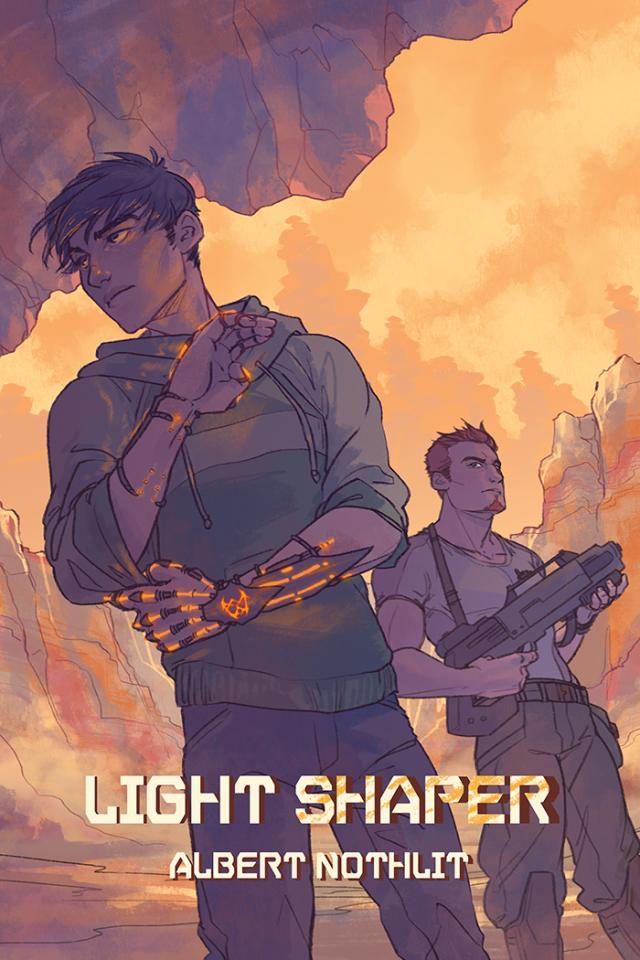
Light Shaper, page 8


“There was a girl. From the slums.”
“What?”
“Tonight, in the park. She was carrying a really big suitcase. She was lost, Misha. I had to help her.”
“From the slums? For real?”
Rigel nodded, still looking out the window. “Yeah. No sign of her parents, wherever they were. She had her little brother with her, and it was obvious that they had nowhere to go. I helped them carry the suitcase to Terraces and gave them some money for train fare. All the cash I had.”
“Oh, Aaron.”
Misha got closer and embraced him from behind. She could be a belligerent brat most of the time, but she was also a good friend.
“I just couldn’t refuse to help, you know?” Rigel said through gritted teeth. Misha’s hug tightened slightly. “It’s humiliating to be like this, unable to even carry the groceries home without being afraid of the damn pain, counting the number of words I can safely type at my computer, having to remind myself not to hold a glass of water for too long. I’m a man, for fuck’s sake. I shouldn’t be weak as a kitten. When I saw the girl… I knew it would hurt me. It’s probably going to hurt for weeks. And yet….”
“You’ve got such a big heart,” Misha told him. “And you’re tall and handsome. You’re a catch, Aaron. Don’t ever change.”
Rigel grinned reluctantly. He turned around and stepped away from Misha to put his metal braces back on. “Is that why I’m still single?”
“You just wait. I know you’ll find the right man when you least expect it.”
Rigel’s phone buzzed loudly.
“Now what?” he said irritably.
“What is it?” Misha asked.
“I’ll know, some kind of e-mail. From…. Uh-oh. It’s from CradleCorp.”
“What does it say?”
Rigel tapped the e-mail to display the message. Misha walked over to read over his shoulder.
Dear Mr. Blake,
We have been notified that at 23:04 today, March 27, you were involved in an incident in which you established an Otherlife session under user credentials not your own. The unauthorized session lasted for forty-three minutes and thirteen seconds, followed by a sudden logout interrupt. For verification purposes, please find the corresponding data log attached to this message.
We would like to inform you that this behavior is in breach of article 77-A of Aurora’s Civil Charter regarding online activity in virtual enterprises, User Section. As such, it warrants immediate referral to the pertinent authorities and a preemptive arrest followed by a public trial.
Nevertheless, we are prepared to offer you an alternative to this procedure, whereby you will not be held accountable of any responsibility stemming from this incident. If you are agreeable to this, please come to CradleCorp tomorrow at 0900 for an interview and an Otherlife-based evaluation. Should you not arrive at the appointed hour, we will refer your case information to Auroran authorities at the earliest possible opportunity.
Many thanks,
Marcus Wall
CradleCorp Legal Department
“Are they insane?” Misha asked. “They’re threatening you!”
Rigel looked slowly up from his phone. “Yeah. I knew it was too good to be true when they let me go like that.”
“But… but… you didn’t do anything. It was me!”
“Did you get an e-mail like this?” Rigel asked her.
“Let me check.”
She left for her bedroom and came quickly back. “Nothing. Let me call my dad, okay? I’m going to sort this out.”
Rigel busied himself eating a brownie while Misha was on the phone. She talked to her dad, who apparently talked to someone else and then someone else before getting back to her. When Misha finally put the phone down, she was furious.
“Nothing!” she exclaimed. “My dad doesn’t know anything, and his boss doesn’t know anything. My dad checked with the Legal Department, but they have nothing on me, and they won’t share information about you. What the hell is going on?”
Rigel closed his eyes for a moment. His head was still pounding. Could this day get any worse?
Then his phone buzzed. Rigel opened his eyes and took out the device. It was another text message, no sender registered.
They are dangerous, Rigel. Tanner plans to get rid of you.
Come to CradleCorp. I can help.
—Atlas.
“Is everything okay, Aaron?” Misha said. “You’re all pale.”
“Yeah. I just… I’m going to bed, all right? I’ll skip dinner. It’s late, and I guess I’ll have to go back to CradleCorp tomorrow.”
“But….”
“Good night.”
Rigel ignored her and went to his room. He’d had enough of everything for the day.
Chapter Six
RICHARD TANNER swiveled in his chair and looked at the bust of his grandfather, Kyle Tanner, set on a pedestal by the north wall of the office. Portraits of him were hung in various places throughout CradleCorp, but this was the only bust of the man. It was all white marble, skillfully done, and nearly fifty years old. Tanner noted with an unpleasant twinge that the sculpture was nearly as old as he was now, having been made shortly before Tanner’s birth. Kyle Tanner had been sculpted as a balding and middle-aged scientist, his brow furrowed as if he had been lost in concentration with a deep, piercing stare in his stone eyes. The artist had been truly gifted to make ordinary marble seem so lifelike. To this day, Richard Tanner felt as if the bust were looking right at him disapprovingly.
Tanner snorted with derision. He thought the bust and all the portraits were a bland attempt at trying to glorify a lucky but otherwise unremarkable man. He had never created anything, least of all Otherlife. All his grandfather had done was discover an electronic treasure by happening upon it by accident. Anyone could do that. To take the treasure and make an empire out of it, though….
“Sir?” a female voice asked him uncertainly. Tanner looked away from the sculpture slowly, deliberately letting the tension build as he kept his silence. After all, he was the boss. Marion Fay was his best researcher, true. She was also the woman in charge of his fifteen-year classified project code-named Linker, a true veteran of CradleCorp. But she was easily manipulated, and there was much to be had by keeping the atmosphere of vague intimidation going.
“I have often wondered why people love my dead grandfather so,” Tanner mused, meeting her eyes at last. He saw the flicker of puzzlement in them as he said it. “Why do you think this is, Ms. Fay?”
“Sir?” she said. “I thought this meeting had been called because an emergency had arisen.”
He nodded slowly and ignored the comment. “He was intellectually unremarkable. A terrible entrepreneur. And yet, ask anybody in the streets of Aurora today and they will each and every one tell you that Kyle Tanner was the creator of Otherlife, responsible for the unique network that mixes avatar simulation with real-time networking at a level of technology so advanced that few people can even begin to understand it. They will say that if it weren’t for him, the city of Aurora would have never grown out of the ashes of civilization to become one of the most important urban centers in what remains of the world.”
He paused, looking at Marion Fay as if he expected some sort of answer. Predictably, she fidgeted and tried to provide one. She twirled one of her fingers unconsciously around a lock of her long black hair as she spoke.
“Kyle Tanner discovered the undisturbed set of algorithmic templates that had been buried in the Cradle as part of Project Atlas,” she told him, and Tanner nodded. She interpreted that as encouragement to continue. “He was first to see the potential that could be achieved if the templates were activated according to the original plans set in the Project. Most people agree that the site where the Cradle was found, out in the uninhabited desert, must have been some kind of secret military outpost given its remote location and heavy fortifications guarding the technology within. There’s also the fact that it had been hidden in what is one of the most inhospitable places in this region, practically on top of the aptly named Death Valley. Kyle Tanner’s genius was in realizing that the technology that had been discovered there was vastly more advanced than anything else that had survived the Cataclysm. And when he activated the software templates after years of research, he also created Otherlife.”
“They treat him like a saint,” Tanner said calmly, disguising his old resentment well. “Yet the only thing he did was stumble blindly upon treasure with his digging of these ruins. He vaguely saw the potential of Otherlife, but it took an entire generation of visionary individuals working in CradleCorp after his death to bring that potential to fruition. It was not something that one man can do alone, but thanks to all their contributions, we now have this. All of this. A large pool of committed users, an ever-growing database of interactions between them, and the highest net worth of any industry in the world that shows no signs of stopping its exponential growth. It is something to be proud of.”
“Yes, sir,” Marion Fay agreed uneasily. Tanner saw that she was getting impatient. She was a brilliant scientist, and like all people committed full-time to research, she did not like to be away from her lab very long during work hours. Time to get to the point.
“Ms. Fay. I have called you here today because we do have an emergency. In a manner of speaking, the time for your team is running out. I have reason to believe that Atlas is becoming fully self-aware at last.”
Tanner’s piercing glare missed nothing. He saw the shadow of doubt pass through Fay’s countenance, the quickly suppressed start of guilt, and then the cautious wariness hidden behind a screen of careful politeness.
So. She did know. None of the other programmers on her team had. All of them had been interrogated thoroughly before this meeting. The fact that she knew what Tanner was talking about spoke highly of her intelligence and perceptive nature.
“You knew this was happening,” Tanner said. He was not accusing her; he was merely stating a fact.
She nodded slowly. Her hair, like Tanner’s, was beginning to show signs of gray. It was another unpleasant reminder of the passage of time to Tanner. He had hired her as a young woman, full of ambition and ideas as well as youthful zeal. She had lost only one of those traits, however. If anyone could crack the Atlas code, it would be her.
“Yes, sir,” Fay answered. “I have been monitoring the increasingly complex dynamic network generation mechanics that the entire structure of Project Atlas has exhibited over the last few months, particularly inside its application to the Otherlife simulations. I did not wish to divert the entire team’s attention to this phenomenon due to the fact that we are finally making some progress in reconfiguring the linking algorithms to allow us to gain access to users’ thoughts directly, but I myself have studied it. I was hoping it would give me insight into the deeper structure of the technology that governs such a complex collection of programs. Even….”
“Go ahead,” Tanner said gently.
“I had even hoped to get more information on the original purpose of Project Atlas itself.”
Tanner grinned, allowing himself to show it. “Ah yes. The mystery that has resisted all attempts at solving it. We both know how very little useful information on the original purpose of the technology that my grandfather found survived the passage of time.”
“Exactly!” Fay said. Her tone became slightly more animated now that she was speaking about the topic she had dedicated her life to. “When the Cradle was discovered, most of the records had decayed beyond retrieval or had simply been wiped out by the pulses. Even the theory that the Haven III site was a military research stronghold, as others have suggested, is nothing but a supposition. The fact remains, however, that the technology found in there is so superior to anything we have been able to make that we have little hope of understanding it completely. Even our own scientific contributions in the last few decades pale in comparison to what was originally there.
“Take the avatars, for example. They are so impossibly… lifelike. Complex. I have studied their sensory replication protocols my entire career, and I still don’t know how the neural correlation matrix works. How is it that users can experience perfect simulation of their senses? How does moving in a virtual world feel as natural as moving in this one, without having the operator’s physical body mimic the motions? The things my own team has been able to add into the system are, as you have expressed before, woefully inadequate. The environments that we create look like crude outlines of things, simplistic out of necessity. It will be a long time before our programming knowledge can catch up to the system we have only now begun to contribute to—”
Tanner held up a hand, cutting off the tirade. “Let’s focus on the problem at hand.”
“Yes. Of course.”
“Based on your own observations, Ms. Fay, what are the dangers of Atlas achieving full self-awareness?”
“Well, Atlas has always held executive control over most of the functions that direct the operation of Otherlife. Its existence is not common knowledge. Few of my engineers are aware that there is a potential sentience hidden inside the network. Should it achieve self-awareness, it would make it infinitely more difficult to direct it according to our preordained specifications, but as long as the original safeguards that limit its operation remain in place, it will matter very little whether Atlas resisted commands. The worst-case scenario is that it would cooperate unwillingly. This would, of course, make our own work nearly impossible, as we require full cooperation of the network pathways to learn how to reverse the flow of information to and from users’ minds. As you rightly point out, our time is literally running out as long as this stimulus that has accelerated Atlas’s awareness continues to exist. The best course of action would be to remove this stimulus, thus allowing us a little more time.”
Tanner nodded. “What if I told you, Ms. Fay, that this external stimulus you speak of is a person?”
“A person?” Marion Fay echoed. “A user, maybe? No, that would not make any sense. The level of interaction with the Atlas subroutines must be deeper, much more complex. A programmer, then?”
“An artist,” Tanner corrected. “Or so his file says. His name is Aaron Blake. I was hoping to get your input on how his sudden interaction with the system might have triggered this.”
Fay considered. “Well, there’s always the possibility that Atlas is modifying its network to emulate the structure of a real mind. Perhaps one or more characteristics in the mind of this individual are particularly consonant with Atlas’s own underlying architecture. If they are, however, they would be extremely complex. Nearly impossible to analyze or reproduce.”
“I expected you would say that. Now, let’s consider the scenario where I remove this stimulus from Atlas. If I do so right now and ensure that the contact will never be repeated, will it stop Atlas from reaching full awareness?”
“Oh, most definitely,” Fay told him with confidence. “In fact, even with the presence of this user mind you speak of, I cannot begin to imagine how Atlas would make the jump from a collection of programs and monitoring subroutines to a single entity with a driving will and personality that is also able to circumvent the locks that limit its functions. The software in those safeguards is even more advanced than the one driving Atlas itself. One would have to physically remove the drives that contain these lockdown programs from the main network in order to disable the restrictions on Atlas’s artificial intelligence, and that is only an option in the case where those programs are not fully integrated into the greater architecture of the network. If they are, then there is no way for a single person to free Atlas, so to speak. I just don’t see how. I suppose Atlas could attempt to assemble additional higher functions out of the collection of information provided by the users currently available to it via Otherlife, but the process would take a very long time and probably not be successful. A far easier way would be simply to perform subsumption of a catalyst mind in some way…. I’m sorry. I’m only theorizing here.”
Tanner nodded thoughtfully. “Excellent. I appreciate your input. While this emergency solves itself and I find a way to ensure that our catalyst is removed from the equation, I wish for you and your team to direct your efforts to stopping the increasing complexity in Atlas’s network. Keep only one or two members working on the Linker project, but until this crisis is resolved and we reach stability once more, I want everybody focused on keeping Atlas under control. I expect daily updates. Understood?”
“Yes, sir.”
Tanner dismissed her with a gesture. Fay seemed relieved to be allowed to go back to her lab. He watched her go, thinking about what she had said. Despite her lack of assertiveness, she was a brilliant scientist, and her insight was always helpful.
There was a discreet knock on a door as soon as Tanner was alone. The sound came from a small door, cleverly concealed underneath the old portrait set on the wall.
Tanner pressed a button, and the door opened. A slender, dangerous-looking woman stepped out of the shadows and headed for his desk.
“Did you hear all that?” Tanner asked her casually.
“Yes,” the woman said. “Not that I understood much of it. Was that why you called me?”
“Please, have a seat,” Tanner said, standing up and gesturing to the seat that Marion Fay had recently vacated.
Diana Herrera narrowed her eyes suspiciously and set a hand on her hip. “I won’t be staying long. Just tell me what you need me to do.”
Tanner nodded and remained standing as well. One of the things he valued most about Diana was the fact that she never let her guard down. Not even with her employer.
“Will your Trackers be ready today in case I need you to cut a few loose ends?” Tanner asked her.
Diana nodded stiffly. “My boys are on standby. Just give us the target, and we’ll track it down and eliminate it if you want us to. Will it be that woman who just left?”