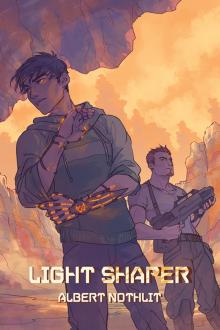
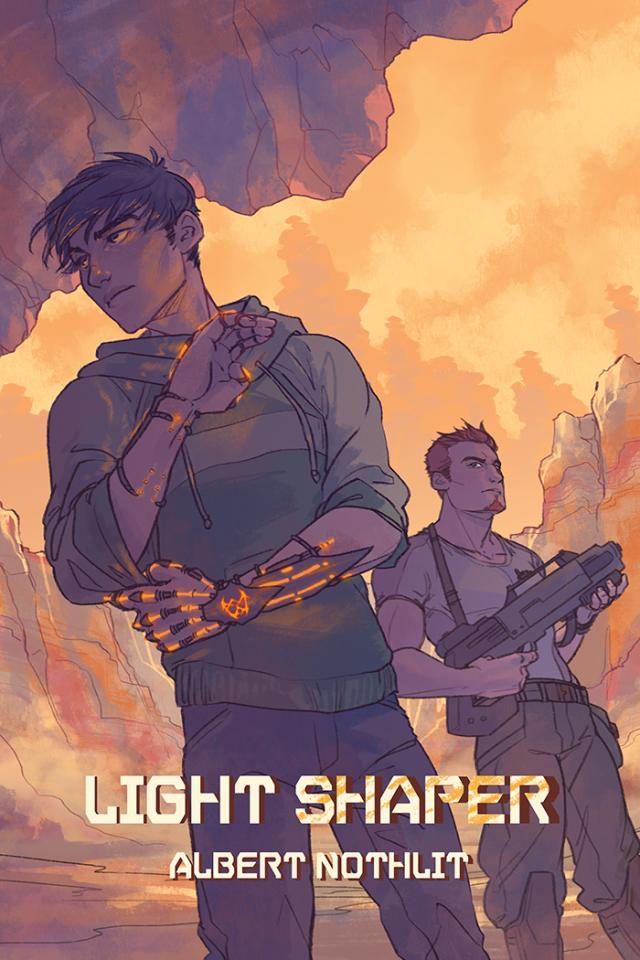
Light Shaper, page 24


He left for the bathroom, which was good because Rigel could not have hidden the flush that crept over his cheeks at Steve’s words. And at the way he had looked at him, as if acknowledging that Rigel wasn’t just some helpless city boy but someone who could actually take care of himself. Rigel still felt the echo of Steve’s hand clapping him on the shoulder, the heavy yet welcome touch of that powerful man.
Rigel shook his head quickly and drank almost half his beer in quick gulps.
No. Don’t fall for him, Rigel. Don’t you dare.
He managed to talk himself into believing he really didn’t feel anything in the couple of minutes he was alone, but then Steve came out of the bathroom. The sleeve of his shirt was folded above the cut, the shirt itself straining against Steve’s muscular figure, and Rigel felt that little kick in the pit of his stomach that told him it was too late. He looked at Steve’s red hair, the stubble on his cheeks, and his intense green eyes, and found he could not look away.
Steve noticed and held Rigel’s gaze. He sat back down at the table.
“Hey,” he said, reaching out for his beer. His hand missed the bottle by several centimeters.
“Hey,” Rigel echoed.
Then Rigel finally managed to look away. He opened the pizza box clumsily, tore off a piece, and began to eat, looking everywhere except at Steve.
They ate in silence at first, the only noise coming from the TV where a news announcer was going on and on about the recovery efforts after the fire in CradleCorp. People were speculating on how it had happened, whether it had been an accident, as the official version insisted, or whether it had been something more sinister, like a Prime attack or maybe a terrorist. Rigel listened, although not very attentively. He was surprised at how hungry he was, and soon Steve and he had finished most of the pizza. Rigel wondered where the food had come from, whether there were pizza places here in the slums or whether it had been brought from the city. He knew almost nothing about this place even though he had lived practically next to it all his life. Steve, however, was obviously familiar with it. Rigel wondered whether he should ask.
After the second beer, he decided to risk it. “You’ve been here before, haven’t you?”
“What do you mean?” Steve answered. Rigel thought he heard a lightly guarded tone in his voice.
“Here in the slums, I mean. You know that guy,” Rigel said, pointing at Howard. “You also know this guy we’re looking for, Streaker.”
Steve’s eyes flickered over to Howard, but he wasn’t paying any attention to them, and the TV was loud enough that they could talk without being overheard.
“Yeah, I’ve been here. I told you about the airship business, right?”
Rigel nodded. “You said you had been a security guard for one of the ships or something.”
“Yes. We used to come to the slums often when we needed parts that we couldn’t find in the official markets. Also fuel, when we went over our quota. I used to come here with the captain of the Titania most of the times, acting as a bodyguard. I got to know the place pretty well.”
“And this… Night Market?”
“That’s where everything is sold in here. It’s really big, bigger than any department store in Aurora. You can find things they won’t sell in any official business establishment, things from other Havens, bits of scavenged technology, weapons, you name it. It’s dangerous to go there if you don’t know what you’re looking for or who to ask for, though. Not many city people talk about the place, let alone go there. You’ve seen how it is in here. People are more likely to stab you for the contents of your wallet than make a deal with you.”
“And so this man, Streaker, he can give us a vehicle that will take us over the desert?”
Steve shook his head. “Not him, not directly. But he’s one of my best contacts, and if anybody knows how to get an illegal four-by-four, it will be him.”
“But we don’t have any money,” Rigel said.
“Yeah, well, he doesn’t know that,” Steve said calmly.
“How are we going to get away with the car, then?”
“Well, the first thing is for Streaker to get us the vehicle. Once he gets it for us, I’ll talk to him. There’s got to be something he’s interested in. Maybe salvaged technology from the military site if we make it over there, maybe some information he can sell about this whole CradleCorp mess. Or maybe we just threaten him and force him to hand over the car. I’ll think of something when the time comes.”
“Okay,” Rigel said. “Although…. Well, if we do need to pay up front, I have the money my parents left me. I got all of it out of my bank account before getting to your apartment last night. Just in case. I have it here, in a data card.”
“Put it away,” Barrow said quickly. “How much money is there?”
“Not that much. A bit under a hundred thousand. I figured I might need it.”
“A hundred thousand dollars?”
“My entire inheritance. They left it to me when they died.”
“Okay. We’ll try not to use it unless we must.”
Rigel put the card away and smiled at Steve. “I’m just glad I’m with you, in all this awful mess. You saved my life several times over, and without you I wouldn’t even have known what to do. Thank you.”
Did Rigel imagine it, or did Steve look suddenly uncomfortable?
“Right,” Steve said. “I’ll go get more beers.”
They spent nearly the entire day in that bar, and although there weren’t any more exciting incidents, Rigel barely felt the passage of time. He talked to Steve as he hadn’t talked to anyone in a very long time, about his life before his parents had died, about art school and everything Atlas had ever told him, about his injury and how he had been forced to leave many things he’d used to enjoy doing. Rigel found himself venting about the many little frustrations his condition introduced into his life, from not being able to open a jar of pickles to the fact that he would never be able to paint again as he had done before. He told Steve about Misha, the only friend he had managed to keep, and he admitted that now he didn’t have anywhere to go. Talking to Steve, though, the thought was not scary but instead liberating. Steve listened, not interrupting, and nodding earnestly from time to time as if he knew exactly what Rigel was talking about.
Then Rigel asked Steve about himself. At first Steve was evasive, giving answers that were deliberately brief, but as the hours passed and the beer kept coming, he opened up a little bit and shared his story with Rigel. He told him about flying aboard the Titania, about seeing other Havens for the first time. Rigel listened, drinking in every word as he described the strange cities he had seen. It was hard for Rigel to imagine a city that wasn’t Aurora, and he found it particularly difficult to envision the vast metropolis that was Haven Prime. Steve told him that he had once flown over the blighted wasteland that had been Haven VII, now merely a skeleton of a city after it was overrun by something so deadly, the entire population had been lost in a single night. Nobody really knew what had happened down there, and for decades now, the place had been declared strictly off-limits to any but Prime soldiers. You couldn’t land there, but Steve could not imagine why anybody would want to. That one time he had flown over the place, he had noticed strange structures coming out of the city blocks here and there, things that reminded him of giant termite mounds. Nothing had been moving below in that gray desolation, but Steve had had the distinct feeling that the city was not entirely dead.
Rigel asked him why he had stopped working aboard an airship if it was so obvious that he missed it, but Steve was deliberately vague, and Rigel knew it was a question that was too personal, maybe. He changed the subject and decided to ask Steve about his family, but that turned out to be even worse.
“I’d rather not talk about that,” Steve said, his eyes going far away. He grabbed a little melted key he wore in a chain around his neck. Rigel followed the motion with his eyes. Steve noticed, and he slipped the key beneath his T-shirt.
That gesture told Rigel most of what he needed to know.
“You miss them, don’t you?” he asked gently.
Steve looked at him, then quickly away. There was a long pause. And Rigel waited patiently. “Not so much, anymore,” Steve finally said. “It’s been many years.”
“I don’t miss my parents that much either,” Rigel admitted. “But in my case, we were never very close. They were both important executives in the Energlaive Corporation.”
“The energy drink?” Steve asked, raising an eyebrow.
Rigel grinned ruefully. “The very same. I grew up hating those purple Energlaive cans because they were everything my parents seemed to care about. They were pretty successful too. My mother made it all the way to Marketing VP, and my father wasn’t too far behind. I guess I shouldn’t complain. Growing up I had everything I needed, and they even agreed to send me to art school after I graduated, even though neither of them thought it was a good career choice. After the accident, I came to appreciate just how much they were doing for me, if only because I suddenly didn’t have any money of my own. They had never made arrangements, and the government confiscated some of their assets. It wasn’t an easy time, but….”
“But what?” Steve asked him, looking sincerely interested.
If somebody had told Rigel last week that today he would be sitting in a bar pouring his life out to a ruggedly handsome man who actually cared about what he was saying, Rigel would have told them it was insane. No, more than that, impossible. And yet here he was. Steve’s green eyes were sincere and intense. Rigel forced himself to pick up the thread of what he had been saying.
“But…. Well, I did mourn them, my parents I mean. But I wasn’t devastated or even that sad. It’s awful to say this, but after I turned fifteen things were never the same between us. They took to pretending nothing had ever happened, that I had never said anything. And I found myself drifting away from them knowing that by refusing to accept me and clinging to their fictionalized version of me, they were also pushing me away. By the time they died, we were almost strangers.”
“What happened when you turned fifteen?”
“I came out to them,” Rigel answered simply. “They were pretty shocked, but they assured me that it wouldn’t change anything between us. Except it didn’t turn out to be true. I could see it in their eyes, you know? At special moments, like my graduation when I was the only one without a date. I saw the disappointment, the… distancing, I guess. It was an awful thing to see. At first I was hurt, but little by little the hurt was replaced by indifference.”
“I’m sorry,” Steve told him, and his eyes were soft as he looked at him. Again, Rigel felt the little kick of emotion inside him. “Nobody should have to go through that.”
“It’s okay,” Rigel said. “I got over it, and I’ve never had issues with myself. I’m not ashamed of who I am.”
Steve grinned. “I can tell. You are tougher than you look, you know?”
They shared a brief smile. Rigel didn’t know how to answer that, so he said nothing.
Outside, the furnace glare of the sun died down very gradually. They waited for hours, sometimes dozing off, until at long last Rigel saw Steve look at his watch.
“It’s time,” Steve announced.
Rigel stood up, stretching. “Finally.”
“Thanks for everything, Howard,” Steve told the bartender as he walked over, shoving his TV aside and handing him back his revolver.
Howard snatched it back without a word. Rigel could feel his eyes on their backs as they left the establishment.
“I bet he’s glad to see us go,” Rigel commented.
“Yeah. I wouldn’t try to go back in there, ever.”
They stepped out onto the street, and the first thing Rigel noticed was now that the sun had gone down the temperature was tolerable, almost cool. The second thing he noticed was the crowds.
The slums were transformed. Lights were everywhere, illuminating the alleys. Neon signs, multicolored lightbulbs, even glow sticks arranged in interesting patterns lined the street. And there were people all over. It felt like rush hour on the Skytrain, only multiplied times ten.
“Come on,” Steve told him. “Everybody’s going to the same place.”
“The Night Market,” Rigel said.
Chapter Twenty-One
THEY WALKED casually through the narrow, meandering alleys that could barely be called streets as they made their way to the Market, trying not to draw attention to themselves. Unfortunately, Rigel was showing every telltale sign of the first-time visitor to the slums even though it was painfully obvious to Barrow he was trying his best to blend in. It wasn’t his fault, really. It took a practiced eye to pick out the little hints that marked visitors as potential easy prey. There was the barely concealed gawking as Rigel directed his attention to the weirdest storefronts and strangest denizens of the subworld they were in. There was also the way he paused at every intersection, waiting for Barrow to show him which way to go. The way he walked, as if by hunching over slightly he would make himself less visible. And, of course, the way he kept smiling as if this were the most wonderful place he had ever seen. It was that more than anything that marked him as an outsider. Barrow tried to be annoyed with him, but he found he couldn’t. After all, if you had never seen the lively bustle of this place before, you might mistake the colors and lights for friendly invitations, the strange-looking young people for interesting examples of new fashions, the many smells of homemade cooking wafting from windows and doors for visitor-friendly households.
Barrow had thought the same, once. He had been very young then, and scared. The fire had left him with nothing, and he had come here, to the place where people who had nothing usually came. But he had found out that the colors were meant to lure you into traps, that attractive teenagers were more vicious than wolves, and that there was no food to be had for free anywhere, even if you were starving.
The crowds were getting thicker now that they were close to the Market, and Barrow shoved somebody roughly out of the way. Behind him he heard Rigel gasp, but Barrow had no time to explain to him that it would have been much worse to politely wait for the man to move his cart and stop blocking the street. There was no such thing as pedestrian etiquette here, and people were more likely to leave you alone if you acted with confidence, not letting others get in your way and making sure everyone knew you could defend yourself. Which was why Barrow had his gun prominently displayed under his belt by his right pocket. Rather than invite theft of the weapon, that gesture told people Barrow could and would use it if somebody tried messing with him.
If Barrow hadn’t been with Rigel, nobody would have paid attention to him. He knew his way around, and some people even knew him by sight from his days of working as a security guard on Titania. He knew he looked threatening enough to take seriously but not too threatening to warrant any kind of suspicious monitoring or organized retribution. His years of living here as a teenager had taught him which alleys to avoid at all costs, and he always knew the quickest way in and out of the Market depending on what he wanted to go and buy. Right now, however, it was obvious he was with the new guy. People were probably assuming Rigel was some very rich eccentric city boy come to the slums to purchase illegal drugs or something along those lines. A prime target if there ever was one. They would assume Barrow was his bodyguard, which was in a sense correct. By the time they made it to the Market, Barrow had already seen two people tailing them discreetly, no doubt waiting for an opportunity to get Rigel alone if he somehow got lost in the mad rush that was the Night Market.
“Wow,” Rigel said aloud when they finally arrived. “This is it?”
Barrow barked out a laugh. “Not even close. This is only the part we see.”
“But it’s enormous! And there are so many people!”
Barrow nodded, scanning the crowd. The two tails were hanging around nearby, but they were not making any moves, so for the time being, Barrow dismissed them. They had arrived to the Market at the illegal substance section, which would confirm the impression that Rigel was here to procure some drugs while his bodyguard stood watch. He had led Rigel this way because this would be where Streaker was, but Barrow decided to run with the rich-guy deception for a little bit in case somebody else was tracking them.
“Rigel. Follow me. Don’t talk, just play along. Shake your head no to everything I ask you, all right?”
“Sure, Steve. Whatever you say.”
Barrow nodded. “Let’s go, then. Stay close.”
They entered the Market. It was technically out in the open in a massive square-shaped area of the desert and surrounded by the slums. However, there were so many stands with makeshift roofs set in neat parallel rows in every direction that it was impossible to see the night sky above. It felt as if they had entered a gigantic supermarket with glaring lights strung everywhere along the ceiling, with aisles spreading out as far as the eye could see and row after row of tantalizing wares displayed neatly along their path, in everything from forbidding-looking reinforced-glass shelves to simple threadbare rugs set on the dusty ground and piled high with items for sale. Each stand was manned by a single person, and at first glance it would appear that they were all individual sellers who were constantly fighting among themselves and trying to shout each other down as they attracted customers. Barrow knew that was not so, however.
Many times, a single family or group of families would own several stands along the same row and would only pretend to fight with each other for the customers. Likely spenders could then be herded to the spot where they could be charged the most, although the customer would be under the impression that he was getting the best available deal. He would also see that the vendors were apparently very trusting, sometimes handing the customer merchandise upfront and disappearing for a few minutes on some fabricated excuse like going to get some change so it would be possible to close the transaction. The customer would then be left alone in front of an apparently unguarded stand, sorely tempted to simply walk away with the merchandise for free. This was a trap, of course, since there would be many pairs of eyes fixed on him waiting for him to make a wrong move. If he even attempted to steal the merchandise without paying, the entire family would be on him in a flash, beating him to a pulp and stealing everything he had with him. Rival families would also look after each other’s interests, and finally there were the few very rich overseers of the entire Market, people who controlled whole sections of it and charged high fees for the privilege of selling merchandise within their section and providing mercenary security in return. Their agents were always walking around, disguised as normal people, but their surveillance was constant. They were often cruel just for the sake of it, even to a young boy who might approach them, terrified, to ask where he might sell off his phone to get some food.