Heroes, page 1
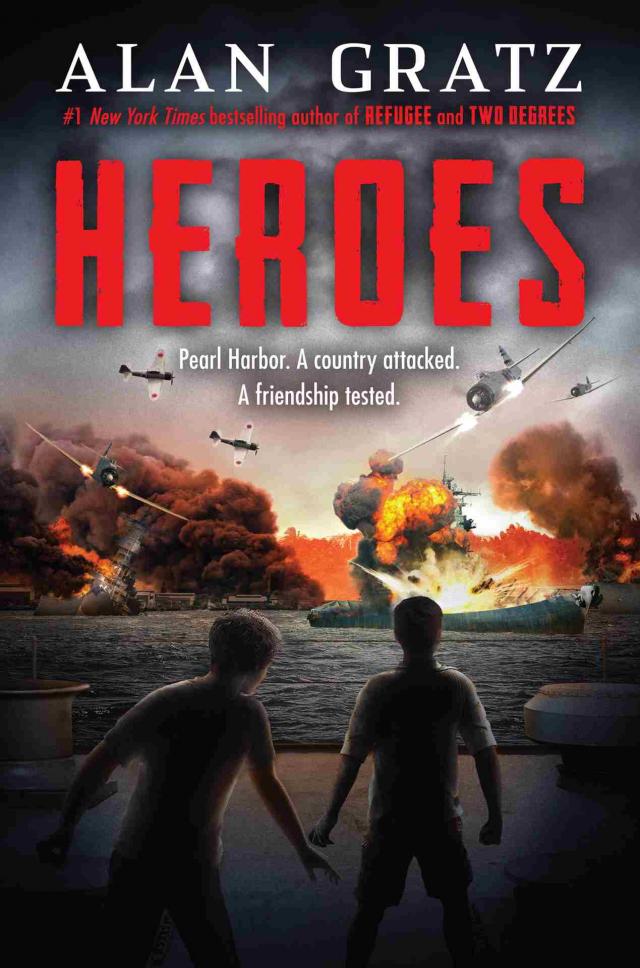


For my grandfather, Frank A. Hull III of the USS Pelias, and all the other service members and civilians at Pearl Harbor on December 7, 1941
Title Page
Dedication
A Note to the Reader
Epigraph
Part One: Before
The Arsenal of Democracy
Near Miss
Worst-Case Scenario
Backyard Battleships
Invincible
Meatballs
Part Two: During
Battle Stations
Three Hots and a Cot
Full Tilt
Sentinels of Liberty
The Power of Prometheus
The Body in the Water
Underwater
The Sub-Mariner
Be More Koa
Once Bitten
Duck and Cover
Grounded
Hawaii Calls
Buried
A Volcano Erupts
No Going Back
The Good Fight
The Dungeon
The Sandman
The Truth
Oil and Water
Just One
Battleship Row
Dead in the Water
Papayas
Fireworks
One Chance
The Real McCoy
Fins
Deep Breaths
Diving Deep
Everybody Forgets the Eels
Hospital Point
Part Three: After
The Sand Island Express
The VVV
The Future
Limbo
Aloha
Arsenal of Democracy comic
Map
Author’s Note
Acknowledgments
About the Author
Copyright
A NOTE TO THE READER
In order to accurately reflect the historical time period, some characters’ dialogue in this book includes racially offensive language that was used in the United States during the 1940s.
We must be the great arsenal of democracy.
President Franklin D. Roosevelt
Radio broadcast to the American people
December 29, 1940
“It’s an attack!” Stanley cried. “Enemy airplanes—dozens of them. Coming in low over the water!”
“They’re shooting machine guns,” I added, turning in my seat. “Dropping torpedoes—”
“Fire! Explosions! Shrapnel everywhere!” Stanley said.
The water around us was a sparkling mirror, the sky bright blue without a cloud—or plane—in sight. My best friend Stanley Summers and I were sailing across Pearl Harbor in our little aluminum motorboat, headed home from baseball practice. Stanley was steering and I was sitting facing him. We were talking out a story idea for the superhero we were creating together. I was the writer and Stanley was the illustrator. It was going to be the greatest comic book ever.
“And flying up to meet them,” I went on, “is Warhawk, Protector of the Innocent. Guardian of Freedom! He smashes one plane with his fist and uses his heat vision to destroy another. Bullets ping off his chest—”
“Wait, Frank,” Stanley cut in. “Warhawk has too many superpowers.”
I paused, confused. “What do you mean?” I asked. “He’s got as many powers as Superman.”
“Superman’s a cheat!” Stanley said. “He’s super strong and super fast, he can fly, he has X-ray vision, and super hearing, and super breath. It’s boring!” He shook his head. “Our character should have one superpower. Like how Captain America has super strength or the Flash has super speed.”
I leaned forward in my seat. “Oh, come on,” I said. “You’re telling me you’d rather be Captain America than Superman?”
“Heck yeah!” Stanley said. He took his hand off the tiller to give me a crisp salute. “Stars and stripes, baby! Wouldn’t it be amazing to get the Super Soldier Serum?”
I wanted to say yes. But Steve Rogers hadn’t known what that Super Soldier Serum was going to do to him before he took it. What if it had killed him? Or turned him into a monster? I wouldn’t have taken that risk. Not even for the chance to be Captain America.
But I wasn’t going to admit that to Stanley.
I held tight to the sides of the boat as Stanley steered us toward Ford Island. A light breeze wafted the smell of pineapple and sugarcane across the bay, and the palm trees along the shore swayed. Somewhere a radio played the soft, plinky sounds of Hawaiian ukulele music.
In some ways, it felt like someone had already slipped me the Super Soldier Serum. I’d grown twelve inches in the last year. Now, at thirteen years old, I was taller than my mom. I was like one of those Charles Atlas ads you saw in the back of comics: Send for this free book, and go from scrawny runt to Greek god in just three months! Only I didn’t feel like a Greek god. I was always tripping over my own big feet, and I felt clumsy and awkward in my new body.
Stanley was the opposite. He was comfortable in his skin, with a casual confidence that I tried to copy but could never quite get right. Like his clothes. While I wore a T-shirt and rolled-up jeans like most boys our age, Stanley stood out in his white shorts and oversized Aloha shirt with bright red flowers. He did his own thing and didn’t worry what anybody thought of him. Stanley and I looked different in other ways too—I was white, with skin that turned pink from sunburn, blue eyes, and wavy light brown hair. Stanley was a cross between his Japanese American mom and his white dad, with tan skin, dark brown eyes, and straight black hair. But we were brothers, forever and always, thanks to our love of comic books.
“How sold are you on the name Warhawk?” Stanley asked, pulling me out of my thoughts.
“Hmm? Not particularly,” I said. We’d taken his name from the type of fighter plane my dad flew in the Navy, but I’d never loved it. It made our hero sound like he was always looking for a fight. “You got any other ideas?” I asked Stanley.
“No,” he said. “You’re the writer. I was hoping you had something.”
I thought about it as I looked out across the water. Ringing Pearl Harbor like stone sentinels were the steel-gray battleships and cruisers and destroyers that made up the US Pacific Fleet, all enjoying a lazy Saturday afternoon in port.
The big ships gave me an idea.
I turned toward Stanley, feeling a rush of excitement. “How about ‘the Arsenal of Democracy’?” I said. It was something I’d heard President Roosevelt call the United States on the radio.
There was a war happening overseas. Adolf Hitler, the evil leader of Nazi Germany, was trying to conquer all of Europe—and maybe the world. Hitler had made a pact with Italy and Japan to form the Axis powers. Great Britain, Russia, China, and most of the other countries in the world—the Allies—were fighting against the Axis. But so far America had stayed out of the war. We still wanted to help, so the US had become “the arsenal of democracy,” cranking out ships and planes and tanks and guns to loan to the Allies.
“I don’t know,” said Stanley. “It’s kind of … wordy.”
Stanley’s lack of enthusiasm took some of the wind out of my sails, but I wasn’t ready to give up.
“It’s like the Sentinel of Liberty,” I argued, knowing how much Stanley loved Captain America’s nickname. “And we can call our character Arsenal for short.”
“Okay, yeah,” Stanley said, smiling as he came around. “And maybe he uses a shield, just like Cap. Something like this!”
Stanley pulled a pencil and paper from his pocket and started sketching.
Which was a bad idea, because he was the one driving the boat.
“Stanley!” I cried, my voice so shrill it cracked. “Stanley, steer the boat!”
Stanley got up, moved to the middle seat, and bent over his piece of paper. “You steer,” he said, intent on his drawing.
I gulped. Stand up in a moving boat? Cross the middle seat? Steer? I never steered!
Without anybody to guide it, our boat swung slowly to the left, heading straight for the USS Nevada—a five-hundred-eighty-foot-long, thirty-thousand-pound battleship.
That was not good. Because when big boat hits little boat, big boat always wins.
I fought to release my death grip on the sides of our boat and stood quickly, before I did something stupid like faint. I lurched over the middle seat like Frankenstein’s monster and practically fell onto the seat at the rear of the boat. I almost went over backward into the water, but at the last second I managed to grab hold of the tiller on the outboard motor. The boat swung wildly as I pulled myself back up and swerved us toward the dock on Ford Island.
“Holy cats, Frank!” Stanley said. He held his pencil up off his paper until the boat stopped rocking. “You okay?”
“Great!” I lied. “Just lost my balance for a second.”
Stanley nodded and went back to his drawing.
I stared straight ahead, squeezing the handle on the tiller so hard my knuckles went white. I had to remind myself to breathe. How could Stanley do something like that to me?
But then, Stanley didn’t know the truth about me. The secret I’d kept carefully hidden since I’d first arrived in Hawaii a little over a year ago.
The one thing I was desperate to not let anybody know.
I was afraid. Of pretty much everything.
Like right now? There were a hundred ways to die at Pearl Harbor. I could drown if I fell over the side of the boat. That was why I insisted we always keep a life preserver on board. Of course, the outboard motor could chew me up before I ever got to use the life preserver. Which would bring the sharks. Native Hawaiians said Pearl Harbor was home to a shark goddess and her son, and we’d all seen shark fins circling ships in the bay.
Worse than the sharks were the giant eels. Everybody forgot about the giant eels! There were also stinging jellyfish and poisonous centipedes everywhere.
Plus, the whole territory of Hawaii was built on volcanic islands, and some of those volcanoes were still active. Maybe not on the island of Oahu, where Pearl Harbor was, but on the Big Island, which was close enough. A volcano had actually erupted on the Big Island just before my family and I moved here, filling the air with smog.
Stanley kept sketching, and I focused on steering the boat and trying to stay calm. That had always been hard for me, ever since I was little.
I was born cautious. I was the kid who always held the railing going downstairs. Who waited until his hot cocoa was lukewarm cocoa so it wouldn’t burn his mouth. Who carried scissors upside down, fist wrapped tightly around the closed blades, and never, ever ran with them.
And then in third grade, when my dad was stationed in Pensacola, Florida, came The Incident. I shuddered even now, remembering it.
The Incident changed me from a kid who was careful to a kid who would do anything to never get hurt again. My constant fear had gotten so bad that sometimes I wouldn’t leave the house unless I had to.
But here in Hawaii, things had gotten better. Much better. And a lot of that had to do with Stanley. When we got to talking about comics, and making up our own characters and stories, it was like I forgot to be so afraid.
“And with a stupendous scribble here, and a deftly drawn dimple there,” Stanley said, putting down his pencil, “the illustrious illustrator brings the Arsenal of Democracy to life!” Stanley talked like that sometimes—like the narrator in a comic book. That was one of the great things about being friends with him. In his own way, Stanley was as much of an oddball as me.
Stanley tried to hand me the drawing. “What do you think?” he asked.
“Here—switch back,” I said, and clumsily traded places with him so he could steer again.
Once I was safely settled in the middle seat, I looked at his drawing. Stanley was an amazing artist. When I came to Hawaii, I’d had notebooks full of comic scripts and ideas I’d written down. But I couldn’t draw, so I’d never thought I could actually make any comics. Not until I met Stanley.
He’d drawn the Arsenal tall and muscular, wearing a white V-neck shirt with the sleeves rolled up and a neckerchief like the ones US sailors wore. He had on shorts like Captain Future, and long gloves and boots with the tops folded down like Green Arrow. He looked Japanese American, like Stanley, and wore a pair of goggles pushed up into his mop of black hair like Smilin’ Jack from the Sunday comics. He stood confidently with one hand on his hip, while the other hand held something tall and narrow that tapered at both ends.
“Is that a surfboard?” I asked.
“Oh,” said Stanley. “No. It’s supposed to be a shield.”
“And what’s this glow around him?” I asked. Stanley had drawn the Arsenal with a crackling force field, like the flames that surrounded the Human Torch or the electricity that sparked around the son of Professor Supermind.
“I don’t know,” Stanley said with a shrug. “I just thought it looked swell.”
“It does! Maybe it’s a force field that protects him and anybody he’s close to.”
“Or maybe he has a magic surfboard he can fly around on!” said Stanley.
“Hmm. Maybe,” I said. It wasn’t quite right. Not yet. But it was fun figuring it out.
Stanley pulled the boat up to the dock on Ford Island, and he leaped out like he’d done it a thousand times before. Which he had.
Stanley had grown up in Hawaii. He’d been the one to explain to me that “Pearl Harbor” was both the body of water where the US Navy’s Pacific Fleet parked its ships and the name of the whole military base. Ford Island, where we lived, was a little island in the middle of the harbor that was part of the base. The rest of Pearl—the fleet headquarters, repair docks, submarine base, barracks, and base hospital—filled the coastline all around the harbor.
I stood up shakily in the boat and tried to focus on the towering green mountains in the distance. Pearl Harbor was about ten miles due west of the city of Honolulu, on the island of Oahu—one of the many islands that made up the US territory of Hawaii. Everyone on Ford Island called Oahu “the mainland,” which was super confusing. To me, the real “mainland” was the continental United States, which was five days away by ship. Because Hawaii sat smack-dab in the middle of the Pacific Ocean, a third of the way between the US and Japan.
Stanley held the boat while I climbed out, which I managed to do without imagining all the bad things that would happen to me if I slipped and fell.
“Okay,” I said. “Now that we’ve got a name and a look for our superhero, he needs an origin story.”
“That?” Stanley said as he tied the boat up. “He crawls through a cave with magic crystals in it or something and gets superpowers. Easy.”
“No. I don’t mean how he gets his powers,” I said as we started walking toward home. We were due at Stanley’s house for an early dinner with our families. “Once the Arsenal has his powers, why does he decide to be a hero?”
“Like Bruce Wayne deciding to fight crime as Batman because his parents were killed by a mugger?” asked Stanley.
“Exactly,” I said. “Getting superpowers is one thing. Choosing how to use your powers is another. That’s what an origin story is.”
We headed along the one road that ringed Ford Island. To our left, a row of houses separated us from the blue water and the parked battleships. To our right, beyond some palm trees and administrative buildings, a patrol bomber took off from the runway at Ford Island Naval Air Station, where our dads worked.
“Maybe the Arsenal is the son of a sea king,” Stanley suggested. “He surfs around the coast, righting wrongs.”
“Or he lives in Atlantis,” I said, “and a huge kraken destroys the city and eats his entire family, so he goes on a one-man crusade to rid the seas of giant monsters.”
Stanley chuckled. “You always come up with the worst things to happen to our characters!”
“I guess I do,” I said, forcing a laugh. If Stanley only knew.
A green US Navy fighter plane zoomed overhead, and Stanley and I waved. The pilot responded by tipping his wing down at us. We couldn’t see his face, but he must have been someone Stanley and I knew through our dads. I smiled as we kept walking.
Then I froze.
Just ahead, under a huge old banyan tree, two boys named Arthur Edwards and Johnny Ross were hovering threateningly over a younger boy named Charlie Moore. Stanley and I knew all three boys. The school we went to on the mainland was small, and the community of military families here on Ford Island was even smaller. Charlie was a grade younger than us and played saxophone in the school band.
Arthur and Johnny were in ninth grade, and they were bullies.
When I’d first moved to Pearl Harbor, Arthur and Johnny had picked on me like they picked on everyone. But then something strange had happened. As I’d gotten bigger and stronger, I’d gotten better at sports. Which made me more popular. Suddenly kids like Arthur and Johnny and their friends started saying hey to me in the halls. And I was pretty sure Arthur’s younger sister, Maxine, who was in my grade, was sweet on me. Which was new too. I didn’t know how to handle any of it, so I just avoided them—Arthur and Johnny most of all.
“Hey, McCoy,” Johnny said to me now, and Arthur raised his chin to acknowledge me.
“Hey,” Stanley said, even though they had conspicuously not said hello to him. He frowned. “What’s going on?”
It was perfectly clear what was going on. Arthur and Johnny had found some excuse to pick on Charlie. And Stanley and I both knew that the best way to not have them pick on us too was to keep on walking.
“Come on, Stanley,” I said. “Let’s get home.”
“Charlie stole my bike,” Arthur said, grinning.
A red bicycle lay on its side among the roots of the banyan tree. A red bike we all knew belonged to Charlie.
“I did not!” Charlie cried. “This is my bike!”
“Pretty sure he’s right,” said Stanley.
“Pretty sure you should mind your own business,” Johnny told him.