Heroes, page 10
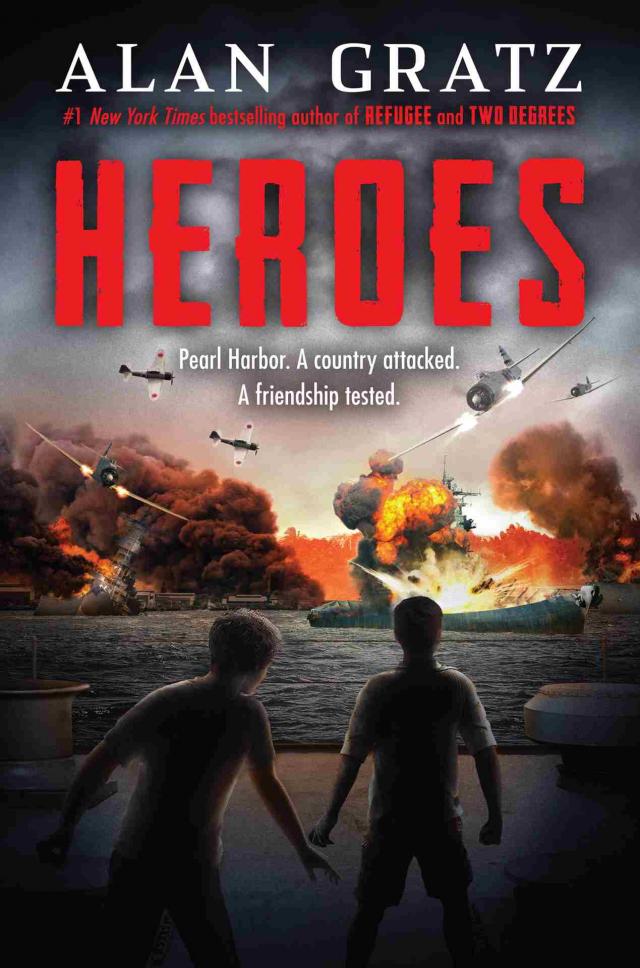


“I do too,” he said. He tried to start the engine again. “But you don’t have a home anymore. And neither do I.”
He was right. And there was a lot more in what he was saying. Everything that Hawaii had been, for both of us, was gone.
But that didn’t mean I wanted to die.
“The Dungeon, then! We can hide there until the battle is over,” I told him. “Maybe there are medics there now who can help this guy.”
Stanley gave me a look. We both knew that Kowalczyk, Joseph H. needed more than a field medic. Going back to the Dungeon was a death sentence for our passenger.
“We’re more than halfway to the hospital,” Stanley said. “If we turn back now, we’ll be on the water even longer than if we keep going forward. You’re Mister Risk Assessment. You tell me which way makes more sense.”
“I don’t know,” I told Stanley, covering my head with my arms. “I don’t know, I don’t know, I don’t know …”
Stanley yanked on the engine’s starter rope, and—VROOM!—the outboard motor roared to life.
“Then we’re going to Hospital Point,” Stanley decided for us. He revved the engine, and we were moving again.
Thick, oil-black smoke was everywhere, making it hard for Stanley to see where he was going. Me, I couldn’t see where we were going because I had my eyes closed.
“Frank, get to the front of the boat and tell me if I’m about to hit anything!” Stanley shouted.
I didn’t want to move, but I didn’t want to die either. Heart in my throat, my arms and legs shaking, I crawled past the barely breathing Kowalczyk, Joseph H. to the front of the motorboat, where I could keep my eyes on the water.
I glanced back at Stanley, but he looked right past me. I knew he was focused on steering, but he had to be mad too. He’d been understanding before about my cowardice, but his patience had to have run out. And I couldn’t blame him.
THOOM. A new explosion rocked the Navy Yard to our left, and I flinched as yellow-gray smoke clouds mushroomed from the Cassin, the Shaw, and the Downes, all in dry dock for repairs.
What did me being brave matter when it was the end of the world?
I turned to tell Stanley about a piece of debris in the water ahead, and I gasped.
A giant steel-gray battleship was right behind us, and about to run us over!
“Stanley! Look out!” I yelled.
Stanley yelped and swung the tiller so hard we both went tumbling. But our little boat swerved out of the way just in time.
As the big battleship slid past us, I looked up at the name painted on its prow.
“It’s the Nevada!” I cried. The same battleship we’d almost run into when Stanley had handed me the tiller on our way back to Ford Island. I reeled. Had that really just been yesterday afternoon?
I stared at the USS Nevada now. Somehow the ship had gotten underway during the battle, even with a house-sized hole in her port bow. How in the world had she not sunk? Her guns were still roaring too, hurling artillery into the sky in every direction.
Ha! I thought. Maybe the US Pacific Fleet isn’t such a pushover after all.
I wasn’t the only one feeling inspired. Sailors all across the harbor cheered as the Nevada chugged by, and Stanley stood up in our launch and saluted.
“Pull in close to her,” I told Stanley. “She’ll give us cover from the airplanes.”
It was a good idea—until it wasn’t. The Japanese planes noticed the Nevada too, and suddenly every bomb and bullet and torpedo was headed the battleship’s way. And ours. Stanley put some distance between us again, and we watched as the Nevada took the brunt of the Japanese second wave.
Over on the docks, a trio of sailors wearing nothing but white underwear and flat metal helmets fired old bolt-action rifles at the Japanese planes, but they weren’t hitting anything. As we watched, the sailors threw down their rifles and tossed away their helmets, then dove into the oily water of the harbor.
“Holy cats!” Stanley cried. “What are those papayas doing?”
“I don’t know,” I said, “but they’re swimming right for us!”
Stanley steered the launch to pick the sailors up from the water, but when we got close they waved us away.
“We’re headed for the Nevada,” one of them said, swimming hard. “At least there we can do something useful!”
A few moments later, we watched as a sailor on the Nevada threw them a line. The three sailors climbed on board and immediately ran to help with the portable hand pumps on deck.
I shook my head in disbelief. The three sailors were bonkers, or else they were heroes. Maybe they were both.
High above us, a Japanese plane released a whistling bomb that looked like it was headed straight for me and Stanley. We cried out and fell to the bottom of the boat, but the bomb kept carrying, missing us and the Nevada, and flying all the way across the harbor, where it crashed down through the deck of the already-burning Shaw.
There was a breath of a moment where nothing happened. And then suddenly—KATHOOM—the Shaw erupted in the most spectacular fireworks show I’d ever seen.
Stanley and I stayed low as flaming chunks of dock and twisted pieces of shrapnel flew through the air. POOM! POOM-POOM-POOM! POOM! KABOOM!
The Shaw kept exploding, just like the Arizona had. The brilliant yellow eruption lit up the dark clouds and silhouetted the palm trees that still stood on the shore. It looked like something out of a war movie. It was unreal.
The shock wave blew dozens more sailors off the docks. They fell all around us, most of them already dead. Some of them were alive enough to scream though, and I screamed with them as the human fireballs hit the water.
All those sailors—dead, I thought. All those sons and dads and friends and boyfriends who’ll never come home again. Like Brooks.
Like Stanley and me if we didn’t get off the water. Fast.
Stanley crawled over to turn the tiller, and the boat swerved. Then, to my surprise, he cut the engine.
“What are you doing?” I cried.
“Look!” yelled Stanley, pointing.
I peeked my head up just far enough to see. The water between us and the Shaw was covered with burning oil, the fire so bright and so hot I had to raise an arm in front of my face.
Finally I saw what Stanley was pointing at. One of the sailors thrown from the Shaw was still alive. Incredible! But he was trapped, treading water inside a huge ring of burning oil.
A ring that was getting smaller and smaller by the second.
The trapped sailor was white, fair-haired, and frightened out of his wits. He waved to us frantically and called out for help, his words swallowed by the roar of the fire.
“I can’t get any closer to him,” Stanley told me. “That oil’s burning so hot it’ll cook our boat.”
“You have to swim under the fire!” I yelled to the stranded sailor.
“I can’t!” the sailor yelled back. “I think my arm is broken!”
I stood in the boat and threw him our life preserver. It sailed through the flames and landed in the open water where the sailor could reach it.
“Yes! Nice!” said Stanley, and we slapped hands. Our celebration was short-lived, though. The life preserver would save the sailor from drowning, but it wasn’t going to do anything about the fire that was slowly creeping up on him. He was going to burn to death before he drowned. But what else could we do?
“We have to leave him,” said Stanley.
“What? No!” I said.
“Frank, if we go over there, our motorboat will catch on fire.”
“I know,” I said. “But he’s right there. We can see him.”
The sailor couldn’t understand what we were saying to each other. He looked back and forth between us, his eyes full of desperate hope that we would find a way to save him.
“There’s nothing we can do,” said Stanley. “We have to accept that and save the one guy we know we can save,” he said, pointing to the still-unconscious Kowalczyk, Joseph H. “And save ourselves.”
I sagged. The thing was, I could think of a way to save the trapped sailor. A chance, at least. But it meant I might get hurt. Or even die.
“I’m sorry!” Stanley yelled to the sailor.
“No! Please!” the sailor yelled back, but Stanley shook his head and turned to start the engine. Like he’d said, there was nothing he could do to help.
But there was something I could do that Stanley couldn’t.
I took a deep breath.
“Wait,” I told Stanley. “I can swim under the fire and pull him out.”
“Swim under the fire and pull him out?” Stanley cried. “Are you nuts? Frank, the water is on fire!”
“I know!” I yelled. I could feel the waves of heat, taste the burning oil in the air. “But we have to help!”
“Just one,” Stanley said, pointing at Kowalczyk, Joseph H. “That’s what your sister said. If we could save just one, that would be enough. He’s the one, Frank!”
“But is one really enough, Stanley? A true hero steps in when they see somebody getting hurt, and that guy’s about to get hurt. Bad! And you said yourself that holding my breath underwater is my superpower.”
“Frank, I was kidding,” Stanley told me. “You’re good at holding your breath, but you’re not Namor. Nobody is!”
I looked again at the distance between the boat and the sailor. It was maybe, possibly, just close enough for me to swim the entire way underwater while I held my breath.
“Frank, there are a hundred ways you could die trying to save that guy,” Stanley told me. “A thousand!”
“Oh, I know,” I told Stanley. I’d gone through them all in my head already. “I could run out of air and have to come up in the fire. Or the fire could close in on the sailor while I’m underwater. There could be Japanese subs down there. Or sharks. Or giant eels. Nobody ever thinks about the giant eels.”
“If you know all that, then why do it?” asked Stanley, looking at me like he didn’t recognize me.
I blinked. He was right. Who was this Frank McCoy who wanted to jump into burning water to try and rescue some man he’d never met before?
I remembered Web Edwards’s words from the radio in Stanley’s house: Folks, this is the real McCoy.
Who was the real McCoy? Was I the Frank McCoy who froze up when the going got tough? Or was I the Frank McCoy who could be brave in the face of danger? Who stood up for his friends in a fight? Who helped people when they were in trouble?
I was still afraid. Of pretty much everything. And this right here—swimming under fire to maybe rescue a trapped sailor—this was the scariest, most dangerous thing I’d even thought about doing in my entire life.
But of all the things in the world I was afraid of, I suddenly realized that my greatest fear was being too scared to do the right thing.
That’s who I wanted to be. That’s who I was.
“Because this is the real McCoy,” I told Stanley.
I stood up and pulled off my shirt and pants, stripping down to my underwear like Namor. Then I dove headfirst into Pearl Harbor.
I timed my dive so my momentum would take me straight under the burning oil, giving me a little burst of speed like a racer off the starting blocks.
I’d braced myself for the water to be cold, but it was hot under the flames. Not as hot as the oil would be if I came up through it, of course. But hot enough to remind me not to waste a second getting to the sailor.
But wait—where was he? The water of Pearl Harbor was usually clear, but now it was dark and murky, the only light coming from the wobbly, eerie ceiling of fire right above me.
A seizing panic rose up from my stomach to my lungs and then my throat, and I struggled to hold my breath. What if I got turned around in the darkness and couldn’t find the edge of the fire? What if I ended up like those burned, oil-covered sailors we’d been seeing all day?
I closed my eyes to clear my thoughts. The only thing we have to fear is fear itself, I told myself. I couldn’t freeze up. Not here. Not now. I had to move. I had been pointed in the right direction when I’d dived in. I had to trust in that.
I swam forward as hard and fast as I could. After a few moments, a body loomed up at me out of the darkness. The sailor? Already? No, this man was dead. Unless the sailor I was after had already drowned? Was I too late after all?
I swam closer. No—this sailor was Black. His dead eyes stared not at me, but down into the depths, as though he could see something at the bottom of the harbor. Something no living person could see, or would ever want to.
I swam on.
The attack was still going on up above, but it was muffled like before, when I’d swum from the Utah to Ford Island. The booms of bombs sounded like somebody banging a big bass drum in the distance, and I thought I could hear someone tapping on the hull of a ship. Or maybe that was my imagination.
I jerked back in surprise as a long, thin torpedo with fins ticked by, bound for some bigger target. Where was it going? What if it hit the motorboat? And … was that a shark’s tail I’d just seen flicking away at the edge of my vision?
I gulped down my fear and swam faster.
There was still a little air left in my lungs when at last I saw the churning legs of the trapped sailor. I kicked hard and came up right beside him in his little circle of clear water, gasping for breath.
The sailor jumped in surprise, almost swimming into the burning oil. I grabbed hold of his life preserver to pull him back. The flames were so close and so hot I felt like I was getting a sunburn. Sweat beads immediately popped out on my forehead and ran down my face.
“Are you—are you one of those kids from the boat?” the sailor asked. “How did you swim that far without coming up for air?”
“It’s kinda my superpower,” I said. “Like Namor.”
In the motorboat, Stanley was jumping up and down and pumping his fists in the air, no doubt thinking the same thing.
“I don’t suppose you can fly like Namor,” the sailor said.
I blinked, surprised he knew the comic book.
“No,” I told him, my throat raspy from the thick smoke. “We’re gonna have to swim for it.”
“I can’t swim that far underwater!” the sailor said, his voice pitched high with panic.
Up close, I could see now that he was really young—just a few years older than me and Stanley, with not a hint of stubble. Probably right out of high school, like Ginny. He was shivering, and his frightened eyes never stayed in one place. There were scorch marks on his face from when the Shaw had blown up, but he didn’t look too badly injured.
Except for the broken right arm he held sideways against his stomach. That was going to be a problem.
“What’s your name?” I asked the sailor.
“What?” he said, like that was the strangest question he’d ever heard.
“Your name,” I said. “What’s your name?”
“Patrick.”
“Okay, Patrick. I’m Frank. I swam here underneath the water, which means we can both swim back.”
He shook his head frantically. “I can’t,” he said.
“You have to try,” I told him.
“We’ll die,” he told me. “We’ll come up in the fire and we’ll burn to death!”
“Frank!” Stanley yelled from the boat, urging me to hurry.
I waved an arm at him to tell him I understood but kept my eyes on Patrick.
“I know you’re scared,” I told Patrick. “I am too. I’m really scared. And there are a lot of ways we don’t make it out of this. Trust me, I’ve imagined every single one of them. But if you freeze up now, the one way you die for sure is being here when the fire closes in on you. Right?”
Patrick’s eyes flitted all around us, confirming, again, that we were surrounded by fire. And that it was getting closer. He nodded.
I peeled his good hand away from the life preserver. “Okay. So we’re letting go now,” I said.
“No no no no,” he said.
I nodded, looking him straight in the eyes.
“Yes, Patrick. We can do this,” I said.
I turned and looked at the distance we had to swim back to the boat, and all the calm I’d been showing for Patrick’s sake burned away like smoke. What had I been thinking? The distance was too far. The fire was too hot. Patrick was too heavy. We were never going to survive this!
“Take a deep breath,” I whispered to myself.
Patrick thought I was talking to him, and he started trying to take deep breaths. The fact that he was listening to me, that he trusted me, scared me a little. I was just a kid, and he was a sailor in the US Navy! But it also gave me confidence. Made me feel like we were in this together. I nodded and breathed deeply with him. The heat was almost unbearable now, and the oily smoke burned my throat.
“All right,” I told Patrick. “We go on three. Just swim as hard and fast as you can until you can’t swim anymore.”
“And then what?” he said, panic rising in his voice again.
“Then I’ll be there to help you,” I said. “Ready? One … two … three—”
We both took the biggest gulps of air we could and slipped under the water.
Patrick was not a great swimmer, and his broken arm made him worse. We’d only gone a few yards when he gave up trying to drag himself along and hooked his good arm around my shoulders, like when I was a little kid and rode my dad’s back in the pool.
I kicked my legs with all my strength. Bullets streaked slantwise through the water ahead of us, and I suddenly thought about Stanley, a sitting duck up top while we swam here below. I’d forgotten how dangerous it still was above the water too.
Please be okay, Stanley, I thought.
I swam through the darkness for what seemed like forever, and there was still no end to the flames above us. The fire must have been spreading. The swim from my boat to Patrick hadn’t taken nearly so long, I was sure of it.
I was certainly going slower with Patrick hanging on to me. And now he wasn’t even kicking anymore! My frustration turned to panic as his arm around my shoulders went slack. No no no no! I turned in horror to see Patrick burping air bubbles, his eyes half-closed. Patrick wasn’t kicking anymore because he was drowning!