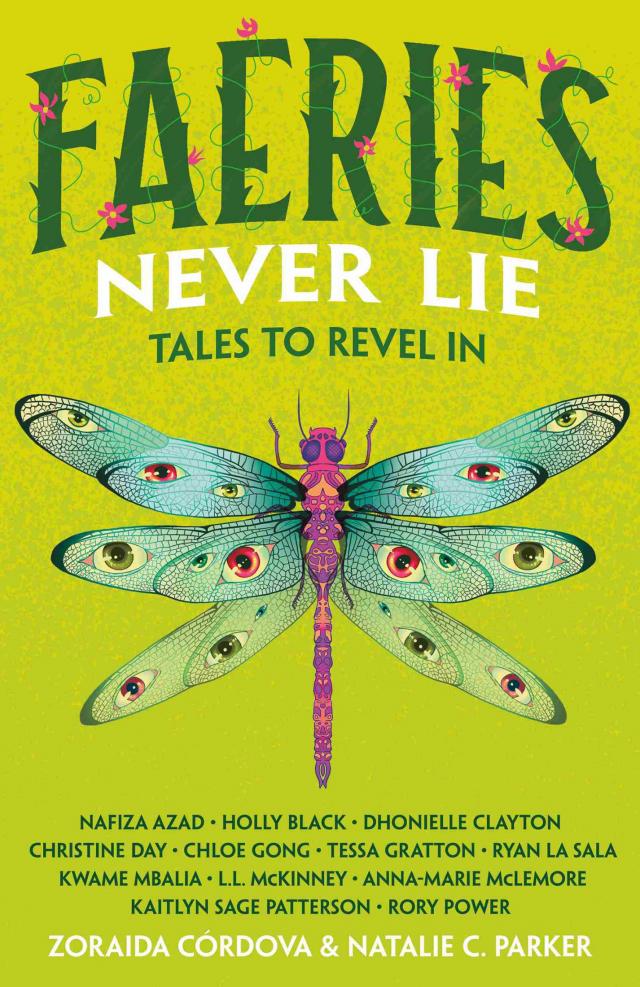
Faeries Never Lie, page 1


Begin Reading
Table of Contents
About the Author’s
Copyright Page
Thank you for buying this
Feiwel and Friends ebook.
To receive special offers, bonus content,
and info on new releases and other great reads,
sign up for our newsletters.
Or visit us online at
us.macmillan.com/newslettersignup
For email updates on Zoraida Córdova, click here.
For email updates on Natalie C. Parker, click here.
The author and publisher have provided this e-book to you for your personal use only. You may not make this e-book publicly available in any way. Copyright infringement is against the law. If you believe the copy of this e-book you are reading infringes on the author’s copyright, please notify the publisher at: us.macmillanusa.com/piracy.
For Lara and Suzie, our very own faerie godmothers
INTRODUCTION
A Note from your Editors:
This is the third installment of the Untold Legends Anthology Series and we have arrived at what might be the most famous of mythological creatures: the faerie.
If we asked you to name one faerie, we feel confident that you could. In fact, we think you could name two, three, maybe even four or five faeries that you’ve heard stories of over your lifetime. Whether it’s Tinker Bell or Queen Titania, Oberon or the Blue Fairy, Cinderella’s Fairy Godmother or our beloved Tooth Fairy, their stories flit through our cultural narratives, ubiquitous and (usually) delightful. But faeries also have a dark side. There’s Queen Mab, Morgan le Fay, Maleficent, and the macabre creatures from Guillermo del Toro’s mind, who tempt and torment in equal measure.
While these are examples most common in Western cultures, faerie lore exists globally—taking the shape of nature spirits or tricksters from other realms. Stepping into the world of faerie is an invitation to dream and imagine. A metaphor for experiences that defy all reason, and leave us feeling outside the norm.
In this collection, you will find stories that peer into the darkness because they carry within them such sparks of light. Each one will take you on a different, fantastical journey toward what it means to be human. The tropes you know are all here: wild hunts and faerie revels, sumptuous treats and dangerous deals, mistaken identities, and most important—the absolute power of words.
Step into our faerie revel, and stay a while.
Cheers,
Zoraida & Natalie
AN ETERNAL FIRE
Chloe Gong
Tang Dynasty, 750 CE
My grandfather says that I was bestowed “Mimi” for my small name because I’ve been a chattering menace since birth. Most Mimis are named after the character for rice, mǐ mǐ, because they’re so adorable that they could just be eaten up. I was named after the sound that incessant birds make when they’re perched over the city walls of Chang’an in the morning: mimimimimimi—
“Mimi, stand up straight.”
I adjust in an instant. I’ve learned to behave when I’m working the shop, at least. Grandfather wouldn’t boot me out, but Mother comes around often to remind him that he really ought to, so I’m on my best behavior. Sixteen-year-old girls should be sitting nicely at home sewing something beautiful, Mother says. Instead of greeting customers by flashing all my teeth and trying to sell every product on the shelves in one breath. It’s not that I don’t like sewing too. I do. I just have a lot of hours in the day and a lot of teeth when I smile. The customers deserve to see my teeth.
Grandfather glances over again. He’s in his chair by the entrance, watching the street. Every morning the main thoroughfare goes through the same routine: The sun rises over Chang’an’s walls, the birds flock onto the roof tiles to join the early bustle, the carts selling flat cakes and egg bǐng push out to greet the shopkeepers opening their doors. Today, the city is even more raucous than usual, abuzz while it begins setting up for the annual Lantern Festival. Some years it’s a longer affair; this year, it’s a one-day extravaganza. Although we’re not participating as vendors, I’ve been bouncing on my toes since I woke up, thinking about the candy I’m going to buy.
Maybe I can’t stand still, but at least my spine is straight now. Grandfather nods in approval. “Isn’t that so much better?”
“I suppose,” I allow. “But it seems horribly arbitrary that we’ve decided spines should be straight. If humans were built to feel more relaxed while slouched, then we should change the custom.”
A small bird lands at the shop entrance. It hops right up to Grandfather, sniffing at his feet.
“No need to change humanity before noon, Mimi.”
“I didn’t ask to change humanity, I asked to change society.”
The bird chirps. Slowly, Grandfather runs his fingers through his long beard, considering my correction. He’s done this since I was a baby: I would hand him a shaker filled with uncooked rice insisting that he needed the entertainment too, and he would examine it sagely, giving it two shakes with utmost gravity. I feel like the smartest person in the world with my grandfather. No one else takes me seriously like he does.
“Fair,” he concedes. “Are you ready for your task today?”
“Yes!”
The bird flies off in fright over my loud volume. Grandfather gives me a chiding glance; I pay no mind. Grandfather never misses a day in the shop, but he’s getting old and he needs people around to help out. Xiao Bao is the actual hired assistant, except Xiao Bao isn’t as good as I am at dusting the top shelves or explaining to customers why our tricolored glazed pottery is better than every other store’s in Chang’an.
“Take this.” Grandfather leans over the side of his chair, reaching for a case on the floor. His chair creaks and groans in protest, the wooden hinges older than he is. Just as he’s lifting the case, Grandfather winces, and I hurry forward in a rush. He doesn’t make any audible protest, letting his chair complain for him, but I know what’s wrong.
“Are you—”
“All is well, Mimi,” Grandfather assures before I can finish my question. Nonetheless, he makes a slow exhale, smoothing his palm over his chest.
Grandfather doesn’t like to talk about it, but he’s having heart problems. Healer Pei is in and out of the house often, giving Grandfather herbs and cleansing his internal system from blockages. While the problems persist, Grandfather can’t go anywhere other than home and the shop, and even when he’s manning the shop, he needs to be sitting down.
“Here,” he says, passing me the case.
I suspect he is distracting me from asking further, but it works. I open the case, finding only red lining inside, and immediately shake it around as though that might summon an item I can’t see.
“There’s nothing here.”
“Yes, Mimi. Mrs. Wu borrowed an heirloom for her son’s wedding last month—I’d like you to fetch it back for me.” He still sounds a little pained. I know if I ask, though, he’ll deny it. “Do not tuck it under your arm willy-nilly. The glass horse is very fragile.”
I go still. “The glass horse? That’s the heirloom on loan?”
Grandfather pats my elbow. “Yes, yes. Off you go now.”
The glass horse is usually on display with our ancestral shrines, in a part of the house where I don’t often go … which is probably why I haven’t noticed it hasn’t been there lately. I’m hardly to blame. The shrine room is dark and damp, infused with the smell of burning smoke even when the rest of our house is aired out with the nearby market’s fresh bāo, even when light spills through the thin walls to turn the air fiery. I used to cry that there were ghosts in the shrine room, and that’s why it smelled so funny. Then Grandfather would always say: Silly child—there are ghosts everywhere. Why would the shrine room be special?
“Mimi,” he prompts now.
I snap to attention. Right, right—I have a task to do. I bellow, “On it!” and then I’m prancing out from the shop, kicking a cloud of dust under my feet.
A frantic energy has been building and building in Chang’an since the New Year. Once night falls and the lanterns come to life, we’ll have marked the final celebration: two weeks of festivities from new moon to full moon. Errand boys have been yelling at the top of their lungs since predawn, pulling stalls into their places and hanging lights off the brown buildings just right.
I turn the corner, skirting around a half-built stall. Chang’an is easy to navigate, even for visitors who haven’t been here their whole lives. The buildings rarely move around, and the grid system has everything we need in our ward. I have been here my whole life, so I know all the wards surrounding us too, from one side of the city wall to the other, across each of the gates that provide entry and exit to the province outside. In our ward, Mrs. Wu is the nearest fish seller, located two streets away.
“My goodness.”
I skip up to Mrs. Wu’s shop. It’s busier here than I’ve ever seen. Everyone wants a centerpiece for their table before the festival, I suppose, and a steamed fish surrounded by ginseng and scallion is a top choice. I just barely move around two people waiting by the corner, separate from the fish line—Is the man in the middle of a marriage proposal? What is going on here?—before lodging myself in front of Mrs. Wu.
“Oh, Mimi, it’s you.”
I hardly need to say anything before Mrs. Wu wipes her hands on her fading apron. Her daughter continues taking orders while she steps back, waving me to follow her into the shop, past the tanks.
â €œThis was such a lovely decoration,” she calls over her shoulder. “You thank your grandfather for me, would you?”
“Of course, Mrs. Wu.”
“You’re being good lately?”
“Yes, Mrs. Wu.”
“Ah, excellent.”
Mrs. Wu reaches onto the top shelf. There, I see the glass horse, and with the way I’m suddenly clamping my breath in my lungs, you’d think I’ve encountered a demonic entity in the flesh.
The thing is, I broke that glass horse once upon a time. Or I thought I did. I had been sent into the shrine room to leave some fresh oranges across the ancestral displays and I wasn’t watching where I was walking because I was too busy daydreaming about trying on my new red ruqun when it arrived from the tailor and how nice it would look. Then all of a sudden, my elbow was knocking into the horse, the horse was smashing to the ground, a horrifying sound was echoing through the room, and instead of checking on the horse first I had rushed to the entryway, peering out to see if anyone had witnessed my mistake. Scene was clear. I had time to cover my behind.
Yet when I picked up the horse, it was perfectly fine. No crack. No scuff mark on the glass. It didn’t make any sense. I had heard it shatter.
“Grandfather invites you for tea soon,” I say as Mrs. Wu sets the heirloom into the case. The clear glass catches light, refracting back a dozen rainbows against the red lining before I snap the lid closed. My arms feel ten times heavier immediately.
“I’d like that very much,” Mrs. Wu replies, leading the way back out. “Do you need any help carrying the case?”
“No! Not at all!” I heft the case higher as I walk, just to prove my strength. While Mrs. Wu returns to the counter, I turn backward, still yapping as I exit the shop. “We have a new set of porcelain teacups with golden decorative edges. Grandfather is very proud of them. You’ll love—oof.”
In my defense, I thought my path was clear. Who stands at the door, anyway? The fish line was curving to the left. It’s not my fault if I slam into idlers hovering beyond the line.
“How much for that?”
He’s speaking before I’ve had a chance to get my bearings, and I’m retorting, “I beg your pardon,” before I’ve finished turning around.
“The horse inside that case,” the boy in front of me says, as though this is a matter of me misunderstanding him. His eyes are ginormous, blinking down innocently. “How much?”
Huh? What a snoop. How does he know what’s contained inside the case?
“This is not for sale,” I say firmly. “Good day.”
When I shove back onto the street, the couple I’d almost collided with earlier are still hovering there. I swerve before either of them can break apart to move for me, though they seem to be in the middle of their conversation anyway—“Miss Qiu, please, I cannot bear another day without you—” “Mr. Zhou, you are the single most dramatic person I have met in a hundred lifetimes, I am not declining”—but I’m hurrying through the bustle and before long their voices fade into the rest of the morning busyness.
They call Chang’an the million-man city. All of China wants to be here, and it means some of these new merchant trainees like the one in Mrs. Wu’s shop have absolutely no tact. His mentor needs to have a stern talk with him about not soliciting the wrong people, truly—
The faint mumblings of a crowd reach my ear before I see it. I turn the corner, and I don’t immediately register what might have gathered the other shoppers on the street like this, nor why it’s our shop that all the onlookers have flocked around.
Then I see Xiao Bao tugging Healer Pei through the crowd and into the shop. A faint ringing sound begins in my ears.
Grandfather.
“Hey! Hey!”
The crowd shifts for me, making way while I push to the front frantically. My arms tighten on the case, afraid that a stray elbow might send the heirloom flying. The second I break through the crowd, though, Xiao Bao rushes before me and blocks my path. I lunge to the side. Xiao Bao, despite his name, is large enough that he easily steps to counter me.
“Mimi, you should watch the shop,” he says. “I will help Healer Pei take your grandfather back to your house.”
“What happened?” It comes out hesitant. I get on the tips of my toes to peek over his shoulder, and I only catch the brief glimpse of a stretcher being moved out the back door. The ringing in my ear gets louder. “I can help. Right? I’m sure I can help somehow.”
“You’re not strong enough to help lift him,” Xiao Bao says bluntly. “He’s going to be fine. Mind the shop.”
Xiao Bao pivots and hurries through the entryway, then out the back exit with Grandfather and Healer Pei. I take another second to blink at the scene. A pit gnaws at my stomach, aching inside out.
“Show’s over!” I bellow. I’m full of authority I don’t actually feel when I stomp my way to the shop front, waving my arms at the gawkers. “Come on. Go away. Unless you want to buy glazed pottery—then you can come right on in.”
I set the case down on the counter. A flash of movement plays in my periphery. The hint of a long sleeve, moving closer. In an instant, I lash out, catching someone’s wrist before they can lift the lid on the case.
“Excuse me. Were you raised in a pigsty?”
“I could ask you the very same,” the boy replies gleefully. It’s him again, the one who had tried to buy the glass horse in Mrs. Wu’s shop. “Fast reflexes.”
“No manners,” I shoot back.
This time, I take him in properly. He had looked young on first glance—enough that I would have guessed him to be my age—but on closer examination … there’s something hard to pin about his features. For a moment, I’m sure I’m only tired. That his eyes don’t change with the light. That there’s no ethereal sheen to his skin. Then his sleeve flutters at the edges, like it’s trying to dart off on its own despite there being no breeze blowing. My grip tightens on his wrist, feeling his temperature to be neither hot nor particularly cold, and I know exactly what has found its way into our shop.
“Absolutely not,” I declare. Grandfather has entrusted me with an heirloom, and of course it’s today that an immortal faerie creature comes after it.
He slips out of my grip anyway and snatches the case.
“No! Hey!”
By now the crowd has cleared out, and there aren’t many witnesses when I make chase. If this boy looks so human, he must be a xian. He’s too powerful to be a mere huli jing or some other animal spirit. The xian, according to our stories, are morally neutral by nature—neither good nor bad, neither serving yin nor yang. They aren’t bound by mortal confines either; the xian could take flight and phase into the air if he wanted. Nevertheless, I pounce off the shop entryway, landing on his back and clinging tight. Morally neutral, my ass—this one is a complete kleptomaniac.
“This is unexpected,” the xian says. He’s amused. There’s a lilt to his words, as though we’re struggling over a toy in the neighborhood yard and he knows he’s stronger.
“Unexpected?” I screech. Grandfather has enough to deal with, like healing his heart. I can’t let his beloved heirloom be stolen too. “Release it immediately. Before I make you regret it!”
The xian almost seems like he’s considering my threat. I feel the vibrations along his back while he hums. Then he says, “I admire your ambition. Let’s play a game.”
“What?” I shake his shoulders, trying to force a release. The xian only giggles in return. “No! This is my heirloom.”
“Be more fun. Don’t you know what I am? If you play and win, you will be granted a wish.”
I stop shaking his shoulders suddenly. A wish. Any wish?
“How do I win?” I ask, and the xian knows he’s got my interest, because the humming in his shoulders grows stronger.
“Find me in the city before nightfall. Then you may get your heirloom back and your wish. If you fail, I will keep it.”
Logic catches up. This is ridiculous. There’s one wish I want to make, but a xian could not possibly fulfill it. I would need a god. I would need the entire pantheon of Chinese immortals, and then some. “No,” I say firmly. “How is that fair when you’re stealing it to begin wi—”