

The Just, page 1


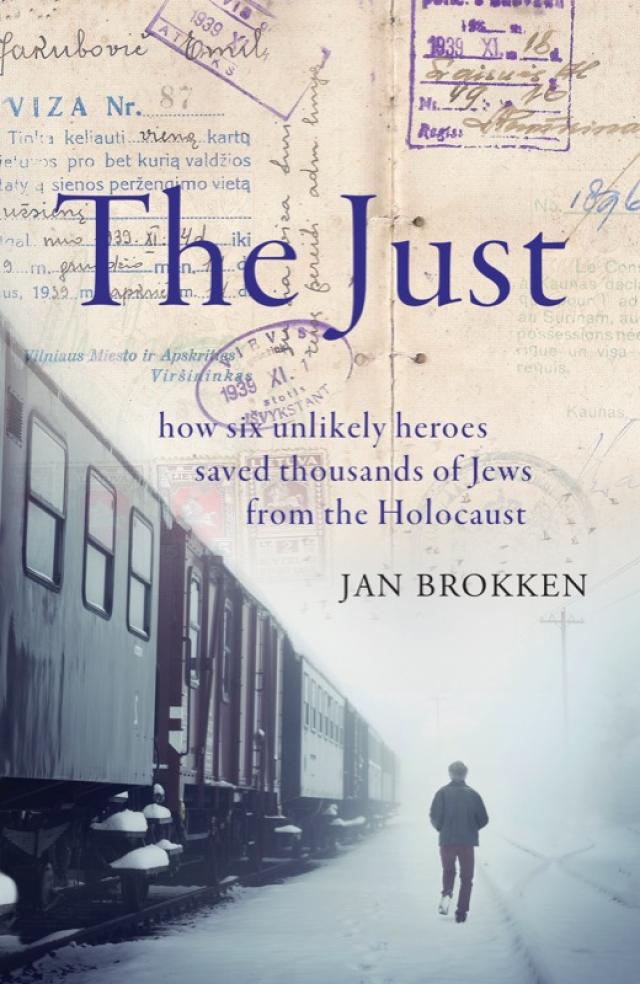
THE JUST
Jan Brokken is a writer of fiction, travel, and literary nonfiction. He gained international fame with The Rainbird, The Blind Passengers, My Little Madness, Baltic Souls, In the House of the Poet, The Reprisal, and The Cossack Garden, and his books have been translated into ten languages. The Just is his latest book.
David McKay is an award-winning literary translator who lives in The Hague. His recent translations include The Convert, by Stefan Hertmans, and the classic political novel Max Havelaar, by Multatuli. For more information, see openbooktranslation.com.
Scribe Publications
18–20 Edward St, Brunswick, Victoria 3056, Australia
2 John St, Clerkenwell, London, WC1N 2ES, United Kingdom
3754 Pleasant Ave, Suite 100, Minneapolis, Minnesota 55409, USA
First published in Dutch as De rechtvaardigen by Atlas Contact 2018
Published by Scribe 2021
Text copyright © Jan Brokken 2018
Translation copyright © David McKay 2021
All rights reserved. Without limiting the rights under copyright reserved above, no part of this publication may be reproduced, stored in or introduced into a retrieval system, or transmitted, in any form or by any means (electronic, mechanical, photocopying, recording or otherwise) without the prior written permission of the publishers of this book.
The moral rights of the author and translator have been asserted.
Every effort has been made to acknowledge and contact the copyright holders for permission to reproduce material contained in this book. Any copyright holders who have been inadvertently omitted from the acknowledgements and credits should contact the publisher so that omissions may be rectified in subsequent editions.
This publication has been made possible with financial support from the Dutch Foundation for Literature.
9781925849295 (Australian edition)
9781912854219 (UK edition)
9781950354566 (US edition)
9781925938722 (ebook)
Catalogue records for this book are available from the National Library of Australia and the British Library.
scribepublications.com.au
scribepublications.co.uk
scribepublications.com
Contents
Author’s note
1 Mister Radio Philips
2 One last breath of peace
3 Losing your company
4 Scales and cacti
5 Erni Christianus
6 Between Prague and Rotterdam
7 Aletrino
8 Stalin in the shop windows
9 Peppy Sternheim Lewin
10 Nathan Gutwirth
11 Not a chance in hell. But who knows?
12 The manual for consular officials
13 The white ship with the black hull
14 The independent-minded Sugihara
15 The yard of the Lietūkis garage
16 Comrade Nina
17 The fiat: the party leader and the influential dwarf
18 Pan Tadeusz
19 Chanson russe
20 Please forgive me. I cannot write any more.
21 Every man for himself
22 The Swedish route
23 An overlooked date
24 Towards the ends of the east
25 No way forward, no way back
26 The house with the green shutters in Kobe
27 Zorach Warhaftig
28 Zofia and Count Romer
29 Odd is death; even is life
30 Escort to Shanghai
31 The secret of Kaunas
32 Mauthausen
33 A secret burial
34 Mister Frits
35 Hey! Blow! Scream! Bang!
36 From Avenue Joffre to the ghetto
37 So many names on a wall
38 Everything’s fine in Psychiko
39 The reprimand
40 The need to know
41 Under a spruce or pine tree
42 No news from the survivors
43 The exodus from Egypt
44 Whoever saves one life saves a whole world
45 The Holland 977 Case
46 A wedding in Antwerp
47 Pebbles on a grave
Sources and Acknowledgements
Illustration credits
Author’s note
The Talmud tells of the khasidei umót ha’olám, the Righteous Among the Nations. According to legend, there are thirty-six such people at any moment in world history. In 1940 there were two in Kaunas, Lithuania; one in Riga, Latvia; one in Stockholm, Sweden; and two in Japan – one in Kobe, and one in Tokyo.
This is, at its heart, the story of Dutch consul Jan Zwartendijk in Kaunas. I have reconstructed it with the help of his children, drawing on documents and personal testimonies. But no one succeeds alone. It is also the story of three other consuls and two ambassadors, all equally unknown. Together, they set up one of the greatest rescue operations of the twentieth century. Thanks to their children, I can now recount their historic acts.
Ach, töten könnt ihr,
aber nicht lebendig machen.
Oh, you can kill,
but not bring to life.
– Friedrich Hölderlin
Inscription on the memorial plaque for Louis Aletrino in Mauthausen concentration camp
1
Mister Radio Philips
Everything important begins unexpectedly and makes you suspicious. You may be confronted with an impossible choice and have only a split second to decide. You’re not yet sure what to do, but already you sense that the rest of your life may depend on your decision. How will you respond? I can’t answer that question for myself, and that may explain why I’ve burrowed into this story like a mole.
Jan Zwartendijk heard the telephone ring. He was already outside with his bag under his arm and a key in his hand. He had just locked up the office and the showroom. It was almost 6.00 p.m., Eastern European Summer Time. The sun was shining through the treetops along Laisvės Alėja, ‘Freedom Avenue’, the longest, widest boulevard in Kaunas. The radios gleamed in the display window; their emblems – four stars and three waves – looked like silver. ‘Mister Radio Philips’, the people of Kaunas called him, always with a hint of admiration, as if he had screwed the sets together himself and equipped them with electron tubes and loudspeakers. In Lithuania, more than in the West, radios were seen as heralds of the modern age.
Kaunas (sometimes still called by the pre-war name of Kovno) had shaken off its provincial backwardness many years earlier. But the complete telephone book was still a slim volume. Something told him that if he didn’t answer the phone there would be consequences. The date raced through his mind like a warning: 29 May 1940. Although he was just an ordinary businessman – forty-three years old, married, with three children – he was also a foreigner, and in Lithuania he never knew exactly who to trust. Whenever he could, he kept a safe distance. If he unlocked the door, walked back to his desk, and picked up the receiver, he would let in all the dangers of a city teetering on the brink of war.
He was not a born hero. He lacked ambition. What he really wanted to do was hurry home for an idle hour in the garden with Erni and the children before dinner. It was his third year in Kaunas, and he knew you had to savor the warm summer nights. Otherwise you’d never make it through the long winter. Under the apple trees, the unhinged world would dwindle into a cloud on the far horizon. He couldn’t help hiding away from reality sometimes, even though it had become absurd to believe in peace.
All afternoon at the office, he’d felt the tension. On the surface, nothing was out of the ordinary, aside from the overflowing ashtrays. No customers, no orders. A grim quiet. He had sent De Haan and Van Prattenburg home at five-thirty. De Haan, the manager of the radio-assembly plant, now frittered away his days at the office. Since production had been halted, he made only a brief appearance at the factory each morning, to show the few remaining employees he hadn’t vanished from the face of the earth. Van Prattenburg kept the books and was the financial director. His one brief spurt of activity came at the end of the week when they paid the wages. The three nerve-wracked men had not done much that day except smoke cigarettes and glance outside every other minute. Everyone in town was expecting the Red Army. Maschewski had stuck around for a while, until he’d spotted a woman in a much too skimpy summer dress standing in front of the showroom window. He’d approached her as if she were a potential customer, and struck up a conversation in German, Lithuanian, Polish, or Russian – Zwartendijk couldn’t hear. But he was sure Maschewski had gone outside mainly to steady his nerves.
The city was in the calm before the storm. At any moment, tanks might roll down the hills and take their positions at the bridges over the Neris and Nemunas (or Neman) Rivers. He could already picture Russian soldiers marching down the two-kilometre-long Laisvės Alėja, which – oh, the irony – had been built in the tsarist period to enhance the glory of military parades. It could happen today or tomorrow. From that time on, there would be no more free, independent Lithuania. The country would be incorporated into the Soviet Union; there was no question about that.
Jan Zwartendijk
The telephone went on ringing. All week it had not rung once. Was this, at long last, a customer? The threat
A customer calling to place an order? No. Who would call around 6.00 p.m. on a weekday to buy a brand-new radio? Nor was it Philips headquarters in Eindhoven; they did everything in writing, because an international call was as expensive as a railway ticket to Berlin. It had to be something else, something that couldn’t wait.
Bad news, no doubt. He hoped it wasn’t Piet. His bond with his identical twin was so strong that when Piet caught a cold, two thousand kilometres away, Jan started sneezing. He hadn’t heard from his brother in a month. Had Piet been in Rotterdam on 14 May, during the German bombing? If Jan didn’t pick up the phone, he would spend all evening and all night wondering whether something had happened to his brother.
Or was the call somehow connected to the precarious political situation? And supposing it was, what kind of chump would pretend he didn’t hear it? He turned the key in the lock, pushed open the door, sprinted through the showroom, rushed up the stairs to the office on the second floor, lifted the receiver from the Bakelite telephone, and panted, ‘Hello … Lietuvos Philips …’
‘Zwartendijk?’
The voice was Dutch, with a rolling southern r. Jan made an affirmative grunt as his free hand loosened his necktie – he had brought the heat in with him.
‘De Decker speaking.’
The name meant nothing at first.
‘Dutch legation in Riga.’
Oh. That De Decker.
‘Your Excellency —’
‘No need for all that, under the circumstances.’
He had met De Decker only once, at the reception in the presidential palace when the ambassador had come to present his credentials. At that stage, the Baltic countries had still been independent. It was some time in the spring of 1939, a few months before Hitler and Stalin made their infernal pact, dividing Poland and the Baltic states between themselves as if playing Monopoly. De Decker had been appointed the Dutch ambassador to Latvia, Estonia, and Lithuania. In each of the three countries, he’d had to present himself to the president and the parliamentary leader. Though still in his fifties, he looked old before his time, worn down by life. Shortly after his arrival in Riga, his wife had died. No children. How must that feel, in a country where you don’t know a soul?
As the director of one of the few Dutch companies in the region, Zwartendijk had felt an obligation to show his face at the event, even though he hated receptions.
Bald. Long face, crooked nose, sunken cheeks. At the reception, Zwartendijk was surprised to learn that De Decker had been born in Belgium, because he certainly didn’t glow with southern European joie de vivre. Apparently, he was something of a homebody, and he never walked away from negotiations until he got results.
He was also a man of few words. After the two of them were introduced at the reception, he had mumbled, ‘Ah, Philips … How many countries have you been assigned to?’
Zwartendijk tried to keep his answer short: ‘I worked in Prague for a long time … then in Hamburg.’ He’d worked for a different company back then, but what did that matter?
‘Hamburg? I just finished a seven-year stint as consul general in Düsseldorf. Nice country, Germany. Did you have a good time there, too? Or did you get a little tired of all those outstretched arms?’
He had asked the question in a serious tone. Zwartendijk liked that.
After the Dutch capitulation, which came much sooner than expected, De Decker had stayed in his post. The Kingdom of the Netherlands had not yet been subjugated completely – they still had the Indies, Curaçao, and Suriname – and the queen and government had not resigned, but gone into exile. A few days after the surrender, the ambassador had sent a telegram asking whether Philips would keep its Lithuanian branch open. Zwartendijk had telegraphed back, ‘No instructions to close from Eindhoven.’
They’d never talked on the telephone before.
‘I’d better cut to the chase, Zwartendijk. I’m in sore need of a consul in Kaunas.’
He said nothing. Then, ‘We have Tillmanns, don’t we?’
‘A German. After the invasion and capitulation, I’d have to be crazy to let our country be represented by Herr Doktor Tillmanns. And he’s not just any German! You know —’
‘That’s his wife, more than him. She’d stand in line to welcome Hitler here tomorrow with a bunch of flowers. Tillmanns is not so bad, I think. He’s been living in Lithuania a long time.’
‘All German speakers in Lithuania are Nazi sympathisers – you know that better than I do. Anyway, it’s beside the point. I didn’t have to give Tillmanns the boot. He tendered his resignation the very day of the German invasion, the tenth of May. Have to give him credit for that. I haven’t officially accepted his resignation yet, but I can’t put it off much longer. I need an acting consul tout de suite. You’re the obvious choice.’
‘Goodness gracious, what an honour.’
Zwartendijk wondered whether his words had sounded ironic enough.
‘This way we’ll have an office there, you see …’
Ah, that explained it.
‘… since we’re no longer welcome under Tillmanns’s roof. We have to clear out of there right away. Your shop would make a fine consulate.’
‘You’re assuming Eindhoven will approve?’
‘All the top Philips managers are in London now, with our government and Her Majesty the Queen.’
‘All except Frits Philips and Guépin, who stayed at work in Eindhoven. Guépin is my direct supervisor. Yesterday I received a message from him to all the foreign branches.’
‘And?’
‘Keep a cool head and carry on as usual.’
‘Sounds like a fantasy to me, Zwartendijk. Philips is under German supervision now, like all major Dutch companies. But if I’m not mistaken, you, as the director of the Lithuanian office, run an autonomous enterprise and have a fairly free hand.’
‘Your information is correct, Mr De Decker.’
‘I need to fill this vacancy as fast as possible, you understand?’
‘I don’t mean to be difficult, Mr Ambassador —’
‘Envoy. The Kingdom of the Netherlands has envoys, not ambassadors.’
‘What’s the difference?’
‘Lesser powers have envoys; great powers have ambassadors. Since the Congress of Vienna in 1815, the Netherlands has been classed as a lesser power. An ambassador outranks an envoy. It’s called préséance. I have to defer to the German, French, and British ambassadors.’
‘You see, I don’t know the first thing about this stuff.’
‘Just call me ambassador. It makes no difference. That’s what everyone does around here.’
‘I wish I could help you, Mr De Decker, but when it comes to diplomacy and consular affairs, I’m an ignoramus. I don’t have a clue about the field or the work involved.’
‘There’s practically none. Now and then, our fellow Dutch nationals may need a passport renewed … or a little advice and assistance while travelling abroad. A Dutch company might ask you to act on its behalf. Nothing too demanding.’
The ambassador coughed, as if he were only too well aware of the gap between this rosy picture and the actual work involved.
‘The thing is, Zwartendijk, the Netherlands needs a representative in Lithuania. If we close the consulate, we’ll lose our foothold in the region. Now, I’ve managed to keep the consulate open in Tallinn, and the legation in Riga … but I sometimes feel like the captain of a sinking ship. I need help. I can’t handle this on my own. There’s too much trouble on the way: the nationalisations, the refugees. Everyone in the region has come adrift. I am asking you to be our man in Kaunas.’
‘All well and good, Your Excellency, but I don’t see how I can help you with those kinds of problems … What exactly would I have to do —’


