Curbchek, page 10


Chapter 21
Listening…A Lost Art
Working the worst area of the largest city has had effects on me that I’m still just finding out about.
One day I was on the street, talking with a woman from central city, the oldest part of town with the lowest rents and highest number of parolees, ex-cons, and mental subjects. She said that the residents saw us as too afraid to get out of our patrol cars, afraid to get out and face what the city had become. We didn’t walk it, live it, and breathe it like they did.
I thought she was joking, messing with me maybe.
I left the call I was on and thought about it as I drove around in the car and listened to the radio. I watched the people as I passed by, hearing dispatch describe the usual horrific details of life in the boiled-down, foreign language of the 10-code.
I stopped and talked to an older guy I knew who’d lived in the area a long time, asking him what he thought. Did people see us as afraid?
“Yep,” he said. “You guys do seem afraid, driving around, never getting out of your cars, never talking to folks. Yep, it does look that way.”
I made up my mind then and there that I’d get out and walk as much as I could. Never again would I leave a call to do paperwork and not return. I made it a point to write my paperwork at the scene and get out of the car on slow nights or early in the morning and walk, look around, and listen.
The world was different on foot; screams, gunshots, and blood trails appeared out of nowhere on the sidewalk, then disappeared just as well. The whole feel of the city was different on foot.
As a field-training officer, I made my trainees get out as well.
There was one guy that I really liked; we hit it off immediately. He was quiet, thoughtful, and listened to people - and yet he could be hard and tough as nails; one didn’t cancel out the other.
Working the central city one quiet Friday morning, maybe 3 a.m., I pulled over and told him to get out and walk. At first, he looked at me like I was crazy and just shook his head no. Then I shut off the engine and got out, and he followed.
I said, “I mean it; we’re gonna walk.” He rolled his eyes but walked beside me. I told him the story of the woman and what she’d said to me, as well as the old man’s comments. I then told him that I never felt afraid but that if people thought we were afraid, we’d lost their respect.
The further away from the car we walked, the more jumpy he became, looking behind us as we walked. Every scream and gunshot made him hop, but I just kept walking and talking to him. When we were several blocks from the car, I stopped and turned to him and said, “You’re afraid, aren’t you?” He said he felt vulnerable; he was away from the car, which was his security with its mobility and communication. He felt safer by the car.
“Look at it from their point of view, the people we work for, the people who live here,” I said. “You’ve got 45 rounds of ammo, a bulletproof vest, a night stick, pepper spray, and training. You get on the radio, and you have back up in seconds. Is that right?”
“Sure,” he said.
I continued, “What do they have? The women, kids, and old people who live in this area? They have nothing like that. They have you and me. They depend on us to be there for them.”
He got a strange look on his face; I could see that I’d reached him.
“You may be afraid, but you have to walk this area, any area you get. You can’t let your fear make them live in fear. Get out and walk and listen to your area. Listen for how it’s supposed to sound, and when it doesn’t, talk to people. See what’s going on in the neighborhoods you patrol.” I can get preachy like that, rambling sometimes, so just to lighten the message I added, “Don’t feel like you have to put your ear to the sidewalk. Listening is just a big part of this job; it can make it much easier.”
We started to walk again. Still visibly nervous, he was much more relaxed at that point, understanding that he was setting an example.
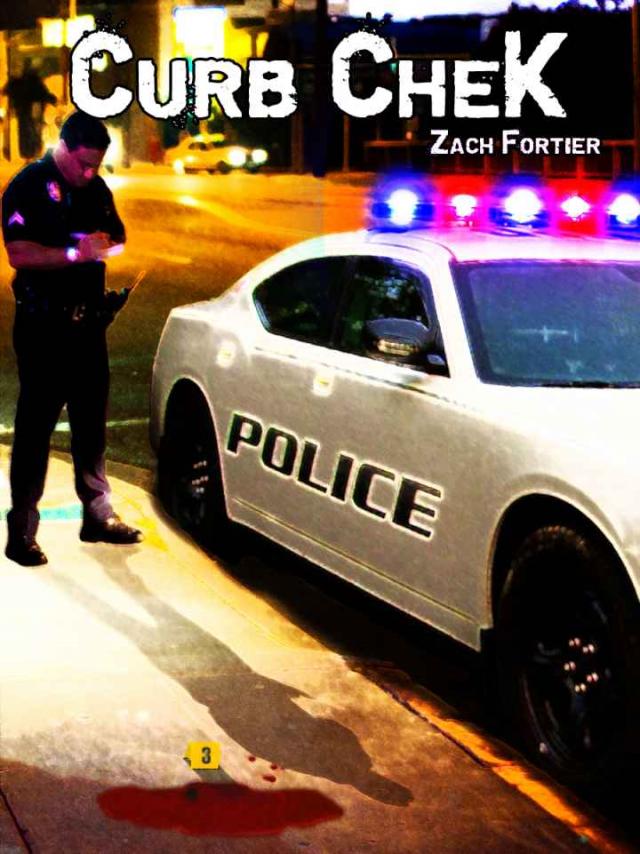
A block later, we came across a huge pool of blood. It was relatively fresh on the sidewalk, and a trail led away from it. It didn’t really go anywhere, eventually disappearing in the grass of a vacant lot. “You see, this is what the people on the street see, what they live in. We never would have found this if we hadn’t gotten out and walked.”
We never did find out what the pool of blood was about or who its owner was. I checked the area, then the local hospitals, but no one had come in either injured, stabbed, or shot. Whoever it was had lost a lot of blood; nevertheless, I’d impacted my trainee. After he was out on his own, complete with a patrol car and bloody streets to monitor, I heard him frequently sign out in his area and go it on foot. I don’t know if anyone else thought it mattered or not, but it did to me. You can’t expect people to walk the streets if armed Constables On Patrol (Cops) won’t.
Later, while working in central city again (as was usual those days), I had another trainee with me. His name was Jeff McKell, and he was actually a reservist, not yet a certified peace officer hired and sworn. He asked to ride with me, and after a few hours he said to me, “You don’t work like anyone else I’ve ridden with.”
We heard a call come over about a large male breaking into an apartment a few blocks away. He’d beaten the occupants pretty badly, then left on foot, running.
Manu Rio had been active in the street gangs there, but he’d left town a few years earlier when his gang had fallen apart, taken over by a rival gang. Rio had a girl in the city and had missed her a lot. Finally, he had enough and came back to visit, riding the bus from several states over. When he got there, there she was in her apartment - having sex with some other dude. He was devastated. He kicked the guy’s ass and beat her up pretty badly, and we came across him on foot some four blocks west of the chaos he’d just left behind.
Manu was a huge man, maybe 6-foot-4, and he was built like a linebacker and mean as hell. He had a reputation on the street as a brawler, particularly a guy that liked to fight cops.
I got out and approached him - and he squared off with me right away, assuming a fighting stance; he was covered with sweat, all warmed up and ready to go.
I could see that he was exhausted and visibly devastated, so I started to try to talk him down; it was obvious that he didn’t want to fight if he didn’t have to. I started to talk to him quietly, then just listened to get him talking.
He told me about his girl and the long drive he’d just made, thinking about how much he missed her. They had a baby together, and he wanted to be a man and be the baby’s father. He went on and on, getting everything off his chest. He was emotionally wounded and upset, so I just listened to him and let him vent. When he looked like he was about done, I let the other cars know that I had him and gave them our location. They lit up lights and sirens, and we could hear them coming. I told Manu that he had a choice to make, that I wanted to help him and understood what he was going through, but I also needed him to trust me. Naturally, he was suspicious; he’s a banger, and I’m a cop. I told him, though, that with all the other units coming I had a minimal amount of time to get him safely into my car; I didn’t want to see him hurt, but the reality was that we had a lot of new guys that were hotheaded and looking to make a name for themselves. On top of that, they’d heard of him and his attitude toward cops. So, I asked him again to trust me and let me take him into custody before the other guys showed up.
As the sirens closed in, he stood his ground and said, “Fuck it. I wanna fight them bitches.”
“Look man” I said, “Let’s resolve this like men. You don’t have to prove shit to anyone. I’ll even give you the cuffs, and you can put them on and get into my car.” As I handed him my cuffs, Mckells eyes were huge and his mouth dropped open. I had nothing to lose. If he listened and cuffed himself, I didn’t have to fight him and he’d be in my car when the backup arrived; if he didn’t, we’d be fighting - but I’d have a lot of help in the next few moments.
He stared at me for a few seconds, holding the cuffs and listening to the sirens getting closer. Finally, he said “OK” and cuffed himself. I opened the door, and he got into the car. Then I seat-belted him in and closed the door as the first unit arrived, officers jumping from the car with their nightsticks out. They wanted to know where Manu was. Did he already run off?
I said, “No, he’s here,” and explained that I’d asked him to cuff himself and get into my car politely - and he had. As proof, I pointed to him sitting in my patrol car.
“Bullshit!” they exclaimed. “You did not get Manu Rio in your car without a fight.”
I said, “OK, if you say so,” then got in the car as more units arrived. While I spoke to Manu, taking down his information for my report, they all stood outside the car, nightsticks quivering, glaring like I was the high school principal who’d canceled the rumble after a big game.
They asked McKell if what I said had actually happened.
“Ya, I wouldn’t have believed it if I hadn’t seen it,” he said.
I was pretty proud of that moment. I thought of it as an accomplishment - and I’d certainly disappointed a lot of my co-workers.
Listening wasn’t rocket science; it was just common sense.
Take Doobie McKelroy, for instance. Doobie was a Los Angeles gang member who migrated here in the early 90s. He dealt a lot of cocaine until he was finally caught and shipped off to federal prison. He had a reputation on the street as a real scrapper, and he fought like hell. He came back here after serving his time and made a true attempt to stay straight. Then I got a call to his house one night.
He’d been working a job as a semi-skilled laborer for a company in a nearby industrial park; he’d given up all the adrenaline rushes and instant gratification, whatever the draw was of life on the edge, the gang life. His boss was impressed with his work ethic. Doobie showed up for work one night, and the boss told him to go home and gave him the night off. They were way ahead of their projected output, and it was mostly because of Doobie’s efforts. The boss also said that he’d be providing Doobie’s parole officer with the feedback that he was one of his best workers - if not the best.
Doobie was feeling something new, a sense of accomplishment, of reward. He was happy; finally, his life seemed to be turning around. He was starting to believe that with hard work you could get ahead. It was working for him, and he was getting used to coming home happy. Maybe he could make this life work. He was accomplishing all of this while still hanging around some of the old crowd that remained in “The Life.” These were the people that he cared about and had known for years...maybe he could show them something.
He was living with his girl. She’d stayed with him through prison, and she had his children, a boy and a girl. He was trying to be a father and a husband, and he liked how it felt. Now, with the props from his boss, he liked how he felt for the first time in a very long time.
Excited to surprise his wife with an extra night with her and the kids, he pulled up to his house and walked to the front door – only to see his wife on the floor of the living room with his two best friends, fucking. At first, he thought he’d gone to the wrong house as he looked through the glass; then he saw the kids - his kids - watching TV quietly in the living room, the same room, while his wife was being tag-teamed by his two best friends.
Blinded by rage, he walked in and beat serious ass. He beat the hell out of his buddies first, then turned on his wife. He’d been in prison and was the real deal, a banger from L.A. – so he knew how to fight...to kill.
I got the call from a neighbor who heard the fighting. When I arrived, Doobie and the wife were sitting quietly on the front porch. I asked her what happened, but she wouldn’t tell me anything. He sat without a word, just staring straight ahead. Several moments passed, then finally he said, “I beat her ass.”
I arrested him and put him in the car. He was in shock and acting strange, so I finally pulled over after a few blocks and asked him what had gone wrong. As I talked to him, he started to cry; at first, they were just silent tears, but then he began sobbing and really broke down. He told me what had happened, how he had signed on for the whole notion, the good life; he naively bought into “the work hard, live right, come correct, stay clean, and life turns around” scenario. Now, he felt totally destroyed, an emotional train wreck.
We just sat, and I listened and let him get it all out. He told me about his life selling drugs, gang banging, prison, and how he was trying to walk away, do the right thing, and “come correct.”
I listened for what seemed like hours, and after a while I knew I wouldn’t arrest him. I’d probably get fired, but instead of aggravated assault, I wrote it up as misdemeanor assault so that I could release him on a citation. I didn’t fully explain the injuries to his wife, minimizing that in my report.
I told him that he was doing the right thing and living the right way, but that he had to realize a few facts. He had changed, but his wife had not. I’d seen it all the time while I was in the gang task force: bangers would change and expect that the wife or girlfriend would go along with it, but they didn’t. The women that are attracted to gang bangers have a whole different set of issues all their own. Most liked the element of danger in being around the life; the constant chaos, drama, and abuse were addictive for them. When the thrill was gone, they turned to sex and betrayal of the gangster, streetwise hood rats craving the chaos. I told Doobie that he and his wife had a lot to work out if he wanted to go back and asked him if he wanted to. He said that he did.
I took him back to the house when he was ready, then met with both of them and told them what I was going to do. The wife went to a friend’s place, and he stayed home.
I told him I didn’t know what his parole officer would do but that I wasn’t going to put him in jail, which would for sure “violate him,” as we called it: it meant to violate his parole conditions, which would put him back in prison.
I don’t know what happened to him next, but if he ended up back inside I’m sure I would have heard about it; instead, I never saw him again - which was a good sign. I never regretted the decision not to arrest him. I was never called to court on the citation, and I never got a call from his parole officer.
Chapter 22
Bad Stop Ben
Once I had a new guy, Ben, develop a real interesting habit of stopping cars. He had no legal reason to stop and search them with no probable cause, which was the lowest legal standard of evidence on which we were allowed to act. It’s a fairly simple concept, really: “probable” as in it probably could be suspicious to a reasonable person.
He made a lot of arrests with this “style” of his, but they wouldn’t stick; prosecutors wouldn’t file charges on them, and any defense attorney worth his pay could get them thrown out.
One night, I was called to back up Ben, “back” as we called it; it happened a lot that he always needed a back. He was at the south end on one of the main streets of the city, which wasn’t a cop-friendly area. He’d stopped a truck that had left a suspected drug house. We’d do it if we could - but we can’t, so we don’t. Pulling over everyone who departs a suspicious house not only wastes a lot of time, but it can get a department sued more than it needs to be. Besides, “suspected drug house” just isn’t enough to go on. Probable cause is also the standard for a warrant to shut down a drug house, and if we had it we’d close the place.
Anyway, Ben had the suspected drug house customers pulled over and asked me to standby while he talked to the three people in the truck. He asked the driver if he could search the truck; the driver consented. Ben searched the truck and found nothing. He then searched the passengers, and one had a purse with drugs inside. He arrested all the occupants and impounded the truck.
I knew the search was bad and that the arrests wouldn’t hold up, and I tried to explain it to Ben - but he wouldn’t listen. Trying for common sense, I told him to take the drugs, flush them somewhere, and send them on their way. Ben wouldn’t budge.
About a week later, he got a letter from the prosecutors telling him that the search was illegal and that the arrests had been thrown out and squashed. This went on for months: Ben stopping people, illegal searches, arrests being tossed. Another night, he pulled over a car because “it was a car full of Mexicans driving around at four in the morning.” I couldn’t believe he said it out loud. He had all the occupants out sitting on the curb in handcuffs. Several other cars had rolled up, as well as a Sergeant, and Ben started to search the car when he got permission from the non-English speaking driver who agreed with whatever Ben said to him.
The trunk was full of used car stereos, and Ben and the Sergeant decided that the property was obviously stolen, so they arrested everybody. We, the rest of the squad, about shit ourselves at this brilliance. The stop was bad – which made the search illegal - and the property hadn’t been proven to be stolen. The people hadn’t even been checked for warrants yet, but they were checked later - and they would all have none.
We all left, driving off and refusing to come back. Ben and the Sergeant dealt with all the paperwork: the impounding of the illegally stopped vehicle, property forms for the illegally seized stereos, and booking of the illegally arrested Mexicans.
The next day, we had a heated debate with the Sergeant in shift briefing. He said he never wanted to see that lack of teamwork again, but we pushed back, bringing the Constitution into the discussion, as well as the Fourth Amendment, search and seizure rights, oaths, and our assertion that this stop was bad from jump.
Regardless, this went on and on. The Chief and Assistant Chiefs came in one day and awarded Ben “Officer of the Year” for all of his felony arrests, then sat in the shift briefing and told each of us that we needed to learn from his example. He had twice as many arrests and seized more property than any of us “and he’s new.” You could almost hear our respect for the brass evaporate from the room. Ben lost almost every case he made an arrest on, but the department didn’t track convictions. This got to be a joke on patrol: just go out and be an idiot, and management will reward you.