

Unquiet on the Eastern Front, page 1


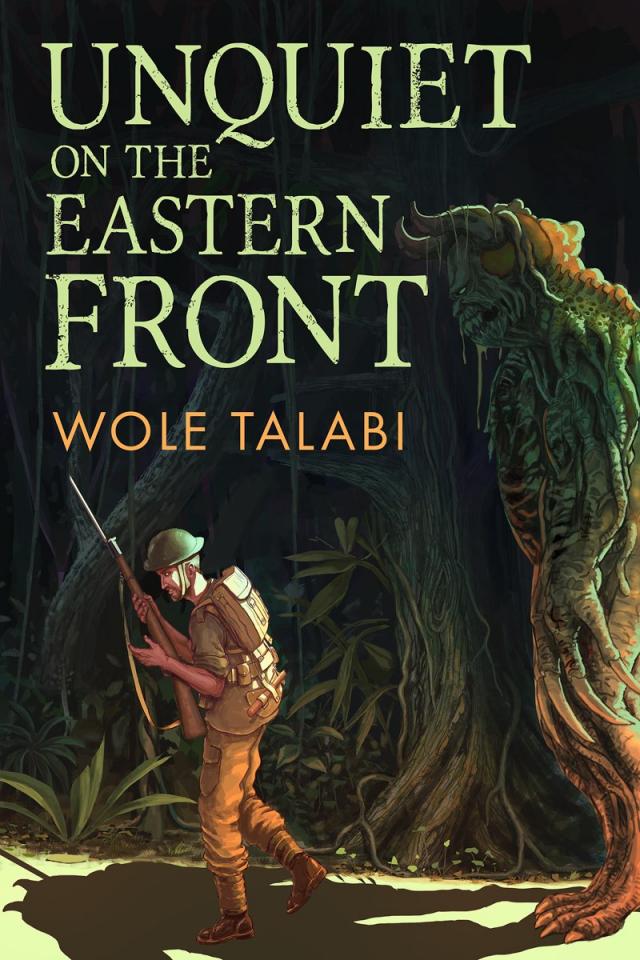
UNQUIET ON THE EASTERN FRONT
WOLE TALABI
Unquiet on the Eastern Front Copyright © 2024 by Wole Talabi. All rights reserved.
Cover illustration Copyright © 2024 by Manzi Jackson. All rights reserved.
Ebook Edition
ISBN
978-1-64524-273-4
Subterranean Press
PO Box 190106
Burton, MI 48519
subterraneanpress.com
CONTENTS
Chapter 1
Chapter 2
Chapter 3
Chapter 4
Chapter 5
Chapter 6
Chapter 7
ONE
20 September 1940
My Dear Mother,
I write to let you know that I have returned from my journey to Bonny which sits at the mouth of the New Calabar River about sixty kilometres from my base in Port Harcourt. It is a strange place, perhaps the ugliest place I have been to on the West African coast, despite its history. Or perhaps because of it. In the old days it was a major slave-trading station where people were brought downriver in canoes and herded together in barracoons before being traded to Portuguese and British slavers for cigarettes and mirrors and gin. After we had finished the official inspection, William, the District Officer, told me that after abolition, Bonny shifted focus from the sale of flesh to the trade of palm oil until Port Harcourt was built and all trade moved upriver. Now Bonny sits in ruin and decay. A fate, William tells me, the locals believe to be the work of vengeful, unquiet spirits, the victims of its dark and horrible history. I almost believe it. Buildings are boarded up. Pitiful shacks and lean-tos of corrugated iron dot the streets. Rusty old cannon and their mountings, sagging under the weight of disuse. Goats and fowl and small naked children wander the streets aimlessly. William told me that there have also been a series of bizarre deaths recently. Men being attacked by what the locals call an Ibagere, a white crocodile spirit which is an embodiment of the river itself, as they headed out to their small fishing boats at dawn. There is no evidence of such a creature, and he believes it is likely that these are just murders to settle old blood-feuds. If so, then it seems even the minds of the people are hopelessly broken. Truly, the curse of pain and suffering inflicted there endures, and I was glad to leave. It is perhaps the only place in all of Africa I have been to that truly made me uneasy. We travelled out by steam launch yesterday, as there is no direct road to or from Bonny. I arrived back to Port Harcourt at four in the evening.
I know Father doesn’t particularly care about me or my doings here, but I hope you are both well and that the cold bite of winter has not been too difficult on his leg.
David’s fiancée Suzanne wrote that she can now hear the roar of bombs every night in London. Can you hear it all the way from Oxford too? I hope desperately that you are not affected by the bombardment. Perhaps it is time to move to the country house in the north? Here in Port Harcourt, the great war seems so far away. Like so much of Africa, this land is quiet and beautiful, except in the places where the ugly, brutal recent history has been etched into it and where blood has been spilled to claim it. I am sure you still remember its spectacular skies from your time here during Father’s service. I consider myself lucky to have been born here. As I write to you from the verandah of my house in the government quarters, the sun is bright, the sky is a ribbon of perfect pale blue, and the breeze is steady. Calming, cooling. Yet I sense the menace of war in everything. The governor has just visited us from Lagos and once he left, Lieutenant Colonel Frederick (my new commanding officer) asked me to begin drilling the men in my platoon twice a day. There are rumours that we may be mobilized soon.
I had a new dream last night. It was a strange dream, of walking through thick, misty forests and being stalked by a hulking shadow with many sharp-looking edges. Like the silhouette of several animals stacked atop each other, their tusks and horns making an impossible shape against the light. I do not remember many details of this dream, but I remember the sense of dread, and the sight of long, sharp claws. You always did say that dreams are the way our subconscious processes the things we don’t want to think about. Perhaps the shadow represents my fear of the impending war. If it remains solely in the realm of dreams, then I shall be glad for many such nightmares because I now find myself conflicted. I do not want war and bloodshed to make their way to this beautiful place but at the same time I want to do something to help in the war effort. To make a difference. I know you want me to remain safe where I am since the fighting has not yet made its way here and continue to pray that it does not, but I have felt so useless being kept here to guard offices and inspect storerooms while the most important battle in the history of mankind rages on. Perhaps it will be best if we are sent somewhere where the fighting has already begun but I must do something. I am just as fit as any of the men fighting at the frontlines and I hope we get to do more than just drills soon.
These enlisted men of the Niger seem tough and eager enough in their duty, but I don’t know how they will respond in battle. Honestly, I don’t know how I will either, but I cannot imagine what it must be like to fight on behalf of someone who has taken over my home. I hope I never come to be in their shoes but if the Germans and Italians win, then it may be our fate, assuming we do not die resisting them. What cruel irony it would be, wouldn’t it?
This afternoon I spoke to my steward boy Emeka, an Ibo, who has been ministering to my needs. He is a smart young man whose family is from a bit north of our position, in Anambra, but came here to trade. He is short and stocky with astonishingly white teeth. Quiet but contemplative. I can see wisdom behind his eyes. His English is broken but clear. He claims to have taught himself to speak English and seven other languages by listening to traders in the markets by the docks. A bold claim. I have learned enough Ibo myself for us to have a conversation, clumsily alternating between two languages. Between his broken English and my stilting Ibo, we understand each other. He said he wants to join my platoon. To train with the men and join the drills. When I asked why, he simply said he wanted to learn how to defend his home.
I keep thinking about what he said. About what it means for Emeka and his people to defend their home. About why we are here. Why I am here. I was born in this land, but I represent an invading, conquering force. What does that make me?
As always, please do not discuss any of this with Father, I don’t want him to get riled up again. I already know his feelings about me and Africa and its people. You are perhaps the only person in the entire world I trust with the deepest and most honest of my thoughts.
Before I forget, how is Stephen? I trust you are still checking in on him regularly at the institute despite the difficulty imposed by the war. It must be so hard for him to understand what is going on, what any of this means. He could barely understand the world in peacetime. Even I can barely make sense of it myself. I wish I could be a better brother to him, but I don’t know how. He is in his own world. I hope they still let him go outside and spend time with the others at the institute. Perhaps they understand each other in a way we could never understand him and his unusual mind.
Please stay safe and stay well. You remain in my thoughts and prayers, and I look forward to your next letter.
Love,
Your son Kenneth.
TWO
4 October 1940
Dear Mother,
It happened. We have been deployed. I cannot write down any details but two days after I received your last letter, Frederick gave us our orders.
I write to you from the Gulf of Guinea, at sea. We are to land at Doula and march east, to rendezvous with the 5th Indian Infantry brigade and help them to take back East Africa from the Italians. I cannot write down our exact path or any other numbers as the commander fears that courier and convoy ships may be attacked, and any letters studied for intelligence.
I am surprised at my relief. Deep down, I had feared I would be sent to Asia or back to Europe or worse, that the Germans would attack the West African coast, but helping to defend this continent, in a place away from my residence, holds more meaning for me. I have truly fallen in love with this place that has always felt more like home to me than the England of my youth, which we returned to after Father’s own colonial service. Yes, I know you hate it when I say that, but it’s true. There is something that feels right, righteous even, about fighting to repel the Italians from this continent and if that helps weaken the Germans in Europe, then all the better.
On the day we mobilized, I went to the chapel to say a prayer for you, Father, and Stephen because I do not know when next I will find a house of God. Then I took a shortcut through the governor’s farm to meet the men. There I had my first sight of my platoon in their full uniforms, holding their weapons. Thirty-three of them in all. Four of them were British officers—chaps who had been on the same colonial service course as me. Nigel, Andrew, James and Phillip. They were dressed in green with khaki bandoliers, just as I was. All the other men were the natives I’d been drilling, in their clean and pressed khaki shorts, shirts and helmets. I was proud to see them looking so ready, Emeka among their number, his head held high. We marched down to the docks, where the Queen’s Glory, the troopship that is taking us to Doula, was berthed. A concourse of curlews had perched on the gangway, making it sag under their weight and when we arrived, they took flight, drifting and rising and turning in fascinating formations like a shapeshifting shadow set against the blue sky. r />
“It’s an omen,” Nigel remarked with a smirk. “Birds flying overhead when a ship sets sail are a warning of death to come.”
Phillip and James laughed but I didn’t.
Queen’s Glory is a small ship but that’s fine because this is a short trip—only two days long. It will save us an additional seven or eight days of marching through treacherous forest and consuming precious supplies. For some of the native men, this is their first time aboard a ship and their stomachs are not handling it reliably. I try to encourage them. Phillip, who trained with me in Lagos, laughs at them and refuses to eat with them at dinner. He takes his meals alone, on the deck. He reminds me of Father.
I have been practicing my Ibo with Emeka and learning a few words of the other languages he knows as I prepare for the long march ahead once we get to Doula. It will take a few weeks. Thankfully, we have been fortunate with the weather as the skies have remained clear, and the water has not been rough. It is hard to imagine that we are heading towards a war.
It is a bright moonlit night, and the water looks like it is speckled with silver. We saw a whale, who obligingly spouted twice, before disappearing into the dark depths. I was excited to see the majestic creature, but Emeka says this is bad omen according to the deckhands. Two bad omens on one ship? I doubt the gods of this land would be so unsubtle. Besides, how can nature as beautiful as this be signs of evil to come? No, I think evil is man-made and the sight of places like Bonny are more omen than any animal on land or air or sea.
It is wonderful to leave the offices and go out into the wild of the continent again. I find delight in the opportunity to see new parts of this land. I hope I also come back safely.
I am not sure when I will be able to send this letter to you. Perhaps I can find a place to send mail in Doula but after that, once the march begins, who knows? I will keep writing anyway, I find that it helps me to maintain perspective on what is happening.
Please give my regards to Father, I am glad to hear his leg is better now that you have moved up north and that you are both managing to eat healthily despite the national food rationing. I suppose Father will be happy to hear that I am finally going to join in the fighting. That is one of the few things we still agree on. That we must always face our fears and fight to protect what we care about.
God keep you safe,
Kenneth.
THREE
13 October 1940
Dearest Mother,
Before I go any further into the bush, I am compelled to drop you a line to let you know that we have reached Bangui in Ubangi-shari, what used to be the French Congo when Father served. I remember he mentioned visiting here once for an event.
The march here has been difficult but uneventful, and we have encountered no enemies on the way. If I must be honest, it was somewhat boring. We are marching to war, and I find myself bored to tears. How strange! Many of the other officers complained of the climate out here but I do not find it in any way too bad perhaps by virtue of my being born here. Hot sun, brief but heavy rain. I prefer it to the grey clouds and snow of my adolescent years in Oxford. The hardest parts have been the occasional river crossings. As regards the other menaces that allegedly lurk in dark of the jungle, we have not encountered any dangerous wild beasts—beyond a wild pig and several snakes which Andrew assures me were not venomous. Sometimes my mind plays tricks on me and I think I can see the shadow from my dreams, its ill-defined horns poking out from between trees but that is often gone with a shift of the light. Even the insects are not the bane that I expected they would be. Mosquitos have worried me less here than they did in Port Harcourt. There are ants everywhere but those of the depredatious white or red variety have yet to make an appearance. We only lost one man. A native Ogoni chap. He was sick with malaria and unsteady on his feet when we crossed the river. He fell and was swept away before anyone could reach him. Was this the omen of the curlews and whale? He may not even be dead, perhaps washed up somewhere downriver. But we cannot go back for him. I hope he is safe.
Phillip made some of the younger native soldiers, including Emeka, carry him on their shoulders so he could save his own strength. When I approached him and told him that this was unfair, that we were all soldiers in the King’s service, he laughed and said, “They are animals.”
I almost hit him at that.
Do you remember when Father made the same comment at dinner, after the rebellion? I don’t understand how anyone can think of their fellow human being as an animal. Nigel and James looked away from our confrontation when I ordered Phillip not to do it again. He glared at me for a long time but eventually acceded.
As we approached Ubangi-Shari, we came upon a great rubber plantation where we were met by a group of young French officers led by a man named Serge. He spoke good English and seemed glad enough to see us once he had determined for certain who we were. He had his men, who had been tapping rubber and tilling soil, load our supplies onto a lorry, along with the other British officers and we sallied forth behind the native servicemen of our company who marched ahead of us. Before we left, I saw Emeka speaking to some of the native workers as they loaded up the lorry. I suppose he wasn’t lying about learning to speak all those languages from the market. I often find myself wondering how well such an illustrious and hardworking young man would do if he were not encumbered by the limits that we have placed on him by seizing control of his home, even as we continue to fight to defend ours. At least we have brought him an education and some civilization. Though I am less certain of the value of these things than I once was and Emeka may see no fairness to the trade.
When Serge saw Emeka speaking to the workers, he admonished him quite harshly, slapping him across the face. I am ashamed to confess that I did not say anything as I did not want to upset my host. I noticed many scars and mutilations among the number of his workers, and I knew the kind of man he was. Of these observations, I also said nothing. The sting of my cowardice remains but I cannot afford to start fighting my allies during a war when I am yet to face my enemies.
As the lorry drove slowly behind the marching men, I thought I saw the shadow from my dreams standing in the middle of the road behind us, dark and sharp. It was the first time I had seen it outside of the forest and a lump appeared in my throat. I asked Serge if there were any strange, wild creatures in this area and he said there weren’t any. But he did tell me of what some of his more superstitious workers from the east called the Ngoloko, a mythical, ferocious carnivore with red hair and horns that stood on its hind legs, far taller than a man, and which killed livestock and scalped evil people it encountered in the forest.
“It’s a tale they tell children and criminals that have been exiled from their villages as they wander into the forest,” Serge assured me. “We have occupied and tamed this land for decades. No such creature exists.”
I believe him, but I am growing increasingly concerned at my mind’s inability to keep this creature made of my own fears relegated to the realm of dreams.
We spent the evening at Serge’s home where I met his young wife and small son of only ten months. Serge is a pleasant enough chap outside of the plantation, though inclined to his own brand of paranoia. He kept warning me to be careful with the natives, relaying stories of French soldiers who had been abandoned or betrayed by their men in the middle of the jungle. Shot in the back while they marched or slept. His wife is very lovely though. A slight creature who seemed so uncomfortable in her own home.
I slept fitfully and dreamt of the shadow creature again. I remember this time; it approached me and asked a question, but I don’t remember what it was. All I woke with was the memory of terror and long, sharp teeth.
Serge resupplied us with some rations and gave us the use of his crop-loading lorry. He has also promised to send this letter to you as the local officers here have a direct connection to the Free France in London where General de Gaulle governs in exile.


