

The Cometeers, page 13
part #2 of Legion Series


“The power beam – if that’s what it is,” he whispered huskily. “Between the planet and that atomic engine. It has caught us, with its own field of force. A danger I hadn’t expected.”
He paused to read the screens again, and swiftly calculated a new course for the ship.
“I think we can keep free, but this costs fuel.” Checking his figures again, he shook his head and bit his lip. “I’m afraid we’ll land a little too hard for comfort.”
Stern-faced, abstracted, he turned again to screens and calculator, fighting a silent battle to conserve every precious drop of fuel.
In hours, perhaps the flight was long. But always it seemed to Bob Star that they had hardly left the asteroid, before the Halcyon Bird was slanting down out of a pallidly green sky that swarmed with many-colored worlds, toward the dark, strangely level surface of the master planet.
That great world seemed a perfect sphere of indigo, unbroken by mountain or sea. It appeared absolutely featureless, save for the overwhelmingly colossal machines, red and mysterious beneath their pale domes of greenish radiance, that scattered it at distances of hundreds or thousands of miles.
As that dark, strangely forbidding surface expanded before them, Kay Nymidee pointed through an observation port at the looming bulk of one of those machines.
“Go – ” she said eagerly, and groped for a word, “there!”
Bob Star nodded, and set the nose of the Halcyon Bird toward it. Then he looked doubtfully at a fuel gauge.
“I’ll try,” he whispered.
But the needles crept inexorably toward zero. The even drumming of the rockets was interrupted by a warning cough. He shook his head, and brought the Halcyon Bird to a jarring landing upon the strange flatness of the indigo world, with rockets dead before the ship was still.
“The tanks are empty,” he muttered blankly. “The ship won’t move again.”
Kay Nymidee seized his shoulder, and pointed imploringly at the crimson, cyclopean mass of the machine ahead, a bewildering and fantastic enigma of red metal, within its transparent shell of shimmering green.
“Sorry, Kay.” He shook his head again. “We just couldn’t make it.”
The mute reproach in her brown eyes changed slowly to frightened dismay.
“Perhaps we can walk, if we aren’t discovered,” Jay Kalam suggested hopefully. “Kay seems determined to take us to the machine. And it doesn’t look so far – ”
“The distance is deceptive,” Bob Star told him, “because of the vast size of the planet, and the remarkable clearness of the atmosphere, and the lack of any other object for comparison.”
“How far is it?”
Bob Star looked at his instruments.
“According to my last observation,” he said, at last, “that machine is about a hundred and twenty miles from us.”
The hostile impact of an alien world struck the five with shocking violence, when they left the air-lock of the useless Halcyon Bird. It was five hours later. They had spent the time in preparing to undertake a desperate march of more than a hundred miles. Bob Star and Hal Samdu were dragging two sledges improvised from metal doors torn from within the ship, packed with food, water, and weapons.
The runners sang musically across the flat infinity of the planet’s surface. The puzzling substance of it was absolutely smooth, hard and slippery underfoot. Nowhere, so far as they could see, was it broken by any irregularity. At first they found walking difficult; Giles Habibula fell sprawling twice. As a compensatory advantage, however, the sledges, once started, glided along with little effort.
“A whole world, armored?” marveled Bob Star. “Is it metal?”
“It isn’t metal.” Jay Kalam shook his head. “I took time to examine it, after I finished those atmospheric tests – though I still don’t know what it is.” He shrugged uneasily. “Something harder than diamond and tougher than steel. Acids don’t affect it. It neither absorbs nor radiates heat. Perhaps it isn’t actually matter at all, but another stable energy-field, more or less like that green barrier.”
Surprisingly, his tests had found a breathable atmosphere. A rich oxygen content made up for the low barometric pressure. The surface gravitation, Bob Star had reported, was slightly less than Earth-standard. Since the planet had four times the diameter of Earth, that meant that its relative density must be extremely low.
At a little distance from the Halcyon Bird, Jay Kalam paused, and they all looked back. The silvery cruiser lay small and lonely upon that blue, jewel-smooth plain. It was the only object upon the infinite world behind, a solitary gleam under the pale green sky.
Blue flame, as they looked, gushed suddenly from the gun turret. The bright hull glowed swiftly red, and flames exploded from the ports. The five went on, regretful, for it had been a faithful ship.
“They’ll surely find the wreck,” Jay Kalam said. “But I hope they’ll think we died in it.”
They plodded on, wearily dragging the sledges, toward the red riddle of that enormous machine, a hundred miles away. Bob Star’s eyes rested on it, with an apathetic fascination. It stood on a square platform, which might be, he estimated, two miles high and ten in length. The machine towered above it, so immense that he dared not attempt to guess its height.
The blood-red stuff of it shone like metal. There was a lofty frame of colossal beams and girders. There were moving parts, so intricate, so strange, that he could readily find no name or explanation for them. In particular, his eye was caught by a vast, shimmering white object, shaped like a flattened orange, that moved irregularly up and down between two colossal plates of crimson. The whole was enclosed in a transparent greenish dome, that seemed somehow akin to the sky.
Despair took hold of him.
“Against the scale of that machine,” he muttered, “we’re no more than five flies.”
They plodded on. In the pellucid atmosphere, the machine always looked almost near enough to touch. And always it retreated, mockingly at their weary efforts. At last, at the plaintive insistence of Giles Habibula, they halted. The Halcyon Bird was lost to view. They huddled in a lonely little circle by the sledges, on that shimmering vastness. They drank, ate sparingly, and tried to rest.
There was no wind. The cool air was oppressively still. The green sky did not change. There were no clouds.
“The planet doesn’t rotate,” Jay Kalam commented. “There is no weather, nor even any time. It is a world without change.”
A terrible silence overhung them. Nothing lived or moved or gave voice upon all the empty plain. The green sky was equally devoid of life or motion. The cold disk of the purple sun hung steady, high above the straight horizon. They could see the glowing lines of the triple beam, converging toward it. The multitudinous planets of the swarm stood motionless in the pale green void. They neither rotated nor changed position.
Giles Habibula wiped sweat from his yellow brow with the back of his hand.
“Ah, me!” he moaned. “A fearful world to die in! Upon one journey of forlorn hope, old Giles carried a bottle of wine through the mortal hardship of a continent larger than the precious Earth. But then he fought enemies he could understand. He never felt such need of the bright strength of wine.” He fumbled in the packs on the sledges, and found a bottle of some rare vintage from the asteroid. Watching with a jealous eye, he offered it to each of the others in turn, and at last drained it gratefully.
Even Jay Kalam was worn to confessing despondency.
“It’s true,” he agreed bleakly, “that things were never quite so bad for us, not even on the Runaway Star. Though the things we fought then were able scientists and terrible foes, they were still defeated refugees from their own environment.
“But the Cometeers have conquered theirs. The creatures of the Runaway Star were things that we could sometimes kill, but the Cometeers aren’t flesh.” His thin lips set. “I doubt very much that any weapon men ever made could destroy one of them.”
Startled, Hal Samdu peered at him. “Not even Aladoree’s?”
He shook his head. “AKKA will destroy anything material – but I’m not certain that the Cometeers are material at all.”
“Ah, so, Jay,” croaked Giles Habibula. “Our plight is desperate. In seeking to balk the Cometeers and destroy Stephen Orco, we are no more than five ants making war on all the System – ”
His voice wheezed into silence. His dull eyes, staring into the green sky, seemed to film. The breath went out of him.
“A good thing!” he gasped. “A good thing we drank the wine.”
Bob Star saw a distant object, skimming swiftly toward them through the green. It came from the direction of the Halcyon Bird. Jay Kalam caught at Giles Habibula’s arm, as he started away.
“Don’t run,” he said. “There’s nowhere to go. If we crouch down, perhaps they won’t see us.”
Bob Star was huddled beside Kay Nymidee. He caught her hand, and it closed upon his with a desperate pressure. Her face was drawn, white with strain. Her pale lips quivered. Overwhelming terror shuddered in her eyes. Pity for her stabbed him like a blade.
A nerve-severing sound tore him away from the girl. He jumped, startled, terrified. For a moment he could not identify the sound. Then he knew that it had been Giles Habibula’s scream. Now the old man was trembling, sinking slowly backward upon his knees. His moon face was yellow-gray, contorted with dread. His small round eyes were fixed, glazed, bulging.
“What is it, Giles?”
“Mortal me!” the old man sobbed. “It’s the fearful thing – or another like it – that ate Mark Lardo!”
Bob Star looked up then, and found the object he had glimpsed a moment ago in the far distance, now already upon them. For the first time, his horror-filmed eyes rested upon one of the Cometeers.
It was hanging in the air, close beside them.
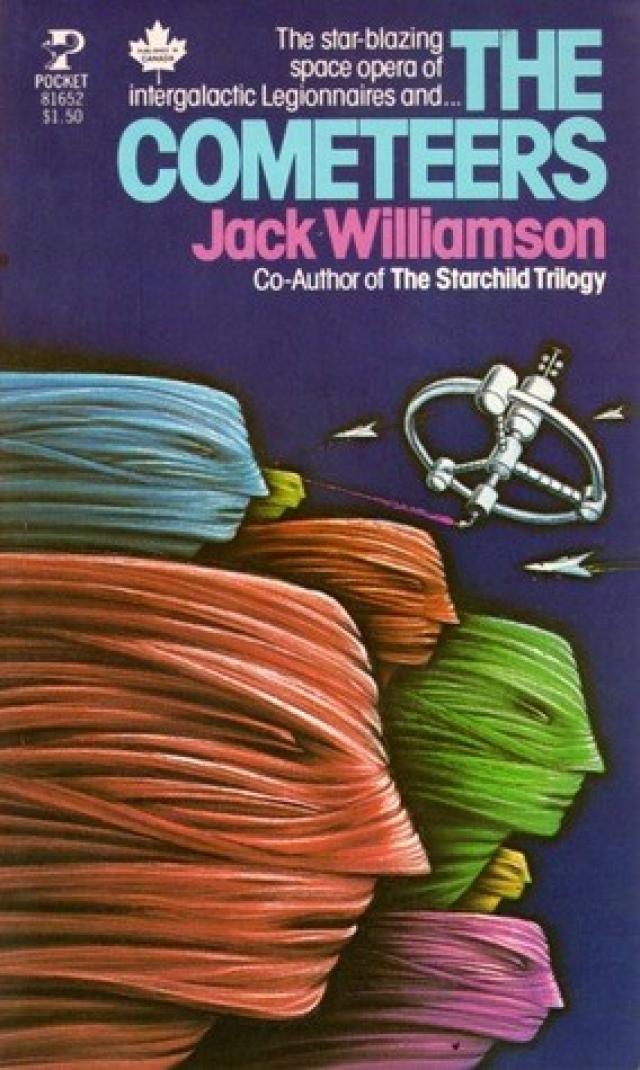
Floating low was a tiny star of red, veiled in a misty crimson moon. Ten feet above it hung a violet star, wrapped in a violet fog. The red seemed hot as the core of a sun, and the violet as cold as outermost space.
A mist swirled between the moons. There was life in its motion; it was like a throbbing artery of light. Red star and violet star beat like hearts of fire. Girdling the misty pillar was a wide green ring. It was the only part of the creature that looked at all substantial – and even it, Bob Star knew, could pass through the hard alloys of a space cruiser’s hull.
His dazed mind first received the thing with startled incredulity. He blinked, and looked down at the dark plain, and rubbed his eyes. But the thing had not gone, when he looked again. And its hideous reality ate into his mind, like a corrosive poison. He fought the queer, numbing horror that came flooding from it.
“Just colored lights,” he muttered. “Moving mist. Shouldn’t be afraid – ”
But mind-frilling dread swept into him. His numbed senses perceived a terrible entity within, beyond, those colored lights; an alien mind supernally powerful and completely evil. Every atom of his body reacted to it with automatic, shocked revulsion.
And the incessant beat of that old, strange pain, behind the triangular scar of the Iron Confessor, was suddenly redoubled. Every throb of it became a sickening, staggering blow against the naked tissues of his brain.
He braced himself against fear and pain. Swiftly, half-unconsciously, his fingers had been slipping fresh cells into his two proton pistols. The two weapons came up, now, together.
The emerald ring looked to be the most material part of the being.
He pointed the guns at that, and pulled the firing levers all the way, to exhaust the cells in one single blast. Those two blinding swords of violet ruin would have cut through a solid foot of tempered steel. They would have electrocuted any living being – as the System knew life – at the distance of a mile.
But, like phantom swords, they flashed through the green ring, harmless.
Quivering to the shock of icy dismay, Bob Star recalled Jay Kalam’s opinion that no human weapon could Injure the Cometeers.
“Kay – ” despair rasped from his leathery throat, “Kay – ”
His voice stopped, as if to the touch of death. For out of the pillar of swirling light another voice had spoken, whose careless, mocking levity was the most appalling thing Bob Star had ever heard.
“That’s rather useless, Bob.” It was the voice of Stephen Orco.
Bob Star staggered backward. That light, ringing voice was more terrible than all the shining horror in the air.
“You had your chance, Bob,” said the voice. “When I was in prison on Neptune, you had only to touch a little red button. But you failed. I’m afraid you’ll never succeed. For now, Bob, I’ve a body that cannot be destroyed.”
“You – ” dread drew his tone to a quivering edge. “You’re – that?”
“I am what you see, Bob. One of the drivers of the comet.”
A low, mocking chuckle rang inside the shining being. There was a little silence, and then the clear voice spoke again:
“Perhaps, Bob,” it suggested lightly, “you would be glad to hear of your mother? It must be some time since you left her.”
Bob Star leaned forward, sick and trembling. A gloating satisfaction in that careless voice cleft his spine like a cold axe. Hoarsely, through stiff, unwilling lips, he forced the whisper: “What about her?”
“I was alarmed for your mother, Bob,” the liquid mockery of Stephen Orco’s voice flowed on. “For she has been lost. My new associates searched the System for her, in vain. I was somewhat worried, for her life is the only barrier before me, now.
“But her capture has just been reported to me. It appears that your father, on his Phantom Star, was taking her away from the System, toward the star 61 Cygni. My associates have overtaken them. And I hope soon, Bob, to meet your mother, here within the comet.”
Chapter 15
The Cattle and the Herdsmen
Bob Star woke from a singular dream.
In the dream he had thought that his body had been exchanged for the shining form of one of the Cometeers. And this bodiless entity, himself, was flying through the green vacancy of the comet’s interior. Ahead of him, fleeing in a similar shining guise, was Stephen Orco.
This Stephen Orco, of the dream, was carrying away a woman. He was going to consume her, in some dreadful way. Only a shrunken husk would be left, bleached, wrinkled, hideous. And even the whimpering husk would die, and crumble to iridescent ash and fluid. Sometimes the woman was his mother, and sometimes she was golden-eyed Kay Nymidee.
Somehow, even in his bodiless form, Bob Star carried a weapon. He had no picture of its shape, but it was something that could destroy Stephen Orco, and save the changing woman. But a terrible fear was beating him down, out of the green abysm. His shining shape was reeling under the incessant blows of a great red hammer of pain. Stephen Orco’s voice was shouting furiously at him, turned to agony by the cruel mechanism of the Iron Confessor:
“You can’t! You can’t kill anybody!”
He woke, and knew that it was the low anxious voice of Kay Nymidee that had roused him.
“Sa daspete!” she was urging. “Sa daspete!”
He was lying down, with his head on her knees. Her hands were cool on his forehead, and they seemed to soothe the old pain behind the scar. He looked up, to find her anxious face oddly blurred and strange beneath pale green light. He tried to rise, and discovered the numbness of his body. Hideous as his dream had been, recollection came back. Ringing in his brain, he heard again the lightly mocking voice of Stephen Orco:
“I’m not going to hasten your destruction, Bob. A ship has been ordered here, to pick up you and your companions. You will be taken, along with a load of the prisoners from Pluto, down into this fortress of my new companions. And ultimately – ”
A chuckle had come from that shining thing.
“Have you ever seen the way we feed, Bob?” that bright voice murmured. “Well, you’re going to. But while you’re waiting for that, there’s something else I want you to think about.
“I can’t be killed.
“You’ve already proved that, with your own guns. And it’s no use clenching your fists and shaking your head – your face confesses your reluctant admiration of my new physical equipment. Certainly, it’s admirable enough. Space is no barrier to me now, neither is any material wall. But its best feature is immortality.
“My new body is truly eternal, Bob. It has mass and potential energy. But its mass is in no form you know as matter, Bob, and its energy is beyond the comprehension of your physics. Not even your mother’s weapon could destroy it.
“These deathless dwellings for intelligence are the supreme achievements of my new associates, Bob. You had not guessed that they were artificial? But the drivers of the comet once were beings of flesh. Not far different, perhaps, from mankind. But they became impatient with frailty, incapacity, death. They called upon their high science for a means of transferring their minds to eternal constructs of specialized energy.
“The Cometeers agreed to make me one of their number, to secure themselves from your mother’s weapon – AKKA could destroy all their somewhat elaborate equipment and possessions of course, even though it could not directly annihilate their bodies.
“And now, Bob,” the gay voice mocked him. “I shall be forced to leave you. Your parents, as I told you, are being brought into the comet. I must go to welcome your mother.”
Stephen Orco chuckled at the mute agony twisting Bob Star’s face.
“I wish to discuss with her the principle of AKKA. There are points not clear from my own research. And when our discussions are ended, Bob –
“If you wonder why we must feed the way we do – it’s because even these indestructible devices of life are incomplete. They were designed to be eternal vehicles for intelligence, and they can preserve our minds forever, against all possible assaults. Yet their very perfection becomes almost a flaw.
“Because they aren’t the bodies we used to own. Their senses are superior, but not the same. The mechanisms of emotion were largely omitted from their design, as useless heritages of the flesh. The consequent penalty we must pay for our undying perfection is a periodic hunger for the emotions and sensations we have lost.


