Combat Reckoning, page 32
part #2 of Jock Miles-Moon Brothers Korean War Story Series


Once they’d raced a few hundred yards up the tracks, they broke out of a scraggly wooded area and into the wide open swamp. The tanks pivoted slightly to the left, clearing excellent fields of fire for each vehicle while staying in plain sight of the .50 calibers covering them from a thousand yards to the rear.
The beleaguered men of Able Company could see the tanks, too. Squad by squad, they began to break contact and run to the Shermans. Sean’s tankers couldn’t see any Chinese yet, but they weren’t worried about cases of mistaken identity:
Those chinks in them puffy white suits ain’t hard to spot, even without binoculars.
But then—like a harbinger of unforeseen calamity—a helicopter swept low out of the east, passing directly over the GIs moving briskly across the frozen marsh. It circled behind the tanks and landed on the dike directly behind them.
“Ah, shit,” Sean said. “Them assholes parked their eggbeater right in the fifty cals’ field of fire.” An officer with a single gleaming star on each shoulder of his winter parka climbed out of the helicopter and strode purposefully up the line of tanks.
The one star officer, a brigadier general Sean didn’t recognize, arrived behind the lead Sherman at the same moment—and from the opposite direction—as the first group of Able Company’s men.
The brigadier grabbed a fleeing GI with sergeant’s stripes on his sleeve. “Who’s your commanding officer, Sergeant?” he asked.
“He’s dead, sir.”
“Well, who’s next in the chain of command?”
“He’s probably dead, too, sir.”
“Then I’m placing you in command, Sergeant,” the brigadier said. “Get control of your men and hold this line right here with these tanks. You’re not going to let some laundrymen get the better of you, are you?”
But there would be no getting control of the retreating GIs. They didn’t so much as look at the general as they kept on moving down the tracks. The only men who stopped—momentarily—were those who were carrying the wounded. Once they placed a casualty on the deck of a tank, they, too, were on their way.
And now there were more men from Able Company running past the Shermans. As the general stood fuming, hands on hips, the sergeant he’d corralled made his escape, too.
Looking up to Sean in the turret hatch, the brigadier yelled, “YOU’RE A WITNESS TO THAT MAN’S COWARDICE AND FAILURE TO OBEY A DIE-RECT ORDER, SERGEANT.”
But Sean couldn’t hear him over the noise of the Sherman’s idling engine. That noise level suddenly increased dramatically as the machine guns of all three tanks opened up on the Chinese racing across the marsh.
The general clambered onto the rear deck of Sean’s tank and, standing behind the turret, bellowed as if watching his team score a touchdown: “THAT’S THE WAY TO DO IT, BOYS. MOW THOSE LAUNDRYMEN DOWN.”
Then he leaned into Sean and asked, “Why aren’t you firing your main guns, son?”
“Waste of ammunition, General. A coupla bullets from the MGs do more good than a main gun ever will against personnel in the open.”
“Why, that’s nonsense, Sergeant. Give them—”
“Begging your pardon, General, but we’ve been pleading for canister rounds for our main tubes for months now. Those bastards could be just the ticket for fights like this, turning these tubes into giant shotguns. But we still ain’t seen none.”
“But you don’t need—”
“Don’t mean to rush you, sir, but it’s time to get the hell outta here. That was just the first wave of chinks. They don’t even send a first wave unless they got a second wave, and then a third wave. You get the picture?”
“Negative, Sergeant. I’m ordering you to stand your ground here and—”
“Again begging your pardon, sir…but that eggbeater of yours is fucking up my covering fire something fierce. And it’s in the way of my vehicles now because we’re done here.”
“I just gave you an order, Sergeant. You’re going to push back these chink laundrymen right here, right now.”
Speaking into his boom mic, Sean gave the order for his tanks to pull back. The general heard the command plainly. But before he could channel the outrage it triggered into words, he heard Sean’s reply to the TC of the trailing Sherman: “If that flimsy little helicopter don’t move, button up and push it off the dike. Them rotor blades are just made of wood. They won’t hurt you none. Just make sure before you do that the infantry’s all clear…there’ll be shrapnel from those blades flying every which way.”
All three tanks reversed direction with pivots that seemed choreographed. As they did, the turrets spun in the opposite direction, keeping their coaxial machine guns facing the Chinese. The general had to do a scampering sidestep over wounded GIs to keep from being knocked off the deck by the main gun as it swung quickly around.
It looked as if the frozen marsh itself had risen to its feet; hundreds of Chinese soldiers materialized as if out of thin air and began running after the tanks.
Sean told the brigadier, “I figure you got about twenty seconds to climb back into that helicopter and get the hell outta here, sir, before my vehicles turn it into scrap metal.”
The general took one last, wide-eyed look at the Chinese horde headed his way. Then he leapt from Sean’s tank and sprinted to the helicopter. When he got there, the closest Sherman was just a foot from the whirling blade tips and inching closer.
The helicopter broke ground with the brigadier’s thrashing legs still dangling from her door.
From his buttoned-up commander’s hatch, Sean decided not to watch the carnage he’d blessed as the .50 calibers on the hill opened fire on the Chinese.
Too many times he’d seen what those massive bullets could do to flesh and bone.
Chapter Twenty-Nine
By early evening, 26th Regiment had withdrawn to within a few miles of the Taeryong River. “I reckon I seen this movie before,” Patchett said, “only this time, I’m watching it backward. What’s it been…not even a week since we crossed that river headed the other way?”
“Let’s hope nobody fucked with all them bridges we built,” Sean added.
Jock replied, “I’ve already sent the engineers down to make sure they’re intact.”
“What’s the word from the rest of the front, sir?” Patchett asked.
“Everybody’s getting hit hard and falling back. Nobody’s calling it a rout…there are no reports of any unit throwing down their arms and running…”
“That’d be a big change from last summer,” Patchett added.
“But there’s nothing we can do right now except fall back,” Jock continued. “These Chinese leaders don’t have much of anything except manpower, and they’re drowning us in it at the moment.”
Sean had been waiting anxiously for Jock to bring up that helicopter on the tracks business. But not a word had been said; not so much as a condemning look, in fact.
Finally, he couldn’t take the suspense any longer and asked, “Just who was that one star I mouthed off to, sir?”
Jock replied, “You mouthed off to him? I had no idea.”
“And they’re not looking to cut off my head up at Division?”
“Not that I know of, Sergeant. And by the way, that brigadier is our new assistant division commander, General Ellis.”
Cautiously, Sean asked, “And this General Ellis…he’s not looking to court-martial me or anyone else, sir? He was feeling kinda ignored and disrespected out there on the tracks…but I didn’t give a shit at the time. Nobody else did, neither. We had a lot more on our minds, you know?”
“And you give a shit about it now, Sergeant?”
“Not really, sir. Just a little curious.”
In the corner of the CP, Patchett was trying very hard to suppress a laugh.
“That’s good,” Jock said, “because whatever you told the general might’ve done him—and the rest of us—a world of good. As it turns out, when he flew away back to Division HQ, he was like a man who’d just gotten religion. Started ranting about how we were fighting these medieval bastards and their human wave attacks all wrong…how we needed to disengage, haul ass south, put about twenty miles between us and the chinks, and let the Air Force A-bomb the shit out of them.”
A little confused, Sean said, “I don’t see us getting ready to disengage and haul ass, sir, so I guess his preaching fell on deaf ears?”
“Not exactly. General Bishop heard him loud and clear…and then fired him on the spot. Called him a defeatist, said he wasn’t exhibiting proper fighting spirit.”
“So nobody’s dropping no A-bombs, sir?”
“Not that every general from Tokyo to Seoul doesn’t want to. But no, Washington will never allow it. They want to look tough on the Commies, but the thought of starting World War Three has them scared out of their minds. So we’re going to continue these retrograde operations until…well, I’m not sure they know when until actually is yet.”
Patchett asked, “So this General Ellis really got hisself the ax, sir?”
“For about an hour. Apparently, General Walker made Bishop reinstate him before the ink was dry on his relief orders. It seems at least a few of the brass are beginning to take the Chinese threat seriously—General Walker included—and aren’t so ready to shoot the messengers anymore.”
*****
The Chinese had surprised the Americans and their UN allies and sent them reeling backward, but they possessed no strength other than sheer numbers. They had little in the way of motor transport and had to march everywhere on foot; pursuing a mechanized foe retreating in vehicles wasn’t in their book of tactics. They had some artillery—including the dreaded Soviet 122- and 152-millimeter howitzers—but no tanks. Their primary small arms were American Thompson submachine guns, captured in massive quantities from the Nationalist Chinese they’d vanquished in 1949; the Thompson was outstanding for close-quarters combat but wildly inaccurate at any greater range. Their other small arms were a mix of Soviet, British, and Japanese weapons.
They had no air support and suffered greatly when exposed to American air power. But they were obviously proficient at making themselves invisible to aerial observation in daylight when they so chose, as the failure of the Air Force’s photo recon missions along the Yalu had proven all too clearly.
And they had nothing to fear from aircraft at night, when they’d maneuver and attack with impunity.
Now, as before, only the GIs feared the night.
*****
“The major rivers hold the key to stopping the chinks,” General Walker told his commanders. “Even at night, they’ll be tremendously vulnerable if they try to cross them.”
It sounded like a good plan. It almost worked.
Twenty-Sixth Regiment’s major river was the Chongchon; they’d form the left flank of 8th Army, defending the river’s southern bank from its delta to the city of Anju. Few obstacles faced the regiment as they moved to this new defensive sector. Every bridge they’d constructed or repaired on their march north still stood, unmolested.
“It’s a damn shame we gotta blow ’em all now,” Patchett said as the tail end of the regiment’s column crossed the river.
For three days and nights, GI artillery pounded Chinese assembly areas on the far bank of the wide Chongchon. With the help of aerial observers, that artillery could even fire beyond the Taeryong—three miles north of the Chongchon—to break up troop concentrations farther north.
Every night, the Chinese tried to cross in boats. Each time they tried, illumination rounds fired by American artillery shattered their veil of darkness so tanks and recoilless rifles emplaced along the bank could blow them from the water.
As far as the men of the 26th could tell, not one Chinaman set foot on the south bank of the Chongchon in the regiment’s sector.
The morning of the fourth day—6 November 1950—brought word that the regiment to their east had been overrun and decimated in the night. The Chinese casualties were reported to have far exceeded those of the demolished American regiment, yet they’d prevailed. With the division’s line now breached, the 26th was forced to withdraw south to escape being immediately enveloped. There wouldn’t be another major river at which to make a stand for forty miles, until they reached the Taedong at Pyongyang.
*****
One week later and halfway to Pyongyang, Jock found Sean directing installation of cleated tracks on the final Pershings to receive that much-needed modification. “I’m afraid it’s bad news, Sergeant,” he said as he handed over the message form.
Sean knew what it was without having to be told. He’d seen those forms handed to officers and enlisted men alike many times before.
But when he read it, a strange relief passed over him: “It don’t say he’s dead.”
The next of kin notification for MOON, THOMAS P, MAJ, USAF, was terse; it stated he was missing in action and listed only the date of the incident, 30 October 1950; the location, North Pyongan province, DPR Korea; and that another pilot had reported seeing a parachute.
“North Pyongan province…ain’t that where we were around that time, on the other side of the Chongchon, sir?”
“Yeah, we were there.”
Spindling the message in his hands, Sean muttered, “So damn close...”
Then he shoved it in his pocket, repeating softly, “It don’t say he’s dead.”
*****
Patchett always knew when Jock’s bad leg was bothering him; right now, he was pretty sure it was killing him. He’d limped badly from his jeep back to the CP van and could barely climb the steps. Once inside, he’d flopped onto a camp stool, his back against the wall, the leg propped on a field case.
He gave Patchett a weak smile and said, “It’ll be all right in a bit. A little too much hill climbing, that’s all.”
He didn’t mention that he’d slipped on ice and slid down a hill, too. It had been a punishing descent on that rock-strewn slope.
“You want me to get the doc to give you a shot, sir?”
“Are you talking about morphine, Top?”
He nodded.
“Hell, no. Save that for the wounded.”
“As you wish, sir. Are you ready to fill me in on the meeting up at Division?”
It was as good a time as any. Jock began, “Well, you’ll be happy to know that Tokyo is sure the Chinese counteroffensive will be running out of steam any week now. Oh, and you’ll be absolutely thrilled to know that we’ve been ordered to keep our casualties to a minimum, since we won’t be getting any replacements for a while.”
“Did them bastards actually say it that way…keep casualties to a minimum…like it ain’t our job to do that every fucking day?”
“I’m afraid so, Top.”
“Well, I’ll notify the chinks of the general’s wishes right away, sir.”
Jock managed a smile, if not a slight laugh. “By the way, the brass figure we’ll have fallen back to around the Han River when the chinks finally do run out of steam.”
“You mean around Seoul, sir? South of the Thirty-Eighth Parallel?”
“Yeah.”
“And then what?”
“They didn’t have an answer for that one, Top.”
“If this ain’t like pushing a wheelbarrow with rope handles, I don’t know what is, sir.”
Patchett poured them both cups of coffee. “It should still be good and hot, sir. Cookie brought it over just before you got back. It’ll warm you and wake you.”
“Thanks, Top. I could sure use some.”
They fell into exhausted silence as they sipped the strong brew. Patchett finally broke it: “You remember back at the Pusan when I said, We’re gonna lose this one?”
“Yeah, I remember that. Been trying to forget it, actually.”
“Well, I’ve been doing a lot of thinking on that, sir. We ain’t never fought an enemy like this before, who just throws people at you until your barrels melt. You mow ’em down, but they just keep coming at you like ghosts.”
“So you still think we’re going to lose this one?”
Patchett shrugged. “Can’t say for sure, sir. But it’s like ol’ Bubba Moon being all worried about what’s gonna happen with his MIA brother. I’ll tell you the same thing I told him.”
“What’s that, Top?”
“Church ain’t out until the fat lady sings, sir. And I don’t hear nobody singing nothing just yet. Just them damn chink bugles.”
* * * * *
Don’t miss Book #3 in the
Jock Miles-Moon Brothers
Korean War Story
Available Christmas 2019
Sign up to be added to the mailing list for
New Release Announcements at
NEW RELEASES, with Mailing List as the subject
More Novels by William Peter Grasso
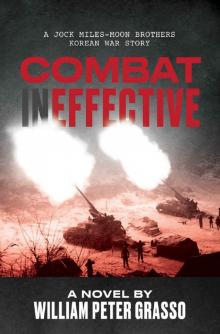
Combat Ineffective
A Jock Miles-Moon Brothers
Korean War Story
Book 1
Summer 1950: the atomic euphoria of America’s WW2 victory still lingers; no man who has joined its postwar military thinks he’ll ever have to fight. The complacent American ground forces are ill equipped, badly trained, poorly led, and painfully unaware of just how combat ineffective they’ve become. That ineffectiveness becomes shockingly clear when they’re quickly overwhelmed by the North Korean People’s Army as it swarms across the 38th parallel to invade South Korea.
American units and their equally weak South Korean allies are forced into a headlong retreat that promises to end only after they’ve been pushed off the Korean peninsula and into the sea. It will take hardened WW2 veterans—proven, combat-effective leaders like infantrymen Jock Miles and “Top” Patchett, tanker Sean Moon, and his brother, fighter pilot Tommy Moon—to stem the rout and turn back the North Korean red wave.