All That Is Mine I Carry With Me, page 1
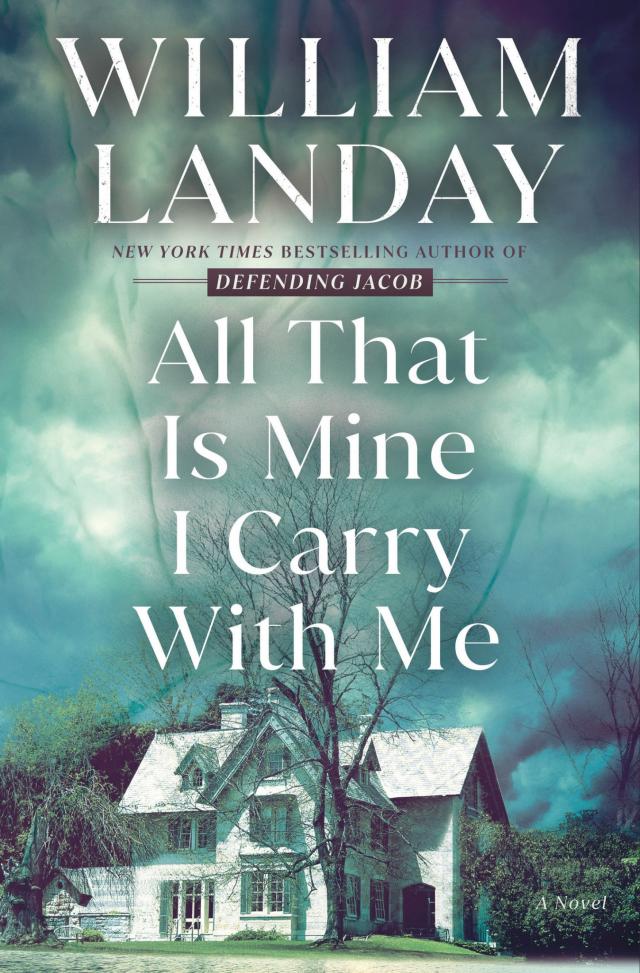


All That Is Mine I Carry With Me is a work of fiction. Names, characters, places, and incidents are the products of the author’s imagination or are used fictitiously. Any resemblance to actual events, locales, or persons, living or dead, is entirely coincidental.
Copyright © 2023 by William Landay
All rights reserved.
Published in the United States by Bantam Books, an imprint of Random House, a division of Penguin Random House LLC, New York.
Bantam Books is a registered trademark and the B colophon is a trademark of Penguin Random House LLC.
Hardback ISBN 9780345531841
Ebook ISBN 9780345531858
randomhousebooks.com
Book design by Diane Hobbing, adapted for ebook
Cover design: Carlos Beltrán
Cover image: Linwood Estate, Stockbridge, Massachusetts. Barry Winiker/Getty images
ep_prh_6.0_142781534_c0_r0
Contents
Cover
Title Page
Copyright
Book 1
Book 2
Book 3
Chapter 1
Chapter 2
Book 4
Chapter 1
Chapter 2
By William Landay
About the Author
_142781534_
BOOK 1
After I finished writing my last novel, I fell into a long silence. You might call it writer’s block, but most writers don’t use that term or even understand it. When a writer goes quiet, nothing is blocking and nothing is being blocked. He is just empty. I don’t know why this silence settled over me. Now that it’s over, I don’t like to think about it. I only know that for months, then a year, then two years, I could not write. It did no good to struggle; the more I struggled, the tighter the noose became. I could not write, then I could not sleep, then I could not bear my own presence and I began to think dark thoughts. I won’t dwell on the details; in my profession, there is a saying that a writer’s troubles are of interest only to other writers. I mention my silent period here only because it is the reason I wrote this book, for it was during this time, when I would have grabbed at any plausible idea for a story, that I got an email from an old friend named Jeff Larkin.
I have known Jeff since we were twelve years old. We met in September 1975 when we entered the seventh grade together at a very august and (to me) terrifying private school for boys, and we became pals almost immediately.
Let me say, I am uneasy about starting a book this way, with friends and confessions about my childhood. I am not nostalgic for that time in my life. I’m not even sure an honest account is possible. I do not trust my own memories. I tell myself so many stories about my past, as we all do. Worse—much worse—I don’t think a writer ought to insert himself into his stories this way. It generally distracts more than it deepens. A writer’s place is offstage. But what choice do I have? If I am going to tell this story, there is no way around a little autobiography. So:
When I was in sixth grade, my teacher called my parents, out of the blue, to suggest I was bored at school, which was certainly true. Had they considered sending me to a private school? Someplace rigorous and rules-y, where I would not continue to be (I will paraphrase here) a daydreamer and a smart-ass. My folks had never thought of it. They had both gone to public schools, and they presumed that fancy private schools were for Yankees. But Mom and Dad grasped the teacher’s essential meaning: what I needed was a swift kick in the pants.
So the next fall I found myself at a school that probably had not looked much different twenty or even fifty years earlier. There were no girls. There was a school necktie. Spanish was not taught, but ancient Latin was required. The gym was called a “palestra”; the cafeteria, the “refectory.” Portraits of mustachioed old “masters” hung in the hallways. There was a half-length painting of King Charles I gazing down at us with his needle nose and Vandyke beard, which alone might have cured me of daydreaming and smart-assery. Even my parents were dazzled and intimidated by the place. My mother warned me, “They smile at you, these WASPs, but I promise you, behind closed doors they call us kikes.”
Jeff Larkin felt no such anxiety when he arrived at school. He was a prince. His older brother, Alex, was a senior and a three-sport star, with the heroic aura that surrounds high school athletes. Jeff’s dad was well known too. He was a criminal defense lawyer, the kind that showed up in the newspaper or on TV standing beside a gangster, swaggering on about the incompetence of the police and the innocence of his wrongly accused client. There was a dark glamour to Mr. Larkin’s work, at least before the catastrophe, when his association with violent crime stopped being a thing to admire. But that came later.
Forbidding as the school was, at least I had a new friend. Jeff and I hit it off right away. We were inseparable. It was one of those childhood friendships that was so natural and uncomplicated, we seemed to discover it more than we created it. I have no adult friendships like the one I had with Jeff. I am sure I never will. Once we slip on the armor of adulthood, we lose the ability to form that kind of naive, unqualified connection.
But forty years later, when I got Jeff’s email in 2015, we had been out of touch for a very long time. He reached me by sending a fan email from my author website, just as any stranger would do.
“Hey,” his email read in its entirety. “Loved the book. Mr. K_____ would be proud.” (Mr. K_____ was a beloved English teacher.) “You up for a beer sometime?”
“I’m up for three,” I emailed back. “Or forty-three. Just name the place.”
* * *
—
The place he named was Doyle’s, an ancient pub in Jamaica Plain, now gone. It was a nostalgic choice. In our twenties, Jeff and I hung out there night after night, shooting the shit. The place had changed over the years. It was bigger and brighter now, more of a family restaurant than the grungy, patinaed old pub I remembered. But the long bar was still the same, and the ornate Victorian mirror behind the bartender.
When I arrived, Jeff was waiting at the bar. His hair was gray, and his face was fuller and more deeply lined than I had expected, but when he saw me and stood up, grinning, he became my old friend again.
“It’s the famous author, Philip Solomon,” he teased. “What an honor.” And we hugged in the clumsy, equivocal way men do.
For the next couple of hours, we drank and bantered as we always had. We picked up our conversation after twenty-odd years as if we had just seen each other the day before. I am a shy man, and I was particularly quiet during that hard time, but this night I yammered like a fool and I laughed harder than I had in a long time.
It was late, around midnight, when Jeff finally mentioned his mother’s case and the forty years of misery that followed. We had moved from the bar to a booth by then. His voice was low and confidential.
“You heard about my dad?”
“No.”
“He has Alzheimer’s.”
“Whoa. I’m sorry.”
“Convenient, isn’t it?”
“That’s not how most people think of it.”
“He gets to forget. Or pretend to.”
“You think he’s pretending?”
“I don’t know. Haven’t seen him. I get my information from Miranda.”
Miranda is Jeff’s little sister, younger by a year and a half.
“Miranda talks to him?”
“She’s taking care of him.”
I made a face: Really?
“She wants me to go see him. Before it’s too late.”
“So go. What’s the difference?”
“I wouldn’t give him the satisfaction.”
“He has Alzheimer’s. He won’t remember anyway.”
“That’s what Mimi says. She says it’s gone on long enough.” He put on a mocking tone: “I’m lost in the maze of hate.”
“The maze of hate? That’s a thing?”
“Don’t even—I can’t.” He shook his head. “Miranda.”
“It’s a good name for a band, Maze of Hate.”
“She says when I hate him, I’m only hurting myself.”
“That could actually be true.”
“Maybe. Doesn’t mean I’m gonna stop.”
“Attaboy. You stay in that maze of hate. Great decision.”
“You should call her, Phil. She’d love to hear from you.”
“Miranda? Nah. Well, maybe. I dunno.”
“Don’t worry, I won’t tell your wife.”
“That’s very considerate, thank you.”
He gave me a dopey drunk grin. “Maybe it’ll give you something to write about.”
* * *
—
Some background:
Jeff’s mom, Jane Larkin, disappeared on November 12, 1975. It was only a couple of months after Jeff and I started school, but I did meet Mrs. Larkin a few times. Looking back now, she does not seem to have left much of an impression on me. I don’t have compelling memories or revealing personal anecdotes about her that I can share with you. Probably, to my twelve-year-old self, she was like any other mom. Certainly there was nothing about her to suggest she was about to become a sort of celebrity, the Woman Who Vanished.
&
One photograph in particular sticks in my memory. It was a staple of the news stories. I presume the picture was provided by her husband when Mrs. Larkin first went missing. It was a formal portrait. Her body was angled, left shoulder forward, and she looked directly into the camera, as if she had just heard you come into the room and turned to look at you. The corners of her mouth were teased upward, her lips slightly parted, an expression that was not quite a smile. I see now, forty years later, that there was a sexy quality to this pose. That is why the newspapers liked it: that little smile was a come-on. Jane Larkin was only thirty-nine when she disappeared, and her attractiveness was an essential part of the story’s allure. It was a hammer that people could use to bash her husband when he became a suspect: How could a man with such a beautiful wife dare to want more? How could he presume to feel unsatisfied? Who did he think he was?
* * *
—
A few days after my dinner with Jeff, I did go visit his sister, Miranda. And, yes, I did tell my wife, though I described Miranda only as an “old friend,” a bit of husbandly understatement.
The truth is, when we were kids I had a devastating crush on Miranda Larkin. She was absurdly pretty. And somehow catastrophe only made her lovelier, left her with an irresistible brooding, damaged quality. She was two grades behind us in school but years ahead, one of those weirdly mature kids—a grown-up trapped in a teenage body. Brainy, a little actressy, unfathomably well-read. I remember once, when she discovered I was a reader, she asked me, “Have you read the Russians?” I was probably fourteen. I was not sure who the Russians were. It seemed to me there were a lot of Russians. My taste ran more to Alistair MacLean, Irwin Shaw, Robert Ludlum, Leon Uris—airport stuff. Suffice it to say, I have always been a little in awe of Miranda’s intellect. (And I have secretly dreaded her opinion of my novels.)
Miranda was also an artist, though it was never clear what kind. It seemed she could do anything. She played guitar. She wrote—stories, poems, even a novel while still in high school. She painted—landscapes, still lifes, abstracts, rarely people. She never worked at any of these things for long. She fluttered from one to the next like a bird in a tree, testing one branch after another. But she always struck me as the real thing, a truly creative temperament. I am not an especially creative person myself—more of a plodder, a grinder, a mechanic—so I have always envied Miranda’s instinctive, effortless creativity.
I lost touch with her around the time Jeff left for San Francisco, where he spent most of his twenties; he was the necessary link between us. So after a lapse of twenty-five years or so, I had to google “Miranda Larkin” to find out what she was actually doing. It turned out she was working as a photographer and a painter.
Her studio was located in a converted factory in Waltham. Outside, the building looked desolate, the sort of abandoned red-brick mill that you find all over New England. But inside, the place was teeming with activity. The lobby directory listed several painters and photographers, a sculptor, a metalworking shop.
Miranda’s studio was a single high-ceilinged room on the top floor, bright with sunlight from enormous multipaned windows. Don’t imagine anything romantic or picturesque, though. The studio was more like a hoarder’s attic. There was not much furniture: a battered oak desk with an enormous computer, a large worktable, one stool. And everywhere stacks of paper, mostly magazines and catalogues, a few books.
Standing amid all this mess was Miranda. She wore jeans and a baggy sweater. Her hair was gathered loosely in a topknot.
“Oh my,” she said. “Phil, you look exactly the same.”
“You do too.”
It was not true. She was still lovely, but there was an austerity about her appearance now. She had gotten very thin—too thin, I thought, for the girl I remembered. No makeup, no jewelry. You could still see the beautiful woman under all that Pilgrim plainness, you couldn’t help seeing her—high cheekbones, clear eyes, white teeth—but she seemed dulled, reduced, drawn. As a kid, she was radiant; not anymore.
I shouldn’t have been surprised, of course; she had simply gotten older, and the work of caring for her father must have been exhausting. It was just that, during the long lapse between visits, Miranda Larkin had never aged a single day in my memory. In my mind’s eye, she had always been sixteen years old (though she was actually older the last time I saw her). For a moment, but only for a moment, I even regretted seeing her and spoiling that vivid, precious memory.
She came over to give me a warm hug, just as her brother had. “My goodness, I’m happy to see you. I’ve missed you.”
I nodded. Like a lot of writers, I think, I am more reticent in person than I am in my writing. So I could not quite bring myself to say, as any normal person would, I’ve missed you too. What I said instead, keeping the conversation comfortably on the surface of things, was “I love your pictures. Is it okay if I look?”
I browsed the artwork that was around. There were maybe a dozen photographs—mostly black-and-white street scenes—but the more interesting ones were unframed canvases, which were propped against the wall. These I loved.
“Miranda, these are just—wow.”
The pictures mixed Miranda’s own photographs and painting with clippings she had found—magazine ads, news photos, headlines—in mixed-media compositions. I don’t want to claim too much for Miranda’s art; this sort of Rauschenberg-style collage is pretty familiar by now, and of course it is hard to be objective about the work of a friend. But to me there was something fresh and alive about it. The arrangements were built around one or two of her own photos at the center, usually black-and-white, usually of people standing on the street. The subjects seemed to have been photographed without their knowledge. Their faces were hidden by slashes of paint or other clippings: swatches of fabric or newsprint, or little pastiches of old master paintings. They were not just decorative collages; they were portraits.
“Miranda, I’m speechless. They’re stunning. Really, really beautiful.”
“Thank you.”
“I want one. How much are they?”
She shrugged.
“More than a car?”
“What kind of car?”
“Ouch, never mind.”
“Well, they last longer than a car, so…”
“How do you get these pictures of people? Don’t they mind?”
“I don’t know. I’ve never asked.”
“They don’t know you’re there?”
“No.”
“How is that possible? Do you hide in mailboxes? Or behind a tree?”
“I don’t hide. I have a little trick.” She got a strange bulky box-shaped camera from her desk. “This is my secret. It’s a Hasselblad. Do you know these cameras?”
“No.”
“Come look.” She stood close and flipped open a little frame at the top. “This is the viewer. You hold the camera at your waist or your chest, like this, and you look down into it. So all you do is, you don’t face in the direction you’re photographing. I look down into the camera but I point it sideways, so the person I’m taking a picture of doesn’t know what I’m up to.”
“That’s it?”
“That’s it.”
“It’s not fair, tricking people like that.”
“Who said life is fair? Here, can I take your picture? For old times’ sake?”
“Absolutely not. You’ll put me in one of your paintings and I’ll wind up hanging in some dentist’s office.”
“I promise, I won’t.”
“Forget it. And I’m not falling for your little camera trick, either.”
“Fine.” She folded up the viewer on her Hasselblad and returned it to the desk. “Here, sit. You want anything? Coffee?”