

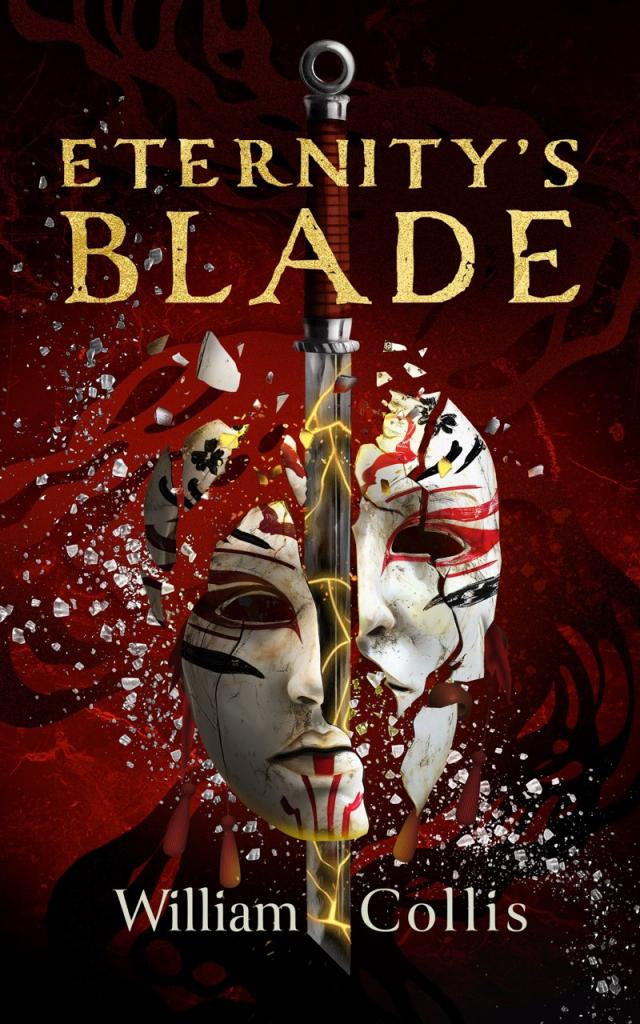
Eternity's Blade, page 1


Subscribe to our newsletter for title recommendations, giveaways, and discounts reserved only for subscribers.
Join here
Praise for William Collis
“A thrilling fantasy set in a unique world. You won’t be able to turn the pages fast enough.”
Cassandra Clare
#1 New York Times bestselling author
“Rich, complex, and tough—this is epic fantasy that will appeal to everyone.”
Lee Child
#1 New York Times bestselling author
“A unique and spellbinding novel. Eternity’s Blade is quite possibly the next Game of Thrones!”
Peter Olson
former CEO of Penguin Random House
BOOKS BY
WILLIAM COLLIS
standalone novels
Eternity’s Blade
nonfiction
The Book of Esports
Eternity’s Blade
WILLIAM COLLIS
Copyright © 2025 by William Collis
E-book published in 2025 by Blackstone Publishing
Cover design by Larissa Ezell
All rights reserved. This book or any portion
thereof may not be reproduced or used in any manner
whatsoever without the express written permission
of the publisher except for the use of brief quotations
in a book review.
The characters and events in this book are fictitious.
Any similarity to real persons, living or dead, is coincidental
and not intended by the author.
Trade e-book ISBN 979-8-8747-5776-2
Library e-book ISBN 979-8-8747-5775-5
Fiction / Fantasy / Historical
Blackstone Publishing
31 Mistletoe Rd.
Ashland, OR 97520
www.BlackstonePublishing.com
I dedicate this book to all my family:
past, present, and future.
Contents
I. The Valley of the Lilies
1. Murder
2. Ritual
3. Rot
4. Purpose
5. Training
6. Assassin
II. The Graveyard Of The Angels
7. Tomb
8. Marriage
9. Reprieve
10. Husk
11. Vengeance
12. Death
III. The Ocean of the Cloud
13. Awakening
14. Remedy
15. Surgery
16. Burial
17. Haven
18. War
IV. The End of Eternity
19. Demon
20. Mists
21. Qu’su
22. Feast
Epilogue
Acknowledgments
About the Author
Part One
The Valley of the Lilies
Chapter 1
Murder
“Hold the knife to my throat,” whispered the courtier.
Just like everyone else in the Valley, Prince Soh’shoro had never seen Death. To the boy, this was just another ritual of silk and rough salt, to bury meaning beneath monotony.
“Be firm and quick.” The courtier’s breath reeked of lilies. “I tire of repeating everything.”
And the boy, still trusting, drew his blade clumsily across the soft neck.
He didn’t understand what happened then. Why a great stain of miracle crimson seeped across the lilac finery. Why the courtier jerked, again and again, like a prayer strip in a sudden wind. Why the disembodied Voice screamed hideously, bringing his attendant, Kenwu, running, and then Obajen-mahoe close behind. And the lord snatched the boy prince into his arms, dragging Soh’shoro away from his first murder.
“What have you done, my son?” Obajen-mahoe choked out, eyes rich with silver tears. “This was supposed to be your secret.”
He fled with Soh’shoro swaddled like a precious gem. He ran higher and higher through the labyrinthine house, as if distance itself could cure the sin. Until at last he caught his breath on the great terraces, clutching the child against him as the two stared out across the entire world.
“Why don’t you understand?” Obajen-mahoe begged. “This is the Valley of the Lilies.” His arm swept across the Mist-thick hills. “Here there is no violence. No illness. No Death.” Obajen-mahoe’s voice dropped like a stone.
“And then there is you, Soh’shoro. And what you might do.”
The boy shivered as he listened, for even then he felt the terrible burden of the power that belonged only to him.
The Valley began with the Mists, their ashen veils parting on a knifing snow line shot through by hoary talus and rockfall. Arête ridges cascaded into moraines of ice and scree, lifeless save for lichens clinging weakly to the frozen slopes. Among these highest peaks the Qu’en Shards rose, mute sentinels against gray oblivion, their angular geometries and luminescent patterns clawing back the limits of the world.
Beneath, the Valley’s heights gentled into high scrubland. Here the taiga began, limber pine and black spruce rising hauntingly from the sparse landscape, unnaturally tall and majestically isolated. A little lower, and the forests deepened with elm and silver birch, ancient boughs tangling above bare yarrow and browning weed. Even here the Mists could reach on cold days, though, so settlements remained sparse: a disused shrine or an ascetic’s cave.
And then the basin of the Valley blossomed: great rolling plains of grass, shimmering as light on water, translucently splendid even in the dark. Streams that started high in the Valley’s walls pooled here, becoming rivers and ponds. Villages dotted these shores, and hamlets walled themselves into obscurity behind terraces of rice. And in the central depths spread the City, majestic and meretricious, silvered strings and lofted lanterns marking the last crèche of Man. The Mists were made here: starting skyward from the Emperor’s Mausoleum, then drifting over the Valley like an endless cloud before collecting against its distant peaks.
The lilies grew most thickly in the basin. By high summer, the whole Valley floor lay blanketed as though with snow. They choked away the laurels and the reeds, strangling ponds and paddies alike, until all that survived was the beautiful white of the lilies.
“We must never speak of this,” Obajen-mahoe commanded, splashing brine over Soh’shoro’s bloodied face and hands. The courtier’s gore ran off the prince’s skin in a languid trickle. “Death doesn’t come into the Valley. Understand?”
Soh’shoro nodded fearfully, as Kenwu patted him dry with devotional silks. The attendant then burned the same cloth in an open salt brazier, touching it only with the tips of his fingers.
“This can’t be a coincidence,” Obajen-mahoe remarked. “Not when the Onan’ji visits.”
“We can still keep this secret,” Kenwu countered. “The courtier was old enough for Rebirth. I will personally oversee Traders vanishing the body, so there will be no way the monk can know.”
“Of course the Onan’ji knows!” Obajen-mahoe snapped, tongue darting over his painted lips. “Ever since her passing, he’s stalked my son. This death is his doing.”
Lantern paper refracted colors like spilled inks across the lord’s face: amber and deep orange and teal. And in that beautiful light, Soh’shoro saw Obajen-mahoe’s tears, falling like gemstones against the iridescent patterning of his intricate double-sleeved robes.
“I’m sorry!” the boy gasped. “I didn’t know.”
And Obajen-mahoe hugged the panicked child.
“It’s not your fault,” he soothed, patting the grass charms woven through Soh’shoro’s hair. But his fingers clenched white with fury. And Obajen-mahoe pushed the child away suddenly, deciding.
“What is it, Father?”
“Stay here,” he commanded, before turning to Kenwu. “I’ll meet the monk alone in the salt shrine. You deal with the body.”
“Of course.”
“Don’t leave me!” Soh’shoro cried.
“I have no choice!” Obajen-mahoe snapped. “Be brave until I return.”
The lord threw the chamber door wide, stalking outside like a rising storm. Kenwu hesitated a moment. He turned to Soh’shoro pityingly, forcing a smile. Then he too vanished into the mazelike Quo’dai-ma House, locking the latch behind him.
Soh’shoro waited until he was certain neither could hear. Then he fell to the reed flooring, burying his face in the silt-stained cushions beneath his salt box. He felt the rubbery flesh of the courtier’s neck, the foreign warmth of his blood. He hadn’t understood. But he had chosen all the same.
And the Voice still whispered, like wind through an ill-fitting screen.
Go away, he begged. Not now.
The boy shut his eyes, pressed his fingers to his ears. Yet these whispers always accompanied violence and danger, growing only louder the more he fled to his inner world.
Please.
Always his mother’s voice. Always indistinct and indecipherable, more instinct than language. With each cry came snippets of her memories: a caress of veinless skin, a clash of crane-bright blades. Each impression compounded until Soh’shoro had no choice but to accept their warning. But safely locked in his chambers, what could be the threat?
The Onan’ji, the prince guessed. My father is in danger. He needs me.
Soh’shoro ran to the window, rolling up its reed blinds with practiced dexterity. Using them like a climbing anchor, he slipped onto the House’s ceramic eaves.
Countless times before, the prince had snuck out to watch fireflies and paint moons, so these heights held no fear for him. Instead, the thin air and chill breezes soothed him, distracting from the Voice with the grandeur of his Palace. The ringed citadel unfurled like a painted scroll: sculpted gardens and ritual homes of osmium and cryptomeria, threading miniature landscapes like beads on a birthing charm. Beyond the inner bastion, residences for base nobility and epoxy priests faded into the first blush of the Pleasure District’s floating lights. And always overhead, the great gray permanence, rising from the Mausoleum to smear away the sky, roiling ever outward to the world’s edge:
The Mists.
Soh’shoro’s entire life belonged within their hoary walls. To touch the Mists was to vanish. Or worse, to have one’s mind burned away like impure glass. Mostly they remained confined to the Valley’s distant peaks. But their roils could turn animal and alien, drifting with a will of their own. And the closer they came, the louder the Voice called, as if its source lay smothered in that silver oblivion. So the Mists marked the edges of Eternity, marking the boundary beyond which Death itself would not cross.
Two more steps, and Soh’shoro slipped through another open window and back into the grand halls of the Quo’dai-ma House. He landed soundlessly on its lacquered flooring, kneeling to catch his breath.
My father is close.
The boy ventured deeper into the reedy shadows of his House and its caseating splendor. Few servants stalked these inner halls. He passed only a solitary pair of courtesans, gossiping about the Emperor’s gossamer entombment. Soh’shoro flattened himself behind a jadeite urn until they passed.
Already he could hear Obajen-mahoe’s angry shouts ahead: “Never again, Onan’ji. Not in my House.”
Reaching the salt shrine, Soh’shoro pressed himself low against its latticed walls, sidling to avoid casting shadows through the upper paneling.
“All the same,” replied the monk’s voice, pale and heavy as icicles. “You refuse him the rituals. So what purpose does he serve your House? You will grant me what I ask.”
The boy reached a familiar tear in the mulberry paper. When he pressed his eye to the narrow gap, the rectory within sprang to life.
Pillars of bare wood glittered with Gi’en charms and tinted lanterns. Elaborate calligraphic myths covered the pulp walls: tigers and winter wolves, snakes and brilliant scorpions. Untold centuries had smoothed all the floorboards with countless polishings. And salt braziers smoldered everywhere, spilling their thick, acrid stench like quenching iron. Boxes and boxes of the white gold lay ready for processing on elevated, ceremonial bricks. Beside each container an angry needle gleamed, freshly blanched in lily water for lancing the cakes into dusty grains.
“You think your Order beyond Imperial law?” Obajen-mahoe countered fiercely. He stood directly in front of Soh’shoro, blocking his view of the monk. “Make whatever threats you want. The courts will never allow your Qu’su monks to steal my son.”
“The courts will have no choice.” The Onan’ji’s voice quickened, like a river’s current in the snowmelt of spring. “We Qu’su guard the Valley’s slumber. Gentle its Mists. Prevent Outside. And all this your child threatens.”
Soh’shoro pulled back from the paper tear, heart pounding. He had to see the monk who dared speak so directly to the lord of the Quo’dai-ma, without care for custom or station. He crept closer to the silk-screened door.
“You sent the courtier. Why?”
“Because I know what Soh’shoro did at his birth. But that could not tell me who lived free, the mother or the child.”
Reaching the doorjamb, the prince peered through its joisting.
The Onan’ji kneeled calmly on the rush matting, head half bowed as if in meditation. His garments were simple: cloth robes and wood-stilt sandals. But the monk’s hair fell in braided waterfalls of dyed silk, and his skin shimmered magnificently in the afternoon light, with an unblemished splendor, like polished gold.
“Soh’shoro is only a boy. Another Reborn flesh in the Eternal guardianship of our House. Nothing more.”
“I will tell you what the child is.” The monk smiled, slithering his head forward like a snake. “An Old Word we have almost forgotten.”
The Onan’ji’s legs unfurled, propelling him upright with unnatural rigidity. And now Soh’shoro saw what caused the monk’s mysterious golden skin. Every vein across his body had been pried free. In their place gleamed artless purity, crawling across flesh like miraculous rot. Even the whites of his eyes blinked without blood vessels, unblemished as summer lilies.
And those lurid orbs stared right into the doorway’s shadow, smiling at Soh’shoro.
“Death.”
The prince gasped.
Obajen-mahoe heard the boy’s cry, wheeling in disbelief at the intrusion.
“Don’t run,” the monk hissed, holding Soh’shoro’s gaze through the narrow jamb. “I hoped you would come.”
Obajen-mahoe threw open the door, seizing Soh’shoro by the shoulder. “Do not speak. Just leave and—”
“Bring him to me,” the monk commanded.
“No,” Obajen-mahoe spat back.
“Bring him. Or the Ang’soon will learn what their daughter must marry.”
Something in Obajen-mahoe broke. Kneeling, he whispered quickly, “Don’t do anything. Just be silent. This will be over soon.”
Holding Soh’shoro tightly against him, he displayed his heir before the monk.
“Quo’dai-ma-na-Soh’shoro. We meet at last.” The Onan’ji bowed deeply. “I am master of the Qu’su monks: the Onan’ji. Call me only by my station, for in service I forsook all other names.”
Nothing made a sound, save the cicadas chirping in the afternoon heat, and the thin trailing of the Voice, growling like a predator in wait. Coldly, the monk surveyed the boy.
“Death,” the Onan’ji repeated, savoring the syllable like a delicacy. “A forgotten thing, full of cold uncertainty. The Valley is permanent and everlasting. Everything you are not.”
The boy’s whole body coursed with fear. He shrank into Obajen-mahoe’s layered robes and their rough scent of cherry incense.
“You want to know, don’t you? What you really are?” Idly the Onan’ji drew forth a lily petal, chewing indifferently. A thin trickle of juice gleamed across his bloodless golden lips. “What our Corpse of an Emperor hides. All things are true to their nature, and yours is killing.”
“How dare you!” Soh’shoro’s bright eyes burned, running saline dye across his cheeks. His mouth ached with dryness. But still he stepped from Obajen-mahoe’s shadow. “You insult our courts! You threaten my father and myself! Get out!”
“Brave.” The Onan’ji sighed, golden face shifting, neither joyous nor bitter. “But bravery requires fear. And you are scared, are you not, Soh’shoro?” The Onan’ji folded his hands, as if unwinding a kite’s string. “Unlike any other in this Valley, you know terror and longing and passion. Because you are Death. And so you can die.”
The prince thought of the courtier, and the thrashing silence of that very morning.
“Watch,” the Onan’ji instructed.
The monk broke into motion like a surging wave, a salt needle already balanced in his palm. The heavy metal lanced cruelly, bright as a harvest moon. But Obajen-mahoe leaped forward, throwing Soh’shoro to safety. The monk’s strike pivoted, legs sweeping into a scissoring motion. Obajen-mahoe crashed to the floor, and the salt needle followed, driving for the throat, its sharpness glittering like starlight across a pond.


