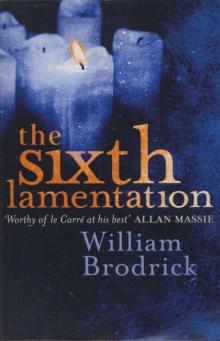
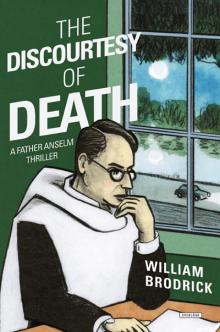
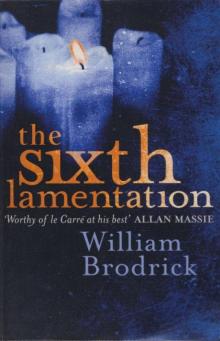
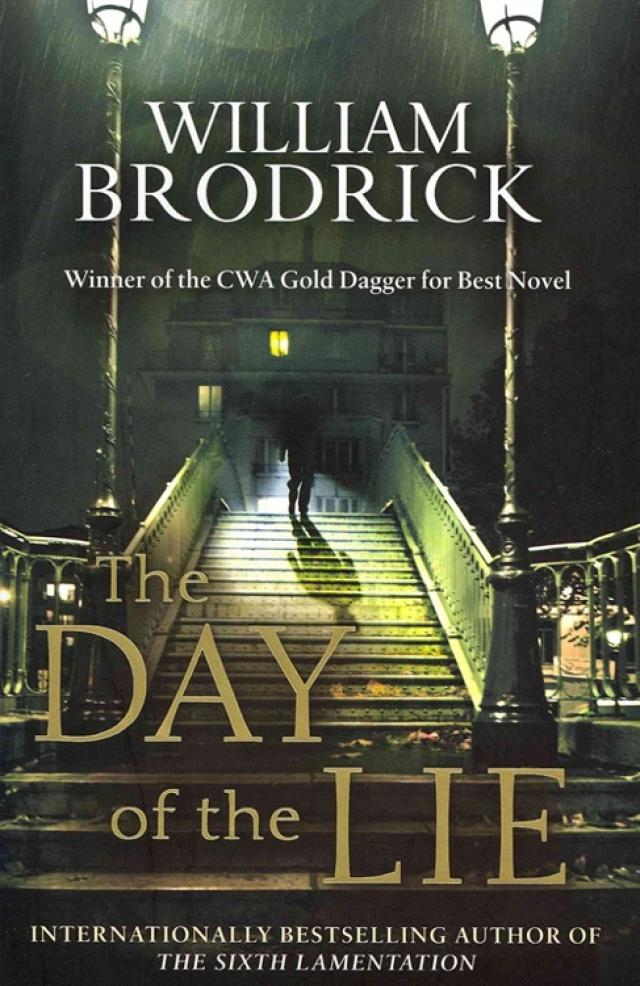
The Day of the Lie fa-4, page 23
part #4 of Father Anslem Series


‘It wasn’t me, Roza,’ he said, sinking to a chair, daring to place his hands on her arms. ‘I promise, I swear, it wasn’t me. I don’t know what they were doing there, I don’t know how they knew, I said nothing to no one, I’d never risk doing or saying anything that might have…’
She wasn’t listening. She stared ahead in a kind of trance, as if she were watching Celina’s film. Deep shadows like heavy paint lay around her eyes. John had never been this close before. He couldn’t help notice the fine hairs on her skin. She appeared at once innocent and fragile despite what she’d seen, despite what had been done to her, despite what she was looking at now.
‘Roza, I have friends… on both sides of the fence.’ John squeezed her arm, trying to get a reaction. It was like holding a bone from the butchers. ‘I can try and find out what went wrong. It’s my job, you know I’ll dig around and find out who-’
‘John.’ She spoke his name like it was a kind of slap to the mouth. Her voice crackled, strangely detached, unwired from the muscles round the lips. Harrowed and still in a stupor, she turned to John as if she’d fallen overboard, water framing her oval face, the hat, jaw and chin; her eyes wide with knowledge… knowledge of a life lived and a coming death. The mouth slowly opened, the skin of the lips seeming to tear across the centre. Her tone was dried out and paper thin. ‘John, promise me you will do and say nothing.’ She seemed to wait for a reply whereas she was trying to stay afloat. ‘Forget about the Shoemaker; forget about the Friends, forget about me: Then, not even noticing his beaten face, she turned away and drowned. She’d gone. There was no point in mentioning a passport.
John tiptoed out of the flat — a sort of reverential act to the body he was leaving behind. He crept down the stairs, hugging the wall.
‘How did she know the Dentist?’
The question echoed in the entrance hall. It tore at John all the way home. Had the Dentist said anything to Roza? Had he told her about CONRAD? Did Roza know what John had been doing? Of his place in the Big Game, his central place? The answers circled lazily like buzzards above carrion, black and distant, wings large and still.
John couldn’t get the key in the lock. Metal rattled against metal with his shaking. He knocked. Celina opened the door. Without looking, she walked back inside, dark against the light.
‘They won’t allow the film,’ she said, slumping on a chair by the dining table. Her eyes were bright and wet, her cheeks horribly black from the run of thick eyeliner. She’d given face paint a go. She’d gone out looking like Nefertiti. Now, she was… something from the Hammer studios. The bandages had been unwound and a curse unleashed.
‘I can’t take it any more, John.’ Her bare feet pointed inwards, her shoulders were low. A pink silk scarf had been wrapped into her hair. ‘My life has been cut into long strips. I want to be whole again. I want to be — ’ she dropped her head into her hands — ‘I don’t want much, I’ve never wanted much. I just want to be happy and free.’
John’s insides turned. He thought they might tip out on to the floor of his flat.
Do I love her? Or is it what she represents? She cleans me. She gives me tomorrow.
He looked at her narrow black jeans. Everyone else wore blue denim bell bottoms. Her toes were curled as if she were clinging on to a perch. He’d seen the nails that morning. They were coloured like a row of Smarties.
The telephone rang.
John made a start. But he couldn’t take his eyes off Celina. Her tears were dripping like rain from a blocked gutter.
The ring seemed to grow louder. Impatient. Angry.
John made a snatch for the phone, sending the console crashing to the ground, the wire tangled round his wrist. He yanked up the receiver and barked out some words — he didn’t know what he said, his eyes were still on Celina.
The announcement came after an offended pause. A few obvious details were confirmed first, but then the nameless functionary read out a text written by some other nameless bureaucrat. John sank to the floor, worked his wrist free and threw the phone as far as the wire would allow.
‘They’ve kicked me out.’
Celina didn’t react at first.
‘I’ve got two days.’
She sat up, turning around, one arm hanging over the back of the chair. She looked like a painting out of the Louvre, something unseen by Ingres, David or any of them. She was classical, offending and timeless.
‘My accreditation has been withdrawn.’ He was leaning back against the wall, hands loose in the gap between his legs. He wanted a beer. He wanted to be happy and free. ‘I’m finished. For collecting materials of an espionage character.’
He told her because it was going to come out. This was a fire he couldn’t hide. Now he was going to get badly burned. The masterpiece wasn’t moving. She was awfully still, terribly sad, agonisingly attentive: the watched and the watcher. He longed, desperately to crawl over to touch every brushstroke, feel every rise and fall in the impossible contours of her face, her arm, her hands, asking himself, ‘Is this real?’, but he daren’t move.
‘I can’t take it any more, John,’ she repeated. The black had reached her lips. The pink silk scarf had come loose and lay along one cheek.
She suspects nothing, thought John, coldly.
‘I’ve had enough,’ she said, with a brutal, hopeless finality.
The phrase turned in John’s mind like a light switch. Instantly he saw something odd. Anselm had used the very same words only recently just before John had come to Warsaw For some inexplicable reason — ostensibly for a jaunt — he’d brought John to a monastery in Suffolk. They’d gone up the bell tower. He’d looked down and said, ‘I’ve had enough.’
‘What of?’
‘Trying to find reasons.
‘For what?’
Anselm had just leaned on the stone ledge, four whopping bells behind his head, looking down at the dots of people on the ground — like Harry Lime in The Third Man, high up on the Ferris wheel in Prater Park. Only Anselm hadn’t got the eyes of a man cynical about the boundaries of pity… he’d been melancholy outreaching, vaguely desperate…
‘You’re not in love, are you?’
There’d be no reply.
‘Who is it? That ballet dancer? Your clerk? No… the jazz singer with the veils? Veil after veil will lift, but there must be veil upon veil behind?’
Anselm had just kept his gaze on the dots and the pink tiled roofs below Obliquely he’d muttered, ‘It’s like a stone in the shoe. Asking why it’s there doesn’t get rid of it. Chasing reasons is like…’
What had Anselm said? John couldn’t remember, damn it, but the message was clear enough: there’s no point in trying to find out why you love something… or someone… you’ve just got to get on with it, regardless of the implications.
‘Come with me,’ John blurted out.
Celina stared back, like Anselm had stared down.
‘Bring your film to London,’ mumbled John. ‘I’ve got friends. We’ll get it out in a diplomatic bag.’ She didn’t react. She just looked at him as if she were grieving. John made it across the floor and took the dangling hand. It was warm, the nails a dark purple, like mussel shells. He kissed each one, feeling the bangles against his forehead. ‘Please come with me.’ His eyes closed and he made a leap into the dark. He let himself fall, no longer resisting, knowing this moment had been coming ever since they’d first met to discuss art and resistance.
‘I love you,’ he said, for the first time.
John dialled 55876. Celina’s passport was organised for the same day Later in the afternoon, he tried to call back. He had to know if the Dentist had spoken to Roza about CONRAD; and he wanted to ask about the file… the file at the heart of their relationship. But it was too late. The line had gone dead.
Chapter Thirty-Seven
Anselm walked away from Father Kaminsky’s church like Roza had once left Mokotow prison: wondering where to go when he reached the junction. The collapse of his theorising had an immediate and profound effect: a loss of confidence in his judgement and the utility of Roza’s statement which finally showed itself for what it was — altogether useless. There were too many names on the quarterdeck. There was no way to allocate a stronger suspicion to one above another. Standing at the intersection a flood of irritation filled the void left by Father Kaminsky’s innocence: all he could do now was accuse someone. If they were guilty he might reach their conscience; if they were innocent, then they might be enraged enough to point the finger at someone else.
Half an hour later Anselm passed beneath an eagle on the elaborate entrance to Warsaw University. Neoclassical grandeur — rebuilt of course — was home to the one suspect likely to speak a language known to Anselm. Roza had watched him grow from boy to man; she’d never want him exposed for what he was. Having found a reception desk, Anselm passed over a name written on a scrap of paper. Moments later, the telephonist handed him the receiver. Anselm skipped any introduction and went straight to the point, opting for French, the idiom of intellectuals across nineteenth century Europe.
‘I’m in Warsaw to find out who betrayed Roza Mojeska in nineteen eighty-two.’
There was a very long pause, followed by ‘You are?’
‘I am. You could say I’m Roza’s representative. I thought we might talk through the circumstances of your sudden release from internment.’
‘You do?’
‘Yes, because the word convenient springs to mind.’
Anselm placed Bernard Kolba at sixty or so. He wore loose jeans, a black roll-neck sweater and scuffed suede shoes. His hair, chestnut brown and rimed with age, was short and smart. The felt hat in his hand evoked an artist rather than an academic philosopher. Without speaking he led Anselm to a car park and a yellow Fiat with a dinted passenger door. He seemed neither insulted nor troubled. In fact, he had the air of a man ready to talk.
‘I thought we’d go the Powazki Cemetery,’ he said, struggling with the ignition. ‘Lots of national heroes are buried in quiet out-of-the-way corners — heroes, of course, according to your convictions. It’s a good place to talk about the past.’
In that spirit of openness, he invited Anselm to say a little more of his mission. Anticipating reciprocity Anselm hid nothing of substance, recounting all that had taken place between John’s coming to Larkwood and Anselm’s departure from the church by the railway line, leaving out, of course, the distraction of the blue paper whose private character commanded Anselm’s continued confidence. He’d just about finished when Bernard parked and yanked the handbrake. Walking in step, they passed through another ornate gate to enter the graveyard where Roza had been arrested by Otto Brack.
‘I’m here to make an appeal to conscience,’ said Anselm, in conclusion. ‘Roza seeks an admission, freely made, without any preliminary accusation. Your thoughts on the matter would, I imagine, be instructive.’
Bernard nodded with appreciation, as if a professor in the law department had come up with a novel scheme to deal with plagiarism. He turned right, his hand guiding Anselm down a long lane flanked by carved angels, bare trees and a scattering of lit candles.
‘I used to think that it was my teachers who’d shaped my mind,’ he said, as if taking up the proposal raised by his learned colleague. ‘But it was Roza. As a child she told me the story of the Shoemaker and how he’d destroyed the red dragon with a homemade bomb.
Later she told me that words were more powerful than any explosion and that set me reading.’
The fairytale had led him to academic philosophy non-violent resistance, factory work, Union activism and, finally a return to the formal pursuit of wisdom. After the collapse of communism in 1989 he’d gone back to university and finished the studies which the government of another day had suppressed. Six years later he’d begun his career as a junior lecturer.
‘By and large my doctoral thesis set out the ideas I’d have published already if Roza hadn’t been arrested by the SB. They’d have appeared in Freedom and Independence. That’s why I wanted to meet the Shoemaker. To talk things out and get his guidance. In those days ideas weren’t kept in the academy they were running wild on the street. He was the giant on the block and I was the pygmy wanting to climb on his back and see that little bit further.’
Anselm had a rather depressing sense of deja-vu. The tenor of these winsome disclosures carried no hint of an impending declaration of guilt. Bernard’s conscience was evidently clear; but he was talking and moving with purpose.
‘I’ve always wondered why Roza just threw her hand in,’ he said, turning left. ‘She’s never spoken of that day to me or, as far as I’m aware, to anyone else. We’ve all been wondering why We’ve all been trying to figure out who tipped off the SB. Obviously it had to be someone close to her, someone she wouldn’t suspect: His hand directed Anselm to the right. ‘Someone like me, you might think.’
Shortly Bernard came to a halt. He looked around, gathering in a memory. ‘This is where it happened; this is where Roza was betrayed… at the grave of Prus.’
Bernard pointed to a large distinctive monument. A small girl, carved in relief, was reaching up against the stone. Her arms were spread out and her head was thrown back. At her feet were yellow and red flowers. A candle burned in a green glass jar. The surrounding trees seemed to reach out to the atmosphere of sadness.
‘Roza chose this place for a specific reason,’ said Bernard. His hands were in his pockets as if he were extemporising in a lecture hall. ‘She picked it because of the girl. She saw herself in those shoes.’
Like Prus, Roza had been a child soldier. They’d both joined an uprising; they’d both been imprisoned and never quite recovered. Prus
… he’d fought in eighteen sixty-three against imperial Russia. The succeeding experience of prison gave him lifelong problems with panic attacks and agoraphobia. He’d turned to writing, but couldn’t decide if resistance was best through ideas or guns.
‘Roza was scarred by Mokotow,’ said Bernard. ‘But she was always sure of the ground where the fight would eventually be won; in the mind and heart. Which is all the more significant now that I know of her husband’s execution:
He began walking away with that steady purpose, so Anselm followed, his intuition tingling with anticipation, undecided as to whether it was agreeable or not.
‘We’d all seen the two rings, we’d all wondered what they meant,’ said Bernard. ‘We’d all been stunned when she turned out to be linked to the Shoemaker. We’d all been baffled when she went silent in eighty-two — realising, with retrospect, that she’d done the same thing in fifty-three… and that the wedding rings were part of her silence.’ He slowed down and took a narrow pebbled lane to the left. ‘Roza is the most mysterious person I’ve ever known. Without speaking she was always crying out for help and I couldn’t do anything… I didn’t know how to reach her. So I’m glad you called. I’m glad, at last, for the chance to do something significant. I’ve waited thirty years for this.’
Bernard took off his brown felt hat and scratched the back of his head. He turned his face sideways to find Anselm.
‘You’ve heard of Mateusz Robak?’
‘Yes.’
‘He got close to Roza, too. He’s another man with a doubtful profile.’
There was a sliver of irony or sarcasm in those strong, hazel eyes, but the surrounding light carried a heavier regret.
‘We fell out, once, over a play by Mickiewicz,’ resumed Bernard. ‘And we nearly fell out again over Roza’s arrest. But he was a very careful man. And he had to be careful for Roza. So he followed her sometimes, even when she thought she was alone, just in case of trouble. So when I accused him of collaboration, like you accused me — though I failed to choose my words as finely as you did — he had a reply He brought me here:
Once more Bernard pointed towards a grave. The headstone was a fraction too tall, making Anselm think the incumbent had been given a straitjacket for eternity. He stepped closer to read the inscription. There was only a name and some dates: the barest elements of identification. No loving words had come to the husband’s mind. It read:
Klara Fielding
8th March 1925 — 1st July 1953
Anselm read the inscription several times as if more information might suddenly appear on the stone. This was John’s secret. He’d only told Roza. It was why he’d come to Warsaw.
‘A BBC journalist wanted to interview the Shoemaker,’ said Bernard. ‘Roza told Mateusz to arrange a meeting. When the guy arrived, Roza tailed him… and Mateusz tailed Roza. In turn, they came here, before convening at the agreed location as if nothing had happened. Mateusz thought nothing of it until much later, when Roza walked into a trap.’
Bernard had tracked down Klara’s family Not the English one, by marriage — they’d left the country — but the Communist Party members who’d come to Warsaw from Poznan after the war: her parents.
‘They were still fiercely proud of her memory,’ said Bernard, stepping to one side, moving his shadow off the grave. ‘Even though they knew nothing of her work for the state, they clung on to the fact that it was significant. That’s what the man in the dark suit had said at the funeral. He’d come round a week later with her medals, recognition from Warsaw and Moscow of her service to the people… difficult service.’
Anselm did the maths. ‘She was only twenty-eight.’
‘Yes:
‘What happened? She had a husband; she was a young mother.’
John, the child, had only just been born.
‘Suicide.’
Anselm breathed back the word.
‘She hung herself. But not in the garage or her bedroom. She chose an unguarded section of railings around the Ministry of Internal Affairs. Her parents didn’t know that, of course — it would have shattered the myth. And myths, even false ones, can heal if you believe in them.’