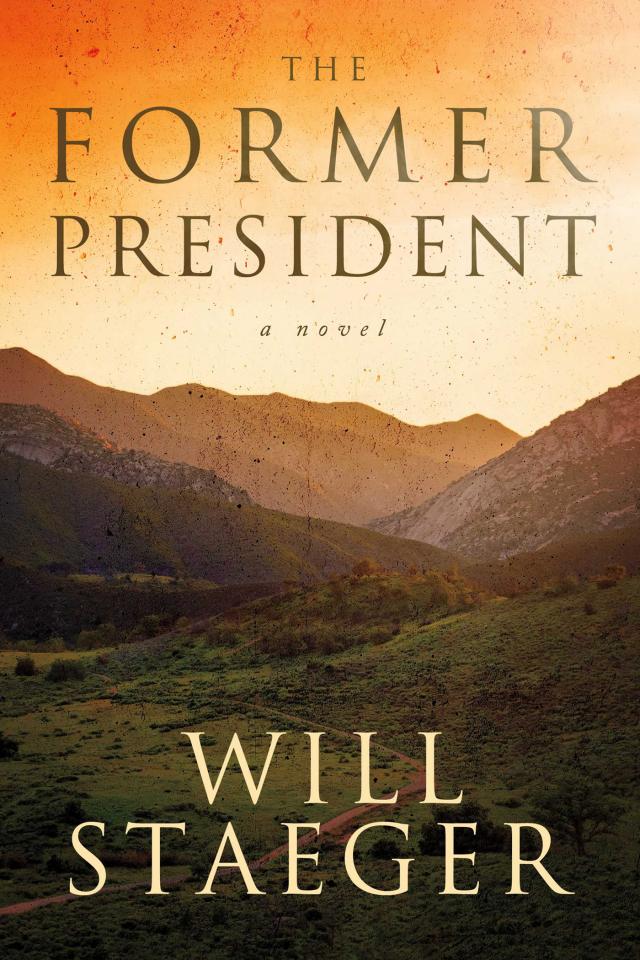
The Former President, page 1


This is a work of fiction. Names, characters, places, and incidents are products of the author’s imagination or are used fictitiously and are not to be construed as real. Any resemblance to actual events, locales, organizations, or persons, living or dead, is entirely coincidental.
© Copyright 2023 William H. Staeger, Jr.
Print ISBN: 979-8-35094-197-5
eBook ISBN: 979-8-35094-198-2
Contents
Part I: The Note
-1-
-2-
-3-
-4-
-5-
-6-
-7-
-8-
-9-
-10-
-11-
-12-
-13-
-14-
-15-
-16-
-17-
-18-
-19-
Part II: The Assassination
-20-
-21-
-22-
-23-
-24-
-25-
-26-
-27-
-28-
-29-
-30-
-31-
-32-
-33-
-34-
-35-
Part III: The Analyst
-36-
-37-
-38-
-39-
-40-
-41-
-42-
-43-
-44-
-45-
-46-
-47-
-48-
-49-
-50-
-51-
-52-
-53-
-54-
Part IV: The Container
-55-
-56-
-57-
-58-
-59-
-60-
-61-
-62-
-63-
-64-
-65-
-66-
-67-
Part V: Washington
-68-
-69-
-70-
-71-
-72-
-73-
-74-
-75-
Part VI: The Pest
-76-
-77-
-78-
-79-
-80-
-81-
-82-
-83-
-84-
-85-
-86-
-87-
-88-
-89-
-90-
-91-
-92-
-93-
for Tallulah
Part I:
The Note
-1-
Knees are shot. Can’t jog anymore, so I ride a bike. I pedal along the running trail, out where you get the icy pinpricks of sea spray plucking at your cheeks. The other thing you get is solitude, made possible by this wide berth between me and my Bozo detail. The latest duo rides along the road about a hundred yards inland, staying street legal yet keeping a view of their charge, while I get the Pacific all to myself.
My ride gets suddenly rough, and I look down to discover the front tire has gone flat. Pulling off the trail, I check my shoulder and observe that the Bozos have already spotted my predicament. I offer a lackadaisical wave to keep them at bay and watch as they dismount and hang tight roadside.
Being hyper-organized, I quickly intuit when my stuff is out of order, and as I unzip the spare-tire kit, I sense something is amiss. This is further confirmed when I find, buried beneath the backup inner tube, a folded slip of paper. This seems near impossible — I packed this kit myself at the counter of the bike shop, and the only people who’ve had access to it since were the Bozos, who know they’d catch hell if they touched my stuff.
Expecting to find nothing more than the words Made in China — a country-of-origin tag required by legislation bearing my signature — I unfold the compact white rectangle, which in turn reveals itself to be a full-size sheet of paper.
On it is a message addressed to me. It’s typewritten, the inconsistencies of the ink revealing that the text isn’t the product of a toner cartridge:
Dear Mr. President,
If anyone is watching you now, please hide this letter and read it another time in private. I apologize for this rude form of introduction, but I have no choice in the matter.
I turn to check on the Bozos. One of them is munching a banana. They’re watching — they’re always watching — but I can see they’re satisfied I’m keeping busy with the tire. I shield the letter with my body and read on.
I am in need of your help. Again, I apologize; it is not fair that I burden you with such a plea, yet the gravity of my predicament requires a degree of discretion held only by a man of your station. You probably won’t remember, but while you were in office, we met. It was only once, but in that one meeting, I remember sensing that I could trust you.
A thought comes immediately to mind: You’ve got the wrong president. I flip the bike, remove its front wheel, disengage the flattened tire from the rim and return to the note:
I recently began a job in Washington. It’s a position I’ve held before. In many ways my post is not significant, yet I work with powerful people. Mostly I am made to feel like a young woman working low on the totem pole of men’s power circles. Because of the access my job affords, I learned something I wasn’t supposed to learn. I was told to keep it to myself. When I refused, things began to spiral out of control.
I am contacting you because the people demanding my silence have attempted to ensure it by taking my child.
They kidnapped my daughter.
“Christ,” I say out loud.
Their conditions have been made clear to me: either I keep quiet and she stays alive, or I speak out, and she dies. I need your help in getting her back. And for the third time in this note, I apologize, this time for getting personal, but I hope you will understand my plea in the context of the loss of your own wife. I cannot lose my daughter.
Her name is Rachel Estrella. She is 32 years old.
I will contact you again with instructions. And please, no matter what — even if you decide not to help — please, Mr. President, you must never reveal what I have told you, or even that you have seen this letter.
Please destroy it immediately.
—Yours in distress
I hear footsteps on the rocks behind me and realize I’ve taken too long. I wad the paper, jam it in my mouth, and chew. It tastes faintly of bleach, but after eight or nine chomps and a painful swallow, it’s down the hatch. I’ve resumed work on the tire before the voice of the top man on my detail rumbles from behind me.
“Use a hand, Mr. President?” he says.
I turn and feign surprise. Wondering, as I do, why I’m playing along — the letter’s got to be nothing more than an ill-conceived practical joke by one of my friends, with the agents surely in on it.
“Took me a while to find the hole,” I say, “but it’s small, so I’ll be able to patch it. Save a trip to the bike shop.”
“Sorry?”
This sort of thing explaining why I refer to them as the Bozo detail.
“No need to buy another inner tube,” I explain, “since I’ll be able to fix this one. Right here, right now.”
Holding up the miniature tube of glue that comes with the patch-kit, I grin with the sort of enthusiasm encountered only in madmen. Considering I’m universally perceived to be exactly that — stark, raving mad — my little diversion isn’t exactly a stretch.
“Right,” the top man says.
He turns and marches inland, leaving me alone with the rubber cement, a dull pang of curiosity, and rapidly developing indigestion.
-2-
Rachel Estrella went missing in December — just over six months ago. Her husband and three-year-old daughter vanished with her, leading authorities in Temecula, California, where the Estrellas lived, to speculate on a range of causes far less felonious than might otherwise have been suspected. Three months later, portions of a body confirmed by a medical examiner to be Rachel’s turned up near Barstow. Cadaver dogs sniffed out the remains in a landfill just over the Nevada state line, one of the places we Californians pawn our mounds of waste. No suspect was identified, no warrant issued, no arrest made. Rachel’s husband and daughter are apparently still missing.
I learn this at Billie’s Smoothies, whose proprietress, a vegan triathlete, lets me partake of her store’s Wi-Fi while I sip specialty smoothies and wheatgrass shots. In addition to the fact that I find Billie herself quite appealing, doing my digital work on an iPad here — rather than in the state of self-isolation found on my guarded property — provides me at least a whiff of socialization. The Bozos wait outside, convincing themselves they’re being unobtrusive — the junior agent giving a strawberry smoothie a try; the top man, pacing curbside, actually smoking a cancer stick in front of a vegan health-foods shop.
The discovery of Rachel Estrella’s body could have been staged; I’ve been briefed on hundreds of conspiracies worse than this prior to pouring my morning bowl of Grape Nuts. But who would manufacture her discovery, presuming it was fake, and why? And if her discovery wasn’t staged, how could it be possible that the letter-writer, evidently a Washington insider, remains unaware that her daughter’s remains have been found? None of it adds up.
A number of tries in my search for the identity of Rachel’s mother come up dry. She doesn’t get any mention in the stories on Rachel’s disappearance, and there’s little to nothing on Rachel’s extended family in the stories I find. At one point a vigil was held outside her home, but even in the coverage of the vigil, no siblings, mother, or father were photographed or mentioned. Rachel’s case was a major national story and I now recall the buzz. Described as a former television producer who worked on everything from cable news programs to Ellen, she’d taken a career pause to raise her child, and hadn’t yet gone back to work at the time of her disappearance.
Billie sees me close the case on my iPad and approaches from her post behind the counter with a smile. I’ve known her a year or so, going back a few months before she opened this shop. Her arms are lean and freckled from many hours of exposure to the California sunshine. Her breasts are small, and she never seems to wear a bra. I think she looks damn good.
“When’s harvest?” she says. “I always forget. Is it next month? I’ve got my straw hat and plastic bin from last year, ready to roll.”
She’s referring to the tangled weave of Zinfandel vines I discovered after acquiring my property up the road. For the period that it captured my interest, I studied YouTube videos and abided by the proper viticulture procedures to get the vines back into production, at which point I inaugurated an annual tradition of recruiting local friends, Tom Sawyer style, to help harvest the grapes.
“It’s getting close,” I say, “but you’re still early. Two months out — maybe three.”
“And I’m still invited?” she says.
“Wouldn’t have it any other way. In fact, I’m looking for a new foreman if you’re interested.”
Her sun-kissed face scrunches into a pricelessly cute emoji of inquiry. “Aren’t you the foreman?”
“Exactly the point,” I say.
Her smile overtakes her face, causing a delicate web of creases to stretch from eyes to chin, and I’m not sure whether I imagine or detect a devilish spark in her eyes. This brings a rush up my spine, not for the first time in response to a simple look from the petite triathlete standing over me from behind the counter.
In the wake of what I like to call my long, strange trip – more on that later — it became necessary to choose a place to live, or hide, perhaps more than live, at the time. Over the course of my travels, I deliberately severed my roots, and the case continues to remain that nobody from either party will touch me with a forty-mile pole. Intending to keep things that way, I discovered Carmel-by-the-Sea, a well-heeled town overlooking the Pacific, and decided it would fit the bill. The weather is mild, the scenery is staggering, and enough artists and their hippie brethren remain — despite too much obscene wealth in the mix — for the place to retain at least some of its character.
At the tail end of my swing through town, a realtor pitched me a dilapidated three-bedroom Craftsman on eleven acres of scruff, and for just a million or two more than you’d expect to pay for the White House, I took it off the market. Foraging through my backyard a day after closing, I came across a weed patch so overgrown it resembled a two-acre geodesic dome. Dug a little deeper to discover the weeds were small trees, and finally that the trees were hundred-year-old, head-trained Zinfandel vines. Turns out I’d acquired one of California’s oldest vineyards along with my bungalow and its adjoining acreage.
Once the hobby fascination wore off, I contracted with a local vineyard management firm to help crush, ferment, and bottle the bounty, thereby providing enough cases of Zin to keep a good number of my friends awash in pretty decent wine. After a week-long second year of February pruning, I officially concluded I was overextended as a backyard gardener.
Rising from my stool, I push a fifty-dollar bill across the counter.
Billie eyes it skeptically.
“Hope you found what you were googling,” she says, “but fifty bucks is too much for a smoothie.”
“Not by much with your prices. But cheaper than a broadband subscription.”
“Despite your dreadful party affiliation,” Billie says, “you remain my favorite former president.”
I slip out into the Carmel sunshine, our typical swirl of morning fog diluting its shine.
-3-
Next stop, post office. Despite the likelihood of falling victim to a shooting at these joints and the organization’s ceaseless teetering on the precipice of bankruptcy, I prefer to personally place my letters in the U.S. Mail. And man do I send letters. It’s an old habit, developed long before the current obsession with snaps and Instagram posts. A habit only intensified by the events of my long, strange trip.
Arriving with my weekly stack of letters, I ask Harry, my favorite of the front-desk staff of three, to supply me with sufficient postage for each envelope.
“Morning, chief,” I say, as always.
“Morning back,” Harry says, as usual, with a wink, “Mr. Commander-in-Chief.”
I tell him that was a long time ago, and Harry says it feels like yesterday to him. I unwrap the rubber band from my stack and hand him the letters one at a time.
It’s between the eleventh and twelfth that I find the postcard.
It’s an alien in my native stack — I don’t send postcards, preferring at least the illusion of privacy. Yet there one rests. On its glossier side are four images, arranged in a grid: grapevine rows, harvest crews, a winery building, a general store. A caption adorns the bottom edge: Sonoma Valley, Wine Country USA.
I turn it over and see five words. There’s no accompanying return or destination address. The words are typewritten, just as with the patch-kit note:
I think she is here.
“Forget to finish that one, Mr. President?” Harry asks.
I look up, snapping out of it. Shake my head.
“Guess so. Old age, Harry — it’s getting ugly.”
“Tell me about it.”
I hand him the next letter, destined for Switzerland, and fold and pocket the postcard. He returns the stack of letters to me, now metered. I saunter to the First-Class Mail slot, knock on the wall, and peer through the opening.
“Lovely Rita,” I say. “You know nothing will come between us . . . ”
Presently a rich brown iris appears on the other side of the slot. Rita’s considerable cheeks blot out most of the fluorescent glow emanating from within.
“Anybody tell you you’ve got trust issues?” she says.
“I trust you,” I say.
A key clinks, the wall swings open a foot, and Rita thrusts her thick hand out. Rita is a woman who knows how to eat and cook. I know, because she had me over for Thanksgiving dinner last year, and she’s been up to my place a few times. Rita is black — one of the woefully low count of people of color you’ll encounter in Carmel, something that may yet keep me from settling here. She doesn’t even live in town — keeps an apartment in the Salinas Valley, a forty-five-minute commute away, and runs a catering business on the side to make ends meet.
“Hand ’em over,” she says.
I fork over my letters, thank her, and am turning to leave when Rita’s other hand appears, laden with a Tupperware container.
“Blueberry,” she says.
I seize the container of muffins. “You tow my heart away.”
“Yeah, yeah,” she says. “See you next week.”
I stroll out to my bike, folded postcard burning a hole in my pocket.
-4-
Every morning, under cover of darkness, a clandestine exchange happens in full view of the White House. At the prescribed time, typically 4 a.m. sharp, one agent arrives with a locked briefcase. A second is there to take receipt of the materials within, but only if he conveys the assigned code. Once he does, the briefcase’s contents are removed, passed to the second agent, and secured again inside a second locked case.
The item subject to this daily exchange is a document that, pound for pound, contains the deepest concentration of intelligence on threats to the national security of the United States. The document comes encased in a brown leather folder, unchanged since its first use in 1961, its cover embossed, in gold, with the words Top Secret. On every page within the folder, another layer of restriction is printed: For the President Only. Midnight briefings with the heads of every major U.S intelligence organization are held as part of the document’s creation, and there is no digital version archived.