How It Went, page 1


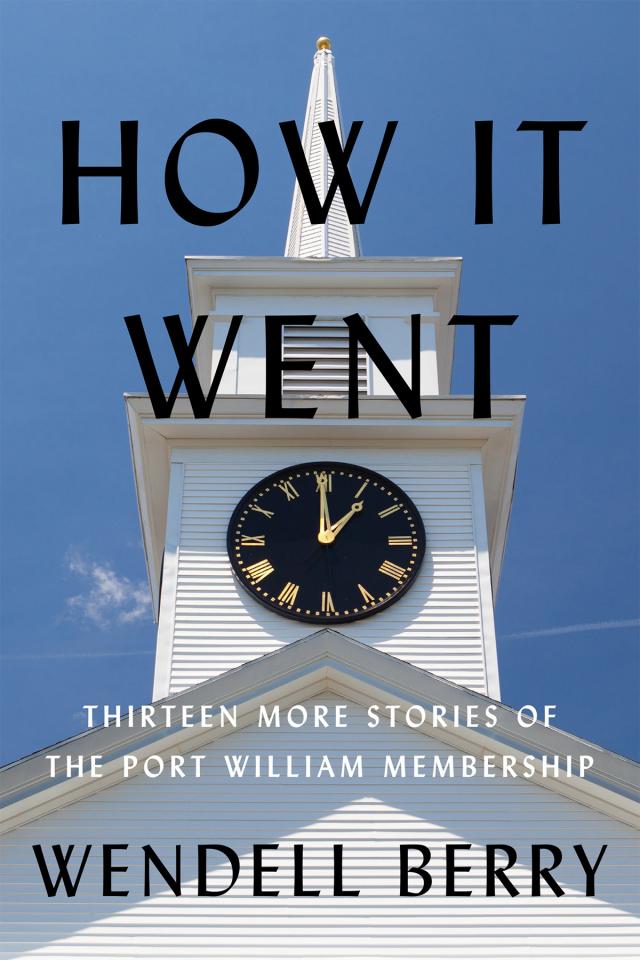
How It Went
This book is for Den—who defined my task:
“How to remember, and why”
—and for Billie
Contents
The Divide (V-J Day)
A Conversation (1943–2013)
A Clearing (1945–2014)
One Nearly Perfect Day (1946)
Time Out of Time (1947–2015)
One of Us (1950)
Dismemberment (1974–2008)
The Great Interruption: The Story of a Famous Story of Old Port William and How It Ceased to Be Told (1935–1978)
How It Went (1979–1994–2002)
The Branch Way of Doing (1932–2004)
The Art of Loading Brush (2015)
A Time and Times and the Dividing of Time (1944–2019)
A Rainbow (1945–1975–2021)
How It Went
The Divide
(V-J Day)
Andy Catlett is sitting on top of a post in the board fence between the back yard and the barn lot, ringing the dinner bell. He can hear the sound of it, dong after dong, flying away, rippling out in circles over the countryside, how far hearable he does not know.
He is facing westward, the now-fading sunset on the horizon beyond the Bird’s Branch hollow, and the world beyond, known to him only from maps in a geography book: California, the Pacific Ocean, its many bloodstained islands now quiet, and finally Japan that now to his supposing also is quiet. Distances and events that he cannot imagine are yet somehow present to his thoughts. In a thought that he will think for the rest of his life, he is sitting at the world’s center, sending forth in circle after circle around him the joyous clamor of the bell. It is August 15, 1945, and he is ten days past eleven years old.
Before supper he had been in the barn, leading and handling the filly foal of old Rose, his grandpa Catlett’s saddle mare. By portions of intuition and perseverance and portions of incomplete advice from his grandpa—“Don’t fight her. You can’t force her to agree with you. Mind, now, what I tell you”—and some help gently given by Dick Watson, he broke the foal to lead with a halter that Dick had fashioned for him from a piece of cotton rope. But now he had a real leather halter of his own, made by A. M. Naparilla in his harness shop at Hargrave. “That’s a Naparilla,” his grandma said of the halter as she presented it to him on his birthday, announcing the name, rare and famous in that country, as another kind of woman in a different place and time might have said, “That’s a Botticelli.” For the little halter was in fact a thing of beauty, a work of art, as the boy himself readily saw, though he did not know yet to call it “art.” Before he ever put it on the filly, he spent much time handling it and looking at it, seeing and feeling its lightness and strength, the elegant proportions of its supple leathers finely stitched, its shined brass hardware, its precise fitting to its purpose.
That evening, when he had returned the mare and foal to their pasture and started to the house for supper, he had heard suddenly rising and building in the town of Port William, too far away to be ordinarily heard from, an exuberation compounded of car horns, bells, and a shout compounded of many voices.
And so he ran the rest of the way to the house, to be met on the screened back porch by his grandma, whose eyes were moist behind her glasses, who said, “Oh, honey, it’s over. This terrible war has stopped at last.”
The public electric line by then had reached their place. She had heard about V-J Day on the small radio she had ordered from the catalog.
She was not a woman of high expectations. That human beings would by their sorry nature make war did not surprise her. She had been born when memories of the Civil War were still fresh, and she had borne, grieving in her thoughts, the wars that had followed, surprised by none of them, and yet knowing, as a woman of her kind and time would know, the cost in suffering and tears. And so when she spoke the word “war” she invariably added the adjective “terrible,” as if to call it almost courteously by its full name. She applied the noun, moreover, not to a series of similar but distinct calamities, but rather to a single calamity that, as she expected, reappeared from time to time. In her grandson’s memory of her, her sentence of just before the Christmas of 1941, “Oh, Andy, what of this terrible war that has come upon us!” seemed merely to continue in the summer of 1950: “Oh, Andy, we are at war again. It has come again.”
Falling so short as he did of her length of memory, Andy supposed only that the peace he had awaited with longing had finally come. So far as he was capable of feeling, he felt that it had come forever.
With the clamor from town still audible through the open windows by the kitchen table, he was not long at his supper. His grandmother, greatly moved by her thoughts, only picked at her food. His grandpa, by long habit concentrated on the place, its life and its work, conceded by principle, perhaps by defiance, no importance to the largeness of the world. While his grandma picked and lingered, gazing away, and his grandpa ate as ever with intense concentration and relish, Andy placated his hunger by cleaning up his plate as fast as he could. He then pushed back his chair and ran out again into the yard. The tumult at town was still in progress and he had to respond. He climbed onto the post-top and, seizing the bell rope, began ringing back to Port William and to all the world.
Without a thought of anything else in the world he might do, he rings the bell. In his little knowledge and great ignorance, he rings back to the celebratory ruckus in Port William and with a fierce gladness in his heart for the end of war and the beginning of peace. He will not forget his simplemindedness of that night, which joined him as if drunkenly to the equally singular elation that danced, drank, shouted, and sang itself away before dawn in Port William. He rings for the peace he dreams has come forever, for all the absent ones who now will come safe home.
That all who have gone will not come back, he knows, though in his joy, in the flightiness of his young mind, he is not thinking of them. He knows that his uncle Virgil, his mother’s brother, whom he loved and loves, who was reported “missing in action,” is now believed by the family to be dead, killed in what way, somewhere along the battle lines of the Bulge, they will never know.
Of such knowledge he knows more. He knows that his uncle Andrew Catlett, the loud-laughing, careless, unreckoning man whom he loved and loves, for whom he was named, was shot dead in a quarrel at Stoneport, several miles upriver from Port William, in the summer before.
Andy’s experience thus, at the beginning of his twelfth year, includes grief. It includes, intermittently for the time being, but also forever, awareness of the curtain, impenetrable by the living, before which they enact their lives. He has begun his acquaintance in the graveyard on the hill at Port William, a fellowship that by now, when he is old, far exceeds his acquaintance among the living.
He does not know the deaths that are to come, that will end his childhood. He has not begun the long growing up that will call him to the work that will be his to do.
He does not know the wars yet to come.
That his government, in ending the war, has again proved the willingness of some of his kind to do anything at all that is possible, he has after a fashion heard, but is far from knowing.
He is far from knowing that, virtually from that moment of rejoicing at the coming of peace, an industrial assault upon his home community and countryside, and upon such homeplaces everywhere, will now begin, and will continue into his final days.
And so ring the old bell, young Andy Catlett. Ring your ignorant greeting to the new world of machines, chemicals, and fire. Ring the dinner bell that soon will be inaudible at dinnertime above the noise of engines. Ring farewell to the creaturely world, to the clean springs and streams of your childhood, farewell to the war that will keep on coming back.
A Conversation
(1943–2013)
Andy Catlett’s grandma and grandpa Catlett had survived the hard times of their life—the depressions of the 1890s, the first decade of the next century, the 1920s, the 1930s—and had held onto their farm by a series of tight squeezes. This surely amounted to success, as the people of their kind and time and place would have reckoned it, but it was a success that rested upon a long discipline of economic minimums. They survived by the plentitude of their subsistence, which they took from their farm by their own skill and effort and that of their one or two hired helpers who shared in the same providence from underfoot, but they survived also by much abstention from the economy of money, much doing with less and doing without.
One of their luxuries at the time of Andy’s childhood was the coal pile in the barn lot from which they fed the large stove in the living room. Loaded with coal at bedtime, the stove gave warmth all night and quickly enlarged its radiance in the early morning. For the large iron cooking stove in the kitchen, wood was both a cheaper fuel and more versatile. Thick pieces of a heavy, long-burning wood such as hickory were fine for winter; in summer, lighter woods in smaller pieces burned quickly, to cook a meal without too much heating the kitchen.
And so, also in the barn lot and not far from the coal pile, there was a woodpile. The coal pile, which never changed except by getting bigger or smaller, was of no interest to Andy. But the woodpile was always changing. It was a work place, a place of transformation, and to Andy it was a place of never-ending interest. Some of the happiest times Andy spent with his friend Dick Watson were at the woodpile. Dick was Grandpa Catlett’s hired hand who belonged, as Andy knew, to the race once enslaved and still subservient in that country, but who in Andy’s consciousness had emerged from h is race and “place” completely as himself.
The trunks of trees would be gathered as they blew down or were felled in the woods or the fencerows, hauled to the woodpile, and ricked on the far side of the sawbuck and chopping block. To replenish the supply of firewood for the kitchen, the logs or poles would be lifted one at a time off the rick, placed on the sawbuck, and then sawed into stove-lengths, which either as splits or rounds would be piled on the near side of the chopping block to be carried as needed to the woodbox beside the kitchen stove. To split the larger chunks, Dick stood them or leaned them against the chopping block and drove his axe into the grain with hard, precise licks. The chopping block would be a substantial log that would be slowly chipped and fretted away as the axe struck through. Finally the thinned-down chopping block also would be laid onto the sawbuck and sawed into firewood. Except for the sawdust and the smallest chips, everything that went into the woodpile would be burned.
This work was ceaselessly varied. No two logs, no two poles, no two sawed chunks were ever alike. Each was a problem to be solved. Every pole, for example, had to be correctly placed on the sawbuck so as to lie steady under the saw. Every one of the larger sawed chunks presented a best place for the axe to strike, where the grain and the knots gave least resistance to the blade.
From time to time Andy would make a secret attempt to use the axe, but he lacked both strength and accuracy. As the men of the place would have told him, the work was above his breakfast, and he could not hit where he looked. But from the age of eight or nine, he was able to take one of the handles of the two-man crosscut saw. And this he had longed to do. The saw was sharp, its teeth well set, and Dick could use it by himself when he had no help, as he usually did not. He would stand erect in a sort of stopped stride, drawing the saw through the deepening kerf and pushing it back in short strokes with the skill and the perfectly submitted patience that the task required. But to Andy the unmanned handle seemed always to be asking him to take hold. And finally when he had become tall enough, or perhaps only eager enough, he took hold.
And then he began to learn the job. It was not as simple or as easy as it had looked. He learned first that his help could be a hindrance. If he pushed the saw, as in his wish to help he was much inclined to do, the blade warped and bound in the kerf.
And Dick would say, for a while he had to say too often, “Don’t push the saw, buddy.” Or, “Pull, but don’t push.”
If he bore down on the saw at his end, thinking to make it cut faster or just from weariness, that made it pull harder at Dick’s end.
And Dick would say, “Don’t ride the saw, buddy.”
Riding the saw could be maddening for one’s partner. People forbore to ride the saw for fear, as Andy would later learn when, as a bigger boy, working then not with Dick Watson: “If you’re going to ride, pick up your goddamn feet!”
But back then, in those old times at the woodpile, in his great patience, his endlessly tried and unending gentleness, Dick only said, until he seldom needed to say again, “Buddy, don’t ride the saw.”
When he worked at the other end of the saw, Andy wanted, as much almost as he would want his supper, to believe he was helping Dick, and perhaps he was when he worked well. He knew he was helping when Dick went to the kitchen with a big armload of stovewood and he followed with a smaller one.
Andy loved Dick Watson with his whole heart, and so it was fortunate for him that Dick was a man entirely honorable and upright. At that time Andy was far from the consciousness by which he might have formed and articulated a judgment, but he probably would not have loved Dick so much if he had not also looked up to him. His love was in large part a response to Dick’s kindness, but a part of it also was his admiration for Dick’s workmanship. He could see, when it was pointed out to him by his grandpa or his father, that Dick was a good workman, but Andy also was capable of seeing it for himself. Perhaps he was not always competently aware of what he was seeing, but it would have been plain to him that Dick knew how to work. He did not fumble at it. He never applied too much or too little force, but always just enough. He was never angry or violent in applying himself to a task or a problem. He was not a slacker. He did not hurry. Surely Andy would have loved him less if he had ever seen him slight or shortcut his work.
And Dick was one of the few teachers in Andy’s childhood that he did not at some time resist or resent. This certainly was because he loved and respected Dick, but it was also because they were chiefly friends. Dick taught Andy what he needed to know when he needed to know it. If Andy was determined to help saw the wood for the kitchen stove, then obviously he needed to know how to use the saw, and if he was going to learn, Dick would have to teach him, and Dick did. It was the same when Andy begged to drive the team of mules, Beck and Catherine, that were known as Dick’s team, and Dick finally handed him the lines. It was best for both their sakes then that Andy should handle the lines and speak to the mules in the right way.
“Tighten up on ’em, buddy. Not too fast. Take hold of ’em.”
At first when Andy would be turning the team, Dick would sometimes have to tell him quickly, “Not too short! Not too short! Straighten ’em up a little.”
And sometimes Dick would need suddenly to overrule whatever Andy was doing: “Whoa!” It was wonderful how instantly the mules obeyed when Dick spoke.
If Andy’s blunder had been large enough, perhaps dangerous enough, Dick would laugh out in ridicule and relief that it had not been worse. “Oh ho! You asking them to do what they know better than.” When he saw that the mules concurred in Dick’s bad opinion, Andy would feel three times embarrassed.
He was most seriously scolded one day when, as he saw, Dick was truly frightened for him. He was riding his grandpa’s saddle mare and he had urged her into an all-out run, which in the first place he had been forbidden to do, but then he rode her without slowing, hardly tightening the reins, straight over a steep bank. When he rode on back to where Dick had stopped his team, he met a stricture he had not expected or even, until then, known to expect.
“I saw what you did. She’d a stopped, the way I thought she might, you’d have kept right on, right over the top of her head. Long way to the ground, buddy. Would’ve hurt.”
He took thought then. He looked at Andy with a surprising, terrible gravity, for he had imagined what the boy had not. He said, “I reckon you don’t want to get killed. I reckon I don’t want to see you get killed. Oh ho, buddy, no sir!”
It was a moment, for Andy, of startling seriousness—a startling perhaps endearment, though he would never know what to call it. Dick had required him to imagine what he had risked, and he had imagined it. He knew two things. He knew he would not take at least that particular risk again. And he knew that the gravity of that brief time belonged only to the two of them. There would be no need for either of them ever to speak of it to anybody else.
And so their friendship was intimate insofar as they had acknowledged a seriousness in it to each other and to nobody else.
Endearments enough passed to Dick from Andy, whose mind then was unbalked and freely spoken. They may have passed the other way too, but from a mind by then, by its history, far more complicated, and old Andy, in strict courtesy to Dick and in hope of justice, allows himself no conclusions. And yet he wonders. Dick had of his own flesh no child. Did Andy in some way perhaps stand in for Dick’s never-existing actual son or grandson? “Well,” he thinks, “it is best to wonder and not know.”
It was a long conversation, long at least from the boy’s perspective, an eight-years-long conversation, kept up almost ceaselessly when they were together by Andy’s inexhaustible wanting to know, his always wanting to take part, and Dick’s enduring willingness to respond. Often Dick responded at length, remembering and describing in detail, because of the pleasure of being so intently listened to, or because of his own interest in what he had to say.
As he needed to, Dick instructed Andy in how to work, how to stay out of the way of somebody who was working, how to be careful. But sometimes he would turn the conversation to less welcome instruction. This would have to do with growing up, becoming responsible, and taking the right kind of care of things. Dick, it seemed, had looked ahead and seen, as the boy Andy did not wish to see, Andy Catlett as a grownup man with obligations and responsibilities. Perhaps Dick, in his good heart, felt for the boy the burden of that coming time and the burden of the boy’s unreadiness, and he assumed the duty of trying to warn him and somehow prepare him. He would hold up the example of Andy’s father, who was responsible, who had accepted the burden of the care of things: