*batteries not included, page 1


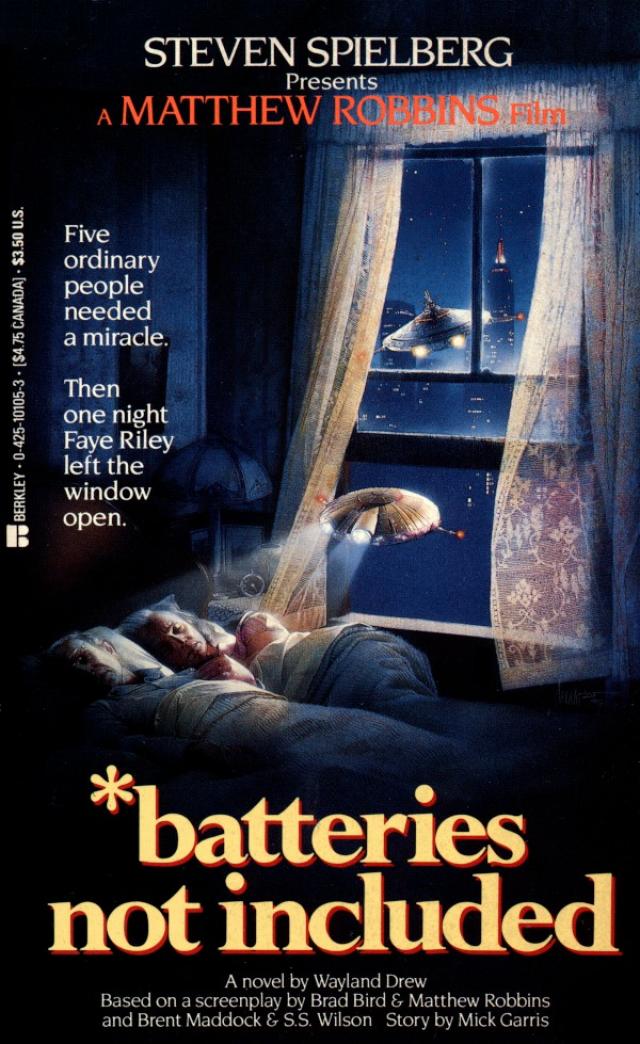
A novel by
Wayland Drew
Based on the Screenplay by
Brad Bird & Matthew Robbins
and
Brent Maddock & S.S. Wilson
Story by
Mick Garris
BATTERIES NOT INCLUDED
A Berkley Book / published by arrangement with
MCA Publishing Rights, a Division of MCA, Inc.
Copyright © 1987 by MCA Publishing Rights, a Division of MCA, Inc.
ISBN: 0-425-10105-3
First printing: December 1987
RetroReadingTime.com
1
Imagine passing over New York on a clear afternoon. Imagine seeing, in the Lower East Side, an area of devastation apparently no different from many others where the city is changing itself, demolishing buildings from other times and replacing them with glass towers. Imagine sensing something unusual about this site, dropping closer to reconnoiter, and discovering that the destruction is not quite complete. One old apartment still stands there, shocked and very vulnerable amidst the swirling dust, like a pine that has alone survived a hurricane in a forest. Most of its windows stare blankly out at the surrounding rubble, but a few have curtains. Incredibly, this building is inhabited…
From the several hats spread on her bed, Faye Riley chose the one Frank had given her in 1942.
They were young then and in love for the first time. It had been Easter when he bought it. He had a 72-hour leave before his carrier sailed, and he had looked so handsome in his whites. Those bell-bottoms! That hat! She had taken the whole weekend off work so they could be together, and she had never been happier. She remembered it that way — happy. But she also remembered crying that weekend, terrified that the ship would be torpedoed and she would never see Frank again. “I'll come back,” he said. “I promise. I'll come back!”
He had bought her the hat to make her smile again. He had laughed at first when she picked it out. “It looks like a bowl on a plate, upside down.” But when she put it on, he had stopped laughing. “Beautiful!” he said.
When the ship sailed, she had stood with other wives and sweethearts on the pier, biting her lip and trying to smile while she peered up into the sun above the camouflaged hull, far up to the superstructure where she believed she saw her Frank, a tiny, vulnerable human speck, waving.
He had come back, just as he said he would. They got married right away, and they had Bobby, and all these wonderful years together, with the cafe and all their friends.
“How many years?” A wrinkled and white-haired old woman spoke up from across the room, and Faye Riley had to wave and make a face to be certain she was looking into a mirror.
“Forty,” she said. “No, forty-five. No…” She couldn't remember exactly. It didn't matter anyway. What mattered was that they had been happy years. “Happy,” she said firmly, and the woman in the mirror smiled and nodded, yes.
Faye fixed the hat on her white hair and tied its ribbons under her wrinkled chin. It was still a beautiful hat. The mauve flowers had faded a bit and the wide brim was grayer and dustier, but it was still a striking hat. People stared when she wore it. Of course, people often stared at her no matter what outfit she was wearing. She would smile at them with grave dignity. Sometimes, young men cupped their hands and called at her from across the street, and she would nod to them even if she did not hear what they said, even if she did not recognize them as any of Bobby's friends.
She put on her pink bathrobe over her underclothes, found her shopping cart in the closet, and crept down the stairs and along the hall to the door, carrying her shoes. She could hear Frank talking to Sid Hogenson in the cafe farther down the hall, but she did not want them to hear her. They would stop her. They would call Muriel. Muriel Hogenson would take her by the arm and lead her back upstairs, saying it was time for her nap. Muriel would give her another of those wretched pills that always made her feel so tired. Senility, the doctors had said. Aggravated by shock. Faye grunted. What did they know!
Quietly she unbolted the door and tiptoed through the vestibule with her eyes shut tight. Smiling, full of anticipation, she opened the front door.
What would it be today?
Would it be 1925? Sometimes it was. Some days, East Ninth Street was exactly as it had been in her childhood, slow and colorful in the summer sun. Large-bellied men called to one another from the doorways of the shops. Aproned women laughed. Delivery boys swept past on bicycles. In those days, awnings adorned the street, and Faye would skip through their shade down to Majursky's to pick a two-cent licorice-pipe out of a tall glass jar. There were still cart horses then, and sometimes she would take sugar cubes from the bowls on the cafe tables and hold them out, flat-palmed, for the beasts to snuffle up with their velvet lips. In those days the street was alive with cheerful sparrows, drawn to the seeds in the horse droppings, and robins still tugged worms out of backyard grass. Sometimes, on her roller skates, Faye would glide around the end of a dripping ice wagon and find a blue-green splinter of ice, while the iceman carried blocks with his tongs and his horse whinnied to others pulling bread wagons, milk wagons, wagons heaped with scrap iron and rags. Sometimes in winter the street would be so slick with hard-packed snow that she and her friends could catch the tail of a passing wagon and skid along for blocks, holding on to one another like the laughing tail of a kite.
Some days when she escaped from Frank and the Hogensons, the street was like that. She would meet old friends she hadn't seen for decades, and she would run with them and skip, and play hopscotch just as if they were all eleven.
But what about today? What would East Ninth Street be like today?
Faye opened her eyes.
Ah! How wonderful! It was 1948, another favorite time! What a feeling there had been, then, with the war over and the boys back home, settling down. The street was a community then, one big family, and people helped each other as they do in families, without even thinking. If there was something you could do, you did it, and later the favor was always repaid in wonderful, magical ways.
At least, that was how Faye remembered it.
Her baby carriage waited at the bottom of the stairs. Carefully she carried Bobby down and tucked him in. Then she was off, a young matron, to do the marketing.
Behind her, music and laughter drifted out under the awnings of the cafe. In 1948, Rileys' Cafe was always full of people coming and going, talking and joking. Flirting. The neon Wurlitzer was always playing one of the Dorseys, or Artie Shaw, or Woody Herman, or a Glenn Miller tune that had meant so much during the war.
Some days after breakfast, or after lunch when most people had gone back to work, she and Frank would drop some nickels into the machine, watch the mechanical arms pick out the records, and then dance the slow dances in the little cleared space in the center of the cafe. They would dance cheek-to-cheek, and she would not have to stretch up on her toes, because Frank was short. Later there would be lots of other people dancing with them, but in the afternoons they would be all alone, with the world going past outside.
In the evening, other couples would come to Rileys', many other couples, and the residents of 817 East Ninth Street would come down to join them, and Marty Schwartz was always ready with his Graflex and flashbulbs to take pictures of smiling groups in the booths while the music played and played.
Such days!
Ecstatic, quite oblivious to reality, Faye Riley passed down East Ninth Street through a summer morning in 1948, proudly pushing the baby carriage with her infant son. All the way to the corner she waved to friends and neighbors, acknowledging with a graceful inclination of her head the gentlemen who raised hats to her, stopping frequently to allow the women to admire her fine son. How beautiful it all was! How full of promise!
She swept past the pharmacy on the corner of Avenue D and on towards Majursky's Market in midblock. Here again she stopped often to chat with friends, and here again she was overwhelmed with the soft beauty of it all — like a vision. Like a dream.
Only when she reached the place where Majursky's had once been did reality descend on her. Only then, when the shopping cart she was pushing bumped over some loose bricks and hit what was left of the concrete step did the soft visions of the past fade and the grim present replace them.
Majursky's was gone.
All that remained was the roofless shell of the building, with men in hard hats swarming over it, swinging wrecking bars. Where her old friends, Walt and Moira, had stood smiling so many years behind their counter, ready to help her, clouds of dust swirled, and wires dangled from shattered plaster.
Confused, Faye Riley stared at what was left of the building. She hated reality. She hated it when Frank led her to the cracked and grimy old window of Rileys' Cafe, and pointing to the devastation outside, said, “There it is, kid. That's today. That's reality.”
Now here it was, surrounding her, and she was all alone. Horrible!
Nothing was left of what she used to know. The old neighborhood was gone. Flattened. The cheerful little shops had vanished. The elegant apartments lay in ruins. Sidewalks where she had skipped and rolled her hoop so many years before were now cracked and heaved, strewn with rubble, clogged with mud from bulldozers. The folks from her girlhood were all gone.
“Gone where?” she asked aloud, stopping suddenly. “They must still be somewhere.”
But in their place were strangers indifferent to her, sweeping through this blighted place in closed cars, or grumbling along in trucks that hi ssed like fierce cats when they stopped at corners, or lurched across sidewalks. What was going on? Who were these people? Who was this old man washing in a dribble of water from a hydrant, straightening up to stare at her open-mouthed?
Who were those young men calling to her across the street, and that one with the moustache and the sleek hair, his hands to his mouth shouting, “Hey, Grandma, you need some help? You come see Carlos, eh? Come see the Crusaders. We help old ladies get where they gotta go.”
Why were they laughing?
Frightened now, Faye backed into the street, staring wildly around at what was left of the neighborhood. Rubble, that was what was left. Mounds of rubble, and trucks, and bulldozers, and a gang of workmen, with a crane in the midst of the devastation, erecting a huge sign with a picture of gleaming apartment towers: lacey plaza — elegance, convenience, security.
A truck rumbled towards her, its air horn growling, and she hurried back onto the sidewalk, staring at the sign and its looming vision of the future. Beyond the sign, across two blocks of rubble, stood the little old four-story apartment building with Rileys' Cafe on the ground floor. Bulldozers prowled around it like big cats, ready to pounce.
“Bobby?” Faye said. “Where are you?” She was quite lost in this new world, without bearings or certainties except that building: home.
Frantically she scrambled straight towards it around and over the heaps of rubble. Workmen shouted at her, but she paid no attention. Machines snarled around her, but she ignored them. Her empty shopping cart bounced along behind her. Her pink hat with the mauve flowers got knocked askew. She scraped her foot on the edge of a brick. “Bobby,” she said, beginning to cry the dry and silent crying of a forlorn old lady. “Oh, Bobby!”
At a corner table in the cafe, Frank Riley took off his glasses and brushed tears of laughter out of his eyes with a large checkered handkerchief. “Terrible, Sid! Terrible! ‘I remember your mane perfectly, I just can't recall the pace.’ What a line! Listen, it reminds me of the one about the guy who's way out in the country painting a church. Stop me if you've heard it. Guy almost gets finished and he runs low on paint.”
“Yeah?” Sid Hogenson leaned on the table, grinning, working a toothpick in the corner of his mouth.
“‘Damn it!’ fella says. ‘Now what am I gonna do? Too late to get more paint and only half a wall to go.’ Suddenly, an idea!”
“Yeah. Yeah.”
“Fella thinks to himself, ‘Hey, this is latex paint, right. Water-base. All I gotta do is water it down a bit. Spread it out.’ Get the picture, Sid?”
“Yeah.”
“So he does that. Finishes the job, and he's just walking around admiring it when the biggest, goddammedest thunderstorm you ever seen opens up right overhead. Pow! Bam! And when the rain stops, paint's gone. Washed clean off.”
“Yeah?”
“Every square inch! Poor guy claps his hands to his head. Says ‘Good God, now what am I gonna do?’ Big voice comes outta heaven. Says, ‘Repaint, repaint, and thin no more!’”
“Awww,” Sid Hogenson howled. “Terrible! Terrible! ‘Thin no more.’” He swatted the table so hard the empty coffee cups bounced on their saucers. “Listen, that reminds me of the one about the guys paintin’ the ceiling of a church. Big scaffolds, see. Stop me if you've heard it. Down below…”
“Stop.”
“You heard it?”
“No. I'm just gonna get us some more coffee. Hold on.”
Stooped a little, squinting through his bifocals, his big apron hanging loose since he had lost so much weight, Frank Riley started towards the kitchen with the two empty cups. At that moment, a six-wheel truck, rumbling past with a massive load of broken concrete, shook the whole cafe, jiggling the plates on their glass shelves, trembling the records in the old jukebox, and jarring several photographs on the walls.
“Dammit!” Frank shouted. “Goddammit! That's the fourth time today!” He set the cups down and shook a scrawny fist towards the receding truck. “What’re you tryin’ to do, knock the place down while we’re still here? Go ahead! That's what you'll have to do anyway!” He went over to straighten the photos. Old friends smiled at him out of dusty frames. There was Cy George the night he won the bowling trophy, and there was Emma Kowalski with all her friends the day she got her first bit part in the movies, and there he was himself, twenty-five years ago, working at the grill in his cook's tall hat. And there was Faye, Faye when she was still waitressing, looking so great in that starched cap and uniform…
“She's gone!” Muriel Hogenson thumped down the hall and into the cafe on the square heels of her sensible shoes. “I knew it! I knew it, goddammit! I turn my back for twenty minutes to do a little cleaning and what happens? She escapes! She gets past you!”
Frank peered over his glasses. “Cart gone?” Muriel nodded.
“Majursky's,” Sid said, getting up and hurrying after his wife, who was now headed out the front door of the cafe. “Don't worry, Frank. We'll bring her right back.”
“Don't worry! But what if…”
The little brass bell tinkled as the door slammed shut.
Frank rushed after them. His heart raced. He suddenly had trouble getting breath.
Outside, pale sunlight filtered through clouds of dust. To his left, the Hogensons disappeared into the now-empty lot where the twin building to 817 had stood until three weeks before. To his right, East Ninth Street stretched away past other buildings in various stages of demolition, empty of pedestrians. Across the street, to the south, the vacant lots reached right through the block.
Frank hurried up the steps of the apartment entrance next to the cafe so that he could see more clearly past the machinery, into the rubble heaps. Sure enough, close to the spot where a crane was heaving a giant sign into place, he saw a bobbing bit of pink. “Faye! Goddammit!”
He ran. He ran blindly across the street, aware only of that dot of pink that was the hat he had bought for his best girl long, long ago.
He embraced her when he got to her. He gathered her into his arms and drew her close and put his hand on the back of her white head, under the pink hat. “Faye, honey. Faye. For the love of Mike, where you been?”
“I did the marketing. Somebody's got to do the marketing.”
Frank stared at the empty cart, its wheels twisted from her journey through the ruins. Gently, still gasping for breath, he led her towards home. “That's great, honey. What'd you buy?”
“Nice melons. He had nice melons today. And he sends regards, Walt Majursky. He wants to know when Bobby's next baseball game is. He wants to bring all his family. He says he's never seen a pitcher…”
“Faye, there hasn't been a baseball…”
But she was calling, “Bobby! Bobby!” to the driver of a bulldozer parked right in front of the cafe, chief broom was painted in large letters across its flat back. The driver was a bulky man in a checkered shirt and faded blue nylon vest. He turned at the sound of her voice and tipped back his hard hat, grinning. “Bobby? Must be some mistake, ma’am. My name's Gus.”
“You got a nerve!” Frank shouted at him.
“Hey! Just comin’ in for a coffee, Pop.”
“Get it someplace else. Back it up! Clear off!”
The diesel roared.
“And be gentle!”
“Gentle,” Gus laughed as the immense cleats ground the asphalt to powder. “Sure.”
Another crack opened in the bottom of the window, zigzagging towards the faded gold lettering.
“Bobby?”
“He isn't Bobby, Faye. Just a guy with a warped sense of humor.”
“Maybe he's seen Bobby.”
“Uh-unh, he hasn't, honey. Come on now. Come on inside.”
Grimly the old man guided his wife into the cafe and sat her down at a table near the window. His hand trembled as he poured mugs of coffee for them both.
Faye sniffed. “I don't smell bacon. Is it Sunday, Frank? Monday and Tuesday don't smell at all because Cream of Wheat is instant, and it's not Thursday. I know that. I can smell Thursday all the way back to Wednesday when people put their garbage out. So… so… it must be Sunday! Sure! We got to walk in the park if it's Sunday!” She brightened up just as Sid Hogenson came in, red-faced and winded.