

Conditionally Human, page 1


17-07-2015
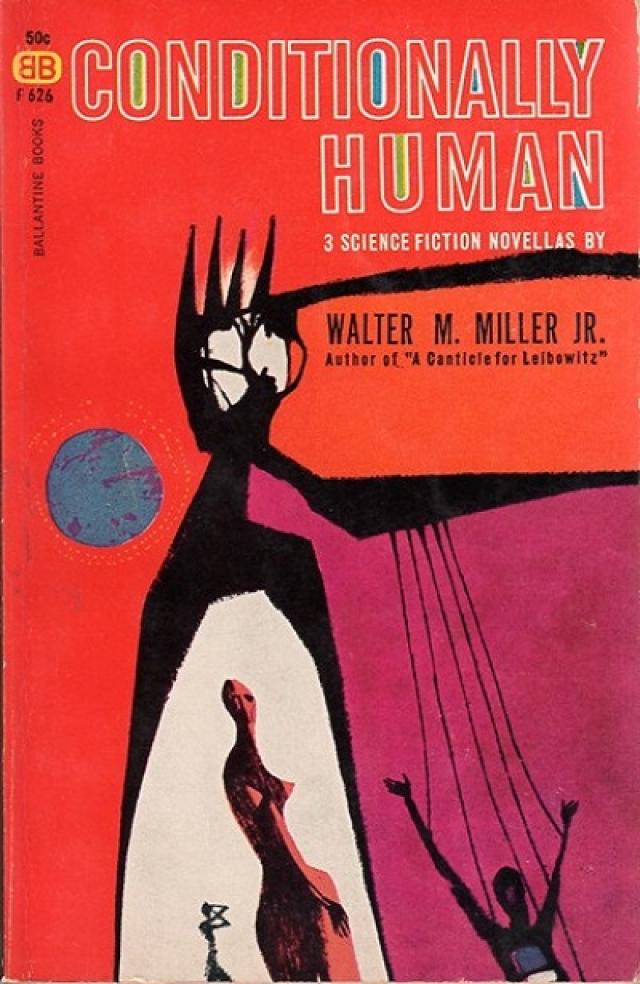
CONDITIONALLY HUMAN
3 Science Fiction Novellas
By
Walter M. Miller Jnr
A Ballentine Book
1962
Contents
CONDITIONALLY HUMAN
DARK BENEDICTION
THE DARFSTELLER
CONDITIONALLY HUMAN
He knew there was no use hanging around after breakfast, but he could not bear leaving her like this. He put on his coat in the kitchen, stood uncertainly in the doorway, and twisted his hat in his hands. His wife still sat at the table, fingered the handle of an empty cup, stared fixedly out the window at the kennels behind the house, and pointedly ignored his small coughings and scrapings. He watched the set of her jaw for a moment, then cleared his throat.
"Anne?"
"What?"
"I can't stand seeing you like this."
"Then go away."
"Can't I do anything—?"
"I told you what to do."
Her voice was a monotone, full of hurt. He could neither endure the hurt nor remove it. He gingerly crossed the room to stand behind her, hoping she'd look up at him and let her face go soft, maybe even cry a little. But she kept gazing at the window in accusing silence. He chuckled suddenly and touched her silk-clad shoulder. The shoulder shivered away. Her dark hair quivered as she shuddered, and her arms were suddenly locked tightly about her breasts as if she were cold. He pulled his hand back, and his big pliant face went slack. He gulped forlornly.
"Honeymoon's over, huh?"
"Ha!"
He backed a step away, paused again. "Hey, Baby, you knew before you married me," he reminded her gently.
"I did not."
"You knew I was a District Inspector for the F.B.A. You knew I had charge of a pound."
"I didn't know you killed them!" she snapped, whirling.
"I don't have to kill many," he offered.
"That's like saying you don't kill them very dead."
"Look, honey, they're only animals."
"Intelligent animals!"
"Intelligent as a human imbecile, maybe."
"A baby is an imbecile. Would you kill a baby?— Of course you would! You do! That's what they are: babies. I hate you." He withered, groped desperately for a new approach, tried a semantic tack. "Look, `intelligence' is a word applicable only to humans. It's the name of a human function, and . . . "
"And that makes them human!" she finished. "Murderer!"
"Baby—!"
"Don't call me baby! Call them baby!"
He made a miserable noise in his throat, backed a few steps toward the door, and beat down his better judgment to speak again: "Anne, honey, look! Think of the good things about the job. Sure—everything has its ugly angles. But just think: we get this house rent-free; I've got my own district with no local bosses to hound me; I make my own hours; you'll meet lots of people that stop in at the pound. It's a fine job, honey!"
Her face was a mask again. She sipped her coffee and seemed to be listening. He blundered hopefully on.
"And what can I do about it? I can't help my aptitudes. Placement Division checked them, sent me to Bio-Authority. Period. Okay, so I don't have to work where they send me. I could ignore the aptitudes and pick common labor, but that's all the law allows, and common laborers don't have families. So I go where they need my aptitudes."
"You've got aptitudes for killing kids?" she asked sweetly. He groaned, clenched his eyes closed, shook his head fiercely as if to clear it of a sudden ache. His voice went desperately patient. "They assigned me to the job because I like babies. And because I have a degree in biology and an aptitude for dealing with people. Understand? Destroying unclaimed units is the smallest part of it. Honey, before the evolvotron, before anybody ever heard of Anthropos Incorporated, people used to elect animal catchers. Dogcatchers, they called them. Didn't have mutant dogs, of course. But just think of it that way—I'm a dog-catcher."
Ice-green eyes turned slowly to meet his gaze. Her face was delicately cut from cold marble. One corner of her mouth twitched contempt at him. Her head turned casually away again to stare out the window toward the kennels again.
He backed to the door, plucked nervously at a splinter on the woodwork, watched her hopefully for a moment.
"Well, gotta go. Work to do."
She looked at him again as if he were a specimen. "Do you need to be kissed?"
He ripped the splinter loose, gulped, "See you tonight," and stumbled toward the front of the house. The honeymoon indeed was done for District Inspector Norris of the Federal Biological Authority.
Anne heard his footsteps on the porch, heard the sudden grumble of the kennel-truck's turbines, choked on a sob and darted for the door, but the truck had backed into the street, lurched suddenly away with angry acceleration toward the highway that lay to the east. She stood blinking into the red morning sunlight, shoulders slumped. Things were wrong with the world, she decided.
A bell rang somewhere, rang again. She started slightly, shook herself, went to answer the telephone. A carefully enunciated voice that sounded chubby and professional called for Inspector Norris. She told it disconsolately that he was gone.
"Gone? Oh, you mean to work. Heh heh. Can this be the new Mrs. Norris?" The voice was too hearty and greasy, she thought, muttered affirmatively.
"Ah, yes. Norris spoke of you, my dear. This is Doctor Georges. I have a very urgent problem to discuss with your husband. But perhaps I can talk to you."
"You can probably get him on the highway. There's a phone in the truck." What sort of urgent problems could doctors discuss with dogcatchers, she wondered.
"Afraid not, my dear. The inspector doesn't switch on his phone until office hours. I know him well, you see."
"Can't you wait?"
"It's really an emergency, Mrs. Norris. I need an animal from the pound—a Chimp-K-48-3, preferably a five year old."
"I know nothing about my husband's business," she said stiffly. "You'll have to talk to him."
"Now see here, Mrs. Norris, this is an emergency, and I have to have ...”
"What would you do if I hadn't answered the phone?" she interrupted.
"Why I—I would have—"
"Then do it," she snapped, dropped the phone in its cradle, marched angrily away. The phone began ringing again. She paused to glance back at it with a twinge of guilt. Emergency, the fat voice had said. But what sort of emergency would involve a chimp K-48, and what would Georges do with the animal? Butchery, she suspected, was somehow implied. She let the phone ring. If Norris ever, ever, ever asked her to share his work in any way, she'd leave him, she told herself.
The truck whirred slowly along the suburban street that wound among nestled groups of pastel plasticoid cottages set approximately two to an acre on the lightly wooded land. With its population legally fixed at three hundred million, most of the country had become one gigantic suburb, dotted with community centers and lined with narrow belts of industrial development. There was no open country now, nor had there been since the days of his grandparents. There was nowhere that one could feel alone.
He approached an intersection. A small animal sat on the curb, wrapped in its own bushy tail. The crown of its oversized head was bald, but its body was covered with blue-gray fur. A pink tongue licked daintily at small forepaws equipped with prehensile thumbs. It eyed the truck morosely as Norris drew to a halt and smiled down out of the window at it.
"Hi, kitten," he called. "What's your name?"
The Cat-Q-5 stared at him indifferently for a moment, uttered a stuttering high-pitched wail, then cried: "Kitty Rorry."
"Kitty Rorry. That's a nice name. Where do you live, Rorry?"
The Cat-Q-5 ignored him.
"Whose child are you, Rorry? Can you tell me that?"
Rorry regarded him disgustedly. Norris glanced quickly around. There were no houses near the intersection, and he feared that the animal might be lost. It blinked at him, sleepily bored, then resumed its paw-bath. He repeated the questions.
"Mama kiyi, kiyi Mama," it finally reported.
"That's right, Mama's kitty. But where's Mama? Do you suppose she ran away?"
The Cat-Q-5 looked startled. It stuttered for a moment. Its fur crept slowly erect. It glanced both ways along the street, shot suddenly away at a fast scamper along the sidewalk. Norris followed it in the truck for two blocks, where it darted onto a porch and began wailing through the screen: "Mama no run ray! Mama no run ray!"
He chuckled and drove on. A couple who failed the genetic requirements, who could have no children of their own, could get quite attached to a Cat-Q-5, but the cats were emotionally safer than any of the quasi-human chimp-K models called "neutroids." The death of a neutroid could strike a family as hard as the death of a child, while most couples could endure the loss of a cat-Q or a dog-F. A couple with a genetic "C" rating were permitted to own one neutroid, or two non-humanized models of daily food intake less than four hundred calories each. Most psychologists regarded the neutroids as emotional dynamite, and advised attaching affections to some tail-wagger with a lower love-demand potential.
Norris suddenly lost his vestigial smile. What about Anne? What outlet would she choose for her maternal needs?—for his own Social Security card was stamped "Genetic-C"—and Anne loved kids. He had been thinking in terms of the kennel animals, how she might direct her energies toward helping him take care of them, but now that her hostility was evident . . . well .. . su ppose she wanted a pseudoparty and a neutroid of her own? Of this, he disapproved.
He shuddered slightly, fumbled in his pocket, and brought out a slightly battered invitation card that had come in yesterday's mail:
You are cordially invited
to attend the pseudoparturition
and ensuing cocktail hour
to celebrate the arrival of
HONEY BLOSSOM
Blessed event to occur on
Twelveweek's Sixday of 2063
at 19:30 hours
Reception Room, Rockabye Hours Clinic
R.s.v.p. Mr.& Mrs. John Hanley Slade
The invitation had come late, the party would be tonight. He had meant to call Slade today and say that he and Anne would probably drop in for cocktails, but would be unable to get there in time for the delivery. But now that she had reacted so hostilely to the nastier aspects of his job, perhaps he had better keep her away from sentimental occasions involving neutroids.
The battered card reminded him to stop in Sherman III Community Center for his mail. He turned onto the shopping street that paralleled the great highway and drove past several blocks of commercial buildings that served the surrounding suburbs. At the down-ramp he gave the attendant a four-bit bill and sent the truck down to be parked under the street, then went to the message office. When he dropped his code-disk in the slot, the feedway under his box number chattered out a yard of paper tape at him. He scanned it slowly from end to end—note from Aunt Maye, bill from SynZhamilk Products, letter from Anne's mother. The only thing of importance was the memo from the chief, a troublesome tidbit that he had been expecting for days:
Attention All District Inspectors: Subject: Deviant Neutroid.
You will immediately begin a systematic and thorough survey of all animals whose serial numbers fall in the Bermuda-K-99 series for birth dates during weeks 26 to 32 of year 2062. This is in connection with the Delmont Negligency case. Seize all animals in this category, impound, and run applicable sections of normalcy tests. Watch for signs of endocrinal deviation and non-standard response patterns. Delmont has confessed to passing only one non-standard model, but there may have been others. He disclaims memory of deviant's serial number. This could be a ruse to bring a stop to investigation when one animal is found. Be thorough.
If allowed to reach age-set or adulthood, such a deviant could be dangerous to its owner or to others. Hold all seized K-99s who exhibit the slightest departure from standard in the normalcy tests. Forward these to Central Lab. Return standard models to their owners. Accomplish entire survey project within seven days.
C. Franklin
"Seven days!" he hissed irritably, wadded the tape in his pocket, stalked out to get the truck.
His district covered two hundred square miles. With a replacement quota of seventy-five neutroids a week, the district would have probably picked up about forty K-99s from the Bermuda factory influx during the six-week period last year. Could he round them up in a week? Doubtful. And there were only eleven empty cages in the kennel. The other forty-nine were occupied by the previous inspector's "unclaimed" inventory—awaiting destruction. The crematorium behind the kennels would have a busy week. Anne would love that.
He was halfway to Wylo City when the radiophone buzzed on the dashboard. He pulled into the slow lane and answered quickly, hoping for Anne's voice. A polite professional purr came instead.
"Inspector Norris? Doctor Georges."
Norris made a sour mouth, managed a jovial greeting.
"Are you extremely busy at the moment?" Georges asked. He paused. Georges usually wanted a favor for some wealthy patient, or for some wealthy patient's tail-wagger.
"Extremely," he grunted.
"Eh? Oh well, this won't take long. One of my patients—a Mrs. Sarah Glubbes—called a while ago and said her baby was sick."
"So?"
"No baby. I must be getting absent minded, because I forgot she's class C until I got there."
"I'll guess," Norris muttered. "Turned out to be a neutroid."
"Of course, of course."
"Why tell me?"
"It's dying. Eighteenth order virus. Naturally, I can't get it admitted to a hospital."
"Ever hear of vets?"
"You don't understand. She insists it's her baby, believes it's her own. How can I send it to a vet?"
"That's your worry. Is this an old patient of yours?"
"Why, yes, I've known Sarah since—"
"Since you presided at her pseudopart?"
"How did you know?"
"Just a guess. If you put her through pseudopart, then you deserve all the trouble you get."
"I take it you're a prohibitionist."
"Skip it. What did you want from me?"
"A replacement neutroid. From the kennel."
"Baloney. You couldn't fool her. If she's blind, she'd still know the difference."
"I'll have to take the chance. Listen, Norris, it's pathetic. She knows the disease can be cured—in humans—with hospitalization and expensive treatment that I can't get for a neutroid. No vet could get the drug either. Scarce. It's pathetic."
"I'm crying all over the steering wheel."
The doctor hesitated. "Sorry, Norris, I thought you were human."
"Not to the extent of doing quasi-legal favors that won't be appreciated for some rich neurotic dame and a doc who practices pseudopart."
"One correction," Georges said stiffly. "Sarah's not rich. She's a middle-aged widow and couldn't pay for treatment if she could get it."
"Oh—"
"Thanks anyway, Norris."
"Hold it," he grunted. "What's the chimp's series?" "It's a K-48, a five-year-old with a three-year age set." Norris thought for a moment. It was a dirty deal, and it wouldn't work.
"I think I've got one in the kennel that's fairly close," he offered doubtfully.
"Good, good, I'll have Fred go over and—"
"Wait, now. This one'll be spooky, won't know her, and the serial number will be different."
"I know, I know," Georges sighed. "But it seems worth a try. An attack of V-i8 can cause mild amnesia in humans; that might explain why it won't know her. About the serial number—"
"Don't try changing it," Norris growled.
"How about obliterating—"
"Don't, and I'll check on it a couple of weeks from now to make damn sure you didn't. That's a felony, Georges."
"All right, all right, I'll just have to take the chance that she won't notice it. When can I pick it up?"
"Call my wife in fifteen minutes. I'll speak to her first."
"Uh, yes . . . Mrs. Norris. Uh, very well, thanks, Inspector." Georges hung up quickly.
Norris lit a cigaret, steeled himself, called Anne. Her voice was dull, depressed, but no longer angry.
"All right, Terry," she said tonelessly. "I'll go out to the kennel and get the one in cage thirty-one, and give it to Georges when he comes."
"Thanks, babe."
He heard her mutter, "And then I'll go take a bath," just before the circuit clicked off.
He flipped off the auto-driver, took control of the truck, slipped into the fast lane and drove furiously toward Wylo City and the district wholesale offices of Anthropos Incorporated to begin tracing down the suspected Bermuda K-99s in accordance with Franklin's memo. He would have to check through all incoming model files for the six week period, go over the present inventory, then run down the Bermuda serial numbers in a mountain of invoices covering a thirty-week period, find the pet shops and retail dealers that had taken the doubtful models, and finally survey the retail dealers to trace the models to their present owners. With cooperation from wholesaler and dealers, he might get it down to the retail level by mid-afternoon, but getting the models away from their owners would be the nasty part of the job. He was feeling pretty nasty himself, he decided. The spat with Anne, the distasteful thoughts associated with Slade's pseudoparty, the gnawing remorse about collaborating with Dr. Georges in a doubtful maneuver to pacify one Sarah Glubbes, a grim week's work ahead, plus his usual charge of suppressed resentment toward Chief Franklin—it all added up to a mood that could turn either black or vicious, depending on circumstance.
If some doting Mama gave him trouble about impounding her darling tail-wagger, he was, he decided, in the right kind of mood to get a warrant and turn the job over to the sheriff.


