Pirate, page 1


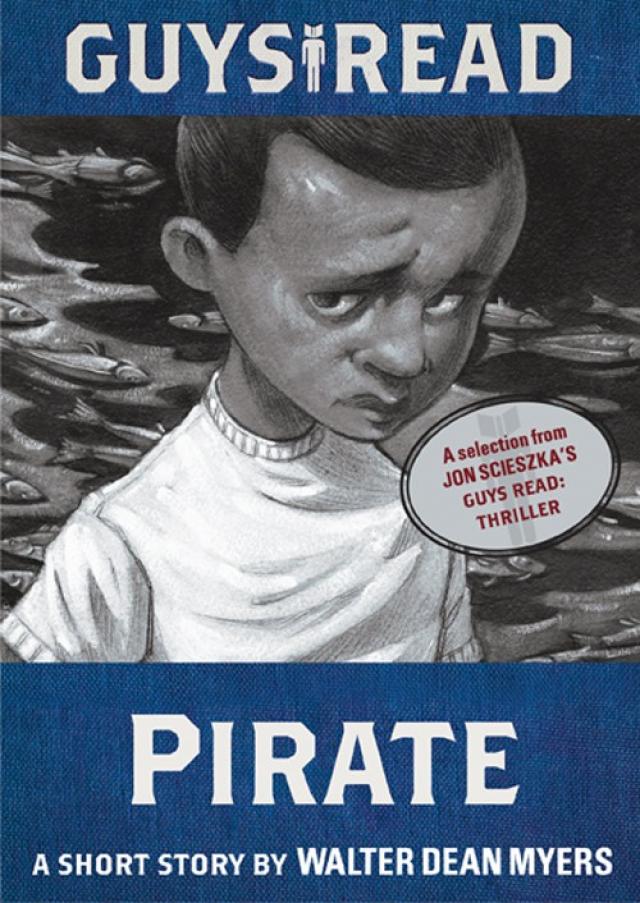
GUYS READ
Pirate
Walter Dean Myers
A Short Story from
Guys Read: Thriller
Edited and with an Introduction by Jon Scieszka
With Illustration by Brett Helquist
Contents
Cover
Title Page
Pirate by Walter Dean Myers
Guys E-Read
Biographies
Back Ad
Copyright
About the Publisher
Pirate
by Walter Dean Myers
My name is Abdullah Syed Hari. My great-grandfather was born in a gleaming white house just southeast of Marka. He was a fisherman who had worked those waters for all of his life. My grandfather, too, was a fisherman. His black hands were hard and the fingers twisted from years of pulling the nets into the boats, mending them in bad weather, and so full of salt that he could not feel my face except by turning his hands so that the backs would touch my cheek. My father’s gift was music and he played in the evenings after coming home from a day on the sea and the songs soothed me when I was a child. In the wars before I was born, clan against clan, friend against friend as Somalia tore itself apart, he was wounded and made cripple. I am Abdullah Syed Hari. I am a Muslim, the very servant of God. I am fourteen years of age. And I am a pirate.
My father tells me that when the first foreign boats came, our fishermen didn’t think much of them. But soon we saw that what they could do was far more than what we could do. We had boats and they had ships with huge nets that caught five times as many fish as our boats could even carry. Sometimes their steel ships would push our boats from the best fishing grounds.
“Their fishing boats could eat ours,” my friend Kambui said, “and still be hungry.”
This was certainly how it seemed to me. They came from Norway and Germany and Japan and from all the countries of the world beyond Somalia.
Other ships came, too. Sometimes they would drop barrels into the water, barrels mostly sealed, but some of them leaked a fluid that turned the water dark. Some of the fish off the shore began to die. They would float onto the beach, their bodies white and shining under the hot sun, until the tide left them to rot and for the gulls to eat.
Then the gulls began to die.
Obe Bashir Hari, my uncle, said that what we must do was plain for all the world to see.
“We have to fight back or watch our families starve,” he said. “They want to pretend that they don’t see us, but we must insist upon being seen.” This was what he said to my cousin and my father when he first became a pirate. When my father asked if I would go with them, my uncle looked at me and felt my arm.
“Yes,” he said. “The boy is old enough to fight. He should go.”
“They are polluting our lives,” my father explained to my mother. “They are making even our dreams dirty.”
My mother looked at me sadly and nodded. She had often spoken about how many boys from Marka had already gone.
“They have to take you young people to do the killing and the dying,” she said. “The rest of us are already too tired of it all.”
The evening that we left she put her hand on my arm and told me to walk with God. But even as she spoke she looked away.
Mussa Cali is nineteen years old and he is our leader. He is very black in color and also speaks well. He first went to war when he was sixteen and the enemy was the peacekeepers with their blue United Nations peacekeeper helmets. They had tried to stop the people from raiding the government food stores. The peacekeepers were beaten back but he had sustained a scar across his forehead that seemed to move when he was angry. Then he had teamed up with the Volunteers, who provided weapons when they were needed by anyone who attacked the foreigners. They also took part of whatever was taken. Mussa sometimes talks about how the foreigners have no business in our waters, but I know he is a pirate because he likes the money he gets. He has bought a motorbike for himself and for his uncle, who tears around the city like a madman.
This was my second trip. The first trip we got nothing because an American navy boat came up on us as we neared our target and we had to turn away.
Our boat, six meters long with two nearly new engines, was called Raqq al-Habib, after a song the owner liked. If we were successful we would paint it over and change the name before going out again. Our families came to the beach with us and kissed us many times before leaving. Then the guns were handed out and packages of cooked rice and spicy lamb. When I was handed a gun, my heart pounded in my chest. I told myself to look calm and I tried to think calm thoughts, but I knew I was close to shaking, I was so afraid. The men kissed Mussa on both cheeks and embraced us all.
“It’s good to see young warriors.” A man with a small stubble of a beard touched my head.
The Habib was a very special boat. It had a false tiller mounted on the back that had no real use and a wheel in the cabin. My uncle said that the tiller made it look like a slow boat but the twin screws would let it fly across the water.
I had a band of ammunition that was slung across one shoulder and that came down past my waist to my hip. My uncle showed me how to release the safety of the AK-47.
“You will know who the enemy is and where to point the gun when the time comes,” he said. His voice was higher than it was in the marketplace or when he sang at home. It was high and wavered and I knew that somewhere inside of him there was also fear.
I said a small prayer to God and told him that I did not want to die, knowing that if he could read my heart he already understood this. There were seven of us altogether, and I imagined seven prayers drifting to heaven.
Mussa let the boat drift without turning on the engines, watching the water lap along its sides, letting the strength of the tide rock us gently. It would be a weak tide, someone said. A weak tide on a dark night.
When satisfied that he knew the tide, Mussa turned on one of the engines. The Habib started off toward the middle of the gulf.
When I was young I used to sit by the old piers, sometimes on one of the pilings they used to moor large boats, and dream of a time when strangers came to Somalia in boats with huge masts and gleaming white sails cutting across the blue sky. My mother, with a smile in her voice, called me a dreamer.
“Everyone under cover except Abdullah,” Mussa said when we had reached a point where the tide was most affected by the opening to the gulf. I watched as the others crowded into the small cabin.
Mussa turned out the light and let the boat drift. I peered into the darkness but saw nothing except shadows that could have been only in my mind. Then, in a moment when the clouds parted and allowed rays of the dim moon to shine through the fog, I saw our target.
The yacht was twice as big as our boat, with a high cabin just ahead of the boat’s center. It was moving slowly through the fog and darkness, its wake barely troubling the water. I looked at my watch. Nearly midnight. The sidelights swept over us as it sounded a warning blast of its horn.
“It’s coming toward us, Mussa!” I called to him.
“Sh!” Mussa worked the false tiller to make it look like he was trying to turn away.
The fog was thin and I could see the sleek white boat slow and turn. There was a rail around the wheelhouse.
Brriiing! Brriiing! Its alarm sounded again. I looked at Mussa as he turned toward the yacht and shrugged his shoulders.
Brriiing! Brriiing!
The alarm sounded again and I could see someone in the wheelhouse moving. The yacht veered sharply to its right and I could hear the engine of the Habib rev up for a second, putting us at an angle as the two boats drew closer together.
“Watch it, you fool!” shouted a voice from the yacht. Our two boats were touching!
“Sorry!” Mussa cried. “Very sorry!”
The moment he said that, the first two men sprang from our cabin, crossing the small deck quickly and leaping up to the deck of the yacht. The next two followed immediately, screaming as they jumped onto the boat.
The white gleam of the yacht’s body was like a ghost as it lurched toward us. The sound of our machine gun sent a chill through me as our fifth man stood and shot just toward the radio mast. I looked toward Mussa and he signaled me to be still.
On the yacht there were nothing but shadows darting here and there. The shouts were sharp, almost like barking dogs. Mussa was on his toes straining to see what was happening. The man with the machine gun shot short bursts from his gun.
A long minute passed. And then silence.
“Completed!” Ahmed, a young man who fancied himself a good footballer, appeared at the rail with his forearm around the neck of a short white man.
We tied our boat to the yacht and we all climbed aboard it.
There were six people on the yacht, which was about fifteen meters long. As Ahmed pushed them down into the rear well of the boat, Mussa shined his light in each face. The first was the white man that Ahmed had brought to the rail. He was small and fat and his eyes rolled wildly as he tried to understand what was happening to him. Mussa had plastic ties, and spun the man around and bound his hands behind his back. Then he kicked his legs and forced him to the ground.
The next white person pushed to the deck was a woman, younger than the man and harder looking. When Mussa tried to turn her around, she spit on him.
Smack!
The blow stunned her. Her eyes widened and her mouth flew open.
Smack!
Now everything was gone from her and she sank to the ground. Mussa twisted her arms behind her and fastened them roughly. I heard her cry out but it was only for a moment and then she was still, bent forward, her face down. I looked away.
The next was a dark man with curly hair; he had been at the wheel and I thought he might be a Yemeni.
“What are you doing?” he called out.
Mussa hit him across the face and I saw that the blow left a smear of blood that came from under his nose and across his cheek.
The next person brought on deck was a girl. She was pale white, her blond hair falling down about her shoulders. Her whole body trembled as Mussa pushed her against the side wall.
Another older man was brought up and a young man who I thought probably worked on the boat as a helper.
Mussa sat on a bench and started going through some of the papers he had found. He went through the small stack, then turned them over and went through them again.
“What do you do for a living?” he asked one of the men. “Tell me quickly before I kill you.”
“I’m a news producer,” the man said. “I’m very sympathetic to you people.”
My uncle was already on his two-way radio talking to the Volunteers who had organized the raid. He told them that things had “worked out well” and that all was in order. My uncle spoke Somali, but the voice replied in Arabic to arrange the hostages quickly.
Mussa heard also and ordered the people from the yacht taken to separate rooms so they couldn’t speak to each other. The two men who I thought worked on the boat were taken to the engine room. The producer was taken to the galley. My uncle told me to follow him and took me and the girl to one of the cabins.
“Shoot her if she tries to escape,” he said in English. “Or if you hear any shooting anywhere on the boat, then shoot her, too.”
I saw her eyes widen and knew she was frightened. My uncle closed the door and she turned and looked at me, and then away.
The yacht was so beautiful. It was grander than my home or the home of anyone I knew. The wooden furniture was polished and gleamed in the soft light of the lamps. In the cabin I was in with the girl there was a narrow bed, a desk with books and pens, two cups, and a small statue of an elephant with its trunk up. I imagined the people sitting in the room smoking American cigarettes and having tea as they sailed. It was a life that was hard to imagine myself being in.
I knew what would happen next. Mussa would report everything to the Volunteers and they would decide what to do next. Maybe we would get into our boat and leave with whatever things of value we had found, or maybe we would hold the people for ransom. If we did that, we would be exposed on the water and it would be very dangerous. I felt my mouth go very dry. There was water in the cabin but I didn’t want to drink in front of the girl, to let her know that I was afraid.
From the rhythm of the rocking boat I knew the tide was changing. A long time before, when I first went to sea with my father, he would say that each changing tide was another chance to do well. I hoped that we would do well, that we would not have to shoot anybody. Mussa meant what he said about shooting people, but I also remembered what my grandfather said one night sitting by a fire.
“Human blood is heavy, and slows the feet of he who has shed it.”
I have never shot anyone, or fired a gun in anger.
The bed looked perfect, the way they do in movies, and I wondered what it would be like to curl up on it and fall asleep. Would my dreams be different? Would I feel more alive when I woke up?
“Do you speak English?”
The girl’s voice startled me.
“Yes,” I said.
“Are you going to kill us?” she asked.
“Maybe,” I said. It was unkind but I was more interested in myself than in the girl. I did not want her to die, but more than that I did not want to have her blood on my hands.
If we did kill these people, I knew all the boys in the village would ask me to tell them about it. They imagine taking a boat to be exciting and a happy thing to do. I did, too, until my uncle gave me the gun.
“My name is Erica,” she said. “I’m twelve.”
“I don’t care about your name,” I answered her.
She began to cry and I knew she thought we were going to harm her.
I hoped we would take what the whites had and leave as quickly as possible. Mussa would take the money and whatever else we found to the Volunteers, who would give us Somali shillings in return and make sure our passage back home was safe. If the Volunteers thought the whites were important enough for us to hold for ransom then it would be very dangerous, for someone might try to rescue them.
Two weeks earlier the Somalian accounts of the raid on a French boat said that French commandos had attacked aggressively, but that one of the hostages had been killed.
“The French have already killed one of the hostages,” they said on the radio. “They will think many times before doing that again because it was not very popular in Paris.”
But they did not mention the two men from our village who were also killed.
“I have to pee,” the girl said.
“I don’t care,” I said.
“Please!” She leaned forward, hunched her shoulders and crossed her thighs.
I didn’t want to call my uncle or Mussa because it would have looked as if I couldn’t make a decision. I went to where she sat on the deck and quickly moved her body around so that she was facing away from me. Then, putting my hands under her shoulders, I lifted her to her feet.
“What is your name?” she asked.
“Shut up!” I opened the door to the small bathroom in the cabin. There was a toilet and a sink. I had never had a toilet in my house. It was gleaming white.
I pushed her in and closed the door.
“You have to take my pants down!” She pushed the door open with her foot.
She was shorter than me by about two inches. Her gray eyes looked up at me and she still moved as if she had to pee very soon. “Turn around,” I said.
She turned and I took off the plastic cuffs. “If you try to get away I will shoot you,” I said.
I didn’t close the door completely but sat away from it, keeping my automatic trained on the framed rectangle. There was a design on the door that matched the statue on the desk. I listened to hear sounds of her peeing, trying to remember her name. It didn’t come to me but then I thought of what would happen if we were captured. Would she say that I had let her pee? Would she remember my face?
Suddenly the door to the cabin opened and Mussa came in. He looked around quickly.
“Where is the girl?” he demanded.
“She had to use the bathroom,” I answered.
He quickly opened the door and I saw her sitting there, both hands in front of her. Mussa reached in and grabbed what she had in her hand. A cell phone. She was texting a message to someone!
He jerked her out by the hair and sent her sprawling across the floor.
“Were you sitting on your ears? You didn’t hear me say to watch her?” he was shouting at me. “You have killed us, you idiot!”
Two steps was all he needed to cross the small cabin. For a wild moment I thought he was going to shoot the girl. Then I saw him draw back his rifle, holding it like a cricket bat, and start a swing. I turned and looked toward the girl but it was my face that received the blow. The pain shot through me and for a moment my senses reeled in an explosion of colors and confusion.
I was on the deck in so much pain it wasn’t bearable. It was all I could do not to cry out but I thought he might hit me again or even shoot me. My left eye didn’t open but with my right eye I saw that he was turning the girl over and was putting the plastic cuffs on her again. On the floor against the wall was her telephone.
Mussa was still yelling. I couldn’t distinguish what he was saying, but in a moment the door opened and my uncle came into the cabin.
“This fool let the girl make a phone call!” Mussa said, pointing the AK-47 at me. “Now we are dead. If the army is notified, we can’t go back to shore unless the Volunteers make a deal. No deal, and we will be shot like dogs right here on the water.”
My uncle looked down at me, and then he kicked me in the stomach. I knew he had to do that. The mistake was mine and I had to pay for it. Maybe later, if we all lived through this, they would decide to kill me anyway. My uncle had to show his displeasure.