

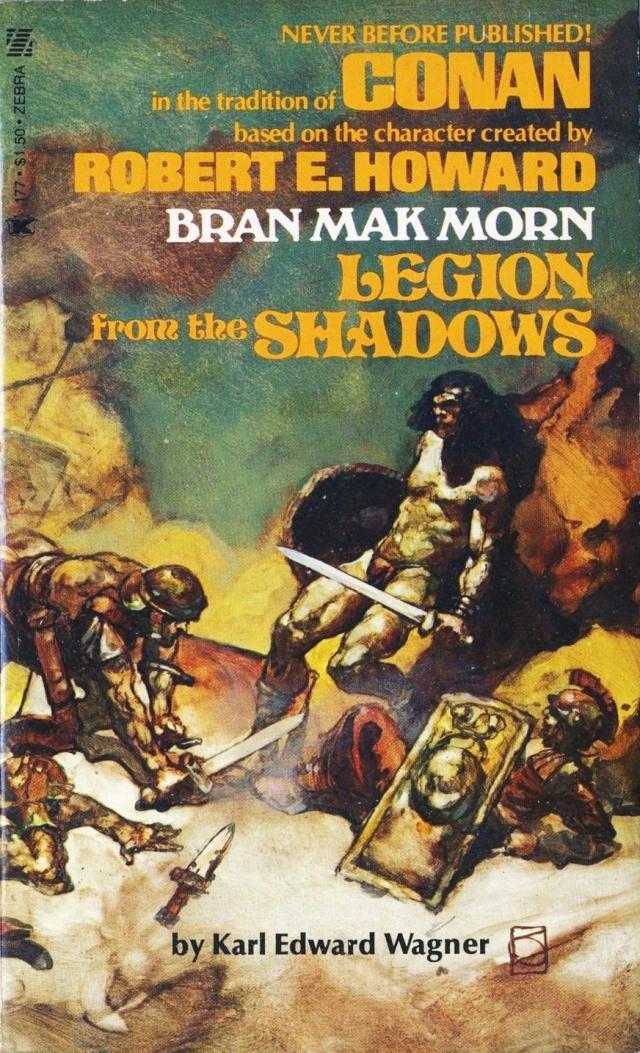
Bran Mak Morn: Legion from the Shadows, page 1


Dedication
To David A. Drake—
A Romanophile who doesn’t believe the Empire has fallen; who has been writing fantasy tales of Classical Rome these past ten years; and who furnished the historical data for this novel:
Noli elicere quid deponi nequitur...
Any man may look lightly into heaven, to the highest star; but who dares require of the bowels of Earth their abysmal secrets?
...Letter from Persil Mandifer: Manly Wade Wellman, Fearful Rock
Great holes secretly are digged where earth’s pores ought to suffice, and things have learnt to walk that ought to crawl.
...Necronomicon of Abdul Alhazred: H. P. Lovecraft, The Festival
Prologue
The sun that morning had shone sullen red through the mists that swirled above the ridges and moors. Now the sun that sank beneath the Highlands’ jagged rim burned a deeper red—as red as the blood that clotted across the trampled heath below. In the lengthening shadow fifteen thousand lay slain—skin-clad savage and armored legionary, Pict and Roman—their hacked and skewered bodies strewn wherever they fell.
Leaning on the shoulders of his chieftains, Othna Mak Morn, war chief of the Pictish clans, looked upon the field of carnage through dying eyes that blazed bright with triumph. An entire legion had died here today—a victory purchased life for life with Pictish blood. Rome had suffered its most crushing defeat on British soil, and Othna Mak Morn would not walk alone on the road to hell.
To protect Rome’s new province from the unsubdued tribes of the North, Emperor Hadrian had ordered the construction of a great wall across the breadth of Britain. Some eighty Roman miles it stretched, the Wall of Hadrian, across the Solway-Tyne isthmus—cutting the island in two with unconquered Caledonia to the north and the partially philoRoman tribes to the south. For years the legions had labored over ditches and earthworks, raising a wall of stone and turf some eight to ten feet thick and some fifteen feet in height, with fortlets for its garrisons at each mile along its length.
The Caledonian tribes made known their wrath over this hated monument of Roman conquest through countless raids and ambushes as the wall progressed. Their tactics were strike and retreat—a sudden storm of arrows amidst the sweating legionaries; sentries slain in the night and fires stealthily set; small bands of legionaries who marched across the moors and never returned. Their sudden, swooping raids were a constant and deadly harassment. The ponderous Roman military machine was too clumsy to overtake these savage guerilla bands who struck like adders and swiftly melted away into the heather—beyond pursuit into the Caledonian Highlands. But neither were the northern tribes powerful enough to mass a major offensive against the entrenched Roman legions, and withal the Wall of Hadrian inexorably rose to completion.
Yes, these murderous guerilla raids demanded reprisals from the might of Rome—some massive counterattack that would impress upon thick barbarian skulls the futility of their petty resistance against the empire that ruled the world. Thus came orders to Publius Calidius Falco, general in command of Legio IX Hispana, whose legion had at last completed its work on the turf wall sector: Advance north among the Caledonian tribes; lay waste to all crops and herds and villages on your march; slay all who stand before you.
And on one morning in late spring the Ninth Legion marched north of Hadrian’s Wall—six thousand legionaries and two thousand auxiliary cavalry, with slaves, women and children in the ponderous baggage train. They marched into the mist and the heather—and vanished from recorded history.
There was little resistance to the Ninth as its iron-shod march carried ever northward through the lands of the Brigantes, the Selgovae, the Novantae, the Damnonii, the Venicones, and others of the Celtic tribes. For how could half-naked barbarians dispute the advance of an entire legion? The barbarians had no towns to burn—towns were a Roman innovation in Britain. But such rude camps and settlements as they encountered, the legion put to the torch—looting herds and stored grain, destroying crops in the fields, slaying all who did not flee. On into the bleak Highlands of Caledonia, where dwelt a race of savages said to be far older than the barbaric Celts.
Calidius Falco had heard tales of the Picts, most of which he greatly discounted. They were blood enemies of the Celts, who feared them and in general left them alone in the fastness of the Highlands. Legends told that the Picts had been masters of Britain in forgotten centuries, before the Celtic invaders long ago defeated them and drove their survivors into the waste places of Caledon. The Picts were said to dwell apart in brutish savagery—a degenerate and ogrish residue of the Stone Age. There were many other dark rumors and legends that brought a sneer to Calidius Falcos lips. On occasion he had been shown corpses of squat, almost dwarfish warriors clad in fragments of crudely tanned fur and armed with heavy black bows. Such men were Picts, Calidius was told—but while he acknowledged their skin was a darker hue and their facial features almost apish, it mattered not to him whether such barbarian carrion was Pict or Celt.
What did matter to Calidius Falco were the persistent reports his spies and scouts brought to him concerning a substantial army of all the Pictish clans that was said to be massing in the Caledonian Highlands. Such reports twisted the general’s sneering lips into a ruthless smile. These barbarian fools were playing into his hands. Had they already forgotten the lesson Calgacus so bloodily learned not fifty years before in these highlands!
For many weeks the Ninth had been burning and pillaging through the heather. They had fought raids and skirmishes beyond counting—but nothing approaching a decisive engagement. Now at last their depredations were drawing the barbarians out of their lairs and mud hovels—luring them together into one great army of rabble that would be meat to dull sharp Roman swords. For it was not battle but butchery when poorly equipped and untrained barbarian armies met the disciplined legions in open battle. Had not Calgacus faced Julius Agricola with an army of thirty thousand barbarians? And had not Agricola left ten thousand barbarian dead on the slopes of Mons Graupius that day, with less than four hundred Roman dead? And in doing that he committed only auxiliary troops, with his legions standing idly by the watch!
Legio IX marched confidendy into the Caledonian Highlands to seek out, engage and annihilate this Pictish army. Calidius Falco felt no fear, for defeat was a chance so unlikely as to change his sneering smile to broad laughter. He was following in the steps of Agricola—and, after all, were not the Picts said to be even more primitive than the barbarians who had followed Calgacus? The Ninth would win a crushing victory, the Caledonian tribes would be subdued, and he, Publius Calidius Falco, would return, in triumph with the governorship of Britain a likely reward once reports reached Emperor Hadrian in Rome.
The Ninth had barely resumed its march that fatal morning when the dawn skies turned black with arrows, and Calidius Falco knew he had at last engaged the Pictish army.
At the moment the Picts attacked, the Ninth had been advancing along a mountain river whose narrow gorge pierced the Highland fastness. Well was it named Serpent Gorge, but guides swore this defile gave passage into the central Highlands where the Picts massed their army. Rain the night before left the rushing stream swollen over its banks, and footing was treacherous on still-damp boulders and slippery mud. Pressed between the walls of the ravine and the flooding stream, Legio IX was stretched out in a poorly ordered column. At the head, men with axes hacked away trees in an effort to clear a roadspace, while midway back cursing legionaries struggled to force the overloaded baggage train through the clutching tangle of tree roots, spiny gorse and rainslick boulders.
Somewhere in the heather beyond, scouts who should have given warning stared sightlessly into the mists that touched their upturned faces. The attack struck the Romans completely by surprise—and this time it was no sudden ambush and swift retreat. The hills swarmed with Picts, and Calidius Falco felt the chill touch of fear.
Since an attack on a column usually came from the rear, the legions marched with their baggage train in a protective position near the middle. Calidius had intended to build a summer camp in the Highlands, so that Legio IX was hampered with enormous quantities of equipage and paraphernalia, as well as the plunder they had taken on the march. Panic reigned as Pictish arrows struck the ponderous baggage train. Straining horses plunged and screamed, throwing all into disorder as deadly shafts cut them down. Men dashed about blindly—seeking in vain for cover from the hail of arrows. Wagons overturned, throwing screaming women and children onto the crimson-streaked boulders. In seconds chaos was master.
Already stretched out in a long and disordered array in order to pass through the deep gorge, Legio IX was suddenly cut in half by the hopelessly entangled baggage train in its center. Desperately Calidius threw his cavalry against the archers massed along the slopes above. In the steep-walled ravine their stirrupless horses were worse than useless, and in a matter of minutes the arrows of the Picts had annihilated the mounted auxiliaries. And now Calidius Falco knew his position was untenable.
Still the storm of arrows fell. Still the hidden Pictish army held back in its sheltered position beyond the crest of the valley. Quick flanking movements to the fore and rear of the column cut off advance or retreat within the defile. To remain in the gorge was certain death. The only slim chance for the Ninth was to storm the slopes of the ravine and break out of the trap. Desperately the legionaries sought to form testudines, to clamber up the steep acclivitie
And there struck the main body of the Pictish army.
The battle lasted throughout the day. But its outcome was foredoomed after that first deadly storm of arrows. Had the legionaries been able to regroup upon struggling out of the ravine, had there been fewer Picts awaiting them beyond the crest... But more than half their number sprawled dead upon the precipitous slopes, and the heather was alive with Picts.
Howling war cries which had echoed before the Stone Age, ten thousand Picts fell upon the legionaries who won past the lethal curtain of archery. This was battle without quarter—fought now in uncounted individual clashes of savage ferocity and Roman courage. As a wolf pack attacks a beleaguered elk herd, the near-naked Picts ripped at hastily formed testudines—assailing the upraised shields with a constant barrage of deadly shafts, stabbing with spear and sword wherever a wavering shield opened a chink in the protecting wall, dragging down legionaries within by the very crush of their bleeding bodies. Time and again the legionaries sought to regroup. But their ranks had been shattered by the ambush, and between every desperate knot of armored legionaries swarmed a seething mass of blood-mad savages who fought with no thought but to slay until slain.
The Romans died hard. The heather was strewn with gory monuments where a closing ring of Pictish dead at last centered upon a mound of butchered Romans. But this time barbarian cunning and savage ferocity overcame superior Roman discipline and armament. Legio IX fought grimly to the end, for the legionaries knew it was for them a last stand.
And as the sun burned the western ridges, the Ninth Legion was no more.
Othna Mak Morn gazed upon the victory that was his triumph and his bane, and felt no regret. Chief of the Wolf clan, his was the dynamic spirit that had rallied the scattered Pictish tribes against the Roman invaders—his the keen mind that had planned this ambush—his the tireless sword arm that had raged across the mountainous battlefield, constantly in the fore wherever Roman resistance held the Picts in check. Finally on that blood-drenched field Othna Mak Morn had fallen from the score of wounds that no surgeon could staunch. And while the wounds that gashed his flesh should have stolen his life hours ago, somehow the war chief of the Picts clung to vitality until the last enemy had fallen.
A gore-spattered nemesis, Othna yet stalked across the battlefield, leaning heavily on the thick shoulders of two other clan chiefs. Their brutish faces were shadowed with grief, for the greatest warrior of their race would not share the victory feast his valor had won.
At the brink of the gorge another chieftain toiled up the slope in answer to Othna’s hail. Like Othna, his form and features were straight and well-molded—evidence of a pure aristocratic bloodline as opposed to the mongrel heritage of the gnarled and dwarfish figures about them.
“Is it finished below, Utha Mak Dunn?” demanded the war chief. Utha of the Raven clan it was, who had led the Picts who attacked Legio IX from the rear—cutting off retreat and forcing the desperate Romans to storm the valley walls.
“Almost so, Othna Mak Morn. By the Moon-Woman, I see nothing but Roman carrion here above! The dogs would have done well to die below and save so hard a climb!”
Utha’s grin fell as he saw the paleness of Othna’s face. A glance at the bleak faces of the others told him all that need be said.
“You said, almost?” Othna growled.
“A cavern opens from the walls of Serpent Gorge,” Utha explained. “When we finally cut down the last of their rear guard and fell upon their baggage train, we found that many of the fools had taken refuge within.”
“How many?”
“I can’t say. Some hundreds, perhaps—though many are women and children from the baggage train. The cavern seems to be a large one, for they’ve drawn wagons of supplies in with them and barricaded the entrance.”
“Can’t you break through?” Othna’s face was implacable.
“So far the Romans have held. The passage is narrow, and it’s impossible to rush their barricade. Time and again we’ve had to drag away our dead to clear the entrance for another assault.”
Utha paused. “Calidius Falco would negotiate a surrender.”
Othna shook off the arms that supported him. “Calidius yet lives!” he shouted. “Thousands slain, and the chief of my enemies yet lives!”
“He cowers in hiding with women and children,” Utha answered scornfully. “With him is the eagle standard of the Ninth and the last of his personal guard. He vows that he and those with him will fight to the last man unless we grant him terms of honorable surrender...”
“By the gods!” Othna stormed. “I’ll grant him such terms as he has offered our people—fire and sword, rope and cross!”
He drew his sword and strode forward, “Are we dogs and slaves of dogs that a handful of cornered Romans think to demand such of us! Picts! Who will follow me into a rats’ den!”
That final blaze of fury was the final spark of life. Othna Mak Morn toppled forward, and Utha caught his slack form as he fell.
“Wo! Wo to Pictdom!” intoned the white-bearded priest who closed the glazed eyes. “In your hour of triumph, your greatest son has fallen. Wo to Pictdom! Wo to the Men of the Heather!”
Utha Mak Dunn bowed his head. Old Gonar was right. Only Othna Mak Morn’s personal dynamism had united the scattered clans into a short-lived confederacy to repel the Roman invaders. Half the blood of Pictdom had been spilled to win this victory, and with Othna dead the clans would quickly drift apart. “Othna has a son,” Utha suggested.
“A babe with a withered arm and crooked back,” Gonar scoffed. “Othna let Berul live only because he feared to die without male issue, and that the ancient line of Mak Morn would thus be extinct.”
“Perhaps Berul will have a son, and he a son...”
“May there be sons of sons for another age to come,” mourned Gonar, “I see naught but wo for Pictdom. Truly today was the last great moment of our race, and now are left only memories of ancient glory. Memories that will fade...”
Utha bit off a bitter retort. One of his captains climbed toward him from the gorge below.
“The Romans still hold the cavern mouth,” he reported. “Calidius demands Othna’s promise of safe passage to the Roman wall. Else...”
His voice trailed away as he gained the crest and saw Othna’s still form.
“By the Moon-Woman, I’ll give the Romans an answer to their demands!” swore Utha wrathfully. “Roll boulders into the cavern’s mouth! By the gods, pull down half the mountain over their rats’ burrow!” He shook tears from his eyes and brandished his fist. “If they dare not give open battle, we’ll grant them a lingering death in the darkness of the earth! Their tomb shall be a cairn to tell of our greatest victory—and their dying moans shall gladden Othna’s heart in hell!”
The order was given, and a thousand willing hands seized boulders and pry-bars—toiled for into the night to roll countless tons of stone over the mouth of the cavern in Serpent Gorge. By dusk the doomed screams of those within no longer penetrated the rising cairn...
Seasons passed. The bones of Legio IX Hispana—the Lost Legion—bleached silently beneath the heather and gorse that bloomed ever more verdantly for the decay that now enriched the sparse Highland soil. Within the river gorge spring freshets washed away the debris of mouldering bone and armor, rotting timber and harness—until at length only the silent cairn in Serpent Gorge stood witness to the blood that once flowed there.
Eighty years passed...
I
Taint of the Black Stone
Mist cloaked the heathered hills in the stark blackness that had swallowed the moon in the hour before dawn. Ash-choked embers of a hundred campfires made sullen bits of light along the rolling waste. The night skies were obscured by the veil of fog, so that at a distance the dark hills and dying fires seemed to be a cloud-locked firmament with a scatter of dim red stars.
About the fires three thousand or more warriors lay in fitful sleep fretted with dreams of coming battle. Here and there small knots of men sat awake, talking in low voices and sharpening iron weapons to a final hone. Beyond the dismal glow of the fires, sentries watched in the mist.


