Goldstein, page 10
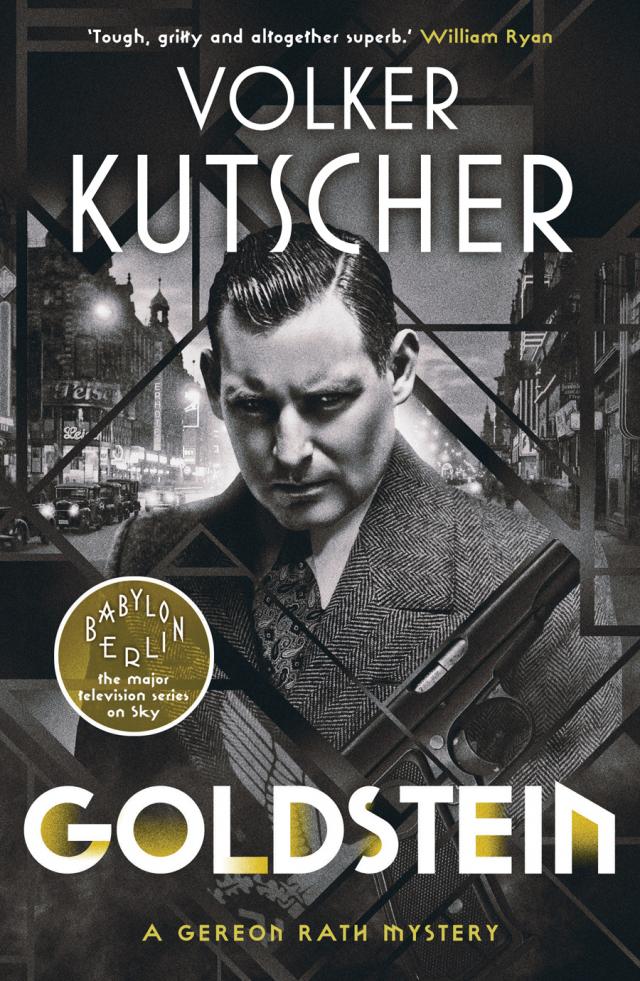


Goldstein grinned. ‘But if I were to have a cup somewhere,’ he said, ‘then you’d sit with me. If you’re absolutely set on paying for your own, that’s fine.’
A short while later they sat in Café Europa, where Rath had spent his first evening with Charly. There was no dancing at this hour, but a great deal of commotion on the roof garden. Two pots of coffee stood on the table in front of them, and Rath was secretly pleased that the American had fallen foul of the infuriating German custom of serving watery coffee in leaky pots. You either scalded yourself on the first cup, or drank the second cold, usually both.
Goldstein left the pot unremarked. ‘I don’t have anything against you personally,’ he said, after serving himself, ‘but it would be better for us both if you left me in peace. Perhaps if you had, you wouldn’t have needed to take your car to the garage.’
‘What do you know about that?’
‘Only that I wouldn’t be leaving my car unattended in a neighbourhood like that, particularly not such a nice model.’
‘I’m forbidden to leave you in peace. Sometimes you have to make sacrifices.’
‘You know, I’m an American.’ Goldstein stirred his coffee, which was still far too hot. ‘Perhaps, as a German, you won’t understand this, but for me the most important thing is freedom. My freedom. If it’s taken away from me, I can get pretty nasty. Just so you know.’
‘Are you threatening me? We’re not in America now. You can’t just gun police officers down.’
‘I think you have the wrong idea about our country. You ought to go there.’
‘I know your country.’ Rath was annoyed. He kept allowing himself to be provoked into making comments that were none of the Yank’s business. He fumbled an Overstolz out of his case.
‘Interesting brand,’ Goldstein said. ‘May I?’ Rath hesitated. ‘Come on. Just because I take something from you doesn’t make it bribery. Besides, you cadged a Camel off me yesterday.’
‘Help yourself.’
The men smoked in silence for a moment and drank their coffee.
‘I still don’t understand what I’ve done to warrant this kind of treatment.’
‘Wrong tense. It isn’t about what you’ve done, but what you might do.’
‘Strange working methods, the German police. So, there’s nothing I can do to get rid of you?’
‘On the contrary. You can leave town.’
‘Do you know what? I have a better idea. I’ll wait until your bosses realise how ridiculous this operation is, and call you in.’
18
Alex stood in Büschingstrasse, checking the lie of the land. She had left her pocket watch in Flat B with the rest of her things, but the smell of onions and cabbage and bratwurst told her it must be about half past twelve. Time for lunch. A few scruffy figures gathered outside the entrance to the male Salvation Army hostel, but otherwise Büschingstrasse was deserted. Hopefully the same was true of the courtyard leading to Flat B.
She had used the last of her money to buy Vicky a coffee at the Grossmarkt, before treating herself to a six-pack of Juno and taking the number 66 out to Büschingplatz. In by night, out at lunch was the best way of avoiding the caretaker and that old snitch Karsunke, especially if you didn’t want to field any stupid questions. Like the time he had asked her where she was going. She had given the answer Benny had drummed into her: to the Grünbergs in the rear building. They had the name from the mailboxes.
That wouldn’t work now the caretaker was keeping a close eye on her. So: in for a final time to collect her things, and that would be it for Flat B. The caretaker could turn the place inside out for all she cared. He wouldn’t find her.
From the opposite side of the road she peered through the entrance to the courtyard. It wasn’t just her sleeping bag up there, but also the personal items she kept in a little tin, as well as Benny’s pictures, which he had guarded like treasure. The yard seemed deserted, even the children who had been playing under the carpet hanger had vanished. Time was getting on. The queue outside the Salvation Army hostel had dwindled to three, reminding her that lunchtime didn’t last forever. She took a deep breath, wished the caretaker and his informant Karsunke bon appétit and crossed the road. She had just reached the archway when the door from the neighbouring house opened and a cop stepped out.
The blue uniform, and the face, seemed like a bad dream. What was he doing in Friedrichshain, damn it? KaDeWe was in the west.
Flat B was too risky now, that much was clear, but she wasn’t sure if the cop had recognised her. Thinking quickly, she switched directions, to make it seem as if she had come from the yard, then veered sharply, turning her back on him and making her way down the road as inconspicuously as possible. This wasn’t anywhere near his precinct.
‘Hey, wait!’
She turned only a little so that he couldn’t see her face. ‘Who, me?’
‘You’ve just come from the building, haven’t you? I’d like to ask you a few questions.’
Even if he had only seen her in boy’s clothing three days ago, he’d recognise her. ‘Sorry, I’m in a rush,’ she said. ‘My boss hates it when I’m late.’
‘Hang on a minute there, little Miss.’
As he drew nearer she accelerated without turning around, not daring simply to run off. His hand fell on her shoulder. Instinctively, her fingers clasped the switchblade in her coat pocket.
‘I just want some information,’ he said. ‘It’s about a boy from the neighbourhood. Two boys, actually.’
She kept her eyes fixed to the ground, as if she were a shy, country innocent, and turned towards him. ‘I don’t know any boys here,’ she said. ‘Mother doesn’t allow it.’
He grasped her chin and turned her face upwards. ‘Don’t I know you, little Miss?’
Now she saw his face, close as never before, and watched the penny begin to drop. ‘Oh, my shoe,’ she said, and bent down.
He’d recognised her, hadn’t he, or would at any moment, the arsehole, the murderer! She fiddled with her shoe with her left hand, using the right to spring open the knife in her coat pocket.
Show no mercy now, she thought, this is the bastard with Benny on his conscience!
Again she felt his hand on her shoulder and knew there was no going back. She had one chance. Shooting up from her squatting position, she slashed him once across the face, and broke loose. The cop cried out, more in surprise than pain, she thought, and for a fraction of a second she stood rooted to the spot as he passed both hands across his face, gazing in disbelief at his blood-smeared palms.
He’s let go of you, now run! But she couldn’t, she kept staring at him.
Blood ran down his right cheek, and the bridge of his nose. He looked at her with the same furious grimace she had seen at KaDeWe until, finally, she ran.
She didn’t know if she had any chance against him, but she ran, ran, ran as fast as she could.
‘Stop! Police!’
Fuck you, she thought, if you want to catch me, you’ll have to work for it, fatso!
He called after her, but the distance between them had grown. Had he stopped running? Then she understood what he was saying.
‘Police. Stop or I’ll shoot!’
She carried on running, ducking instinctively as a shot flew across the road. The sound of a ricochet roared through the air. The cop had only hit a lamppost – but he had fired, he had actually fired, in the middle of the city, in broad daylight.
There wasn’t a soul around.
No witnesses, not even anyone outside the Salvation Army. They were all eating inside.
Come to the windows, damn it, Alex thought, untie your napkins and come to the windows. Come outside, so that he can’t just spray bullets everywhere. But, no one came, and if anyone had still been outside, they’d have scarpered after the shot. The city had painful memories of gun-toting cops.
Alex darted from side to side, zigzagging towards the traffic on Landsberger Strasse. Crossing Barnimstrasse, she looked around. The cop had come to a halt, a hundred metres behind her perhaps, and was taking aim for a second time. She threw herself to the ground as a shot rang out. She thought she heard the bullet whistle past her, but it was probably just the wind. She rolled over and got straight back to her feet. Her injured left hand was aching. She must have landed awkwardly, but it didn’t matter now. He was trying to gun her down.
At last she reached Büschingplatz, and people. Jostling her way through the pedestrians, she hurried across Landsberger Strasse, dodging the cars as best she could. A man with an imperial beard, whom she almost knocked over, shook his head and made some stupid remark about road safety education.
She ran down Landsberger Strasse in the direction of Alexanderplatz, and heard her pursuer again, now shouting, ‘Stop that girl!’
She glanced back to see him in his blue uniform, with his bloodied face. He seemed to have his anger under control, and surely wouldn’t dare open fire here. People stared at him, but no one reacted. The man with the imperial beard made as if he hadn’t seen a girl all day, let alone one trying to flee, and gazed studiously in the opposite direction.
She kept running down the street, further and further. The cop was still on the other side of the traffic. You haven’t given him the slip yet, she told herself. Keep going!
Her strength started to leave her, but she ignored the stitch, turning as she fled, and catching sight of him as he crossed the road. He had put his weapon away again.
Damn it! How could she shake him off? After endless terrace fronts, she came on a sidestreet and darted to the left where he couldn’t see her. Where now? Breathless, looking around as she ran, she saw no courtyard, no open front door. Kleine Frankfurter Strasse, the sign said, and at the other end she saw the swathe of traffic on Frankfurter Strasse. Soon she reached the next street corner. There was still no sign of the cop. Now she darted to the right: Elisabethstrasse, but no hiding place in sight here either. No matter, the main thing was that the shitface cop was nowhere to be seen. ‘Slow down, girl,’ someone said. ‘You’ll make that bus.’
On Frankfurter Strasse, on the other side of the road, she recognised the blue sign with the big, white ‘U’, shining like a promise. The U-Bahn!
First, though, she had to cross the carriageway. This time she did it nice and easy to avoid attracting attention. Her breathing started to settle down, but her stitch remained. She turned around discreetly, as if keeping an eye on the traffic – no sign of the cop. Had she shaken him off? When she reached the stairs leading down from the corner house, she cast a final glance over Frankfurter Strasse and saw him. Around a hundred metres to the east a blue uniform emerged from a side street.
She bent low and stumbled down the steps. The platforms were another floor down and, now she was here, there was no going back. Best to assume he had seen her. No time to make considered choices now, she had to take advantage of her head start. She rushed down the next set of stairs onto the platform. Schillingstrasse said the letters on the pink-tiled wall.
Any number of passengers stood here, but no one paid her any attention. She hesitated for a moment before continuing as calmly as possible along the platform to another set of steps and the second exit. This was where she had seen him, albeit above ground. If he took that route she’d run straight into his path. She strolled back along the platform, beginning to think she had walked into a trap.
There was a deep rumbling noise from the western tunnel. At the top of the platform she turned around. There was no one descending the eastern stairs, but a train roared out of the dark. The doors of a smoking carriage opened invitingly in front of her. A few people got off, a few got on, the door continued to stand open. With no police blue on the stairs she stepped into the nicotine haze of a car populated exclusively by men, at least half of whom had interpreted the Smoking sign as an order.
Waiting for the stationmaster to issue the all clear, she looked outside. The platform plotted a wide curve so that she could clearly make out the other end. The cop descended the stairs and stepped onto the platform in the same instant the stationmaster uttered his ‘Keep back’.
All Alex could think of was: come on, come on, but the train didn’t budge.
The cop sprinted forward, throwing himself into the car at the last moment; someone must have opened the doors for him. Shit, she still hadn’t shaken him off, but at least he was in the front car, which meant he couldn’t catch her on the train, only in a station. And that was where she would have to give him the slip, this stubborn cop, this killer, this pig, this fucking arsehole!
She felt her rage swell, an impotent rage that made her beat the steel bars of the train in frustration. Outside the windows it grew dark as the train entered the tunnel. She had the feeling that people were watching her, but pulled herself together, battling against her rage and despair, and prepared for the next stop.
Strausberger Platz. Now or never. The train stopped, the doors opened and a number of passengers got out. Alex stepped onto the platform with the crowd of smokers, but remained by the door, so that those boarding had to push past her as she looked towards the front of the train.
Damn it! The cop had got off too, and he’d seen her. He was pointing towards her and shouting, ‘Stop that girl, she’s a thief!’
Most passengers didn’t react, or pretended not to have heard, but a fat man with a walrus moustache decided to intervene. ‘Calm down now, lass,’ he said. ‘You won’t be slipping through my fingers.’
‘Don’t touch me, fat ass!’
The fat ass grinned. ‘Would you look at that. You’re a cheeky one, aren’t you. Claws and all.’
‘Keep back!’
The stationmaster’s voice crackled over the loudspeaker. The fat man stuck out a chubby finger and blocked her path, while the cop approached from the other side of the platform. She had to do something, and she knew what.
‘Didn’t you hear? Keep back!’ she said, kicking the man as hard as she could between the legs. He doubled in pain, turned dark violet and sat on the platform facing backwards.
Someone tried to shut the door but she jammed it with her foot, squeezing her body into the sliding door and prising it open. No sooner was she on board with the door closed behind her, than the train began to move. This time the cop hadn’t managed to follow.
All around her, passengers smoked as if what had happened was none of their concern. She pushed her way into a corner where no one could have witnessed the incident, feeling relieved but furious at the same time. The arsehole had tried to gun her down.
At least the train was heading east. She could get out at Petersburger Strasse and walk back to Flat A, where perhaps she’d run into Vicky or Kotze. She needed to feel as though she still had some friends in this city.
When the man in uniform spoke to her, a kindly sort with a white moustache, at first she merely shrugged her shoulders. She was so lost in thought that she didn’t understand what he wanted until he repeated his request.
‘Tickets please!’
19
It had worked, Goldstein had given them the slip. For a moment he thought he was being followed, but the man who emerged from a telephone booth on Kochstrasse and took the same route to the U-Bahn remained on the platform when he boarded. Through the whole journey he studied his fellow passengers to make sure there were no police among them. Only now, climbing the steps at Schönhauser Tor and stepping back into the light, was he certain the coast was clear. He took a deep breath, as if savouring a gentle sea breeze, when all he could smell was the city air with its lime-tree blossom, petrol and fresh asphalt.
How he enjoyed moving without that stubborn detective breathing down his neck. Rath was still sitting by the hotel lifts, convinced that Abraham Goldstein was inside reading the papers and twiddling his thumbs. All you had to do to shake off the cops was let them think they had everything under control.
He glanced at the piece of paper in his hand: Grenadierstrasse. If he had understood her correctly, it had to be here somewhere. He looked around at workers laying steaming asphalt on a patch of road, newspaper boys shouting headlines outside a corner bar, a horse and cart turning the corner, carrying vegetables under a dirty-grey canopy. He crossed the carriageway and followed. This had to be the way. He knew he was in the right place when he read the sign.
The street was busy, but a little run-down, the stucco on the fronts dirty-brown and starting to crumble. Washing hung from some of the windows. Almost everywhere, goods were being sold, even on pavements. Some traders sold directly from their carts. Everywhere he looked, he saw Hebrew letters and Stars of David, either on shop signs or painted on the display windows themselves. Apart from on the Lower East Side, he’d never seen so many Jewish shops in one place, not even in Williamsburg, or so many caftan wearers.
He wasn’t sure whether he felt contempt or revulsion, he only knew that he didn’t want anything to do with these men in their sombre, black uniforms, and that he liked the young men with dark sidelocks even less than their white-bearded elders. Their world seemed to embody everything he had left behind: the cramp of his parents’ two-room flat, his sickly mother and his eternally praying, yammering father. He had hated all of it. Abe, Fat Moe had once said, you’re a goddamn anti-Semite, a Jewish anti-Semite, and laughed his cackling laugh. Neither part was true of course, he wasn’t an anti-Semite, but neither was he a real Jew. At least not the kind his father would have wished for.
The doubts had started after his Bar Mitzvah, when he ought to have felt a sense of belonging but instead turned his back more and more on the God of his fathers. Perhaps it was his mother’s illness that drove him under the bridge to Moe? Or perhaps it was only her death? He could no longer say. All he knew was that, since that day he felt only revulsion for his father’s world, and for those devout self-righteous men with whom Nathan Goldstein spent more and more time now that his wife was gone. The old man and his yammering . . . He called it praying but it was really no more than self-pity – and at some point Abe had no longer been able to stand it. Shunning the family home more and more, one day shortly after he turned fourteen he stopped going back. Better to live an unsettled life than to be sent to Aunt Esther, who wasn’t even his aunt, or indeed to a home, for that was what his father wanted when he realised he could no longer issue orders to his son.