

The Alchemy of Sorrow, page 1


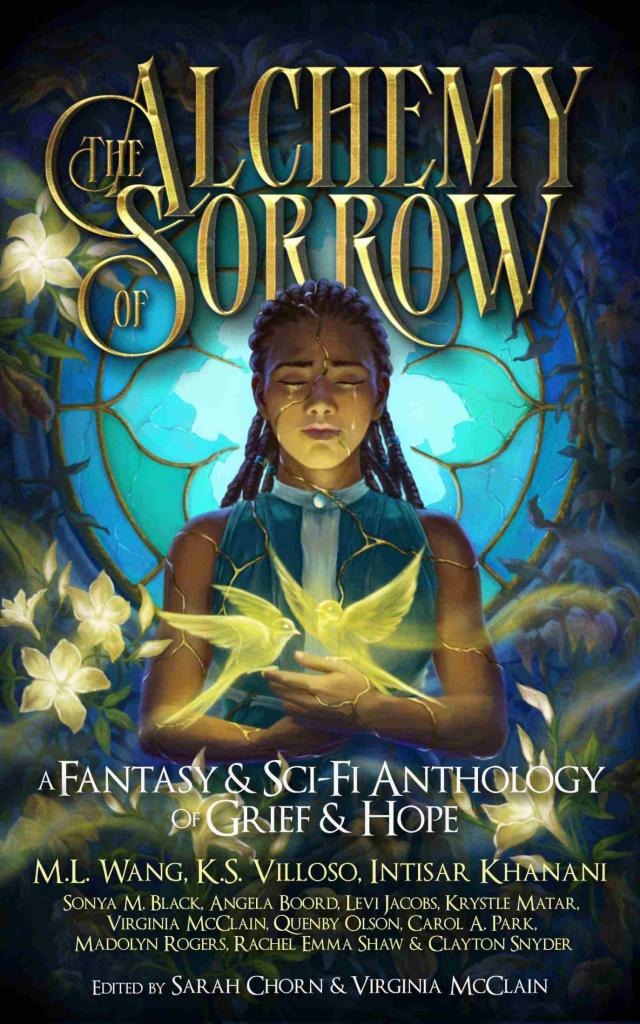
Contents
Title Page
Copyright Page
Content Warnings
Editor's Note
Anthologist's Note
Map Verso
Map Recto
Lullaby Dedication
Lullaby Artwork
Lullaby
K.S. Villoso
Skies on Fire Dedication
Skies on Fire Artwork
Skies on Fire
Sonya M. Black
A Matter of Trust Dedication
A Matter of Trust Artwork
A Matter of Trust
Angela Boord
A Recurrence of Jasmine Dedication
A Recurrence of Jasmine Artwork
A Recurrence of Jasmine
Levi Jacobs
Twice-Domesticated Dragons Dedication
Twice-Domesticated Dragons Artwork
Twice-Domesticated Dragons
Intisar Khanani
The Witch in the Wood Dedication
The Witch in the Wood Artwork
The Witch in the Wood
Quenby Olson
Thief Dedication
Thief Artwork
Thief
Virginia McClain
Thicker Than Water Dedication
Thicker Than Water Artwork
Thicker Than Water
Carol A. Park
Death in the Uncanny Valley Dedication
Death in the Uncanny Valley Artwork
Death in the Uncanny Valley
M.L. Wang
Summer Souls Dedication
Summer Souls Artwork
Summer Souls
Clayton Snyder
Reliquary of the Damned Dedication
Reliquary of the Damned Artwork
Reliquary of the Damned
Rachel Emma Shaw
The Quiet Dedication
The Quiet Artwork
The Quiet
Madolyn Rogers
The Paperweight Watch Dedication
The Paperweight Watch Artwork
The Paperweight Watch
Krystle Matar
About Our Team
Acknowledgements
More from Crimson Fox
Skies on Fire ©2022 Sonya M. Black
A Matter of Trust ©2022 Angela Boord
A Recurrence of Jasmine ©2022 Levi Jacobs
Twice-Domesticated Dragons ©2022 Intisar Khanani
The Paperweight Watch ©2022 Krystle Matar
Thief ©2022 Virginia McClain
The Witch in the Woods ©2022 Quenby Olson
Thicker than Water ©2022 Carol A. Park
The Quiet ©2022 Madolyn Rogers
Reliquary of the Damned ©2022 Rachel Emma Shaw
Summer Souls ©2022 Clayton Snyder
Lullaby ©2022 K.S. Villoso
Death in the Uncanny Valley ©2022 M.L. Wang
Published by Crimson Fox Publishing
Cover art illustration by Zoe Badini ©2022
Cover design by V.M. Designs ©2022
Map of Grief & Hope by Diana Sousa ©2022
Interior Illustrations by Kerstin Espinosa Rosero © 2022
ISBN: 978-1-952667-92-3
This collection is comprised of works of fiction. Names, characters, businesses, events, and incidents are the products of the authors’ imaginations. Any resemblance to actual persons, living or dead, or actual events is purely coincidental.
EDITOR’S NOTE - SARAH CHORN
cancer
ANTHOLOGIST’S NOTE - VIRGINIA MCCLAIN
death of both parents, pandemic
LULLABY - K.S. VILLOSO
classism, infanticide, racism
SKIES ON FIRE - SONYA M. BLACK
alcohol use, alcoholism, amputation, chronic illness/pain, death of a pet
A MATTER OF TRUST - ANGELA BOORD
bodies/corpses, drinking, guns, sex (not graphic), pregnancy, swearing, violence, weapons, marital cheating, divorce
A RECURRENCE OF JASMINE - LEVI JACOBS
death/dying, domestic abuse (emotional), forced captivity, violence
TWICE-DOMESTICATED DRAGONS - INTISAR KHANANI
death/dying, parent death, gunshot wound, violence (non-gory), descriptions of warfare, racism
THE WITCH IN THE WOODS - QUENBY OLSON
child illness, separation of child and mother
THIEF - VIRGINIA MCCLAIN
death of a parent, hospitalization, injury, mild fantasy violence, blood,
terminal illness
THICKER THAN WATER - CAROL A. PARK
bullying, torture, forced captivity, serious injury, violence, weapons
DEATH IN THE UNCANNY VALLEY - M.L. WANG
death/dying, hospitalization, terminal illness
SUMMER SOULS - CLAYTON SNYDER
death/dying, drinking (recreational), weapons
RELIQUARY OF THE DAMNED - RACHEL EMMA SHAW
bullying, classism
THE QUIET - MADOLYN ROGERS
battlefield violence (weapons, gore, death, corpses); pregnancy loss/infertility; depression/suicidal thoughts; child abandonment/sacrifice
THE PAPERWEIGHT WATCH - KRYSTLE MATAR
mentions of alcoholism and/or binge drinking, bodies/corpses, bones/skull (animal), bones (human), classism, death/dying, mentions of murder, swearing, terminal illness, violence
A few years ago, I went to my doctor for a routine cancer screening. I’d just been through treatment, and we were sure it was gone. The doctor, however, felt another lump in my neck and my bloodwork was loaded with tumor markers. I remember sitting in the chair and shattering in a way I never knew I was capable of. I have felt pain before, but this was something beyond even that. A realm all its own. A feeling so powerful no words would ever do it justice. I felt both too hollow and too full at the same time.
How do you breathe when you have no air?
I was drowning on dry land.
Suffocating on sorrow.
The whole world was closing in on me and all I could think was, Not again. Not again. Not again.
Someone was screaming. I’m pretty sure it was me.
The doctor and I talked next steps. When the appointment ended and my surgeon had been contacted and things were underway, he stopped and told me something that has stuck with me all these years: I might not know what you are feeling, but I know grief.
I think about that phrase a lot. There is a devious simplicity and graceful surrender to it that I find both enchanting and powerful.
You and I might feel things differently, but I know what it is to ache.
The simple acknowledgment of those complex emotions, of that pain, gave me permission to feel it.
It was okay to not be okay.
Recently, the pandemic has wreaked havoc across the world. Many people have been hospitalized and there has been a lot of death. For the first time in history, we’ve been able to watch the death toll climb in real-time.
Each number added to the total is a ripple in the ocean of life, touching everyone connected to that person: friends, family, coworkers, and more. Each number represents dreams and hopes and tomorrows. We’ve watched it happen because what else could we do? And those miracle workers, angels of nature, on the front lines are waging wars I cannot begin to fathom.
I might not know what you are feeling.
But I know grief.
When Virginia approached me about this anthology, the first thing I thought about was the pandemic, all the pain, the impacted lives, and the forever-changed families. Literature, art as a whole, has always been a way for people to explore, test boundaries, protest, but mostly, to connect. I felt like, perhaps, what the world needed was someone to say what my doctor said to me:
I might not know what you are feeling.
But I know grief.
Here, we have thirteen stories told by some of the best writers in science fiction and fantasy, each addressing grief and hope in their own unique ways. In a science driven by the heart, they mix their emotional elements to create something truly wonderful.
Perhaps reading these stories won’t exactly be easy, but the journey will be worth it. You’ll explore fae lands and other dimensions, possible futures, and kingdoms on the brink. Here be dragons and warriors and watchmakers and tinkers writ beautifully. Here is pain, and you will feel it. Both the loss and the wound it leaves behind, the frayed edges marking a hole where something used to be.
I promise, however, that you will also see the light at the end of the tunnel. The healing. The end which is all the sweeter for the depths we travel to get there. Here, you’ll find catharsis and understanding. The human story as told through the eyes of thirteen brilliant authors. Acknowledgment of pain and a burden shared, made all the more powerful for its raw honesty.
Perhaps what you need right now is someone to say:
I might not know what you are feeling.
But I know grief.
And this anthology does just that.
Sarah Chorn
May 27, 2022
Organizing an SFF anthology of any kind was never really something I expected to do. Organizing one centered on the themes of grief
In June of 2020 both of my parents died on the same day. Their deaths were completely unrelated events, and they’d been divorced for over 20 years, making the coincidence even more surreal. Due to covid travel restrictions, I couldn't visit either of my parents before they passed away, and I also couldn't go hug my siblings and grieve with them in person. As you might imagine, that only compounded my feelings of loss and sorrow.
About a month after that horrible day, I found myself–as I so often do–turning to writing in order to process my emotions. The resulting fantasy story, Thief, is a raw expression of some of the struggles I went through when my mom died.
But fantasy stories dealing expressly with grief are few and far between, especially those that lean into themes around healing and hope. As such, I struggled to find a place to share Thief with readers. Eventually, I reached out to editor Sarah Chorn to see if she wanted to help me bring to life an anthology on grief and healing–to make a space not just for my story, but for others like it. She said yes, and from there we both started inviting authors to join the project. In fairly short order, we gathered together the 13 incredibly talented authors whose stories you’ll read in these pages.
As with any project of this size, the reality of things is often a bit different than what we have in our heads at the start. When I first thought of creating this anthology, I pictured a collection of great stories wrapped up in a pretty cover, selling well because of all the awesome people involved. That may yet be part of our story, but more than soaring sales and a pretty book, this project has created a beautiful community. First, amongst all 13 authors–who I now consider my dear friends–and then amongst our 605 Kickstarter backers, all of whom have shown us so much love and support through both backing our project and through comments and connection in our backer communities on Kickstarter and Discord. So many people have shared their own stories of grief with us, and already, before a single one of these stories reached our readers, we were receiving messages of gratitude, inspiration, and rekindled hope.
When we first came up with the title The Alchemy of Sorrow, we considered ourselves clever because our stories were all about the hope and good that can be found even through our darkest hours. Belatedly, we realized that this project itself is an act of alchemy. We have taken our individual sorrows, and turned them not only into stories, but into friendships, kinship… and a wondrous sense of hope, love, and even joy.
It is my dearest wish, as the organizer of this collection, that you, dear reader, are able to find some portion of the hope and love we have discovered through The Alchemy of Sorrow.
YOUR HANDS LEFT me that second day.
I cannot say for certain when it happened. I cannot count. I don’t even really know what a day is. I know the pattern—I know your heartbeat, how it speeds up when you are frightened, how it flutters when you hear the man’s low, rumbly voice. How it rolls when you sleep, like the waves in the oceans I’ve never seen, lulling me to join you in dreams. And ah, such beautiful dreams we shared. In my mind’s eye, I can still see your raven hair, your dark skin, your sparkling eyes. I can smell the warmth of your neck as you hold me in your arms, dance with me in circles until the air spins above us like fireflies on a dark night. I hear the laughter in your voice as you tell me that you love me and ask me if I know exactly how much. As much as the world, you answer for me, as much as the moon and the clouds and the sky. The universe, you tell me, cannot possibly contain your love.
I know little of the things you speak of. But I know you. And so, I know when your hands left me. I don’t know why they did. Was it because the man left? After you and he raised your voices at each other—him, muffled against this hollow chamber of mine, you, shrill and strong, like lightning—something shattered inside of you. Even if I cannot count, I sensed your ache. I heard your tears and longed to kiss them away. But you wouldn’t let me. You were closed to your dreams that night; the darkness, a locked door keeping me from comforting you. I tapped and called for you, but you couldn’t hear. Wouldn’t.
And now, even while awake you ignore me. I’m leaning against you, searching for the warmth I had grown accustomed to in the short time I have come to know you. I feel only the cold caress of emptiness. Surely you could feel it; surely you knew I was still here. Yet your hands remained at your sides. The voice that had once been so bright and full of cheer now sounds dreary, murky water instead of a rolling sea. You don’t tell me how happy you are that you’re going to meet me soon. You don’t even sing to me anymore.
Later, we went on a journey.
We used to go on long walks, back when I could still feel the warmth I’d grown accustomed to. In those moments, the rhythm of the ocean changed, resembling the flow of a river—gliding, softly gliding. And you would speak to me, one hand on my back, and tell me stories of your childhood. How your mother called you Nuthatch, for the birds that used to roost outside your bedroom window, and how you would wake up early just to hear them sing. How your father made pottery, and how he tried to teach you to make things using clay, setting you on one side of his workshop with a bowl of water and a bag of fresh earth. You had no patience for the pots, but you loved to fashion figures of living things…horses, goats, birds. The figures grew over time, turned into statues; the villagers praised you for the lifelike quality of your work. Your parents were ecstatic.
They were less amused when you made them move on their own.
“What has no life may never live,” your father told you. “Listen to me, Nuthatch.” When your eyes wander to the dead rabbit on the side of the road, he slaps you hard enough to get your attention. The temptation of turning dead things alive is evidently too much. Then he takes away the bowl and the bag of earth, forbids you to ever touch clay again.
But of course, you do not learn your lesson.
Witchcraft, they said. Your child is practicing witchcraft. Others called you monster and threatened to throw you down the well, to burn you alive. Whatever you did frightened the villagers, told them you would bring the wrath of the Holy King’s army upon that forgotten corner of the world. Your father’s rage was not enough. Your mother’s pleas fell on unhearing ears. They called the priests to take you away. If they had come, you would have been turned into a warrior for the king, an unfeeling weapon of destruction like others before you. They would have taken what power you had and stripped it for their own needs.
But they didn’t. Like a long-awaited typhoon that decided to drift away, you heard nothing but silence on the day they were supposed to be in the village. You remember holding your breath, feeling it turn cold in your mouth. You had been almost looking forward to them. That was the first day you found a dead bird, a nuthatch like your namesake, and made it fly across the rooftops. It reached as far as the second house before tumbling over the eaves, straight into the gutters. Because of course, it would. What is dead can never be alive again.
It was your mother who saved you, in the end. Your mother, who found a man in town who knew a way to smuggle you north where he said the gifted are given power instead of becoming slaves. You don’t know what she had to do to convince him you were worth his time. You don’t want to. The morning that changed your life, he arrived on a horse-drawn wagon, more beautiful than anything you had ever seen in your few years of life. You could see the villagers peering through the windows as you climbed aboard, gazing back at your family. Brothers—you have forgotten how many. Your father, too ashamed to look you in the face. And then your mother, who looked because the pain was worth drinking in another moment of your existence, who loved you the way I dream you could love me, too. You didn’t see what they saw: you, so young and unafraid, walking away from the only world you had known and into a new one. You, with no concept of time or distance, thought that tomorrow was as close as yesterday and that surely you would be back soon. You had no idea that soon could feel like a lifetime.


