

Hair Wreath and Other Stories, page 1
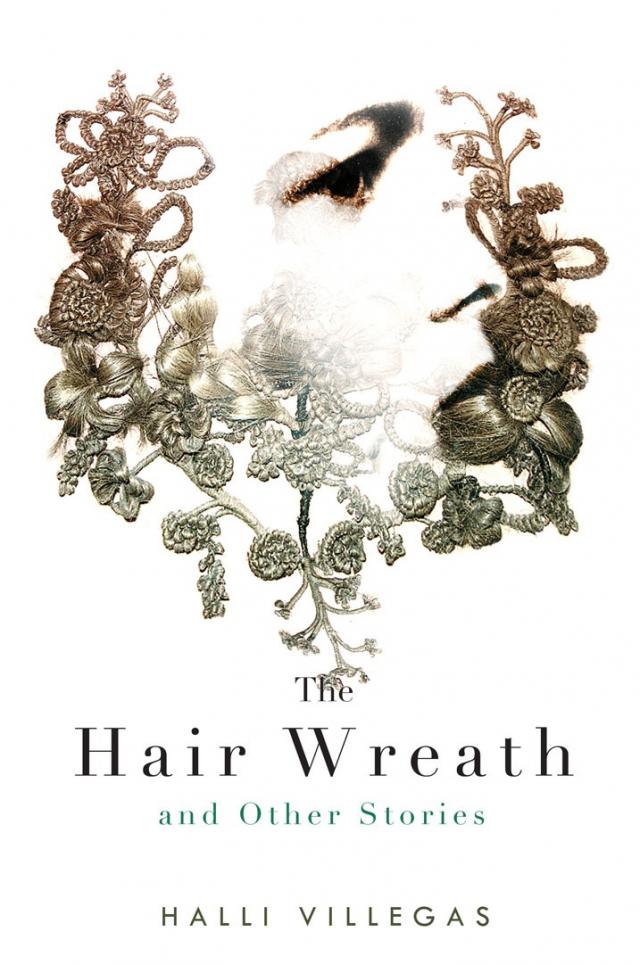


THE
HAIR
WREATH
And Other Stories
ChiZine Publications
FIRST EDITION
The Hair Wreath and Other Stories
© 2010 by Halli Villegas
Cover artwork © 2010 Erik Mohr
All Rights Reserved.
This book is a work of fiction. Names, characters, places, and incidents are either a product of the author’s imagination or are used fictitiously. Any resemblance to actual events, locales, or persons, living or dead, is entirely coincidental.
LIBRARY AND ARCHIVES CANADA CATALOGUING IN PUBLICATION
The hair wreath : and other stories / Villegas, Halli
ISBN 978-1-926851-02-0
I. Title.
PS8593.I3894H35 2010 C813’.6 C2010-903131-8
CHIZINE PUBLICATIONS
Toronto, Canada
www.chizinepub.com
info@chizinepub.com
Edited by Sandra Kasturi
Copyedited by Gemma Files
Proofread by Shirarose Wilensky
For David and Misha
THE
HAIR
WREATH
And Other Stories
Table of Contents
The Hair Wreath
D in the Underworld
Rites
Peach Festival
In the Grass
The Other Side
Dr. Johnson’s Daughter
While He Sleeps
Neighbours
The Beautiful Boy
Winter
His Ghost
Picnic
Twenty-First-Century Design
The Other Door
An Unexpected Thing
The Family
Meadowdene Estates
Salvage
Acknowledgements
About the Author
Back Cover
The Hair Wreath
They had to get out of the city. Their loft, which they had finally bought after many deprivations in the form of forgoing dinner out and Starbucks lattés for two years, was stifling. Despite exposed brick walls, floor-to-ceiling windows and proximity to all the city’s amenities, it had no outside access. No balconies marred the front of this genuine industrial building. The floor-to-ceiling windows that had been such a selling point in January let in relentless light in July.
Standing only in her bikini underwear in the middle of the loft, she said, “We should have taken the place with central air.”
A sheen of sweat brought out the blonde down along her arms.
“We wanted the exposed brick,” he said from the depths of a leather recliner where he sat naked. “Remember, we talked about it?” There was a sucking sound of flesh unsticking from leather as he shifted in his chair.
“Yes, yes, we talked, but who knew the goddamn windows would be so hard to cover?”
They had only managed to rig curtains about halfway up; neither was very handy and they couldn’t afford to have it done professionally. She crossed over to him and sat in his lap.
“I’m not mad at you.” She nestled her head into his shoulder. Her short blonde hair rubbed against his neck.
“Too hot.” He pushed her off. “Let’s go for a drive. Out of this city.”
She tossed her head to settle her cap of hair back in place. “Alright.” She was already walking toward the bathroom. “But I get the shower first.”
The acrid scent of her blonde sweat lingered in the air as he listened to her turn on the water. He lay back in the leather chair, enjoying the easily remedied discomfort of his damp body against the slick surface.
For fun, they took a back road off of the main highway. The city was twenty minutes behind. They turned the radio on loudly and sang along. All the car’s windows were open and the wind whipped their voices away, but every once in a while she reached over and squeezed his hand. He turned and smiled at her, his palm briefly cupping her thigh. Lifted by the breeze, her hair made a glinting halo. His hair had dried quickly, the heat making it curl up at the ends. She wrapped a curl around her finger and smoothed it down flat on his neck as he drove.
Just after an old stone bridge that crossed a creek, they came to a small town. The houses were Victorian for the most part, set back from the road by wide lawns. Occasionally a wartime bungalow appeared; then the Victorian next to it would have a truncated lot, the larger house brooding over the smaller.
They joked about how they would buy one of these houses when they made their first million. Their country place. They looked at each other, still laughing, and felt it was entirely possible.
The little main street of the town had a white clapboard café with ruffled curtains where they stopped for lunch.
“This is the perfect day in the country,” she said over a glass of homemade iced tea. Her face glowed. He reached across the table and touched her hand. Her hair fell across her flushed cheeks as she bent over his hand and kissed it.
After lunch, they wandered up the few blocks of the main street. They looked in the window of the dusty hardware store, and the clothing store with the headless mannequins wearing sweatshirts that featured baskets of kittens or flowers.
“Ready to go back to the car?”
“Alright,” she said, taking his hand, but something across the street caught her eye.
“An antique store.” Her voice was excited. “Let’s go see if they have anything for the loft.”
She crossed and he followed, though he was tired, and the thought of the drive back was beginning to weigh on him.
A bell on the store’s door jangled into the moted air. It was several degrees cooler in the shop. His nostrils flared, recognizing the papery, dry smell of old things. A woman with a long grey braid and a pilled lavender t-shirt watched them from behind a glass counter.
“Howdy,” he said, raising a hand to her. She nodded, then looked back down at the paper she had spread out on the counter top.
His wife had already begun to dig through the shop like a little terrier, her white tennis shoes shining among the heaps of old furniture and listing piles of junk. He picked up a few pieces of glass with knobs on them like glass boils.
He fingered through a tin box of old photos. Dumpy looking women in voluminous dark dresses, heavy hair wound in braids or swathed around their unsmiling faces. To him, the eyes in these old photos always looked blank, empty, as if the unchecked disease or early capricious death of the era had made them into unfeeling automatons. He imagined them pushing out one child after another to replace those that died young, burying their feelings deeper with each successive death. He dropped the photos back into the box and tried to wipe the black dirt from his fingers on the hem of his shorts.
He was about to wait outside in the sun when his wife called to him. She was holding a yellowed cardboard box. Inside, on a pile of tissue, was a shallow shadow box with a faded velvet background. On the velvet was a wreath. It had fibrous-looking flowers with centres of glass beads. Fragile circlets sprouted at various intervals. The whole thing had a dull sheen to it, the colours ranging from dark brown to ashy yellow. He put one finger out and touched it. The texture was unmistakable.
“It’s hair.” He rubbed his hand violently on his shirt. The skin crept up the back of his knees.
“Isn’t it fantastic? It’s a hair wreath. I’ve always wanted one.” She brushed her bangs off her forehead with one hand. There was a black streak along one of her cheeks.
“They were in remembrance, of friends, lovers, family. The dead and the living.” She looked down into the box smiling. “I’ve always wanted one.”
“No.”
She looked up, surprised.
“It’s awful, dead people’s hair. God, it makes me shudder just to think of it.”
She narrowed her eyes. “You’re being silly. It’s artwork. It’s an antique. It will look wonderful on the brick wall in the loft.”
He shook his head. “Not in my house.”
“Your house?”
The proprietress came over. He could see now that her silver plait reached to her waist.
“Find something?”
She took the box. He watched his wife’s face go still. He knew she was wondering if the woman would set the price too high if she saw excitement on her face.
“Oh, the hair wreath. Bought that at an estate sale over to Kirkfield. Used to be you couldn’t give them away, now they’re hard to find. Seems they’ve become collectible.” She chuckled and handed the box back to his wife.
“How much do you want for it?” his wife asked, fitting the lid back on the box.
The shop owner hesitated. A ray of light filtered through the filthy windows and lit his wife’s hair into gold. She held the box close to her chest, her arms crossed over it.
The proprietress shrugged. “Let’s say a hundred, no tax.”
“I’ll take it.” His wife didn’t look at him as she followed the shopkeeper to the front to pay.
That night she had him sink an anchor into the brick wall to hang the wreath from. He didn’t argue, knowing that he couldn’t win, but he refused to touch the thing. She could hang it herself. He went to take another shower, wanting to get the day’s dirt off his skin.
After his shower he bent to clean the hair catch in the drain. Twined in it were her bright hairs and his dark ones, curled together wet and slick from the water and soap. He left it there, and closed the shower curtain.
The l
She was asleep next to him, breathing steadily, her hair fanned out on the pillow like a silk tassel. He closed his eyes to block out the wreath, the dusty shop, the day, and slipped into sleep.
When he woke later into the half-dark of the loft, a woman in a black silk dress bent over him. Her full skirts swayed as she hovered in the close air. Around her head were wound thick dark braids. Her eyes were empty, pale grey. He lay still, hoping she would believe he was asleep. She reached up and unpinned her braids. They uncoiled with the dry sound of snakes gliding through the burnt stubble of summer grass. She began to comb them out with her fingers until they became a fall of dark water. She leaned closer and he was covered in her hair’s smothering weight. The musty odour of long-dead forgotten people rose from the rippling strands. He cried out.
“Shh, shh—” His wife was beside him stroking his hair. She began to kiss him and then stretched her body over his. Her short hair brushed his cheek as she bent her mouth to his again. They moved together silently in the heat. Her scent, blonde and grassy, mingled with the musk of their lovemaking, but underneath he could detect the smell of things that hadn’t seen the sun in a long time. When they finished, she collapsed on his chest, taking his breath away, her hair stinging where it touched his skin.
Over the shuddering crescent of her shoulder, he could see the hair wreath hanging on the loft’s wall—half shadowed, half illuminated in the diluted city light.
D in the Underworld
They stare at her the minute she gets on the bus. D, refusing to be taken in by their challenge, takes the seat directly across from them, even though more than half the seats are empty. She is too old to be intimidated by teenagers. The girl has green hair. Spring green, the colour of new grass. Which means, D knows, that it was originally blonde. Dark hair bleached to take the colour would be spottier, less pure. The boy has straight blond hair that falls over one eye—a pretty face, but hard. For some reason D has always been suspicious of blond men. They strike her as sinister, concealing something behind smiles and light eyes. This is no man, though; he is a boy. Certainly, she has nothing to fear from a boy in a frayed oxford shirt, tie almost undone. He is also wearing grey flannel pants and Doc Martens. School uniform. D, who has only glanced at them when she first sat down, busies herself with her bag. Opens it to arrange crumpled Kleenex, ticket handy should a Toronto Transit operator board and ask to see it. Maybe they are brother and sister, with that blond hair; she glances again. The girl is looking at her. As if reading her thoughts, the girl leans over toward the boy and begins to kiss him, her hands running across his lap while he holds her thin shoulders.
Guess not. D looks at her bag again and snaps it shut. Outside the bus window the unlovely city flashes by. Out here, away from the city’s core, there are strip malls, bungalows meant to look like trim cottages, but instead fronting on the busy street with litter on their lawns, and paint peeling from the quaint trim around their roof peaks. Towering above them, blank apartment buildings. D tries to imagine them new in 1960, 1970, when they weren’t so soot-dimmed, their balconies rusted, hung with six-month-old Christmas lights, garbage banked along their steps among misshapen shrubs. She can’t do it, not in this rain. Spring has been a long time coming this year, days of promise dissolving into this endless rain.
A group of schoolgirls runs for the bus stop, laughing, but they don’t make it. This driver has no pity, and won’t wait for the beauty of their long legs and flushed cheeks. Instead the doors close; the bus lurches forward, indifferent to their waving hands and calls. Despite herself, D cranes her neck around, looking for Stephanie, to see if she can spot her red coat in the midst of the girls. But their backs are to her now, and there is no red coat.
“Got a light?”
It’s the boy across the aisle. He’s holding a cigarette between two fingers, the girl curled around him; rather like a grass snake, D thinks, with that green hair.
“No. You’re not allowed to smoke on the bus.” The boy looks at her. The mother in D rises.
“Besides, it’s not good for you.”
The boy flips his hair out of his eyes, but it falls right back with a fluid motion.
“The bus?” he asks, widening his eyes in mock innocence.
D gives the inevitable answer; it pulls from her tongue like taffy.
“No, smoking.”
He laughs and so does D this time—letting herself not be offended, but easy as an adult might be with a cheeky teenager.
The girl seems to have fallen asleep, her mouth slightly open against the boy’s arm.
“Coming from school?” D asks.
“Nope. Job interview,” the boy says. He puts the cigarette behind his ear and shifts so his arm is around the girl.
D is surprised. A job interview—he doesn’t look old enough to be out of school. One of the things with getting older is that the lower ages seem to blur together. Perhaps he is a dropout, not going to university—like D herself, though that is much more unusual here than in the States where she grew up. Then she had Stephanie, which made it impossible to go back, back especially to the mindset that seemed necessary for university—of being unencumbered, thinking of what you would like, only of yourself. The boy is watching her, stroking the green hair of his girl absentmindedly.
“Did you get the job?”
“Not the Tim Horton’s type. When they asked if I had ever tried their product and what I thought of it, I said you couldn’t pay me to put that shit in my body.” He smiles at D, expecting a rebuke, but she lets the automatic answer go.
“I suppose you had a cigarette right after?”
“Damn right.”
They both laugh again, and the girl on his arm stirs.
“What’s so funny?”
“Just talking about my job interview.” He bends over her and kisses her forehead. She sits up and stretches.
“Oh God, that was a mistake. You at Tim Horton’s, I can see it now. Hey, we’re almost at our stop.” D looks out the window, only a few more stops until her own. Back here, downtown again, the streets are a bit more vibrant—boutiques, galleries, brownstones with brass numbers—but the rain is relentless. The bus shudders to a stop.
The boy snatches something out of his canvas satchel as he stands, drops it into her lap as he and the girl make their way to the doors, he guiding her with a hand at the small of her back. He turns, just as they are stepping off.
“Come if you can, it’ll be fun.”
D drops the paper into her bag and rides the last three stops to her house, watching out the window for Stephanie’s red coat.
The apartment is empty. Ground floor of a threestorey row house; tiny hall, high ceiling, narrow rooms that lead one off the other. D drops her purse on the couch, blond wood and beige cushions, the cheapest IKEA had to offer. She bumps against the trash-picked coffee table, strewn with magazines and one burnt-down candle in a heavy silver holder. She goes into the kitchen to make tea. While the kettle boils, D closes herself in the tiny bathroom off the kitchen. She pees, and as she washes her hands in the sink afterwards, looks at herself in the mirror.
Why had that boy talked to her? Just fucking with her.
D sees her face as always. The slowly growing radius of fine lines around her eyes, the skin on her cheeks a little taut but rough with pores, hair—oh, that is the worst—brown, sere, carelessly pulled back. The brown turtleneck and pants, blunt nails, ugly shoes; no colour anywhere, drab as the day. She raises her hands to her cheeks and pulls them tight. Only thirty-three, but old, older than dirt. She lets her face go and goes back to the kitchen where her kettle is whistling, frantic at being forgotten.
D sits on the couch, mug balanced on a pile of old Toronto Life magazines stacked on the coffee table in front of her. She pulls her purse toward her and reaches in for the paper the boy dropped in her lap. It’s an invitation, hand-lettered, printed on a copier.





