

Ava, page 16


He and Ava were in different social circles at school, so they never hung out together. But their lockers were next to each other because they were assigned based on alphabetical order, and they’d shared the same homeroom in middle and high school. For years, she’d spent the first ten minutes of her school day sitting at her desk, looking at the auburn hair on the back of his head, and listening to him talk and joke with his friends before the bell rang and they headed for their classes. She then saw him sporadically during the day, either in class or at their lockers. They rode on the same bus as he didn’t live far from her, and they occasionally sat next to each other.
If he was absent from school, she missed the familiarity of his presence, and he seemed to feel the same way. When she’d had the flu and been out for a whole week during seventh grade, he’d welcomed her back with a quick hug and said he’d missed his locker buddy. But that was the sum of their relationship: They were friendly acquaintances by alphabetical happenstance.
Another week of school passed, and Ava sat on her bed typing an English essay on her laptop. It was based on her required summer reading, To Kill a Mockingbird. Her topic was the destruction of Scout’s innocence as she developed a greater awareness of the pain and suffering in the world around her. As she wrote, she started to feel an overwhelming urge, as if she needed to have a bowel movement. Again, she knew why this was happening, and she now knew her desperate wishing had failed.
She stood and paced her bedroom’s carpeted floor. Her parents wouldn’t be home for a few more hours. She grabbed two towels from her bathroom, pulled her plush purple beanbag chair to the middle of the room, and made an indentation in the center. She laid the towels on top. Suddenly, she felt she had to push. She quickly pulled down her pants and squatted over the makeshift nest. Her eyes watered, and she felt her face flush.
Ava bore down and started pushing. She cried out as she felt something coming out of her, and she started sweating profusely. She continued to push as hard as she could while making deep, guttural noises. She finally felt a sense of relief when she had completely expelled the inanimate intruder from her body. It felt like an hour had passed, but it all occurred in a matter of minutes.
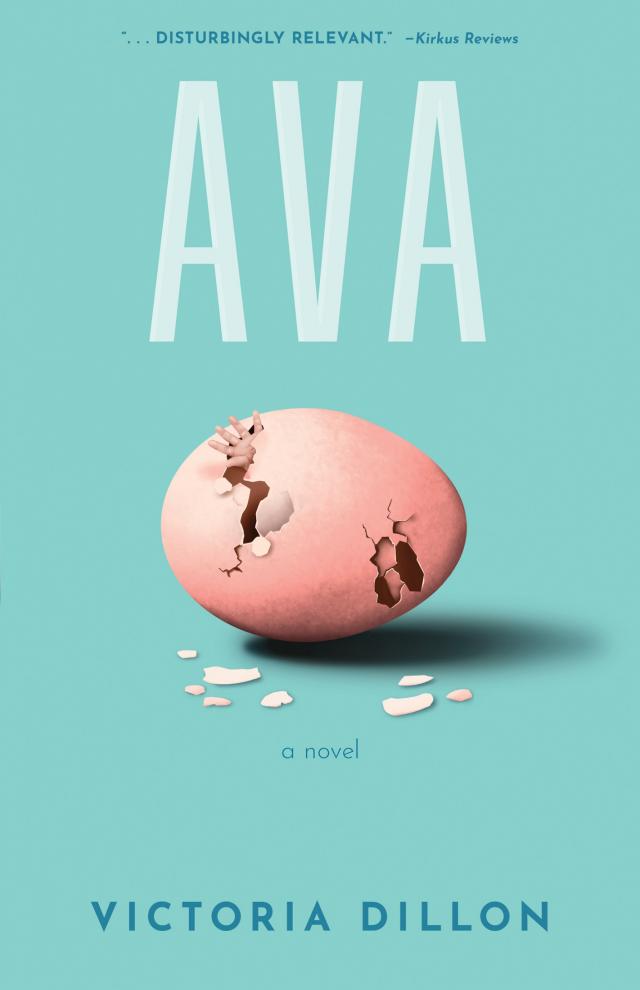
She pulled up her pants and underwear, sat down on the floor, and scooted away from the beanbag. Ava leaned against her bookcase, breathing heavily, her forehead beaded with sweat. She stared in silence and awe at the large peach-colored egg that sat in front of her in the hastily made accommodations. It was tinged with a small amount of blood.
“Peach. My bloom is peach. Just like my earlobes,” she said with wonder as she absentmindedly rubbed her gold stud earrings.
“I made that. Oh, my God. I made an egg,” she said in disbelief. “I am a freak of nature.” She started to sob.
When she stopped crying, she wiped the tears from her face and stood to stare at what she had created in just a few weeks and laid within minutes. She carefully dragged the beanbag into her closet and closed the door, then tried to focus on her assignment while she waited for her parents to get home.
A few hours later, shortly after arriving home, her mom popped her head into Ava’s room to say hi and let her know their dinner plans.
Ava nodded, said a quick “thanks” without taking her eyes off of her work, and went back to writing: As Scout is introduced to more and more hard truths about the world, she loses her childhood innocence. That innocence later transforms into understanding.
A while later, her mother called Ava to the dinner table. Her parents talked about events at work, but they were unsuccessful at prodding Ava to talk about school. Without looking at them, she gave vague answers to their questions and pushed the food around on her plate, taking only a few bites.
“You don’t seem like yourself. Are you feeling bad, Avacado?” her father inquired.
“Yes, you have been very quiet. Did something happen today?” her mother asked with a look of concern.
“No, I’m not feeling fine, and yes, something happened,” Ava mumbled. She stared down at her dinner plate and said nothing more.
“Ava, it will be okay, whatever it is,” her father reassured her.
“It will have to be okay. I don’t have a choice,” Ava said as she pushed her chair back and got up from the table. She walked to her room and sat on her bed with her head buried in her bent knees. Her parents worriedly followed behind her.
Ava looked up at her mom and dad and said, “I just want to know why. Why did you do this to me?”
“Do what, honey?” her mother asked, confused. She looked at Ava’s father.
Ava stared down at her feet and pointed to her closet.
“In there. Look in there.”
Ava’s parents walked over and opened the door. They looked down and saw the large egg nestled on the floor next to Ava’s old stuffed animals and a stack of board games. Her mother gasped and covered her mouth, then stepped back and sat on the bed next to Ava. Her father kneeled to get a closer look.
“Oh, Ava. Are you hurting? Are you okay?” her mother asked as she touched her daughter’s shoulder.
“Am I okay? Am I okay? No! I’m not okay!” Ava yelled as she pulled away from her mother.
“You did this to me. You both did this to me. No one asked me if I wanted this. You decided for me,” she said with tears in her eyes.
“Yes, we did,” her mother said. “You’re right. We really felt this was the right decision to make for you. We wanted you to have more choices and control over your body than I did, but to do that, we had to make this choice for you first. We had no way to ask you before we made the decision.”
“Our hope was that you would never have to experience what your mom did with Maeve,” her father said. “Or what so many other women are experiencing now.”
“And we’re so sorry you were here alone when this happened, Ava,” her mother added sincerely.
“I just feel like such a freak. This isn’t . . . normal,” Ava asserted.
“You’re right—it isn’t normal for people,” her mother said. “But it is normal for other animals, and someday, it might be more normal for a lot of women. You are the proof that it works, and you’re proof of what can be true for more women. This isn’t how I wanted it to happen. I didn’t want you to be surprised like this at your age, but this is incredible, Ava. This is amazing. It is life-changing.” There was excitement in her mother’s voice.
“I didn’t want my life changed like this. I didn’t ask for this.” Ava cried as she told her parents about her sunglasses breaking and how she’d thought she would be okay for just one day. She hadn’t really believed this could happen, but now she knew that’s all it took. Just one day in the sun.
“Now you know, and we know, Ava,” her father said. “It won’t ever happen again. We will make sure your eyes are always protected. We’ll do whatever it takes,” he reassured her as Ava’s mother continued to marvel at her creation.
“You don’t need to help me,” Ava said. “I know I won’t ever make that mistake again. But what are we going to do with that?” She waved her hand toward the closet, and tears streamed down her face. “I want it gone. I don’t want to look at it anymore. Please, just get rid of it,” Ava urged.
A while later, Ava’s parents led Dr. Davis to Ava’s bedroom, where she was sitting in bed under her blanket, knees to her chest, proofreading her completed essay.
“Ava, Dr. Davis is here. Can we come in?” Ava’s mother asked as she knocked.
“Sure,” Ava replied flatly, refusing to look up.
Dr. Davis sat on the edge of her bed and apologized. “I am very sorry today was difficult for you, Ava. You may not know it now, but you are a hero, and you will be a legend. I may have been the innovator, and your mother was the courageous volunteer. But you . . . you are the one who is really going to make a difference in the world. You are living proof of what is attainable, and I thank you. And my parents, rest their souls, thank you.”
Ava looked at Dr. Davis, whose expression was one of pure sincerity and gratitude. In a voice that was barely a whisper, she replied, “You’re welcome.”
He and her father gently lifted the egg and placed it in a large Styrofoam box lined with bubble wrap. Ava could tell that it wasn’t very heavy, but they were both nervous about breaking it. Her mother placed the lid on top and looked up at Dr. Davis with a smile. He told them he would take it to the lab and store it in the refrigerator while he decided what to do next.
“It’s time to let the world know what’s possible,” he said.
CHAPTER 28
La science n’a pas de patrie, parce que le savoir est le patrimoine de l’humanité.
—Louis Pasteur
A few weeks after Ava laid her egg, the Society of Genetics and Perinatal Medicine’s annual conference was held in Chicago. There were about three hundred graduate students, research associates, physicians, and PhDs in attendance. The organization’s president, Dr. Diya Singh, stepped up to the podium in the grand ballroom of the hotel where the meeting was being held. She announced to the audience, “Distinguished colleagues, you’ll note on your programs that Dr. James Davis Jr. was added as a speaker at the last minute. We apologize for not having a printed handout prepared for his presentation, but he will provide a copy prior to your departure. And now, I would like to welcome Dr. Davis to the stage to present his most recent work.”
Dr. Davis approached the dais to the attendees’ applause as he shook Dr. Singh’s hand. He then addressed the group.
“Thank you all. For those of you who are not familiar with me, my research over several decades has focused on facial morphogenesis and osteogenesis, and I’ve valued the professional collaborations I’ve had with many of you over the years. Your expertise and input have been invaluable. Today, however, I would like to discuss the research I have been pursuing in tandem. It is wholly unrelated to my usual area of study, and I’m pleased to present today a recent significant breakthrough.” He then began his slide presentation, which was titled “An Alternate Evolutionary Pathway for Female Reproductive Development.”
“As you know,” he said, “there are three different ways in which mammals give birth. There are placental mammals, such as humans; marsupial mammals, such as kangaroos; and monotreme mammals, such as the platypus.”
He paused before continuing. “I theorized that if humans were able to lay eggs, much like a monotreme or avian species, we could greatly decrease the rate of maternal morbidity and mortality that are inherent risks to childbearing. Therefore, my research has been on altering the human genome by splicing the genetic code for the human female’s internal reproductive organs and replacing it with the code for the avian system.”
Dr. Davis then went through his presentation slides, discussing how he’d achieved this goal by using an in vitro model, which led to subsequently developing an in vivo method using an intramuscular injection. Although his in vivo method had yet to be tested, he had achieved success with the in vitro model after finding a volunteer. This revelation was met with murmurs among the audience members—they undoubtedly knew that Dr. Davis’s research hadn’t been approved by an ethicist from any governing body.
“Yes, I know. You have postulated that my methods are unconventional, and you would be correct, but let’s move on to the results for now. We can save those discussions for another time.”
He then showed fluorescent microscopy photos of Larkin’s embryos, one of which would someday be Ava. He simply referred to Larkin as “AV” for “anonymous volunteer” and the embryo as “Exhibit 1.” He pointed to the areas on the Exhibit 1 chromosomes that had been spliced and replaced.
He then showed the ultrasound photos Aubrey had taken of Ava’s internal reproductive organs—the prepubescent Exhibit 1—highlighting the single ovary and long, tubular oviduct. This was met with scoffs from the audience. The photos proved nothing as they could have come from an internet search for the reproductive system of any random bird.
Dr. Davis embraced the skepticism. “There was a reason I have waited this long to present my findings,” he said. “I needed to protect the identities of the persons involved, and I needed definitive proof that this procedure had succeeded, which is precisely why I am here now.” He signaled for Susan to join him on the dais.
She had been seated next to a large cooler, which she wheeled onto the stage. From it, she removed a large item wrapped in several layers of gauze and placed the bundle on a raised platform. She and Dr. Davis carefully unwrapped the object as the crowd looked on in quiet anticipation.
They revealed to the audience a large egg, at least twice as large as what an ostrich would produce. The onlookers were doubtful. A few laughed derisively, but Dr. Davis reassured them that the egg was indeed real and unfertilized. He then showed them slides of the chromosomal and DNA analysis of a sample he’d removed from the egg using a small diamond-point drill bit to extract some of the albumen. The findings were almost 99 percent consistent with human DNA, save for the section of the code that had been altered.
He encouraged audience members to come onto the stage a few at a time for a closer look. He also offered to let them take samples from the egg’s albumen or a small portion of the shell to their own labs for independent testing. Many requested samples, and he obliged by drilling another small hole as Susan helped them retrieve the contents. She also helped them cut small pieces of the shell to take with them for analysis.
Although there were many doubters who were convinced this was nothing more than an elaborate hoax, several of those in attendance were gradually swayed. They knew how brilliant Dr. Davis was, and they were convinced that he had succeeded. Women could lay eggs with this new technology. His methods were neither ethical nor conventional, but the results were incredible.
Social media quickly became inundated with photos and videos from the conference, and within hours, Dr. Davis’s presentation was the top trending news story. Some thought it was simply a joke and scrolled past. Some thought it was just another random, ridiculous conspiracy. But two groups were paying close attention: the US government and many, many women of reproductive age. Women without access to birth control except through unlawful means. Women who were desperate, seeking illegal abortions, and suffering the consequences of complications. Women who wanted more options for their daughters than the law allowed.
Several news agencies contacted Dr. Davis for interviews in the days after the conference. He was pleased to have a larger audience so he could clear up any misconceptions.
“Please tell us, Dr. Davis, would women lay eggs every day? Every few weeks?” one journalist, Nicole Darcy, asked on her prime-time news program.
“No, not at all,” he said. “Like hens, women would need to be exposed to many hours of sunlight per day to produce an egg. Wearing sunglasses that block a significant amount of light in the orange and red spectrum should serve as adequate prevention against ovulation. When a woman is ready to procreate, she would simply remove her eye protection and make sure she gets an adequate amount of sunlight, likely twelve to fourteen hours a day.”
“So, just sunglasses? That’s the new contraception? No hormones?”
“Correct. So that would be another upside for women. No complications from taking a pill or getting a hormone shot or an IUD. No weight gain, no risk of blood clots.”
“Which is a moot point in our country right now.”
“Yes, that is true.”
“But it would be really difficult for the government to ban aviators, wouldn’t it?” the interviewer mused.
“I believe that would be impractical.”
“And women would no longer have periods?”
“That is correct. No periods. No more feminine hygiene products would be needed. So this has practical cost and environmental benefits as well.”
“And the actual reproductive process will remain unchanged?”
“Sexual intercourse will not be affected, correct. But hopefully it’ll be more enjoyable when people are able to plan a family more easily and not worry about unplanned pregnancies.”
“And how long will it take for a woman to produce an egg?”
“From my limited knowledge, as only one egg has been produced so far, it appears to be less than three weeks.”
“And what would be the gestation period?”
“Well, the correct term now would be ‘incubation,’ not ‘gestation.’ That is undetermined at this time as we do not have a fertilized egg to study, but I suspect it would be similar to the current gestation period. When the neonate is fully developed, the shell would have to be removed, as humans lack the egg tooth that birds, reptiles, and monotremes have to hatch themselves.”
“And will a woman have to sit on the egg for nine months? Or will she have to talk an elephant into doing it so she can take a proper vacation to Palm Beach?” The interviewer laughed at her own joke.
“Aha! My son loved that book when he was a toddler. No, no. I am working on designing an incubator like the ones used for the chicken eggs in my lab, but on a larger scale.”
Nicole’s tone became more serious. “You may not be aware, Dr. Davis, but I nearly died several years ago from an untreated ectopic pregnancy when I was living in Texas. I nearly hemorrhaged to death because my doctor feared being jailed for giving me lifesaving care.”
“Yes, I remember the news story. I’m very sorry that happened to you, and it was very brave of you to share your experience.”
“Unfortunately, bravery doesn’t change laws,” Nicole said as she turned toward the camera. She then shifted back to Dr. Davis. “So, I would like to know. Would women who can lay eggs never experience an ectopic pregnancy?”
“Chickens may experience something similar. It’s called an egg yolk coelomitis. This is more common in commercial egg-laying breeds, so this may be an effect on the reproductive tract that occurs from frequent laying. Hopefully, it will not happen in their human counterparts.”


