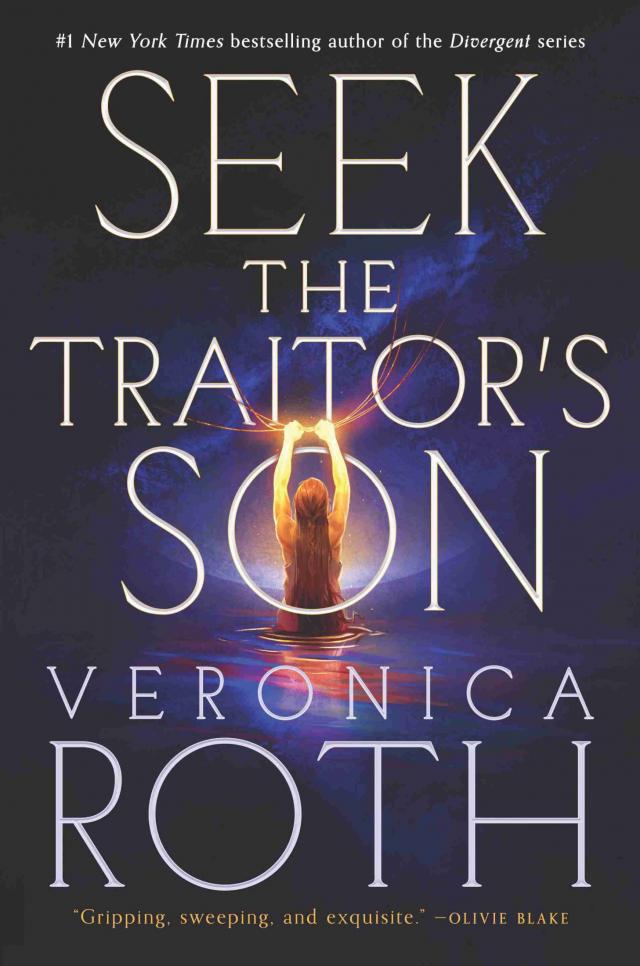
Seek the Traitor's Son, page 1


About SEEK THE TRAITOR’S SON
AN EPIC ROMANTIC DYSTOPIAN FANTASY BEGINS
A world at war.
A prophecy that will shake the stars.
A love that transcends it all.
Elegy Ahn did not ask for destiny to find her.
She is happy with her life as a soldier, defending her small country from the Talusar, a powerful nation that worships a deadly Fever. A fever that blesses half of its victims with mysterious gifts.
But then she’s summoned to hear a prophecy—her, and the most ruthless of Talusar generals, Rava Vidar. Brought face-to-face, they learn that one of them will lead their people to victory over the other . . . but they don’t know which. And at the center of both of their fates: a man. A man that, Elegy is told, she will fall in love with.
In just one day, Elegy’s old life—her job, her purpose, and her future—is over. She and Rava are destined to collide, with the fate of their nations hanging in the balance.
And when they do, only one will be left standing. Elegy intends to make sure it’s her.
Also by Veronica Roth
Arch-Conspirator
Chosen Ones
Poster Girl
The Curse Bearer series
When Among Crows
To Clutch a Razor
THE DIVERGENT SERIES
Divergent
Insurgent
Allegiant
Four: A Divergent Collection
Contents
About Seek the Traitor’s Son
Also by Veronica Roth
Title page
Contents
Dedication
Epigraph
Map
Before
Chapter 1
Chapter 2
Chapter 3
Chapter 4
Chapter 5
Chapter 6
Chapter 7
Chapter 8
Chapter 9
Epigraph
Before
Chapter 10
Chapter 11
Chapter 12
Chapter 13
Chapter 14
Chapter 15
Chapter 16
Chapter 17
Chapter 18
Chapter 19
Chapter 20
Chapter 21
Chapter 22
Chapter 23
Chapter 24
Chapter 25
Chapter 26
Chapter 27
Chapter 28
Chapter 29
Chapter 30
Chapter 31
Chapter 32
Chapter 33
Chapter 34
Chapter 35
Chapter 36
Chapter 37
Chapter 38
Chapter 39
Chapter 40
Chapter 41
Chapter 42
Chapter 43
Chapter 44
Chapter 45
Chapter 46
Chapter 47
Chapter 48
Chapter 49
Chapter 50
Chapter 51
Chapter 52
Chapter 53
Chapter 54
Chapter 55
Chapter 56
Chapter 57
Chapter 58
Chapter 59
Chapter 60
Chapter 61
Chapter 62
Chapter 63
Epigraph
BEFORE
Chapter 64
Chapter 65
Chapter 66
Acknowledgments
About Veronica Roth
Copyright page
Newsletter
To the second ones
Cedre is not a place, it’s the idea that something beautiful can be made out of ruins.
—Iryna Rosyk,
the first Sword of Cedre
Before
The man kneels in the dark and waits.
The plant before him, suspended in water by a delicate metal lattice, is a cluster of dark purple leaves drawn up and in, like a teardrop. It isn’t moving, but the exarch told him to be patient, so he is. He waits until his knees ache.
Then: a creak. The sound of a bent stem.
And a shiver, right through the middle of the teardrop.
The man suppresses a gasp as the plant splits open and peels apart, the leaves unfurling all at once. Then in the center of each one, a vein of light. Of color.
It’s only a plant, but the gentle pulse of its light is almost like a heartbeat.
“Are you ready for the hardest part of our journey?” he says to it, his voice gentle.
He reaches into the water to run a fingertip along one of the leaves. He checks that the lattice is secured to the tank. Then he replaces the lid, locks it down, and steps out of the room and into the main deck of the ship.
There, looming huge in the front windows, is a gate. The sight fills him with dread. He’s passed through so many gates, spent more time in the Manifold than most people ever will, but still: that dread. It’s primal.
A gate is a strange-looking thing. A spherical warping, almost like a soap bubble. At the edges of it he can see pieces of other universes—a streak of starlight, the sliver of a planet, or a moon, or a planetary ring. As his ship draws closer, all those pieces swirl together, as if he’s going down a drain.
He wishes he’d taken a sedative.
He sits and straps himself in.
The ship passes through the threshold, and the gate in front of it splits in two. Two identical soap bubbles. Then three. Then four. The sight makes him dizzy, so he closes his eyes. The ship chimes at him when the array is complete: twelve universes, each with an identical yet distinct gate.
He’s already programmed the ship for the correct one, the second from the left. Passing through that gate is punishable by execution without a trial. It leads to the Cloistered Planet, the one that once refused the offer to join the greater order.
The Cloistered Planet is also the only safe place left. The only place where they won’t look for him.
So he watches as that gate draws closer—or rather, as he draws closer to it, his ship creeping across the vast space that separates them.
When the gate is so large it seems to engulf him, he sees it: the edge of a massive planet with a bright red eye swirling along its belly. It’s not his destination, just a waypoint, but still, his body trembles at its size.
The gate swallows him, and in the instant before the wormhole rips him to shreds, he screams.
1
Wait.” The Sword stops her before she can descend the steps.
Elegy stares at the hand on her shoulder. The Sword removes it.
“This place has been neutral ground for hundreds of years,” the Sword says. “I need your assurance that you will tread lightly.”
“ ‘Tread lightly’?” Elegy repeats. “I’m unarmed. What do you think I’m going to do, throw a boot at them?”
They’re about to meet their enemies, the Talusar, under a temporary ceasefire. But even if the ceasefire didn’t compel Elegy to restrain herself, she’s seen enough battlegrounds to know how foolish it is to engage with Talusar soldiers on foot. Especially when outnumbered—and the Talusar always outnumber them.
The Sword presses her already thin mouth into an even thinner line. “Six years in the army have made you rough around the edges, at best. But this is a delicate situation. So I want your word.”
The door at the bottom of the steps opens, and warmth rushes into the Sparrow. Elegy tastes dust and salt on the air. Wind kisses her cheeks, soft and prickling with particles of earth.
“You have it,” she says to the Sword.
The Sword nods, and walks on.
Elegy stretches her hand behind her, and her husband’s calloused fingers catch it. For a moment he stands at her back, and she can feel the heat of him.
“Wow, you can really feel the love between you and your mom,” Shir says into her ear. “I don’t understand why you waited so long to introduce us.”
Elegy’s laugh surprises her.
Shir’s eyes crinkle at the corners. When she first met him, she noted—with disdain—that he looked like he’d walked straight out of an old-fashioned romance designed to appeal to as many people as possible. Thick, wavy hair. Easy smile. Long eyelashes.
But she fell for him anyway. Annoying.
“Are you ready?” he asks, his thumb tracing a circle on the back of her hand.
She isn’t—how can a person be “ready” to hear a prophecy?—but she nods, and together they descend to the salt flat, where the Sword waits for them.
She doesn’t think of the Sword as her mother, though that’s who she is. Elegy is the result of a transaction. The Sword was required to have two children, one to inherit her title and the other as a spare. Elegy is that spare. Her father applied for the privilege of contributing his genes to her, and once he was approved, he was given the lifelong job of protecting and instructing her. Growing up, she visited her mother and half sister once a year to learn what her father couldn ’t teach her, but otherwise, she only had one parent . . . and it wasn’t the woman in front of her.
Her hand trails behind her to keep hold of Shir’s. The salt flat is wide and white and surrounded by mountains. It’s patterned with hexagons the size of dinner plates, like the scaly skin of a mythical creature. She understands why the Cenobium is here—it feels like a holy place.
She lets go of Shir’s hand and crouches to press her palms to the earth. The salt is hard but fragile, cracking under pressure. It flakes onto her palms and stings the little cuts on her cuticles.
Behind the Sword is a lonely building of flat, circular stone with a vaulted wooden roof: the Cenobium, which houses the augurs. The ones who summoned her here.
Elegy’s first reaction to the summons was a snort. I’m not a dog, she said to Shir. They can’t just call my name and expect me to come running.
But the augurs’ foretellings are something even she can’t ignore. That they perceive the future isn’t a matter of faith; it’s a biological reality produced by the Fever in their blood. And they don’t issue a summons for anything less than world-shaking prophecy.
Movement catches Elegy’s attention in the land behind the Cenobium. Approaching the structure from the north is a line of people on horseback, shimmering in the desert heat. Even from here, she can tell their clothes are too heavy for the hot sun. They’re not used to the desert.
Fear and rage war inside her at the sight of them. They’re Talusar. The augurs summoned them, too.
“Did the augurs say anything else about what to expect?” she asks the Sword.
“No.” The Sword sighs. “As usual, they were irritatingly vague.”
“And we’re sure they’re trustworthy? This isn’t an ambush?”
“They’ve never given us a reason not to trust them, in over a hundred years.”
She touches the mask that covers her nose and mouth, a standard precaution for anyone confronting the Talusar. “They’re Fevered. Isn’t that enough of a reason?”
The Talusar empire stretches across the entire planet—the temperate regions, anyway—and what unites its people is Fever. The Fever is highly infectious, and it kills everyone who contracts it—every single person.
Half of them stay dead.
The other half come back to life, two or three days later. Their bodies regenerated. Possessing special gifts.
As a result, they’ve come to worship the Fever as a god, and it’s hard to blame them. But Elegy’s people, the people of Cedre, view the Fever as what it is: a virus that devastated their planet’s population; a virus whose fifty-fifty survival rate isn’t worth the risk, regardless of the power it offers. So from the start, Cedre sealed itself off from the Fever. To the Talusar, this is denial of God, the height of blasphemy. To Cedre, it’s simply survival.
Shir’s hand is steady between Elegy’s shoulders as they walk to the Cenobium’s front doors. It’s larger up close than it looked from afar. The biggest part of the building, which she assumes is the sanctuary, is spool-shaped, with walls of interlocking stones and a slatted roof made of wood. Another part extends east, a line in the salt—living quarters, if she had to guess. Even augurs need sleep and food.
Waiting at the set of double doors in the sanctuary is a pale older woman with her gray hair in a tight knot. She’s dressed in black robes that are stained gray at the bottom from the salt. Her feet are bare.
“Hello,” she says, once they’re close enough to hear her. “Welcome to the Cenobium. My name is Nerina, head attendant to the augurs.”
Elegy wonders, as she often does when confronted with the Talusar, what this woman’s gift is. Most of the infected have the gift of retrocognition, which means they perceive the past, not the future—as near in the past as a few seconds ago, and as distant as a millennium. Elegy’s even heard talk of Fevered people who can erase memories, seal them off, or warp them. But the rarest gift of all that the Fever produces is the opposite: precognition, the ability to see the future. Only ten people alive have it, and she’s about to meet them.
“This is your daughter?” Nerina asks the Sword. She’s speaking Talusar. Her voice makes the language sound as delicate as a song.
“Yes,” the Sword replies.
Elegy tenses at the description of herself as “daughter,” but she’s not petty enough to argue. Nerina looks right through Shir without greeting him. If he’s bothered, he doesn’t let on.
“She looks nothing like you,” Nerina says, after looking Elegy over. “Her name is Elegy? Was her arrival in the world a lament?”
“Maybe,” Elegy replies, also in Talusar. “I’ve never asked.”
Nerina looks surprised, and then laughs. Elegy can feel the Sword staring at her.
“Forgive my rudeness,” Nerina says. “Not many Cedrae speak Talusar. I just assumed you wouldn’t.”
She leads them into a dim, plain antechamber. Lanterns hang from the walls, and Elegy stares at the flame flickering behind the glass. No electricity here. The energy fields emitted by Fever-changed people tend to interfere with it.
“Wait here a moment. I’ll find out if they’re ready.” Nerina points to a line of slippers near the door. “There are no shoes allowed in the sanctuary. Only the two of you are permitted inside.”
Elegy glances at the Sword, who kneels to untie her boots. They’re fine shoes, polished, not sensible for walking across salt. The Sword is from Cedre Station, so unlike Elegy, she’s not used to walking on the ground.
“I’ll just wait out here,” Shir says. Elegy didn’t really expect him to be able to come into the sanctuary with her. But it’s better to have him close.
“Obviously,” the Sword replies, without looking at him.
Elegy makes a face at Shir, who makes an identical one back. Stifling a laugh, she undoes her own shoelaces and strips off her mismatched socks, one striped and the other covered in little hearts. She stuffs them into the toes of her boots and stands. The stone is cold under her heels. She ignores the shiver that moves through her at the thought of what waits past the sanctuary doors.
The Sword is staring at her. She opens her mouth to speak, then hesitates, and then does.
“You weren’t a lament,” she says.
Elegy stiffens.
“We thought we might lose you, your father and I. So. When you came, and you were healthy and strong . . . you brought joy with you, and relief.”
It seems like she’s going to say more, but Nerina returns with an ornate gold thurible at the end of a long golden chain. Smoke spills from its decorative openings.
“Stand together, please,” Nerina says. “I need to prepare you.”
“Prepare us for what, exactly?” Elegy says.
“To receive the future.” Nerina gives her the gentle smile of an adult being patient with a child. “It requires fortitude. You’ll see.”
Elegy is about to object when the Sword pinches her arm.
The Sword stands beside Elegy so their shoulders are together, their arms brushing. They’re the same height. Nerina swings the ball so the smoke spills out of it in long, jagged lines that wrap around Elegy and the Sword. It smells like sage and something greener, like eucalyptus.
Nerina finishes, and opens one of the doors to the sanctuary with her shoulder. Just before following her, Elegy looks back at Shir. He gives her a lopsided smile.
“I’ll be right here,” he says.
Elegy’s mouth is dry. She follows the Sword through the sanctuary door.
Her steps falter. The room is bigger than she expected, and circular, the outer wall made of thousands of small stones arranged in a spiral from bottom to top. The ceiling is wooden, hundreds of narrow planks converging in the center at a round window that lets in a shaft of light. The floor is white-dusted stone, as cold as the antechamber, and in the center of the room is a mirror with the light from the skylight sparkling on its surface.
It’s as big as a pond, and fragmented, so it reflects bits and pieces rather than whole images: a wisp of cloud, a wink of sunlight, a sliver of blue.
Standing in a semicircle around that mirror are ten people in dove-gray robes with bands of white across their throats. The augurs.
The Sword ushers Elegy forward, toward the augurs and the future she doesn’t want to know.