

Forbidden City, page 1


Forbidden City is a work of fiction. All incidents and dialogue, and all characters with the exception of some well-known historical figures, are products of the author’s imagination and are not to be construed as real. Where real-life historical persons appear, the situations, incidents, and dialogues concerning those persons are entirely fictional and are not intended to depict actual events or to change the entirely fictional nature of the work. In all other respects, any resemblance to persons living or dead is entirely coincidental.
Copyright © 2022 by Vanessa Hua
All rights reserved.
Published in the United States by Ballantine Books, an imprint of Random House, a division of Penguin Random House LLC, New York.
Ballantine and the House colophon are registered trademarks of Penguin Random House LLC.
Library of Congress Cataloging-in-Publication Data
Names: Hua, Vanessa, author.
Title: Forbidden city : a novel / Vanessa Hua.
Description: First Edition. | New York : Ballantine Books [2022] |
Identifiers: LCCN 2021043089 (print) | LCCN 2021043090 (ebook) | ISBN 9780399178818 (hardcover) | ISBN 9780399178832 (ebook)
Classification: LCC PS3608.U2245 F67 2022 (print) | LCC PS3608.U2245 (ebook) | DDC 813/.6—dc23
LC record available at https://lccn.loc.gov/2021043089
LC ebook record available at https://lccn.loc.gov/2021043090
Ebook ISBN 9780399178832
randomhousebooks.com
Title-page image from iStock
Book design by Barbara M. Bachman, adapted for ebook
Cover design: Belina Huey
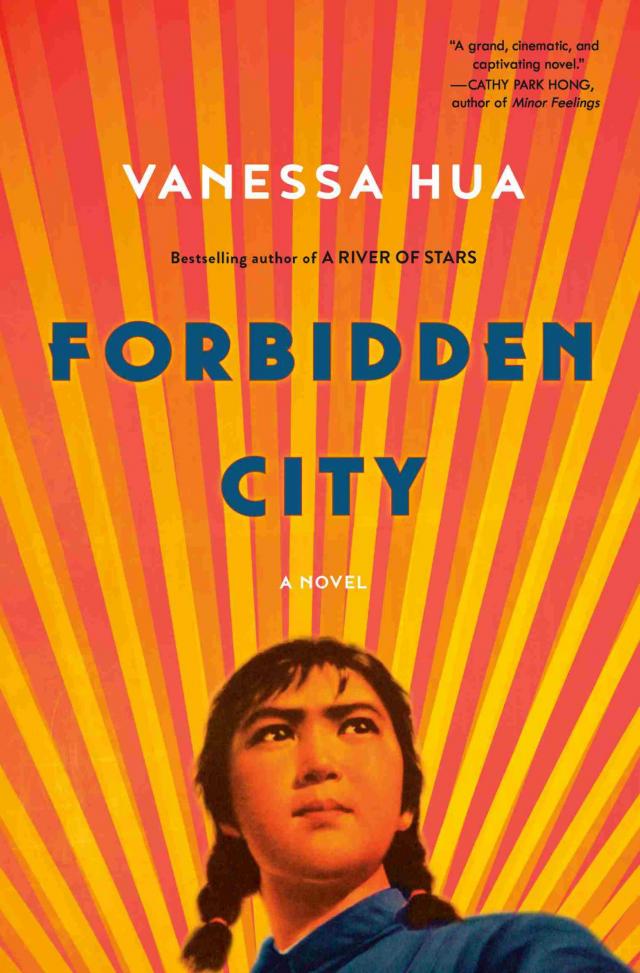
Cover images: Colaimages/Alamy (woman), Jiuji Iv/Alamy (background)
ep_prh_6.0_139899382_c0_r0
Contents
Cover
Title Page
Copyright
Prologue
1965
Chapter 1
Chapter 2
Chapter 3
Chapter 4
Chapter 5
Chapter 6
Chapter 7
Chapter 8
Chapter 9
Chapter 10
Chapter 11
Chapter 12
Chapter 13
Chapter 14
Chapter 15
Chapter 16
Chapter 17
Chapter 18
Chapter 19
1966
Chapter 20
Chapter 21
Chapter 22
Chapter 23
Chapter 24
Chapter 25
Chapter 26
Chapter 27
Chapter 28
Chapter 29
Chapter 30
Author’s Note
Dedication
Acknowledgments
By Vanessa Hua
About the Author
PROLOGUE
The Chairman is dead.
September 9, 1976. Outside, the people of Chinatown are cheering. They light firecrackers and beat pots and pans, chanting as they march three floors below the window of my apartment in San Francisco. Their signs say, smash the emperor! and smash the party! Drips of paint spoil the sweep and curve of the characters, bleeding as if shot.
The cheering swells, the revelers giddy with rice wine and easy victory. No longer will they whisper the Chairman’s name, afraid of his reach here across the ocean to America. No longer will they invoke his name to scare their children, or as a curse against their enemies.
They didn’t hate the Chairman at first—none of us did. In the beginning, he was the beginning. He dared us to make the sun and moon shine in new skies, to end hunger and superstition in China, to end all that made us weak.
The radio crackles with another update, calling him “Father of the Chinese Revolution…an obscure peasant who died one of history’s great revolutionary heroes. Despite criticism from other party leaders, he ordered the Great Leap Forward, ultimately causing widespread disruption and food shortages. Throughout his years in power, he toppled one rival after another in the Party. In the Cultural Revolution, he risked throwing the country into chaos…”
I switch off the radio, shaken each time I’m reminded how those outside of China knew more—and knew more quickly—than the people within.
Turning away from the window, I get dressed in my restaurant uniform. After smoothing down my red satin shirt, I fasten the frog closures, feeling the pinch at my neck. The Ming dynasty springs eternal at the Jade Dragon, the oldest banquet hall in the neighborhood. In the mirror, I’m hard lines everywhere but my chest. As I tie back my hair into a ponytail, my muscles pull tight, and my breasts push against my shirt. Here my awkward younger self emerges, put on display. Although I might appear strong and sure-footed, versions of me compete within: A clumsy peasant. A straight-backed revolutionary. A doubting missionary.
In Chinatown, many lies are born from necessity. Some of us arrive in America with false identities and fake papers. Others alter their ages on their paperwork: Teenagers pose as younger than they are to gain a year’s advantage in school, while their parents add a year or two on their official records to move themselves that much closer to the benefits of retirement. They may change their birth date to a more auspicious and memorable date: New Year’s Eve or the Fourth of July. Some invent stories about the riches they lost in China: the fine silks, the jade cups, all that the Chairman took. Far from home, in the city we call Gold Mountain, every peasant has a chance to transform into nobility, to have served as brave soldiers at the right hand of the highest commanders. Our imaginations give us what life never could.
If you saw me now, would you recognize me? The Chairman turned neighbors into strangers. No one in Chinatown knows my name. The other day, a customer told me that I looked like the girl from the movie musical Flower Drum Song.
“The nightclub singer?” her husband asked.
“The other one. The lead, the one who stowed away from China to San Francisco. I think her name was Mei?” She aimed her bulky camera at me. “May I take your photo, Mei?” she said, laughing at her joke, not realizing that she had hit upon my name. I ducked my head, feigning shyness to avoid the camera. Same sound, different meanings. May, for the permission I never granted. May, for possibilities that once seemed boundless. And May, for the month of green bursting and blooming that feels long gone.
Though my shift won’t start until later this afternoon, I hurry out. On the narrow steep stairs, where the overhead light has burned out again, I brace my hand on the peeling wallpaper, laden with the scent of old grease.
When the throng at my doorstep surrounds me, I push back, trying not to give in to the crush, in to the heat of their breath, and their hands on my shoulders. But my legs go weak at this unexpected pleasure of the masses, so long gone.
A man with permed curls smears a kiss on my face. “My treasure, my treasure,” he coos as if I’m a child or a whore. I shove him away. Entering the scent of spent firecrackers, heavy and sharp, I duck into an alley. My feet slap against the street slick with garbage, each step taking me farther from you.
I’ve wondered how people might treat me if they knew the truth. The curses and threats I’ve imagined seem more real than my life here, and sometimes, I’ve felt as if I were standing outside myself, watching a stranger with my face. For more than a decade, I have harbored my own secrets, trying to forget. Even you. Sometimes it feels I have entered my secrets so fully that I’ve lost the ability to speak them.
I hope you can forgive me.
The past always returns in the smallest reminders—in the musty scent of the yellowing newspapers stacked in my apartment, in the bitter taste of tea steeped for too long, or in the tremors of an old bachelor’s liver-spotted hand. With the death of the Chairman, my memories of him are coming back stronger—in a reckoning that’s long overdue.
We met the year I turned sixteen.
CHAPTER 1
The Party official arrived in early summer, the rumble of his jeep echoing along the rutted road. Vehicles didn’t often travel through our narrow valley, still as remote as in the days when news of an emperor’s passing arrived years afterward. I leaned on my hoe, my shoulders aching. Beside me, my two sisters had also stopped working, listening until the sound drew so close that we ran in from the fields, joining the shouts and cries of excitement.
We halted at the sight of the jeep parked in the plaza, its red flags rippling with importance on the hood. The official spoke with the headman, who pointed at a neighbor, at me, at each girl in the cultural work troupe, and gestured to a spot by the acacia tree.
“Line up. Quickly, now. Don’t keep Secretary Sun waiting,” the headman barked. He had a squat neck and a body powerful in its flab. He was curt as usual, but seemed apprehensive, shifting around on his feet. As I took my place, my blood jittered.
A dozen of us performed patriotic songs and skits on festival days. With few entertainments in the village, we always drew an audience, but we hardly seemed worthy of a Party official.
Secretary Sun had the look of a serpent,
I tried not to fidget. Perhaps he wanted to consider our troupe for a special performance in the city? Or maybe he was checking whether the lessons from the capital had made their way here.
My father, sitting beneath the acacia, tipped the brim of his hat at me, and I hitched up my sagging pants, hand-me-downs from my sisters that were short and threadbare.
Secretary Sun walked along the line, his steps slow and precise, pausing before each girl: the bony ones, the short ones, the village beauty renowned for her deep dimples and petal-soft skin. At last, he stopped at me.
All of us had volunteered for the troupe to get out of field work, but we hadn’t practiced in months. Ten thousand hours of rehearsals wouldn’t have improved our performances. Only my neighbor, who accompanied us on his bamboo flute, possessed any talent. With a nod at us, Fatty Song played an old tune, one that my grandparents had hummed as children about the long days of summer, of sunshine and dreams. The words had been changed and put into the service of the people.
As we sang about victory and freedom, we acted out each verse. We raised our arms above our heads, to imitate the sun rising from the east—the east, where the dawn, where revolution began. I stretched as high as I could, a taut line from my toes to the tips of my fingers, and set my jaw, trying to look fierce. When I glimpsed the girl beside me, though, I almost laughed out loud—her face squinched up as if she was suppressing a gigantic sneeze. Then I faltered, wondering if I might look like her.
Afterward, we lined up again. Our shuffling feet had kicked up the tickling scent of chickens, dust, and straw. Taking my place at the end, I hunched over, panting, sweat dripping down my back. I was the tallest girl, broad-shouldered and gangly, awkward as a baby calf.
Secretary Sun examined each candidate for a second time. Everyone in my village shared the same surname, Song. Our neighbors knew my parents, had known my grandparents. They recognized the inherited shape of my ears, my temper, and my fate, and had me determined while I was still in the womb.
It was 1965, a time ripe with prospect, even if in my village, the buckets of night soil still turned rank and the Party’s painted slogans cracked in the heat. That year, our persimmon trees hung heavy and heady with fruit. In late autumn, we’d heap them into luminous piles, treasures rich as any robber-king’s.
Cicadas droned, their song monotonous yet haunting, punctuated by the flick of their wings. Such tiny creatures, yet together, they were deafening. To my left, my neighbor sucked on the end of her braid. To my right, another tugged on her tunic and rubbed her nose, covered by a glistening mole.
My two sisters, too old to volunteer to perform for the troupe, pushed to the front of the crowd. As the official looked over us again, I prayed to the Chairman, asking him to grant me the opportunity to serve. The people’s republic had been born the same year as me, and we were both still testing our limits, still ricocheting between extremes as we figured out who we would grow up to be.
Besides performing revolutionary songs, I could dig a ditch, spin wool, and demonstrate other skills that our leaders might want to review. I imagined the Chairman beaming, his hand outstretched, and mine reaching up to meet his. My looks didn’t matter, only my courage.
Female heroes were few but vivid in the tales we learned at school: A teenage spy beheaded after she rallied villagers against enemy soldiers. A factory worker burned to death after she stopped a huge fire. A peasant killed when she held together a collapsing kiln. I wanted the official to pick me for this duty and to separate me from the rest of the girls in the village, from everyone here. I wanted to live like a hero.
If the official didn’t select me, in a year I might get married. In time, I would have a baby, then another and another. I had to act now; it might be my only chance. Catching Headman Song’s eye, I floated my hands in a gesture only he would understand. I swiveled my head over the length of the crowd as if to say, I will tell everyone. When his mouth twitched, I knew he understood. Headmen elsewhere in Hebei province had been beaten for lesser offenses, for the people hungered to humble the powerful. To listen to their confessions, strip their authority, force them to clean latrines and catch flies in a jar. Even if only some believed the secret I held, the headman’s reputation would suffer, for such was the strength of accusation in those days.
The cicadas rose in pitch, a teeming, throbbing sound. Headman Song took the pipe from his mouth, turned to the official, and they spoke with their heads bowed.
When Secretary Sun returned and stopped in front of me, resting his hand on my shoulder, I didn’t shy away.
* * *
—
No one else in the village knew what I’d seen. Two years ago, a traveling musician had sought shelter here. Although he wore the same rough clothes as the rest of us, his pale skin glowed, and his high haunting voice silenced us in a performance fit for the Chairman. He sang of heroes, of a mischievous monkey king who rebelled against the heavens, while he plucked at a pipa, the melody spooling from his fingers. Every family volunteered to house the musician that night, for we’d never had such a remarkable visitor. Headman Song prevailed, and he moved his wife and four children to his brother’s home to provide quiet for his guest.
In the middle of the night, I slipped out and crept to the headman’s house in the hopes of another song. Instead I heard grunts, and through a crack in the front door, I saw their shadows on the wall come together and apart, flickering in the firelight. I moved away, but then peeked back in. The musician kneeled on all fours, the headman behind him. Their hands reached, touched, twined. As the headman let out a low moan, their rocking mesmerized me until both men had shuddered and gone still. I bumped against a stack of baskets. Though I caught them in time to keep the baskets from toppling over, the headman burst through the door, naked. His nipples, large and flat, were startling, an unblinking pair of eyes. Scowling, he gripped my wrists, and his body was heavy with a thick soapy smell. I didn’t scream, and after a long moment, he released me. He must have known I would keep his secret—until today, when I floated my hands as the traveling musician once did over the strings. Over the headman.
* * *
—
That night, Ba gave me the biggest portion of millet porridge, the one reserved for him. Our family sat cross-legged at the low table that rested upon the raised brick bed. When the nights chilled, we’d stoke fires in the hearth beneath the bed to keep us warm. My sisters watched, their faces pinched with hunger, with jealousy, as he plucked mushrooms drizzled with soy sauce from his own bowl and dropped them into my porridge. I inhaled the scent. Our village was famed for its soy sauce, its dark fermented flavors redeeming our bland, insubstantial meals. We fermented the sauce in giant urns, pungent proof that the simplest ingredients could be transformed with time. I pushed the mushrooms to the side of the bowl, saving them for last.
“Our Mei Xiang,” he said. Fragrant Plum Blossom.
I looked up. He almost never called me by my name. In our family—like all the families in our village—we referred to one another by our titles, by our roles: Ma and Ba, First, Second, and Third Daughters.
As the stove flickered low, Ba went outside, where he fell into a fit of coughing. He might have been trying to hide it from us; all of us pushed through our illnesses. The stinking herbal brews Ma prepared never cured us completely.
My sisters whispered together. Born less than a year apart, they were always together, crows perched on a roof. First Daughter probably hoped that the official would pass over me. We three shared part of our names, Mei, to show how we lived through the same generation: Mei Tian, Mei Ling, and Mei Xiang, all of us plum blossoms that opened in late winter, pink against the snow—all that was pure, strong, and reckless. Unlike me, my sisters were both dainty, with delicate features—brushstroke brows and long-lashed eyes like my mother’s. First Daughter—Mei Tian, five years older—had no patience for me. Second Daughter—Mei Ling—always tried to stop her bullying or found me after a blowup with the gift of a feather or a dried persimmon. But as much as I resented First Daughter, I also longed for the softness she reserved for our sister.





