The Bounty Hunters, page 4
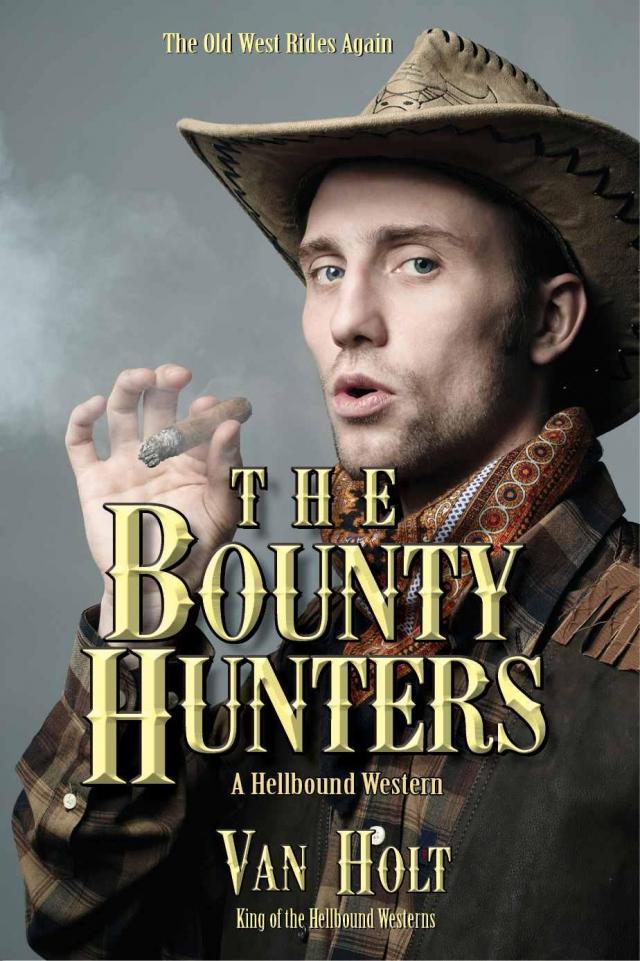


“Sure you do,” Colman said, lighting a long thin cigar. “I’m not sure what’s between you and Barney Pierce, but I know you don’t want anything to happen to him from the way you behaved on the stage. That’s why I thought we could do business. I’ll leave him alone if you’ll help me get the man who called himself Farley. He’s better known as Ben Travis, but I’m not sure that’s his real name.”
“How on earth could I help you get him, as you say?” Lorna asked.
Colman bent toward her and said softly, as if he did not want anyone else to hear, “Listen. Travis is heading toward the Staked Plains. He’s been leaving just enough trail for me to follow. But Travis don’t leave a trail unless he wants someone to follow it. Somewhere out on the Staked Plains that trail will disappear, but he thinks I’ll keep going the way he was headed, and while I’m drying up out there in that desert he’ll double back and head north or south. But I don’t know which and I can’t go both ways. That’s where you come in.”
Lorna Mason stared at him in amazement. “Are you asking me to become a manhunter, like you?”
Colman nodded, flicking his cigar ash in a cup someone had left on the table. “Either we both go after Travis, or I go after your friend Pierce.”
“That’s blackmail!” the woman said indignantly.
Colman smiled a very cold smile. “Yeah, I guess it is,” he said.
“What on earth could I do even if I found Ben Travis?” Lorna asked, still amazed and angry.
“Stay with him and send telegrams to me at a list of towns I’ll give you,” Colman said.
“What do you mean, stay with him?” Lorna Mason asked.
“Handle it however you like,” Colman said. “Just don’t let him give you the slip till I get there. If he leaves town, find some excuse to be on the same stage or train.”
The woman suddenly laughed. “You must be mad!” she exclaimed. “What you’re talking about could take months!”
“I can see the idea appeals to you,” Colman said relentlessly. “You may not like to think of yourself that way, but you’re that type of woman. You’ve already taken up with one man on the run, and if you thought you could, you’d trade him for Travis without blinking an eye. Any woman would. I saw how you looked at Travis at Twin Buttes when we were waiting for the stage and on the stage later when you didn’t think anyone was paying any attention. Then you’d look at Barney Pierce like you were comparing the two, and a blind man could see old Barney was in trouble.”
“You are crazy!” Lorna Mason said, blushing furiously. “Stark raving mad!”
“Correct me if I’m wrong,” Colman said. “Pierce had some idea Travis might be after him because he rode with the Grayson gang, and he left you behind to slow Travis down. The idea appealed to you, though I don’t reckon you admitted it to old Barney. But Travis didn’t fall for it, and now you’re stuck here wondering what to do next. Well, I can answer that question for you. Write Barney a letter and tell him you’ve got to work with me a while in order to save his hide. Send the letter wherever you agreed to meet him.”
“You don’t actually think I’m going to do it, do you?” Lorna Mason asked.
Colman looked her in the eye and said, “Yes, I do, Mrs. Mason. Not only that, you’re going to enjoy doing it.”
Colman headed south with every confidence that the woman would follow his instructions. As for himself, he meant to get to El Paso as quickly as possible and be waiting for Travis in case the latter showed up there. He had a hunch Travis would head for Arizona or possibly California by the southern route and if he did he would almost certainly go through El Paso. If he did not, maybe Lorna Mason would fasten onto him farther north, in Colorado or Utah. Travis was worth five thousand dollars dead or alive and one way or the other Colman meant to collect it.
He had planned everything very carefully. But one thing he had not figured on. That was the attitude Sam Grayson’s men would take toward an outsider poaching on what they considered their private hunting preserve. Some of them had already spent years, off and on, trying for the bounty on Travis and they were not in the mood to let some newcomer ride off with it.
Also unknown to Colman was the fact that at that very moment several members of the gang were hot on his trail—thinking, no doubt, that he was closing in on Travis.
He was so used to trailing other men that it never occurred to him that anyone might be following him, and so he paid little attention to his back trail. There were only a very few Comanches who still caused trouble and no Apaches had been seen this far east lately, so he did not feel in any real danger. As a rule outlaws avoided him as carefully as they would have avoided a hangman. But apparently the Grayson gang had not heard what a dangerous man he was. If they had, they did not let it bother them.
One day at dusk he halted on the open prairie to make a dry camp. He was barely out of the saddle when five riders bobbed over the hill behind him and cantered down the slope. He stayed near his horse—the only cover in reach—and carefully lit one of his thin cigars as he watched them ride up. He held the cigar in his left hand and watched them from beneath the brim of his black hat. They halted their horses in a line and looked him over, and in his mind’s eye he saw what they saw: a tall lean black-garbed man with heavy black brows over dark eyes and a black mustache that nearly hid his hard mouth. A tough, quiet, dangerous man, wearing a gleaming Colt in a tied-down holster.
At the same time he was watching them just as carefully. From his frequent study of wanted posters he knew most of their names and something of their characters and history. There was big, dark, fuzz-bearded “Coon” Hooks from Tennessee, son of a black slave woman and a white overseer. At fourteen he had murdered his white master and headed west, leaving a trail of blood. After going it alone for several years he had joined up with the Grayson gang in ‘73 and had risen to a position of prominence by being bigger, meaner, and louder than any of the others. Wanted for robbery, rape, murder and every other crime in the book, he was worth fifteen hundred dollars alive or dead and would have been worth more if he had been a white man.
“Pinky” Rudd, a red-haired man with a sunburnt face and bloodshot eyes, had strangled his wife before joining the gang.
Les Kerner, Whit Dexter, and Jud Yetman had equally unsavory reputations. Not a one of the five was worth less than a thousand dollars. Although he had decided not to try to collect on them as long as Sam Grayson was alive, Colman stored the thought away at the back of his mind.
It was Coon Hooks who said, “You duh one tryin’ get dat bounty money fuh Travis?”
“Who told you that?” Colman asked.
The mulatto’s scowl became more threatening. His big dark face congested with anger. “You duh one all right,” he said. “We come through dat town back dere”—he hooked a thumb over his shoulder—“and dey says you aftuh Travis too. What duh hell you tryin’ pull, boy? Don’t you knows we done been aftuh him it goin’ on yeahs now? Den when we finally catch up to him almost, you come in and try to get him yo’self. He done kill some o’ our friends too, man. Anybody gets him, it gonna be us.”
“Way I heard it, anyone can collect the bounty who gets Travis,” Colman said, keeping his voice quiet but strong and steady.
“You done heard wrong den,” Coon Hooks told him.
“Where’s Grayson?” Colman asked. “Maybe I’ll see what he’s got to say about it.”
“It ain’t none o’ yo’ business where Grayson at,” Hooks said. “How we know you won’t try collect duh reward on him? Or us, fuh dat matter? It what you does, ain’t it? Kills people fuh duh price on dere haids? How you like try dat on us?” As he said this, the mulatto almost smiled with malicious enjoyment. The other four watched Colman in stony silence, their eyes like daggers.
“I meant to leave you boys alone, if you leave me alone,” Colman said.
“Den you don’t be tryin’ fuh our meat, man,” Hooks told him. “Travis belong to us. Next time we catch you tryin’ come aftuh him, we leave you fuh duh buzzards.”
With that the five outlaws rode around Colman and raised a cloud of dust heading south. He smoked his cigar and watched them go, his heavy black brows lowered in a dark scowl. No one told Link Colman what he could do and what he couldn’t, least of all a half-nigger ape like Coon Hooks.
At that moment Link Colman discovered that he was a racist and that it made him feel good to admit it, despite his own Indian blood.
Chapter 5
On a windy afternoon in November, a tall man with pale copper-gold hair and gray-blue eyes was riding a rangy bay horse through an open pine forest. He was wearing a gray hat, a duck jacket with a corduroy collar and butternut trousers. A cartridge belt was buckled about his lean waist and the gun in the holster was an open-top Colt .44 with a walnut stock and a seven-and-a-half-inch barrel. The gun had been altered from rimfire to centerfire by changing the hammer. It was called an open-top Colt because it did not have a strap over the cylinder. Some guns of this type had Army stocks, but this one had the smaller Navy stock, which was the same size as that of the 1873 Colt Peacemaker. Everyone said the Peacemaker was a better gun, but the man with the copper-yellow hair preferred the 1872 model. It was more like the old Army Colt that he had carried before metallic cartridge revolvers became available.
He had buried that old gun somewhere, along with the name of the boy who had killed three men with it. He had thought for a time that he had buried the boy as well. But he had been mistaken. He had only buried a name. Inside he was still the same man. It did not matter what name he used. Dan Britton, Ben Travis, Rex Farley. It didn’t matter. He might fool others, for a time, but he could no longer fool himself. And he no longer tried to.
In one sense, his solitary existence had become amazingly simple and uncomplicated. He had thrown away everything he did not need, and that included hopes and dreams that would have merely tormented him because he knew they could never be realized. His life had narrowed down to one thing—self-preservation. But to him self-reservation meant more than just staying alive. It also meant surviving with self-respect and dignity. It no longer mattered much what others thought of him. But it mattered a great deal what he thought of himself. He might break, but he would never bend. He might lose his life, but he would keep his pride.
The wind hummed through the tall pines. The forest stretched on as far as he could see, scattered pines with little undergrowth to obstruct the view. But not far ahead there was a rocky hill covered with brush and trees, and beyond it a deep narrow valley that was heavily wooded. In this hidden valley stood the old cabin.
Travis circled around and approached the cabin from the far side, walking his horse through the trees. The bay’s hoofs made no sound on the carpet of pine needles, or at least none that could be heard above the gentle roar of the wind in the tree tops.
He halted on the ridge behind the cabin and studied the scene.
Below the cabin there was a shed and a pole corral. Through the trees he saw one horse in the corral and it was possible that there were others.
If he was not mistaken, the horse was the beautiful brown gelding that Chet Ramsey had raised from a colt. It did not surprise him that Ramsey had decided to come here after all. It was not unusual for the rancher to do the very thing he said he would not do.
Travis still did not ride in openly, disregarding the possibility of danger. He had not lived this long by being careless or taking anything for granted. He had cultivated the habit of seeming indifferent to his surroundings and what went on around him, but that was merely a pose designed to keep observers—even unseen observers—from thinking he had any cause to be worried or afraid. Even now there was nothing in his expression or his actions that might have given anyone a clue to his thoughts. No one would have guessed how much his calm, dreamy eyes saw or how much his ears heard.
After a while he saw Chet Ramsey circle the cabin with a rifle cradled in his arms, looking fearfully about—yet failing to see Travis sitting his horse on the ridge. Ramsey was one of those who always seemed to be looking but never saw much, while Travis saw a great deal without seeming to look. Presently the rancher hurried back around the cabin and slammed the door, as if his courage had deserted him.
Satisfied then that Ramsey was alone, Travis walked his horse down the slope whistling a little tune and dismounted at the corral. Keeping his back to the cabin, he stripped the saddle from the bay and took his time rubbing him down with a handful of grass.
Ramsey finally came out of the cabin with the rifle in his arms and watched him with bitter eyes, chewing his lower lip. The rancher blamed Travis for everything that had happened to him. “I been wondering when you’d show up,” he growled. It was not clear whether he was sorry to see Travis, or tired of waiting for him.
Travis glanced around at the older man, noticing how lined and haggard his unshaven face was. Ramsey looked like he had aged ten years in the past few weeks.
“You here alone?” Travis asked, glancing at Ramsey’s brown gelding, the only horse in the corral.
“I am now,” Ramsey said bitterly, his eyes damp.
He did not add anything and Travis did not ask any more questions. He turned the bay into the corral with the brown horse and took off his hat, running his fingers through his blond hair. He stood looking bleakly at the horses, not at Ramsey.
“Nita run off with that no-account Billy Primrose,” the rancher said bitterly. “In case you don’t recollect him, he was that kid come along with us after them horse thieves. I guess Nita told him where we were headin’. Anyhow, he followed us here and she run off with him. They took all the money I had in the house, close to a thousand dollars. I had most of it hid in case we were robbed or anything. Lucky thing I did too.”
Travis sighed, but did not say anything.
The rancher glanced at him out of the corner of his eye. “I’d go after them, but I ain’t got no idea where they went. I ain’t much good at huntin’ people. I never would of found them horse thieves without you. I was ready to go back, but you kept on goin’ and the rest of us followed you.”
Travis slowly put his hat back on. “If you want me to go after those two, you’ll have to say it this time. I don’t want any misunderstanding about it later.”
“All right, I’m sayin’ it,” the rancher grumbled. “You can take my horse. Yours don’t look too fresh.”
“I’ll take mine,” Travis said. “If anything happened to yours, I’d never hear the end of it.”
Billy Primrose sat in a small barbershop in Tucson, boredly glancing through an old newspaper while he waited for the single barber to finish trimming the crisp white hair of an elderly gentleman. There were half a dozen chairs lined up against the wall, but Billy’s was the only one occupied, so it would have to be his turn next.
Billy Primrose was a young man with a handsome boy’s face and heavy dark sideburns, wearing the flashiest clothes stolen money would buy.
The door opened letting in a gust of cold wind and he glanced up in irritation. His dark eyes widened in alarm when he saw Ben Travis standing there with his head bent slightly, cupping a match to a cigarette. He did not seem to notice Billy Primrose sitting only a few feet away, and the latter instinctively raised the newspaper in front of his startled face, trying to hide behind it.
“Have a seat, sir,” the barber said, smiling. “I’ll get to you right away.”
Travis silently nodded. He was not exactly smiling but there was a relaxed, friendly look on his smooth brown face. He got his cigarette going to his satisfaction, then held the match under Billy Primrose’s newspaper. In no time the thin newspaper began to smoke and a bright flame shot up it.
The barber, smiling one moment, looked horrified the next. “Hey, what are you doing?” he cried, and rushing over he snatched the blazing paper out of Primrose’s hands, threw it down and began to stamp on it. As for Primrose, he seemed too surprised to move or speak. He could only stare up at Travis with protruding round eyes.
“Where is she?” Travis asked quietly.
“Who?” Primrose grunted.
Travis’s mild expression did not change, and that made what he did next all the more shocking. He grabbed the front of Billy Primrose’s shirt, hauled him up out of the chair and slammed him back against the wall so hard the whole building shook and Primrose’s wild eyes almost rolled out of their sockets.
The white-haired old man in the barber’s chair watched them in amazement, and the barber waved his arms and cried, “You two settle that outside, whatever it is. I don’t want my place busted up.”
“Good idea,” Travis said in the same quiet, courteous tone he had used before.
He took Billy Primrose by the arm, opened the door for him and escorted him outside as if they were old friends. Then, in the busy square, Travis said in a soft deadly tone, “Tell me where she is or I’ll take you down an alley where we can talk more privately.”
Primrose jerked away from him and cried hoarsely, “What do you want with her? What’s it to you anyhow? I didn’t force her to come with me. She left because she wanted to. It was her own idea.”
“Just tell me where I can find her,” Travis said. “Better yet, take me to her. Start walking.”
“The hell with you!” Primrose said. “You ain’t my boss. And this ain’t any of your business.”
“You’re already in enough trouble, Billy boy,” Travis said quietly. “You stole a man’s money and ran off with his wife. Don’t make it any worse.”
Primrose glanced quickly about, then scowled and said, “All right, I’ll take you to her. But it won’t do no good. She won’t go back with you.”
“We’ll see,” Travis said quietly. “Let’s go. But don’t try to make a run for it. You’ve put me to enough trouble already.”
Primrose turned and started walking, looking about as if for an avenue of escape or someone to appeal to for help. Even now he walked with an unconscious swagger, having walked that way so long that it had become a habit. He had the face and manner of a handsome punk with an inflated opinion of himself. Walking a little behind him and to one side, Travis had an impulse to give him a good hard kick in the pants, but managed to restrain himself. There was no point in attracting attention.
“How on earth could I help you get him, as you say?” Lorna asked.
Colman bent toward her and said softly, as if he did not want anyone else to hear, “Listen. Travis is heading toward the Staked Plains. He’s been leaving just enough trail for me to follow. But Travis don’t leave a trail unless he wants someone to follow it. Somewhere out on the Staked Plains that trail will disappear, but he thinks I’ll keep going the way he was headed, and while I’m drying up out there in that desert he’ll double back and head north or south. But I don’t know which and I can’t go both ways. That’s where you come in.”
Lorna Mason stared at him in amazement. “Are you asking me to become a manhunter, like you?”
Colman nodded, flicking his cigar ash in a cup someone had left on the table. “Either we both go after Travis, or I go after your friend Pierce.”
“That’s blackmail!” the woman said indignantly.
Colman smiled a very cold smile. “Yeah, I guess it is,” he said.
“What on earth could I do even if I found Ben Travis?” Lorna asked, still amazed and angry.
“Stay with him and send telegrams to me at a list of towns I’ll give you,” Colman said.
“What do you mean, stay with him?” Lorna Mason asked.
“Handle it however you like,” Colman said. “Just don’t let him give you the slip till I get there. If he leaves town, find some excuse to be on the same stage or train.”
The woman suddenly laughed. “You must be mad!” she exclaimed. “What you’re talking about could take months!”
“I can see the idea appeals to you,” Colman said relentlessly. “You may not like to think of yourself that way, but you’re that type of woman. You’ve already taken up with one man on the run, and if you thought you could, you’d trade him for Travis without blinking an eye. Any woman would. I saw how you looked at Travis at Twin Buttes when we were waiting for the stage and on the stage later when you didn’t think anyone was paying any attention. Then you’d look at Barney Pierce like you were comparing the two, and a blind man could see old Barney was in trouble.”
“You are crazy!” Lorna Mason said, blushing furiously. “Stark raving mad!”
“Correct me if I’m wrong,” Colman said. “Pierce had some idea Travis might be after him because he rode with the Grayson gang, and he left you behind to slow Travis down. The idea appealed to you, though I don’t reckon you admitted it to old Barney. But Travis didn’t fall for it, and now you’re stuck here wondering what to do next. Well, I can answer that question for you. Write Barney a letter and tell him you’ve got to work with me a while in order to save his hide. Send the letter wherever you agreed to meet him.”
“You don’t actually think I’m going to do it, do you?” Lorna Mason asked.
Colman looked her in the eye and said, “Yes, I do, Mrs. Mason. Not only that, you’re going to enjoy doing it.”
Colman headed south with every confidence that the woman would follow his instructions. As for himself, he meant to get to El Paso as quickly as possible and be waiting for Travis in case the latter showed up there. He had a hunch Travis would head for Arizona or possibly California by the southern route and if he did he would almost certainly go through El Paso. If he did not, maybe Lorna Mason would fasten onto him farther north, in Colorado or Utah. Travis was worth five thousand dollars dead or alive and one way or the other Colman meant to collect it.
He had planned everything very carefully. But one thing he had not figured on. That was the attitude Sam Grayson’s men would take toward an outsider poaching on what they considered their private hunting preserve. Some of them had already spent years, off and on, trying for the bounty on Travis and they were not in the mood to let some newcomer ride off with it.
Also unknown to Colman was the fact that at that very moment several members of the gang were hot on his trail—thinking, no doubt, that he was closing in on Travis.
He was so used to trailing other men that it never occurred to him that anyone might be following him, and so he paid little attention to his back trail. There were only a very few Comanches who still caused trouble and no Apaches had been seen this far east lately, so he did not feel in any real danger. As a rule outlaws avoided him as carefully as they would have avoided a hangman. But apparently the Grayson gang had not heard what a dangerous man he was. If they had, they did not let it bother them.
One day at dusk he halted on the open prairie to make a dry camp. He was barely out of the saddle when five riders bobbed over the hill behind him and cantered down the slope. He stayed near his horse—the only cover in reach—and carefully lit one of his thin cigars as he watched them ride up. He held the cigar in his left hand and watched them from beneath the brim of his black hat. They halted their horses in a line and looked him over, and in his mind’s eye he saw what they saw: a tall lean black-garbed man with heavy black brows over dark eyes and a black mustache that nearly hid his hard mouth. A tough, quiet, dangerous man, wearing a gleaming Colt in a tied-down holster.
At the same time he was watching them just as carefully. From his frequent study of wanted posters he knew most of their names and something of their characters and history. There was big, dark, fuzz-bearded “Coon” Hooks from Tennessee, son of a black slave woman and a white overseer. At fourteen he had murdered his white master and headed west, leaving a trail of blood. After going it alone for several years he had joined up with the Grayson gang in ‘73 and had risen to a position of prominence by being bigger, meaner, and louder than any of the others. Wanted for robbery, rape, murder and every other crime in the book, he was worth fifteen hundred dollars alive or dead and would have been worth more if he had been a white man.
“Pinky” Rudd, a red-haired man with a sunburnt face and bloodshot eyes, had strangled his wife before joining the gang.
Les Kerner, Whit Dexter, and Jud Yetman had equally unsavory reputations. Not a one of the five was worth less than a thousand dollars. Although he had decided not to try to collect on them as long as Sam Grayson was alive, Colman stored the thought away at the back of his mind.
It was Coon Hooks who said, “You duh one tryin’ get dat bounty money fuh Travis?”
“Who told you that?” Colman asked.
The mulatto’s scowl became more threatening. His big dark face congested with anger. “You duh one all right,” he said. “We come through dat town back dere”—he hooked a thumb over his shoulder—“and dey says you aftuh Travis too. What duh hell you tryin’ pull, boy? Don’t you knows we done been aftuh him it goin’ on yeahs now? Den when we finally catch up to him almost, you come in and try to get him yo’self. He done kill some o’ our friends too, man. Anybody gets him, it gonna be us.”
“Way I heard it, anyone can collect the bounty who gets Travis,” Colman said, keeping his voice quiet but strong and steady.
“You done heard wrong den,” Coon Hooks told him.
“Where’s Grayson?” Colman asked. “Maybe I’ll see what he’s got to say about it.”
“It ain’t none o’ yo’ business where Grayson at,” Hooks said. “How we know you won’t try collect duh reward on him? Or us, fuh dat matter? It what you does, ain’t it? Kills people fuh duh price on dere haids? How you like try dat on us?” As he said this, the mulatto almost smiled with malicious enjoyment. The other four watched Colman in stony silence, their eyes like daggers.
“I meant to leave you boys alone, if you leave me alone,” Colman said.
“Den you don’t be tryin’ fuh our meat, man,” Hooks told him. “Travis belong to us. Next time we catch you tryin’ come aftuh him, we leave you fuh duh buzzards.”
With that the five outlaws rode around Colman and raised a cloud of dust heading south. He smoked his cigar and watched them go, his heavy black brows lowered in a dark scowl. No one told Link Colman what he could do and what he couldn’t, least of all a half-nigger ape like Coon Hooks.
At that moment Link Colman discovered that he was a racist and that it made him feel good to admit it, despite his own Indian blood.
Chapter 5
On a windy afternoon in November, a tall man with pale copper-gold hair and gray-blue eyes was riding a rangy bay horse through an open pine forest. He was wearing a gray hat, a duck jacket with a corduroy collar and butternut trousers. A cartridge belt was buckled about his lean waist and the gun in the holster was an open-top Colt .44 with a walnut stock and a seven-and-a-half-inch barrel. The gun had been altered from rimfire to centerfire by changing the hammer. It was called an open-top Colt because it did not have a strap over the cylinder. Some guns of this type had Army stocks, but this one had the smaller Navy stock, which was the same size as that of the 1873 Colt Peacemaker. Everyone said the Peacemaker was a better gun, but the man with the copper-yellow hair preferred the 1872 model. It was more like the old Army Colt that he had carried before metallic cartridge revolvers became available.
He had buried that old gun somewhere, along with the name of the boy who had killed three men with it. He had thought for a time that he had buried the boy as well. But he had been mistaken. He had only buried a name. Inside he was still the same man. It did not matter what name he used. Dan Britton, Ben Travis, Rex Farley. It didn’t matter. He might fool others, for a time, but he could no longer fool himself. And he no longer tried to.
In one sense, his solitary existence had become amazingly simple and uncomplicated. He had thrown away everything he did not need, and that included hopes and dreams that would have merely tormented him because he knew they could never be realized. His life had narrowed down to one thing—self-preservation. But to him self-reservation meant more than just staying alive. It also meant surviving with self-respect and dignity. It no longer mattered much what others thought of him. But it mattered a great deal what he thought of himself. He might break, but he would never bend. He might lose his life, but he would keep his pride.
The wind hummed through the tall pines. The forest stretched on as far as he could see, scattered pines with little undergrowth to obstruct the view. But not far ahead there was a rocky hill covered with brush and trees, and beyond it a deep narrow valley that was heavily wooded. In this hidden valley stood the old cabin.
Travis circled around and approached the cabin from the far side, walking his horse through the trees. The bay’s hoofs made no sound on the carpet of pine needles, or at least none that could be heard above the gentle roar of the wind in the tree tops.
He halted on the ridge behind the cabin and studied the scene.
Below the cabin there was a shed and a pole corral. Through the trees he saw one horse in the corral and it was possible that there were others.
If he was not mistaken, the horse was the beautiful brown gelding that Chet Ramsey had raised from a colt. It did not surprise him that Ramsey had decided to come here after all. It was not unusual for the rancher to do the very thing he said he would not do.
Travis still did not ride in openly, disregarding the possibility of danger. He had not lived this long by being careless or taking anything for granted. He had cultivated the habit of seeming indifferent to his surroundings and what went on around him, but that was merely a pose designed to keep observers—even unseen observers—from thinking he had any cause to be worried or afraid. Even now there was nothing in his expression or his actions that might have given anyone a clue to his thoughts. No one would have guessed how much his calm, dreamy eyes saw or how much his ears heard.
After a while he saw Chet Ramsey circle the cabin with a rifle cradled in his arms, looking fearfully about—yet failing to see Travis sitting his horse on the ridge. Ramsey was one of those who always seemed to be looking but never saw much, while Travis saw a great deal without seeming to look. Presently the rancher hurried back around the cabin and slammed the door, as if his courage had deserted him.
Satisfied then that Ramsey was alone, Travis walked his horse down the slope whistling a little tune and dismounted at the corral. Keeping his back to the cabin, he stripped the saddle from the bay and took his time rubbing him down with a handful of grass.
Ramsey finally came out of the cabin with the rifle in his arms and watched him with bitter eyes, chewing his lower lip. The rancher blamed Travis for everything that had happened to him. “I been wondering when you’d show up,” he growled. It was not clear whether he was sorry to see Travis, or tired of waiting for him.
Travis glanced around at the older man, noticing how lined and haggard his unshaven face was. Ramsey looked like he had aged ten years in the past few weeks.
“You here alone?” Travis asked, glancing at Ramsey’s brown gelding, the only horse in the corral.
“I am now,” Ramsey said bitterly, his eyes damp.
He did not add anything and Travis did not ask any more questions. He turned the bay into the corral with the brown horse and took off his hat, running his fingers through his blond hair. He stood looking bleakly at the horses, not at Ramsey.
“Nita run off with that no-account Billy Primrose,” the rancher said bitterly. “In case you don’t recollect him, he was that kid come along with us after them horse thieves. I guess Nita told him where we were headin’. Anyhow, he followed us here and she run off with him. They took all the money I had in the house, close to a thousand dollars. I had most of it hid in case we were robbed or anything. Lucky thing I did too.”
Travis sighed, but did not say anything.
The rancher glanced at him out of the corner of his eye. “I’d go after them, but I ain’t got no idea where they went. I ain’t much good at huntin’ people. I never would of found them horse thieves without you. I was ready to go back, but you kept on goin’ and the rest of us followed you.”
Travis slowly put his hat back on. “If you want me to go after those two, you’ll have to say it this time. I don’t want any misunderstanding about it later.”
“All right, I’m sayin’ it,” the rancher grumbled. “You can take my horse. Yours don’t look too fresh.”
“I’ll take mine,” Travis said. “If anything happened to yours, I’d never hear the end of it.”
Billy Primrose sat in a small barbershop in Tucson, boredly glancing through an old newspaper while he waited for the single barber to finish trimming the crisp white hair of an elderly gentleman. There were half a dozen chairs lined up against the wall, but Billy’s was the only one occupied, so it would have to be his turn next.
Billy Primrose was a young man with a handsome boy’s face and heavy dark sideburns, wearing the flashiest clothes stolen money would buy.
The door opened letting in a gust of cold wind and he glanced up in irritation. His dark eyes widened in alarm when he saw Ben Travis standing there with his head bent slightly, cupping a match to a cigarette. He did not seem to notice Billy Primrose sitting only a few feet away, and the latter instinctively raised the newspaper in front of his startled face, trying to hide behind it.
“Have a seat, sir,” the barber said, smiling. “I’ll get to you right away.”
Travis silently nodded. He was not exactly smiling but there was a relaxed, friendly look on his smooth brown face. He got his cigarette going to his satisfaction, then held the match under Billy Primrose’s newspaper. In no time the thin newspaper began to smoke and a bright flame shot up it.
The barber, smiling one moment, looked horrified the next. “Hey, what are you doing?” he cried, and rushing over he snatched the blazing paper out of Primrose’s hands, threw it down and began to stamp on it. As for Primrose, he seemed too surprised to move or speak. He could only stare up at Travis with protruding round eyes.
“Where is she?” Travis asked quietly.
“Who?” Primrose grunted.
Travis’s mild expression did not change, and that made what he did next all the more shocking. He grabbed the front of Billy Primrose’s shirt, hauled him up out of the chair and slammed him back against the wall so hard the whole building shook and Primrose’s wild eyes almost rolled out of their sockets.
The white-haired old man in the barber’s chair watched them in amazement, and the barber waved his arms and cried, “You two settle that outside, whatever it is. I don’t want my place busted up.”
“Good idea,” Travis said in the same quiet, courteous tone he had used before.
He took Billy Primrose by the arm, opened the door for him and escorted him outside as if they were old friends. Then, in the busy square, Travis said in a soft deadly tone, “Tell me where she is or I’ll take you down an alley where we can talk more privately.”
Primrose jerked away from him and cried hoarsely, “What do you want with her? What’s it to you anyhow? I didn’t force her to come with me. She left because she wanted to. It was her own idea.”
“Just tell me where I can find her,” Travis said. “Better yet, take me to her. Start walking.”
“The hell with you!” Primrose said. “You ain’t my boss. And this ain’t any of your business.”
“You’re already in enough trouble, Billy boy,” Travis said quietly. “You stole a man’s money and ran off with his wife. Don’t make it any worse.”
Primrose glanced quickly about, then scowled and said, “All right, I’ll take you to her. But it won’t do no good. She won’t go back with you.”
“We’ll see,” Travis said quietly. “Let’s go. But don’t try to make a run for it. You’ve put me to enough trouble already.”
Primrose turned and started walking, looking about as if for an avenue of escape or someone to appeal to for help. Even now he walked with an unconscious swagger, having walked that way so long that it had become a habit. He had the face and manner of a handsome punk with an inflated opinion of himself. Walking a little behind him and to one side, Travis had an impulse to give him a good hard kick in the pants, but managed to restrain himself. There was no point in attracting attention.