

Final Notice, page 5
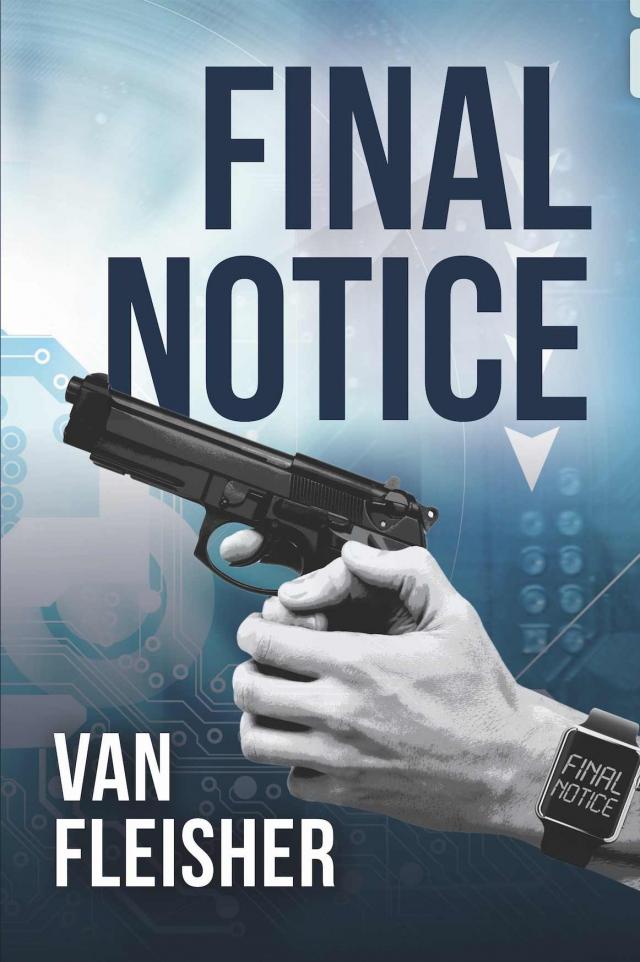


Earl was still not sure why he said yes. Perhaps it was the money, but perhaps it was because he was being included in a small group, made to feel special and belonging to something. The requirements had been simple, and they gave him a watch, although it did a lot of things that Earl didn’t understand. They also gave him a pay-as-you-go smartphone. It had been a while since he’d had a cell phone. After he turned 65, his Social Security pension and Veteran’s Benefit were enough to live on if he watched his spending, and a few extra beers were more important than a big cell phone bill, especially since he rarely used it. The doctor helped him set up the VT2 App which would capture the watch readings and transmit data to the manufacturer. Earl asked Sally Ann, the apartment complex manager, to help him set up the internet connection.
Sally Ann and Earl got along well, even very well from time to time, although she didn’t want anyone to know it. It suited him just fine. He didn’t need a social entanglement, just sex, and he was pretty sure Sally Ann felt the same way. Lately, though, he didn’t feel like either. His stomach pain re- occurred a few times, even worse than before, but the doctor had prescribed a number of the relaxant pills on the initial visit and he never used them all, so he coped without needing to go back to the ER.
As he sat there on his 66th birthday, Earl felt his watch buzz. He looked at the message scrolling across the watch screen: “This is your FINAL NOTICE. You have 1 week. Call your doctor.” If you had asked Earl, he wouldn’t be able to tell you his exact feelings at that point. Was it fear? Loss? Relief? He remembered talking with a woman from VT2 that if this notice appeared, he should call his doctor to see if help was available, as his final days passed. At about the same time, Earl’s stomach began contracting and the pain was far worse than ever. He grabbed the pill bottle and swallowed the remaining two. He then took a beer from the fridge, even if it was before noon, and chugged it as best he could with the pain raging.
He sat there breathing deeply as the pills began their magic. Another beer was opened and downed. Earl went into the bedroom and removed his pistol from the bedside table drawer. It was one of his few possessions, a souvenir from Nam that he had purchased during one of Saigon’s calmer days, a MAC Mle1950 pistol that had been used by the French Army when they took their beating from the Cong. He shot it on rare occasions, and it was well taken care of, as he had few other things to look after. He carried the gun out to the kitchen, downed his last beer. He switched off the safety, put the barrel in his mouth and ended what was left of his life.
It was three days later before Sally Ann used her master key to check on Earl after she repeatedly got no response to her knocks. She found him slumped over a kitchen table covered in dry, almost blackish blood. She was sorry but not surprised. She liked Earl. Liked him a lot, but he would never let her get close. Or was that her? They were like two magnets that could attract and repel, depending on the alignment. When the police asked her if she had any thought about why he did it, she simply said, “It was the logical outcome.
The police left with the gun, VT2 watch and smart phone, which, other than Earl’s very small collection of clothes, represented all of his possessions.
***
Pasadena, California. Vince was surfing, looking for geriatric hit men, when he came across the following article, headlined:
“85-YEAR-OLD MAN KILLS STORE CASHIER.” He read on. “An 85-year-old man shot and killed a 25-year old cashier at a local store in Joplin, Missouri on Saturday. Witnesses said the man walked into the store, shot the cashier, and walked out. It did not appear to be a robbery nor was there any altercation between the man, identified as Quentin Moore, and the cashier, Stephen Kinsead.
“According to a Joplin Police spokesperson, although Moore left the store, a witness identified him, and police were dispatched to his home. He was found dead. The family doctor, called to the home, said it appeared to be from natural causes, possibly a heart attack. The weapon was found, and it was matched to the fatal shooting.
“Sharon Moore, the suspect’s wife, said that her husband had been looking at his smartphone and then suddenly said, ‘I need to go out for a little while.’ He seemed upset. When he returned, he went straight to their bedroom saying that he needed to lie down.
“Police are questioning witnesses, looking for a possible motive.”
“Trudi, come read this article.”
“What is it?”
“Read it. 85-year-old man kills store cashier.” Vince turned the laptop around. Trudi sat down, adjusted her glasses and read the article. When she finished, she sat there silently, thoughts swirling through her head.
Impatiently, Vince asked, “Well, what do you think?”
“I feel overwhelmed, like I’m on the inside of something that nobody is getting. First the talk amongst my friends about getting guns. Then that man in Arizona, and now this?”
“It’s probably just coincidence. There are just these two incidents.”
“You’re probably right, but when I read that article a strange feeling came over me like I knew something. An intuition.”
“I’ll do some more surfing today and see if I can find anything ... any more incidents.”
“Good idea, but we need to set up a schedule, so I get some surf time.”
“Seriously? But remember, I can search your browsing history to see if you’re looking up porn.”
“I don’t need porn. I get together with my friends all the time for some great Chippendale parties!” Trudi parried playfully.
Vince stood up abruptly, “I’m outta here. I’ll take Miles for a walk to try and clear my head of that vision!”
“Even if it were true, what would be wrong with that?”
“What if I stop off at that adult bar in Sepulveda with the all- college-girl lap dancers?”
“They really have that? College girl lap-dancers? I wonder if they get a scholarship or something?”
“I think the ‘or something’ is a job as a lap dancer.”
They both laughed and Trudi said, “Have a nice walk and Miles, you keep your Daddy out of trouble.” Miles stayed neutral and refused to comment.
“Thanks. The Mac is all yours!”
***
FBI Headquarters, Washington, DC. Adam Winters was an analyst with the Violent Crime section of the FBI. Guns played a big role in violent crime and one of Adam’s tasks was to try to keep the FBI ahead of issues, rather than simply tracking down suspects after a crime had been committed. Two items recently flagged his attention in his continual news search: the NRA Senior Discount for guns, and a move by a number of states to eliminate a history of mental illness as a disqualification for gun ownership. Adam knew that the ‘over 65’ ownership of guns was the largest demographic segment in the country and that ageing brings along with it additional mental issues. Current information on the prevalence of gun mishaps amongst seniors was not available and Adam was concerned that the combination of these two moves would result in an increase of problems.
Not long after he had put a watching brief on any news involving guns and seniors, news of two occurrences was picked up: One in Arizona and one in Missouri. As Missouri was one of the states moving to liberalize gun ownership to include those with mental health histories, it was decided to have the Kansas City field office pick up the lead.
***
CHAPTER 6 - FBI NOTES: QUENTIN MOORE
Joplin, Missouri. FBI Special Agent Brouet thought about the Joplin incident one more time before getting out of her rental car: an 85-year-old man walks into a store and shoots and kills a 25-year-old cashier in Joplin, Missouri on Saturday. According to witnesses and corroborated by the surveillance video, the man walked in, shot the cashier and walked out. There was no interaction between the two and it did not appear to be a robbery attempt.
Police found the suspect dead at his home, from natural causes, possibly a heart attack. A weapon found at the suspect’s home matched the murder weapon.
The suspect’s wife told the police that her husband had looked at his phone, went up to their bedroom, and then left suddenly. When he returned, he seemed upset, saying that he needed to lie down.
Zoe gathered her thoughts and her briefcase and rang the bell of Mrs. Sharon Moore’s neat, light green bungalow.
Sharon Moore opened the door to see a striking young woman. She was short but very athletic looking, with tawny-colored skin, almost black hair and exotic, dark, almond-shaped eyes.
“Hello Mrs. Moore. I’m Agent Zoe Brouet, FBI. I’m sorry to bother you and I know you’ve been questioned a lot by the local police. I have transcripts of all that, so we don’t have to waste your time going over everything again, but I have some additional questions.”
Agent Brouet had all the details that the Joplin PD had gathered. Address of the shooting, time, names of shooter, victim and witnesses, weapon used, etc. But there didn’t appear to be a motive and well, there were a couple of other concerns. There was, of course, the FBI’s ongoing concern about the effect of the NRA Senior Discount; and about Missouri’s recent legislation removing virtually any requirement for a background check to obtain a concealed carry permit. And then, there was the comment about looking at his phone.
Mrs. Moore replied, as she let Zoe in and led her to the living room, “OK, but I’ve told them everything that happened.”
“I’m sure you have and thank you for your help. You told the police that your husband was looking at his phone and seemed upset. When we checked his emails and messages, there did not appear to be anything that would trigger a reaction like that. Correct?”
“Yes, that’s correct, but it seemed like he was looking at his phone a lot more recently.”
“Did he say anything about why or what it might be?“
“No. It could have something to do with a new watch he got. His increased attention to his phone seemed to coincide with his getting the watch.”
“A watch?”
“Yes. One of those sport watches.”
“Can I see it?”
“Sure. Let me get it.”
“Do you have his phone, too?”
“Yes, I’ll bring it down.”
Mrs. Moore returned with a black watch and the latest iPhone. Zoe eyed the phone and tried to frame her question tactfully. She recalled the difficulty she and others had when her department switched over to an ultra-hi-tech paperless system. “I’m impressed. This is the latest iPhone and your husband was 85. How did he learn or keep up with the new technology?”
“Quentin was one of the digital pioneers and was always working on the next big thing. He was one of Apple’s top engineers before he retired and moved here.”
Zoe examined the sport watch. She knew they could do a number of calculations like count steps, distances, stopwatch functions, etc., but that’s as far as it went. The brand or logo was VT2. Both the watch and iPhone were dead after a week without charging. Zoe asked, “Can I take these with me to have our techies check them out?”
“Sure. What do you think you’ll find?”
Zoe didn’t really know, but Mrs. Moore’s comment that her husband seemed attentive to the watch and phone around the time of the shooting had piqued her interest. “Not sure, but there are a lot of unanswered questions with respect to your husband’s actions and we want to get to the bottom of it. Is there anything else you can add about what happened? Had you or your husband been to the KwikServe store on Joplin Avenue before the incident?”
“Yes, and now that you mention it, that was odd.”
“Odd? In what sense?”
“About three months ago, Quentin came home after buying a few things at KwikServe. He was furious and muttering about a young cashier there who had insulted him. Apparently when Quentin tried to pay his bill with Apple Pay, there was a problem. The cashier called him an old geezer who shouldn’t be playing with new technology. Quentin exploded and told the kid that he was involved with developing it. He was so upset that I made him promise me that he would never go back there.”
“And did he stick with his promise?”
“Yes, as far as I was aware, at least before the last time.” She
teared up and wiped her nose with a tissue.
“Do you know if the cashier that Quentin shot was the same one that upset him earlier?”
“I have no idea. I hadn’t thought about that.”
“Mrs. Moore, was Quentin depressed or did he show any signs
of … unusual behavior?”
“Perhaps he was a bit more withdrawn, but otherwise, I didn’t notice anything different about him.”
“Is there any way you can tell me what date Quentin had the encounter with the clerk that made him so angry?”
“Unless the problem he had with Apple Pay caused him to pay cash, he probably charged it, so I can check our credit card bills. I’ll have to dig around, so can I do it later and get back with you?”
“Sure. Here’s my card and number. Before I go, one more question. In addition to the gun that Quentin used, the police found another gun. The one he used is very new, purchased just last month and the other one is over 10 years old. Do you know why Quentin bought a new gun?”
“You know, I think he was motivated because of an NRA Seniors promotion. There was a big discount for seniors and he was a sucker for new things and good deals. I remember kidding Quentin about buying something just because there was a discount and told him that I hoped Harley Davidson didn’t come up with a big promotion on motorcycles.”
They both smiled.
“And sorry, one last one and I’m gone. How was Quentin’s health?”
“He had congestive heart failure, which sounds pretty scary, but it seemed to be under control through his medication. Dr. Felder, our family doctor, saw him regularly and said the rate of deterioration was slow.”
“I plan to see Dr. Felder, but you felt he was okay? Were you surprised then, at his sudden death?”
“Well, yes, but I guess I felt whatever happened that made him do that, that shooting, pushed him over the edge medically, as well.”
“Thank you very much, Mrs. Moore. You’ve been a big help. We’ll check the watch and phone out and get them back to you as soon as possible. And in the meantime, if you think of anything else, please give me a call.” She gave Mrs. Moore a receipt for the watch and iPhone.
Looking at her card, Sharon said, “I will, Special Agent Brouet. Good bye.”
As Zoe walked out, she felt her pulse rise with excitement. She looked at her watch and decided to try to see Dr. Felder before she returned to Kansas City.
Zoe told Dr. Felder’s receptionist that it was important that she speak with the Doctor and that it wouldn’t take long. The receptionist said she’d be right back, returning almost immediately to say that Dr. Felder would see her as soon as he finished with his current patient.
Not more than 15 minutes later, Zoe was shown in to the Doctor’s office. Felder looked to be in his late 60’s or early 70’s. Handing him her card and receiving a strong handshake, Zoe said, “Thanks, Dr. Felder, for squeezing me in. I’m FBI Special Agent Brouet and I’d like to ask a few questions about Quentin Moore.”
Shaking his head, Felder said, “Poor Quentin. I’m still baffled by what he did.”
“You had no reason to believe he was … confused or suffering from dementia, depression?”
“Maybe a bit of depression, but not really at a clinical level requiring treatment. He was getting old. Had congestive heart failure and, like all of us, was going to die. But shooting someone for no apparent reason. Way outside my reasonable expectation.”
“How long had you known Quentin?”
“Almost 20 years. Right after he retired from Apple. Nice guy. We were practically friends.”
“You weren’t surprised about his cause of death?”
“Not really, although it came a lot sooner than I thought. Sooner than Quentin thought, too, I think.”
“Why do you say that?”
“Congestive heart failure is a process with a more or less predictable trajectory … unless something else gets you first. Quentin’s coronary capacity was declining, but slowly. Medication was working and surgical options were not a good match for his condition and age. Quentin always wanted me to tell him how much longer he had, but although the outcome was assured, the timing and rate of decline was not something that I liked predicting, but I told him that in my opinion, if nothing substantially changed his current state of health, he could live to 90 or more. Both his parents made it into their 90s and Quentin wasn’t a smoker or drinker and kept himself pretty fit.”


