

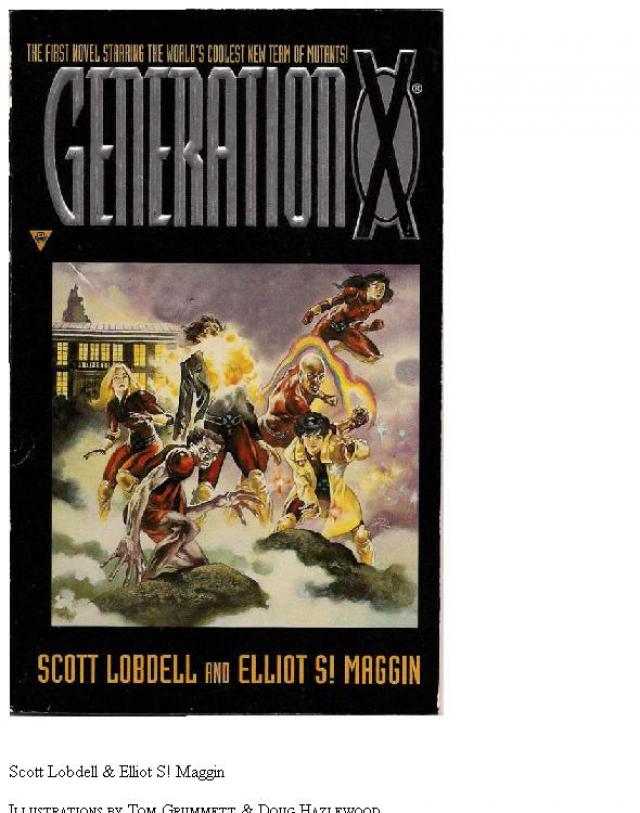
Generation X, page 9


No one, however, could determine without a doubt what harmful effects the thing might have on humans. They had kept the infested plastic hull of the satellite in an isolation chamber for two-and-a-half months before the head of Starcore, Dr. Peter Corbeau, got wind of it. An old friend of the X-Men, Corbeau’s immediate reaction-—after chewing out the responsible parties for over an hour—was to call in McCoy.
The immediate problem: the submarine crew that picked up the satellite had been at sea for over six months and the government was afraid to allow them to come home for fear that they might infect the general population with ... whatever.
“You mean to say these gentlemen have been holed away somewhere in a vacuum tube under the ocean for all that time and you don’t even know whether you’re ever going to let them go?” McCoy asked a Starcore flunky by the name of Whitney when the latter called him.
“That is correct, sir.”
“Do they know why they’ve been detained?”
“Negative, sir.”
“What explanation have you given them?”
“Oh, a number of things. We’ve made up mechanical failures in other sister submarines and told them they have to take up the slack. We’ve led them to believe that their senior officers are testing secret new weaponry. We’ve invented a few wartime alerts to keep them busy.”
McCoy took a breath and counted to ten. “Have any of the submariners displayed any discernible ill effects that may have been caused by an unknown bacterium?” “Possibly, sir.”
“Of what nature?”
“Widespread spontaneous nausea. Extended periods of inexplicable nervousness and sometimes violent hostility among the crew. General behavior unbecoming Naval personnel.”
“Maybe the sort of thing you’d find in a crew of servicemen who’re caught in close quarters too long looking at the same people every day without letup. Sort of thing you’d find in men who haven’t been exposed to some mystery space vims.”
“Perhaps, sir.”
McCoy let out a long low huff of air over the phone line that sounded for all the world like a feral growl. Then he said, “Okay, sport, here’s a freebie.”
“Yes, sir?”
“The boys in the sub are fine. Let them go home.” “Well I mean ... what do you mean, Dr. McCoy?” “I mean you go tell my old friend Peter that Hank McCoy said to send the boys in that submarine home to
their families. And tell him that after I’m satisfied that they’ve all had a nice home-cooked meal and a chance to kiss their kids goodnight, then I’ll consider showing up to analyze your little space bug.”
“Sir, I’m authorized to tell you that—”
“And you can tell Dr. Corbeau that this is a non-negotiable point of our agreement. And, Dr. Corbeau being a generally sensible person, will probably nod his head and agree.”
“Sir,” Whitney started. Then he heard the deep exhalation again, that growl, and he just said, “Yes sir.” Seven minutes later the captain of the Polaris sub got an order to surface immediately and order his men to extended shore leave at the nearest allied port. That afternoon, thirty-two sailors debarked in Marseilles. The next morning, Dr. Henry McCoy perched in the darkness high on the scaffolding outside a hangar at the air base in Dover, Delaware watching his thirty-two sailors tumble out of the old plane into the arms of their parents and wives and children. That evening, McCoy reported to Starcore’s Washington headquarters for his consulting gig-
Two days later, in the middle of a delicate chemical experiment, he looked at the message on his pager, left a note on a beaker promising to be back by midafternoon, commandeered a government Huey using an old-but-still-sometimes-useful Avengers ID card, and flew into a New England sleet storm.
McCoy patched into the phone line in Sean’s office. Jono strained to hear above the noise of the ’copter blades. “The only place anywhere nearby I can see to set this crate down safely is in this open field at the coordinates I gave you, Jono. Over.”
“I’ve got no idea how to translate your position into real space,” Jono’s simulated voice said, “but I’ve got someone here who might be able to figure it out.”
“I’m all ears,” the Beast said as Jono skittered out to the balcony to call down to his new friend.
The cop in the living room fumfered, “So you guys are all...”
“Tired,” Jubilee finished his sentence. She sat to Walter’s right as Paige sat to his left. Statis was wrapped, shivering, in a blanket, barely conscious. Paige sobbed, occasionally accompanying the light heaves of her chest with an appropriate whimper or two. Monet and Sean slept fitfully over the back of an easy chair and a couch respectively, and Emma curled on a rug in a comer, her eyes wide but showing no evidence of awareness of anything around her. “Very tired. We just had ... exams.”
Mike nodded uncertainly.
“Hey Mike!” Jonothon called from up above. “Somebody wants to talk to you.”
“To me?” The big trooper got up and went for the stairs to Sean’s office. “What, my captain?”
“No it’s the doctor. A specialist. He’s coming in by helicopter. Can you figure out where he is from his airline coordinates?”
“What’re airline coordinates?”
Jono shrugged as he handed the phone to Mike.
The trooper spoke with growing urgency: “Trooper Michael Brown, Doctor ... I’m sure I could radio someone along the way to locate ... yes, south of here ... absolutely, Doctor... no sir ... yes sir. .. I’ll be on the road before you can land, Doctor.”
Trooper Brown bolted out the door of the office and down the stairs, suddenly a man with a mission again. “Gotta get the doc here. Tell your boy to hang on.”
‘ ‘Hey Mike?’ ’ Jono called after him. The big cop had slammed the door behind him before Jono could holler, “Trooper Brown!”
Jono wondered if he should have told the officer about Dr. McCoy before they met.
McCoy paced back and forth in front of the big Huey, huddled under a long trenchcoat and a dark floppy hat. He was satisfied that the trooper had figured out his location. Along the road to Princeton, Brown had ping-ponged on his radio between McCoy himself and an air traffic control tower in Worcester where somebody had triangulated McCoy’s probable position. From the air, McCoy had seen an old Coppertone billboard with a baby Jodie Foster in her undies. When Brown passed it they both knew he would arrive soon.
The Beast paced back and forth in the sleet, clapping his hands together and hopping up and down to keep warm. Then he heard the engine and saw the headlights weaving along the dirt path into the fairgrounds.
McCoy lumbered across the field toward the advancing car, huddling under his coat and hat as the trooper stopped the unit and killed the headlights.
“Dr. McCoy, I presume.”
“The very same,” McCoy said as he opened the passenger-side door. Mike thought the doctor’s voice sounded a lot more friendly and—well, cultured, now that it wasn’t coming over a telephone or radio line.
The hulking figure of Dr. Henry McCoy sat down on the passenger seat and slammed the door after himself. Brown drove out of there forthwith.
“Next stop, Snow Valley,” the trooper said, smiling as he picked up speed. Then he looked to his right into the smiling, blue-furred face of the Beast and immediately put the police car nose-first into a drainage ditch.
Fortunately Dr. McCoy was able to lift the front end of the Buick out of the big gully and shove it back up on the road. His ride was intact.
‘ ‘What are you?’ ’ Mike whispered. The former quarterback was certainly a man with little fear, but he was still capable of surprise. The creature that stood before him was man-like without a doubt, but it was like nothing he had ever seen. The creature resembled a gargoyle, complete with fangs. Particles of ice forming on the blue fur that covered his head and hands (and, presumably, the rest of him).
“Maybe we weren’t properly introduced. I’m Dr. Henry McCoy,” and he extended an enormous furry clawed hand.
After a moment Mike understood. “You’re that
Henry McCoy,” he said, “the biochemist. Used to be with the Avengers.”
The Beast nodded, kept the claw open and extended. Mike took the big blue hand in his own, and was startled to find it had an opposable thumb.
‘ ‘I read your book on recombinant DNA. Before you revised it. In college,” the cop said.
“You’re pulling my leg.”
“What, cops can’t read? Get back in the car. You’ve got a really sick kid on your hands. Paws. Whatever.”
“Look Banshee, I can’t hang around here taking care of everybody. The news on Statis is bad enough and I’ve got a helicopter to return. What’s wrong, man?”
Sean squinted through the morning at the Beast, who hunched over a battery of meters and dials in the infirmary, all connected by wires or tubes to various parts of Walter Nowland’s body. “What do you mean?” Sean asked.
“Everybody around here is foggier than the weather, except for Chamber and the gendarme. What is it?” “You’re right,” Sean said. “It’s the weather.”
“I didn’t say—” Beast stopped himself as he became preoccupied with a cell scraping magnified under the special V-2 microscope in the infirmary that was the only instrument that fit the peculiar position of his eyes. “Hey Mike!” the Beast called out, and Trooper Brown, followed by Jono, came in from the hallway.
“Yeah, Doc?” said the trooper.
“Look in here and tell me what you see.”
Mike Brown tried to look through both eyepieces of the microscope and couldn’t fit his eyes over them, then he covered one eye and looked through one tube with the other. “Wow,” he said. “It’s reproducing as I watch. What is it, some kind of accelerated cancer culture?”
“Bingo,” said the Beast. Then he turned to Jono and said, “Chamber, take all of these slides out very carefully in this sealed red bag. Then vaporize them and bury the ashes.”
Jono dutifully went off to do just that.
With Jono gone, McCoy turned to the headmaster and the trooper, “It’s the Legacy Virus, and it’s now in an advanced state. Have you heard of it, Mike?”
“Yeah.” Very few people hadn’t heard of it. “That’s the one that mostly hits mutants.”
“Got it in one.”
“Where’d that culture come from?” Trooper Brown asked.
“From that boy’s spinal column,” the Beast indicated the sleeping figure on the gumey beside him.
The cop squeezed his eyes shut and scrunched up his forehead, suddenly as depressed as the headmaster seemed. The boy here had to be a mutant, to have the Legacy Virus. McCoy was a mutant, and so, obviously, was Jono. That meant the rest of them probably were, too. Somehow, the knowledge did not disturb him. He had always thought that mutants were dangerous. Knowing they had the same problems and feelings as everybody else made them seem more human.
For his part, the Beast decided that the malaise around this place was a result of the sheer awfulness of the fate that awaited Walter. That was his first misdiagnosis in years.
McCoy would leave some painkillers with Sean, he said, but from what they knew about Statis’s powers, they would help him more. ‘ ‘Like I told you before, the electrostatic subtext that suffuses his body,” McCoy said, “should keep him coherent and without significant pain up until almost the very end. The problem with that, though, is that he’ll see everything coming. I’ll be checking back with you when I can.”
Sean nodded blankly.
“Can I hitch a ride again, Trooper?”
McCoy and Brown were out the door and down the road well before seven in the morning. On the way, he finally got some sleep and snored thundering Beastly rales that made the windows of the car shudder. Trooper Brown stopped along the way for some coffee and secretly hoped someone on the street might spot the sleeping passenger in the state police car. Maybe someone did.
Back at the school, Walter, feigning sleep on the gurney, realized that he could count his remaining days on his fingers and, if he was really lucky, he might get to use a few of his toes.
The next day, Paige Guthrie tapped out her little staccato on the door of Walter’s room.
“C’mon in, Paige.” Walter recognized her knock by now.
She entered the room, holding a single trillium in a small plastic flowerpot in her hand.
“I’m glad you’re awake,” she said, making a show of trying to fight back tears but not really pulling it off. They streamed down her cheeks like a breaking river. “This is a very rare flower called a trillium.”
“From the biosphere,” Walter said. It seemed he had been sick as long as he had these powers. There were good days and bad days. The days for him—what few there had been—had been mostly good since he arrived here. Today was one of the bad ones. He felt it was important, though, to keep himself warm under the covers so he didn’t shiver or cough too much when these depressive mutants wandered in.
“No, not from the biosphere,” Paige said, “it’s a New England plant.” The trillium was a delicate flower with three little blue tear-shaped petals coming off a single stem as narrow as a thread. “They’re rare,” she said. “They mostly grow at high altitudes.” She placed it on the table next to his bed.
“Really? Where’d you get it?” He tried to sound interested in the answer.
“In the woods at the base of the mountain. They’re protected, you know.”
‘ ‘Protected?’ ’
“Yes. It’s illegal to pick them. I was careful. I got the whole root out and took the soil it was used to,” her bottom lip started to quiver. “I broke the law for you, Walter.” Paige suddenly ran from the room, crying.
There was definitely something wrong here besides his Legacy Virus, Walter concluded.
At about ten that morning, the Federal Express truck rolled up to the front gate and dropped off several parcel’s of clothing and other goodies. Whoever ordered it had waived a signature, so the delivery person simply left them there. No one bothered to go out to retrieve them.
CHAPTER NINE
THE BARRINGTON MILLS HOTEL
Jono blasted the alien invasion force into oblivion and almost captured their High King when his trigger finger cramped and his eyes felt tired. He saved his game, planning to rescue the President’s daughter another day.
As he turned off the computer, he heard the wail of a volunteer siren. Somewhere, people were interrupting conversations, leaving in the middle of meetings, cutting short phone calls, dropping off passengers in the middle of nowhere, all to join the volunteer force whose job it was to deal with the emergency. Something was wrong in town. Which town? It was too far away to be Snow Valley.
Then he heard a siren from another direction.
Then another.
Then finally the Snow Valley sirens began along Route 9A.
Jono walked out of the computer building. He saw Emma sitting quietly in the grass near where the gazebo had once stood and where nobody had bothered so much as to lift a stick of wood to fix it. Monet swung slowly back and forth like a pendulum on the higher of the uneven bars near the edge of the woods. Paige absently picked up flat stones to skip over the fast-moving surface of the swelled Mad River. Sean sat in a porch chair, watching his inert, unringing cell phone on the chair’s arm. Jubilee sat cross-legged against the wall of the biosphere looking at some book whose pages she had not turned in hours. Penance was somewhere out of sight.
After a few minutes Walter came out the side door nearest the infirmary. He wore a coverall and used an I-V rack to help him with his growing limp. He wheeled his crutch along the flagstone and Jono walked up to help him.
“Where do you need to go?” Jono asked him.
“Aren’t those emergency sirens?” Walter wanted to know.
“Yeah.”
“Well nobody here seems to notice. What’s wrong with these people?”
Jono rattled his head as if waking from a bad dream and looked around. “Dunno,” he said. “We’ll deal with it after the emergency’s over.”
The great palaces of America were the hotels of New England. All along the interior mountains and river valleys through the nineteenth century, the merchants in the wealthy folks’ destinations built great vacation hideaways. They were all of the same type: ponderous structures with white pillars, endless porches, and enormous entryways with rotundas high overhead. The suites were the size of great houses and to their institutional kitchens came many of the great chefs of the world. During weekdays in summer, tall, milk-skinned women in sun dresses and parasols would walk through the manicured lawns and gardens watching their children frolic and ride ponies in the sunshine and clean air. On weekends their husbands would travel by train from their terribly successful businesses in Boston and Hartford and New York to join the families for a few precious hours of scant involvement and rest.
Most of the palace hotels were gone now, to fires and insurance scams. There came a time when people no longer wanted to take their summers with long stretches of repose and gluttony. People wanted trips to the Caribbean and the South Pacific. Walking tours of the Old World. Time share and golf and adventure. It was easy to lose a New England palace. They were made of wood. Their kitchens vented the old fashioned way, through a single breakaway tin pipe up a flue. The fire departments were volunteer and dependent on the responsibility of the local townspeople. Only a handful or fewer of the old palaces remained.
One that remained was one of the biggest, the Barrington Mills Hotel at the base of a ski resort in southwestern Massachusetts. It looked as though it was not long for this world back in the mid-1980s, when New England real estate had hit a fifty-year peak and everyone with any assets at all was leveraged out to the next century. For the first time in living memory, people were starting to unload houses and commercial property for just a little bit less than they paid for it. Tourism and real estate were off. The very wealthy had taken to buying second homes rather than rubbing elbows with the public in hotels. The old Barrington Mills Hotel was ripe for a fall. That was when Channing Murdock, the guy who ran the ski resort, bought it for the value of its insurance policy minus the legal fees it would have cost its previous owners to make a case that the fire they planned was an accident. In short, Channing got it for a song, then he turned it into a bunkhouse.


