

The Anthrax Mutation (v1.0), page 2
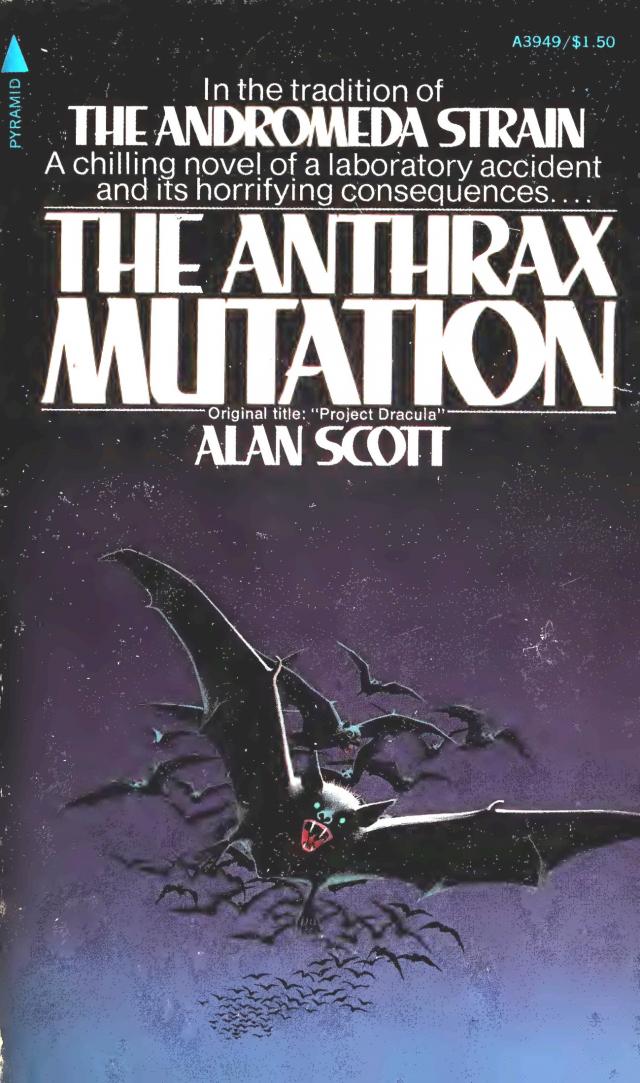


“Aren’t those two little red marks on your neck, Corporal?” McRoberts asked.
“Yes, Sir,” he replied uneasily. “One of them blighters bit me.”
The Captain laughed. “Hope he didn’t get too much.” He turned to the Major. “Private joke, what?”
Thomas nodded and glanced across the room to a group of technicians who were bent over a map of Great Britain, pegged out with red and black flags. The Captain noted his interest. “Damned if I know what’s going on in here, but it’s got something to do with bats.”
“Bats?” he said casually.
“That’s what I said. Flying mice type bats. I saw a crate of them coming in here this morning. Typical Section Three. Purely experimental biological delivery. If there’s a way of dispersing horrible little creepy-crawlies without anyone knowing it, this is where the idea will come from. The whole place is run by a monster named McTavish—a Scot. Genius at the macabre.”
Thomas was thinking. “We used bats back in forty-four or was it forty-two? Some of our boys thought of strapping tiny incendiary bombs to their bottoms and dropping them over Japan.”
“Did it work?”
“Oh, the bright ones managed it all right, figuring the bats would find the nearest oriental nook and cranny in some Jap factory, but when they tested the thing out in New Mexico, some of the pests escaped and burnt down two million dollars worth of hangar and the General’s car to boot.”
“Gave up, eh?” The Captain enjoyed America’s failures.
“They never gave up in those days. Another group took over the project and decided to freeze the bats into a sort of hibernation, drop them from airplanes and hope to God they thawed out and flew away before they hit the ground.”
“And?”
“Some say New Mexico lay under six feet of frozen bats for a week before the Army could scrape them all up. It didn’t take them long to thaw out once they hit the ground, but after falling twenty thousand feet even a pyromaniacal bat can’t fly with every bone in its body busted.”
“Then you gave up.”
“Yea. We invented the atom bomb instead. Much more reliable.”
“Well, I hope McTavish hasn’t come up with a sequel,” the Captain replied, shaking McTavish’s hand. “This is Major Thomas from America. I think you’d better explain what it is you’re up to else the Major might sue for copyright infringement.” He drew a bit closer and whispered. “You’d better mind Corporal Frimley out there—he’s been bitten by one of your pets.”
McTavish who had been considering this in. all seriousness glanced up.
“Keep a wooden stake handy.”
“Away with you, McRoberts,” he frowned, waving him off. “Haven’t we enough to do without your humor to add to our troubles? Now, Major Thomas, did I hear you are working with bats, too?”
“No, Sir,” he drawled. “We gave all that up after the war.”
McTavish looked hurt. He thought again. “Which one?”
“One what?”
“War.”
“Why the Second, of course.”
“I thought it might have been Vietnam you were speaking of,” he replied hopefully. “You’re making the best of that one, eh?”
“How do you mean?” He stared into the mischievous whiskered face.
“Using the defoliation agents. We’d like to get a hold of some of your findings on that I might tell you.”
“I think we’re making some reports for your Ministry last I heard.”
“That’s good to hear. Save us mucking about in the New Forest.”
“How’s that?”
“Just a joke we have.”
“You fellows seem to be full of jokes,” he said unsuredly.
“Major,” he began, leading him towards a comer of the room. “If you work on this stuff too long, it gets to you. I keep my lads smiling as much as I can. Keeps them from taking their work too seriously.”
“Don’t you find that a bit risky?”
“Major, within the four walls of this room are enough biological agents to eliminate man from the face of this earth some ten thousand times over—given optimum conditions, of course. That is where the risk is.”
Thomas nodded. How many had Detrick? Then he became aware of squeaking noises from somewhere near.
“This is our latest project. It’s one of the Ministry’s brain waves. We’ve code named it Project Dracula. Rather good, don’t you think?”
“The project or the name?”
“Oh, the project’s mad. It’s the name we like.”
Thomas shook his head. He peered through a double glazed window, but saw only darkness. McTavish turned to an assistant and nodded. Immediately, the darkness was turned to day and Thomas choked involuntarily. A sea of something black rose before him and settled slowly onto several tiers stretched across a small room behind the glass. He began to discern rows of hundreds of bats, hanging upsidedown as their night was abruptly ended. Most were but a few inches long, but some hung down as much as two or three inches below their mates. He was transfixed by the macabre scene and McTavish relished his surprise.
“There are fifteen hundred bats in there and each one has been fitted with a time-delay capsule. We have managed to copy some of your ideas—the very ones you mentioned to Captain McRoberts. We’ve micro-encapsulated bacillus anthracis and tied it to their bottoms, as you say. Those bats are living on rarified oxygen at the moment, and when we expose them to normal atmospheric conditions, a slow oxidation takes place in the encapsulation material. Roughly, it takes ten hours for the capsule to decompose sufficiently enough to expose the bat to the anthrax. After initial exposure, it should take three or four minutes to bring him to earth and thus spread his delights over the surrounding area.” He seemed pleased.
“Unbelievable. It’s crazy.”
The Captain, standing far enough away to remain unnoticed, heard the plan and agreed. It was madness.
“Unbelievable, possibly. Crazy, no. The bacillus is a hybird variety—extremely potent. We have stepped up the infective power and raw strength to such an extent that the toxicity factor is something like fifty four times the normal. Exposure to it through simple contact will result in death within a few hours. Respiratory contact will kill in two hours. Mind you, our experimentation is restricted to the lower animals, but humans are as equally susceptible.”
“But why anthrax?” he persisted.
“It’s a common enough disease. The English often get it from their precious roses—from the bone meal. But any bacteria is itinerant—it loves to spread itself around. It likes people, too. Oh, yes, these bacterium are extremely sociable. They’d be very good companions were it not for their danger. And they have long lives. Normal anthrax can survive in the wild for several years. Our variety can withstand strong ultraviolet rays for ten, maybe fifteen years. And this stuff multiplies like mad. If on the average one spore divides in half every fifteen minutes, in twelve hours there’d be millions of them. If it develops in the body, well, you haven’t got a chance.
Imagine the mass panic when this stuff gets loose. No doctor in any country has enough antibiotic in his surgery to treat more than a few cases at most, and hospitals could only treat the vast minority who were lucky enough to realize they were infected in time to be injected. Even if only a few of the bats got loose, the general alarm among the public would cause complete chaos.”
The Captain stared hopelessly at McTavish.
“How long have you been developing this idea?” Thomas asked.
McTavish signalled for the lights to be turned off. Immediately, there arose a flurry of wings. “Not too long. We developed the anthrax in its potent form several months ago, but dispersing it was the problem. Then the Ministry came up with this idea—we’re the only plant working on it.”
“And you plan to let these things go somewhere?”
“We plan to release them right here,” he replied, watching the last crate of bats being shunted into the preparation room. He struck the wall. “Behind this cage area is a wire enclosure with an assortment of buildings which any bat might expect to find in an average country. We’re going to let them out tomorrow morning just before sunrise. That should give them enough time to settle where they will, and then the atmosphere will do the rest. When the capsules decompose sometime tomorrow afternoon, we’ll be able to see exactly what happens.”
“What about the village—won’t your anthrax run wild?” He felt in his pocket for a cigarette, then remembered he had given them up two days ago. He cursed. He’d buy some first chance he got. “And who’s going to be there to see if the anthrax works?”
“The entire surrounds will be hosed down hourly with another of our creations. The only known antidote for this particular variety. We plan to keep the area completely neutralized for at least a week while we poke about in the enclosure. After that, we open the flood gates and let the disinfecting agents wash out the whole area. Should be quite safe, thanks to your boys, McRoberts.”
McRoberts wasn’t listening. He was gazing at his watch in vain effort to move the minute hand a bit faster. He never did like having his men risk exposure to the various diseases Section Two dreamed up, nor to the experiments created by Section Three. But he had his orders. He sighed as the minute hand crawled over to two and he turned towards the Major. “I think we’d better make for the mess if we’re to catch the Colonel.”
Thomas looked away from the cage for the first time.
“Well, Major Thomas”, began McTavish, following him out “I hope our little efforts here have impressed you.”
“I never thought you fellows would dare anything like this,” he admitted slowly. “It’s so goddam risky.”
McTavish shrugged. “Times are changing, Major. And you can take some of the blame for all this—it’s your influence.”
The Major twirled his cap in his hands. “Yea, our influence.”
“Well, goodbye. I’ll let you have some details on Project Dracula when it’s over.”
The Captain frowned. Security was bothering him again.
McTavish grinned and pushed his shoulder. He glanced at the Major. “McRoberts here is worried again. Go on, take him to the mess before you get an ulcer. I’ll see you at tea and you can tell me off.”
McRoberts forced a smile. “The Colonel will be expecting us.”
“Yes, yes,” the Major replied. “Thank you Mr. McTavish. I would be very interested in hearing about this.”
“I bet you would/’ the Captain mumbled to himself. “McTavish, I hope one of those bats fancies your hairy neck. Serve you right.”
McTavish wrinkled his forehead. He glanced at the glass doors behind the gates where Corporal Frimley sat. “Frimley/’ he shouted. “Frimley, have you seen the medic yet?”
Frimley stood up and peered through the gates. “No, Sir. I thought I’d wait until dinner.”
“Well don’t bloody wait until dinner. I want to know what he says.”
“You don’t really think it’s true?” Frimley whimpered to the Captain. “I mean about what you said.”
“No, Frimley. McTavish is having you on again. Just ’see the medic and tell him he made a pass at you.”
Frimley smiled, frowned, scratched his head and sat down.
The Colonel was by himself at a small table in a comer of the canteen. He was drinking a cup of coffee as Major Thomas sat opposite him and McRoberts marched off. He signalled to an orderly for more coffee. “Have you seen enough?”
The Major placed his cap on the table. “Very impressive, very impressive. I’m a bit surprised by your Project Dracula, but I suppose we’ve done worse.”
“We work towards the same goal, Major, regardless of our individual aims,” he replied flatly.
“The total annihilation of the human race.” He grinned, but he didn’t think it was funny. “You know, we tried an experiment not long ago—we tried to estimate the overkill rate of our stockpiles and had the boys from IBM rig out a computer program on it. Took them about four weeks and a computer half the size of this room. We had all the top brass in to see what the results would be. Here were these mathematical wizards racing around the computer, punching cards and pushing buttons and looking very pleased with their efforts, and there were the generals and colonels and majors and scientists all eagerly waiting to see what the overkill rate would be. You could see their tongues hanging out. Well, it took the computer about a minute and a half to come up with the answer.” He paused. “And you know what the answer was?”
The Colonel raised his eyebrows and shook his head.
“A hum, a few clicks and clacks and then the goddam thing short-circuited. Smoke was everywhere. It’s impossible to estimate—even for an automated Einstein.”
“You don’t approve of this?”
“Not entirely. I was on the experimental end at one time. I remember my first briefings when*we were working on botulinum. I was told that the purpose of my work was to develop a biological that could not be treated effectively with antibiotics or other drugs, and that the disease should not be one which people might have a natural immunity to. This was the principle of germ warfare. I was given a little table in a little room with lots of little tubes and bottles and jars and several types of botulinum. After a while I separated the proteins into their groups and found the most effective ones—A and B. Working with a friend, we estimated the lethal dose of type A at somewhere around ten hundred millionths of a gramme, and we were a few hundred millionths off anyway. Feeding this into the computer, it told us one ounce could kill fifty million people. Then Tom—the fellow working with me—broke a rule and ate a sandwich he had brought into the laboratory. He was dead in a few minutes. The botulinum toxins had infected his food. It scared me, then. It scared the hell out of me, Colonel. But they thought I was still valuable and so now I’m the Liaison Officer.”
The Colonel looked into his empty cup and seemed perturbed. He found the orderly and signalled him for more coffee. He looked happier.
“I’ve learned a lot in going around from country to country. You have a nice civilized place here, but think of some backward little country who’s struggling like hell for recognition. You get some petty little Hitler seizing power and he digs up some small-time chemist from around the comer and gives him a handful of nasty bugs, a few pots and pans, some old jam jars and maybe a burner or two. Pretty soon he comes up with either some God awful germ that even he hasn’t the faintest clue • how bad it is and hasn’t the guts to test it, or he tells one of-his assistants to take a whiff of this jar and he promptly drops dead. If the chemist has had the presence of mind to remember just how he perfected whatever it was that killed his friend, he has just developed his country’s first chemical or biological weapons system. The newly seated leader gets power happy because he has a jar of bugs he can’t see, and then I’ve got to go snooping around to see what it’s all about. If the discovery is threatening enough, we recognize the country and keep him from throwing his jar across the border.”
“Surely, it is not as bad as that.”
He laughed. “Colonel Wyers, you remember the Batlavian uprising last year? Schelsznik took over the revolutionary government and announced his army had uncovered a weapon so powerful that it was a threat to the entire Eastern world? Well, we smuggled three of our boys in to find out what this weapon was. Schelsznik had been taken for a ride by his peoples’ government— the biggest threat he posed to the world was the common cold. Just an ordinary vims. But how were we to know?” He felt his pockets again. Wyers offered him a cigarette. “But tell me how your villagers down there feel—don’t they, mind you being so near?”
“We are entirely self-contained. They have no contact with us other than in the pubs. Really, they know surprisingly little of what we do. Occasionally, word leaks out about something or other, but the people in Stumford are a’ tolerant lot.”
“I see,” Thomas replied, stifling a cough. His head began to spin slightly at the smoke.
“The plant generates its own electricity, purifies its drinking water, disposes of its own sewage and chemical waste, does its own catering and even grows its own produce. We have an auxiliary system in an emergency which can take over any function should any one or all of the main systems go. Did you notice the generator in Section Three? The controls were next to the bats’ cage. That runs on bottled gas and we store enough fuel to last up to three months. There are a hundred and eighty miles of electrified fencing surrounding us, radar surveillance, guard dog patrols and two hundred men involved in aerial, ground and general security.”
Thomas began to think about the rabbit.
“No one gets in without clearance from London. No one gets clearance from London without a damned severe check. Once at the front gate, no one gets any further without a check from internal security.” He grinned. “I remember once we had some MP from Bagshot stuck in here for two days before London cleared him out. Some foul-up at the Ministry. Haven’t had another MP since—I think word got around that we planned it.” Thomas thought of the bats. He envisioned one escaping and landing in Trafalgar Square or Piccadilly. “You look troubled, Major. Something I said?” “Nothing like that, Colonel. I was just thinking about what could happen if one of your bats decided to do some independent research on its own.”
“Oh,” he laughed. “Impossible. The outside cage has double fencing. The inside fence is made of quarter inch square wire netting and the outside net carries ten thousand volts. If any bat managed to eat his way through the inner net, he’d end up cooked on the outer. And the indoor cage, well,” he smiled, “like the rest of the building the walls are made of six inch thick reinforced concrete—and the only exit the bats have is through the hydraulic hatch. I shouldn’t think a bat could push that open, do you?”


