

The Pseudo People (v1.0), page 1


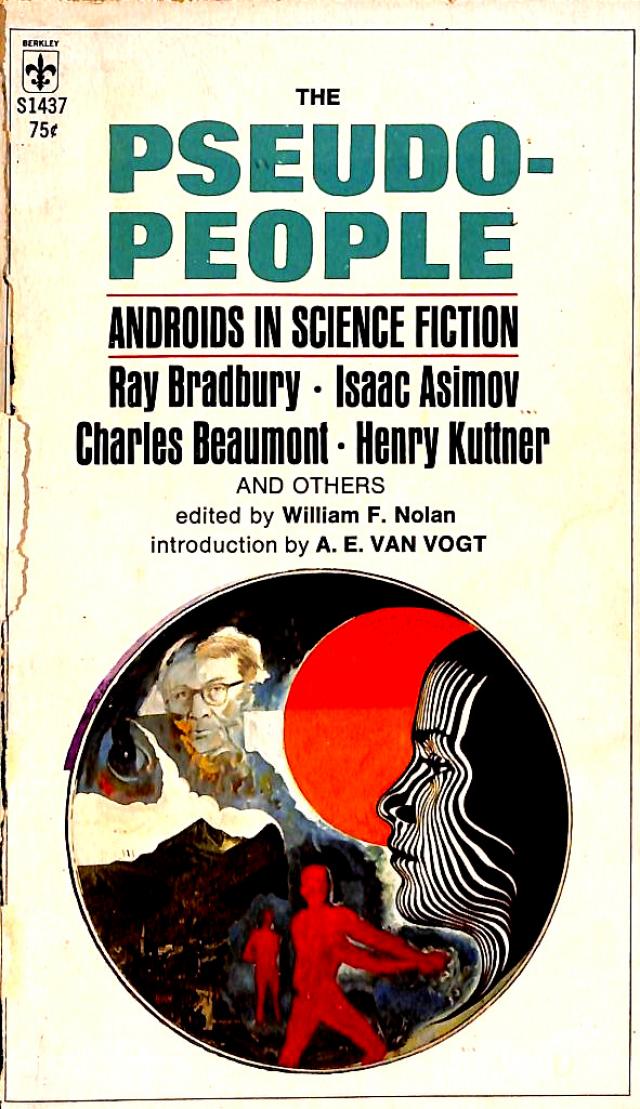
OUTSTANDING REVIEWS
FOR AN EXCEPTIONAL SF
ANTHOLOGY:
’Tastefully chosen, and covering an extraordinarily wide spectrum, little and large, new and classic…
—Theodore Sturgeon
“Fascinating…The Pseudo-People has much to offer…It is a lavish offering indeed, a valuable addition to any science-fiction library.”
—Los Angeles Times
“One of the best anthologies we’ve had in a long time.”
—Analog
“Some fresh views of the robot theme…persuasive, provocative, bright.”
—Virginia Kirkus
THE
PSEUDO - PEOPLE
Androids in Science Fiction
EDITED BY
William F. Nolan
WITH AN INTRODUCTION BY
A. E. van Vogt
A BERKLEY MEDALLION BOOK
Published by
BERKLEY PUBLISHING CORPORATION
With admiration,
to the father of robotics,
ISAAC ASIMOV
and with love, to the mother of the editor,
BERNADETTE MARIANA SCHOLASTICA
KELLY NOLAN
Copyright © 1965 by William F. Nolan
All rights reserved
Published by arrangement with
Sherbourne Press
BERKLEY MEDALLION EDITION, AUGUST, 1967
BERKLEY MEDALLION BOOKS are published by
Berkley Publishing Corporation
15 East 26th Street, New York, N.Y. 10010
Berkley Medallion Books ® TM 757,375
Printed in the United States of America
Acknowledgements
Those Among Us by Henry Kuttner was originally printed, as Android by C. H. Liddell, in The Magazine of Fantasy and Science Fiction in June of 1951. Copyright © 1951 by Mercury Press, Inc. Reprinted by permission of the author’s agent, Don Congdon, of the Harold Matson Company, Inc.
Changeling by Ray Bradbury was originally printed in Super Science Stories in July of 1949. Copyright © 1949 by Popular Publications, Inc. Reprinted by permission of the author’s agent, Don Congdon, of the Harold Matson Company, Inc.
The Addict by Shelly Lowenkopf is an original story. Copyright © 1965 by the author and printed by his permission.
The Life Game by Chad Oliver was originally printed in Thrilling Wonder Stories in June of 1953. Copyright © 1953 by Standard Magazines, Inc. Reprinted by permission of the author’s agent, Willis K. Wing.
Evidence by Isaac Asimov was originally printed in Astounding Science Fiction in September of 1946. Copyright © 1946 by Street and Smith Publications, Inc. Reprinted by permission of the author.
The Show Must Go On by James Causey was originally printed as So Lovely, So Lost, in Orbit Science Fiction in Nov.-Dee. of 1954. Copyright © 1954 by the Hanro Corp.5
Reprinted by permission of the author’s agent, Forrest J. Ackerman.
Geever’s Flight by Charles E. Fritch is an original story. Copyright © 196S by the author and printed by his permission.
The Fires of Night by Dennis Etchison is an original story. Copyright © 1965 by the author and printed by his permission.
Steel by Richard Matheson was originally printed in The Magazine of Fantasy and Science Fiction in May of 1956. Copyright © 1956 by Fantasy House, Inc. Reprinted by permission of the author’s agent, Don Congdon, of the Harold Matson Company, Inc.
Badinage by Ron Goulart is an original story. Copyright © 1965 by the author and printed by his permission.
Juke Doll by Robert F. Young was originally printed, as Doll-Friend, in Amazing Stories in July of 1959. Copyright © 1959 by Ziff-Davis Publishing Co. Reprinted by permission of the author and his agent, Theron Raines.
Last Rites by Charles Beaumont was originally printed in If: Worlds of Science Fiction in October of 1955. Copyright © 1955 by Charles Beaumont Reprinted by permission of the author’s agent, Don Congdon, of the Harold Matson Company, Inc.
The Fasterfaster Affair by Frank Anmar is an original story. Copyright © 1965 by the author and printed by his permission.
The Joy of Living by William F. Nolan was originally printed in If: Worlds of Science Fiction in August of 1954. Copyright © 1954 by the Quinn Publishing Company, Inc. Reprinted by permission of the author.
Contents
Acknowledgements
Editors Preface
A IS FOR ANDROID- William F. Nolan
Introduction - A. E. van Vogt
Henry Kuttner
THOSE AMONG US
Ray Bradbury
CHANGELING
Shelly Lowenkopf
THE ADDICT
Chad Oliver
THE LIFE GAME
Isaac Asimov
EVIDENCE
James Causey
THE SHOW MUST GO ON
Charles E. Fritch
GREEVER’S FLIGHT
Dennis Etchison
THE FIRES OF NIGHT
Richard Matheson
STEEL
Ron Goulart
BADINAGE
Robert F. Young
JUKE DOLL
Charles Beaumont
LAST RITES
Frank Anmar
THE FASTERFASTER AFFAIR
William F. Nolan
THE JOY OF LIVING
A Bibliography of Robot Fiction Section 1
ALL-ROBOT ANTHOLOGIES
Section 2
ROBOT FICTION IN COLLECTIONS AND ANTHOLOGIES
Editors Preface
A IS FOR ANDROID
Of the 250-odd anthologies published in the field of science fiction only four have dealt with the robot theme, and none of these volumes concentrated exclusively on the android. In the introduction which follows, A. E. van Vogt discusses the concept of humanized robots and man’s fascination with his artificially-created self-image. We agree that thinking robots are riot only possible but inevitable. The android will duplicate the human form as nearly as possible; synthetic flesh will cover a body and brain made up of superbly designed electronic components. Mr. van Vogt comments on the “positronic” brains of the future, but what of the very real electronic computer brains of today? Are we making any real progress with our “thinking” machines?
Indeed we are. In just two decades, since the Mark I was developed by Harvard’s Howard Aiken, the growth of these incredible machines has been steady and relentless. In 1951 a total of 100 computers were operating in the U.S. Today we have nearly 23,000. These modern wonder machines are capable of performing complex calculations in billionths of a second; they have progressed to a point where they respond to human commands (with the Honeywell 20 understanding a language very similar to English), and we are told that soon they will be able to “converse” with their human creators. Already, computers have been programmed to play checkers and chess; they have composed poetry and music—and have even plotted TV whodunits! And most importantly, scientists have been able to make smaller and smaller packages of these electronic brains. Our space efforts have done much to perfect the art of miniaturization. The next logical move is clear: to place a miniature computer inside a metal skull.
The birth of the first android is, therefore, a lot closer to us than we might imagine. Artificial hearts, lungs and arteries are already being developed in science; the artificial brain is the next major step toward the creation of humanized robots.
The first fictional androids were brought to us by Karel Capek in his 1921 drama, R.U.R. (Frankenstein’s monster, strictly speaking, does not qualify as an android.) Capek called his humanized creatures “robots”—from the Czech word, robota, meaning to serve—but they were made in man’s image, with synthetic skin, hair and muscles.
That prolific veteran of science fiction, Edmond Hamilton, first brought the word “android” into wide usage back in the thirties, when he chronicled the wild pulp adventures of Curt Newton or—as he was known to his many dedicated readers—Captain Future. Newton’s first assistant was a big steel robot named Crag, who clanked about on iron feet and was not, in any sense, a duplicate human. However, with Crag’s aid, Newton fashioned another sturdy helper he called “Otho, the android.” Described as “rubbery, with blank-white skin and long, slitted, green unhuman eyes,” Otho was very definitely a pseudo-person.
Cap Future and Otho lasted until 1950. By then androids were swarming the pages of science fiction—from Bradbury’s Marionettes, Inc. to Lester del Rey’s Helen O’Loy. Nearly every top writer in sf has utilized the android concept
In my desire to offer fresh material in this collection I had to bypass several familiar and readily-available android classics (such as Anthony Boucher’s The Quest for St. A quin), but I have made certain that these titles are fully listed in the Bibliography of Robot Fiction following the 14 story selections. I would particularly recommend Alfred Bester’s savagely suspenseful Fondly Fahrenheit and Chad Oliver’s poetic jazz classic Didn’t He Ramble. There are many others (No Woman Born by C. L. Moore and Emily and the Bards Sublime by Robert F. Young, etc.), but I’ll leave the joy of discovering them to the reader.
The Pseudo-People, therefore, offers fresh delights. Five of the stories were written just for this book, and appear in print for the first time; another four—including a Bradbury jewel—have never been collected between covers, and the remaining five have appeared only in one-author volumes, most of which are now out of print. None of the 14 has appeared in any other science fiction anthology to date. The reader can thus be assured of much that is new and exciting from the finest talents in sf.
I wish to thank the authors, particularly those who contributed new stories; also Forrest J. Ackerman, Fred Patten, A1 Lewis and “the Sherbourne people” for aid and solid encouragement in this project.
And, of course, my special thanks to A. E. van Vogt for the Introduction you are about to read.
Burbank, California
William F. Nolan
A. E. van Vogt
Introduction
People are interested in people—and, therefore, they will always take time for at least a sidelong glance at anything that looks human. Anything: a doll, a window mannikin, a ventriloquist’s dummy, a figure in a wax museum…
Consider, for example, the puppets in a puppet show. Here we see carved, jointed sticks of wood, animated by strings, filled out with fluff and dressed in tiny clothing. We stand fascinated as they are made to move and dance in human fashion. Why are we so fascinated?
In the answer to that question, there lies a tale—for I recall what I thought when I saw my first puppet show.
I looked. I kept looking. The thought flashed: “Wonder how their insides compare with mine?” I noticed, or imagined, similarities or differences, wood versus flesh.
All this happened rapidly, almost subconsciously.
Two women to whom I told my theory—that we all compare ourselves to human-shaped creatures—rejected the notion that they had done anything of the kind. Yet here is what they did do:
One noticed the sawdust in the stomach of her doll—and, thereafter, when she had a pain in that area, she’d say: “I have a pain in my sawdust!” It was childish fun—but, as an adult, she still uses this expression.
The other tried to make her dolls come alive. It was not enough that they be dressed as little girls; they must perform. She bought her favorite a pair of miniature toy skates, and spent many hours roller skating the doll around.
What they and I did, in automatically comparing our own bodies with those of dolls or puppets, is significant— because everything that human beings do has a deeper human meaning; we are bound to the roots of the subconscious.
Thus, when somewhere in science fiction a creature that looked like a man, yet was made of metal, stepped forth, so to say, from the pages of a story he (it) instantly took his place high in the upper echelon of basic science fictional concepts.
As I recall, the first robot story that made an impression on me was in one of the early Gemsback issues of Amazing Stories. The particular title is lost to memory, but it was about a man-shaped machine that was shipped to the moon. Equipped with television camera-eyes, its job was to explore the planet’s cratered surface. Suddenly, in the story, the robot ran into alien beings, and contact with Earth ceased. The robot had been destroyed. End of story.
That unfortunate mechanical creature could do something which no human could do: it could function under vacuum conditions on distant planets, in any atmosphere, anywhere. This impressed me with the fact that, by means of such creatures, man could safely explore dangerous environments. I nodded my head. “That’s die way it will be,” I told myself.
Robots had entered my life.
This was before the closely-humanized version came on the scene. That first robot was simply a machine to me. It functioned as an extension of man, as one of his tools, but it bore no resemblance whatsoever to the Amazon female android in the current TV series, My Living Doll. When it was destroyed I experienced no sense of personal loss, no sense of sorrow, as one does when a very real story character is killed.
However, as I read that first story, and looked at the illustration which accompanied it, I kept comparing the robot’s structure to myself. When I think back now and see that I reacted to that robot as I had reacted to the puppets it becomes clear that something meaningful goes on in a human being when he encounters, on stage or in a story, a man-shaped mechanical being.
Let me offer, then, my conclusion.
To me, the android is a mirror in which science fiction writers reflect a part of mankind’s unending search into the roots of human behavior. When that notable contributor to robot lore, Isaac Asimov, set up his three Laws of Robotics (indicating that a robot must be programmed to protect and obey man before protecting itself) we reach the first important level in our ceaseless attempt to find a practical way of controlling a “thinking” force that, conceivably, could get out of hand.
Ever since the introduction of Asimov’s laws, I have been a strong admirer of these rules of robotics, so human in their concern, so humanizing of machinery.
Later, in his famous novelet, With Folded Hands, Jack Williamson showed us what can happen with a too-literal interpretation of these basic guides. Williamson’s robots carried the protect-man-from-harm rule to a frightening extreme. They would step up to a man who was about to cross a street and gently but firmly restrain him, cm the well-proven fact that people sometimes come to harm while crossing streets. For the same reason, the metallic creatures were soon preventing almost every human activity.
Let’s .examine the word “robot.”
The term is actually an ambiguous one which can mean. any mechanical device, programmed to perform an automatic function requiring a flexible response resembling thinking. In appearance, a robot can be a tiny mechanism hidden behind a panel, a square box on a table, or a massive, mile-long computer. Or it can look exactly like a human being.
Somewhere along the line, in the early days of science fiction, the words “android” and “humanoid” appeared. At first they were used interchangeably for any electronic machine that looked human, or to identify a lab-created creature of flesh and blood, a human bom of test tubes. These days we tend to call the latter a humanoid and the human-shaped machine an android. Yet these terms are not rigid. In book form, Williamson’s metal men were called “Humanoids.”
And so it goes. The time may come when these terms may be more clearly defined—but as far as I’m concerned the stories in this volume are all about androids. Robots who look like people.
What about an android’s power to think?
I recall the initial impact made upon me by the full consideration of Asimov’s “positronic” brain which he placed inside his creations. The concept was, and is, a bit overwhelming.
Did one author’s positronic brainchildren have this unique ability, or could science—as it has so often done— turn fiction into fact? Just how far did Asimov’s concept extend?
As I re-encountered these lifelike androids in successive stories I began to wonder if they had a self, an ego, a soul, an awareness of personal individuality. Thus, again, I was making comparisons between my self and the android self.
Once such masterful humanized robots appeared on die science fictional horizon it was no longer possible simply to dismantle one. To do so was tantamount to killing an equal. In the process of their development these beings had acquired civil rights—a problem I investigated in my story Final Command.*


