

A Company of Rogues, page 1
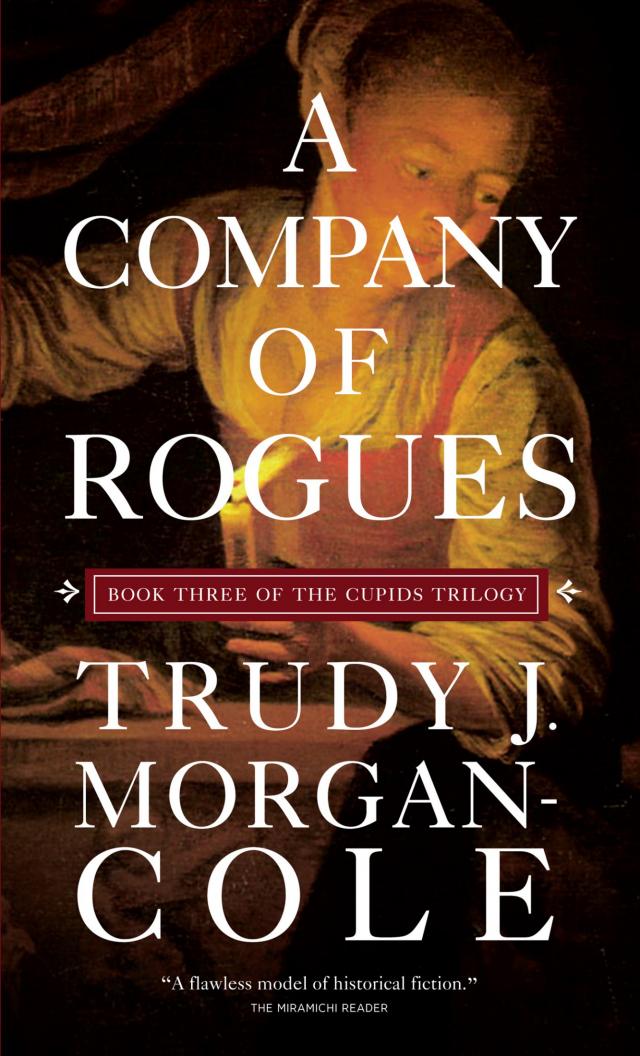


Description The cover image portrays a painting of a woman holding a candle that casts light and illuminates her surroundings.
A Company of Rogues
The Cupids Trilogy
Book Three
A Company of Rogues
TrudY J. Morgan-Cole
Breakwater Books
P.O. Box 2188, St. John’s, NL, Canada, a1c 6e6
www.breakwaterbooks.com
A cip catalogue record for this book is available from Library and Archives Canada.
Isbn 978-1-55081-990-8 (softcover)
Cover painting: detail of Young Woman with a Lighted Candle at a Window, oil on panel, 26.7 x 19.5 cm, ca. 1658–1665, by Gerrit Dou. Museo Nacional Thyssen-Bornemisza, Madrid.
Copyright © 2023 Trudy J. Morgan-Cole
All rights reserved. No part of this publication may be reproduced, stored in a retrieval system or transmitted, in any form or by any means, without the prior written consent of the publisher or a licence from The Canadian Copyright Licensing Agency (Access Copyright). For an Access Copyright licence, visit www.accesscopyright.ca or call toll free to 1-800-893-5777.
We acknowledge the support of the Canada Council for the Arts.
We acknowledge the financial support of the Government of Canada through the Department of Heritage and the Government of Newfoundland and Labrador through the Department of Tourism, Culture, Arts and Recreation for our publishing activities.
Printed and bound in Canada.
Breakwater Books is committed to choosing papers and materials for our books that help to protect our environment. To this end, this book is printed on a recycled paper and other sources that are certified by the Forest Stewardship Council®.
Also in This Series
A Roll of the Bones
Such Miracles and Mischiefs
Also by Trudy J. Morgan-Cole
By the Rivers of Brooklyn
That Forgetful Shore
A Sudden Sun
Most Anything You Please
Cast of Characters
Names marked with an asterisk are people whose names appear in historical documents, though they are portrayed as fictional characters in this novel. Children born after the novel begins are not included in this list of characters; for adult characters, the description indicates where they are and what they are doing as the novel opens.
In the New Found Land
Isaac Bell: A servant of the Guy family at Musketto Cove.
Stephen Butler: A settler who comes out to Newfoundland in 1617 and stays at Musketto Cove.
John and Sallie Crowder: Settlers at Cupids.
*Thomas Dermer: An English sea captain who comes to Newfoundland in 1618.
Alice Guy: Second child of Kathryn Guy.
Kathryn (Gale) Guy: Colonist who came out from Bristol in 1612 to join her husband Nicholas; now living at Musketto Cove.
James (Jemmy) Guy: Youngest child of Kathryn and Nicholas Guy.
Jonathan Guy: Eldest child of Kathryn and Nicholas Guy; first English child born at Cupids Cove in 1613.
*Nicholas Guy: One of John Guy’s earliest Cupids colonists, now a planter at Musketto Cove. Husband of Kathryn Guy.
*Robert Hayman: An English scholar and poet who comes to Newfoundland in 1618.
Hal Henshaw: A settler who comes out to Newfoundland in 1617 and stays at Musketto Cove.
Higgs and Barry: Servants of Thomas Willoughby.
James Hill: A settler at Cupids Cove.
Jem and Elsie Holworthy: Settlers at Cupids Cove.
George and Jennet Lane: Settlers at Cupids Cove.
*Anne Mason: Wife of Cupids governor John Mason.
*John Mason: Governor of Cupids from 1615–1620.
Nancy (Ellis) Perry: Former maidservant of Kathryn Guy who came out to Cupids Cove with her in 1612. Kidnapped by the Happy Adventure in 1613; later a servant in the home of Pocahontas and John Rolfe in Virginia. Wife of Ned Perry.
Ned Perry: One of John Guy’s original 1610 Cupids colonists; later a sailor and ship’s carpenter aboard the Treasurer and the White Lion. Husband of Nancy Ellis.
Gilbert and Sheila Pike: An English pirate and his Irish wife, planters at Carbonear.
Hannah Porter: Sallie Crowder’s sister, living with the Crowders at Cupids Cove.
Dickon Sadler: A settler at Cupids Cove.
William Spencer: A settler at Harbour Grace.
Daisy (More) Taylor: Servant to the Guys at Musketto Cove. Widow of both Matt Grigg and Tom Taylor. Sister of Bess.
Bess (More) Tipton: Servant to the Guy family and planter at Musketto Cove. Sister of Daisy and wife of Frank.
*Frank Tipton: One of the original 1610 colonists, now a planter at Musketto Cove. Husband of Bess.
Matthew (Matty) Tipton: Bess and Frank’s second child.
*Tisquantum: Wampanoag man from Patuxet who was kidnapped, sold into slavery in Spain, and eventually made his way to England and from there to Newfoundland.
Will Tipton: Bess and Frank’s eldest child.
Rafe Whitlock: Servant to the Guy family at Musketto Cove.
*George Whittington: One of the original 1610 colonists, still living at Cupids Cove.
Nell Whittington: George’s wife.
*Thomas Willoughby: Son of Sir Percival Willoughby, who spent time at Cupids in 1612–1613 and later returned to the colony.
Beyond the New Found Land
Captain Bellamy: Captain of the Fair Isle.
John Gale: A Bristol stonemason; Kathryn Guy’s father.
Lily Gale: John Gale’s daughter; Kathryn’s younger sister. Married to Walter Tucker.
John Harvey: A sailor on the Bountiful.
Samuel Hollett: Navigator and mapmaker on the Bountiful.
MacLeish: Ship’s carpenter aboard the Fair Isle.
Omar: A formerly enslaved man who befriended Nancy in Bermuda.
Dickon and Mary Perry, Mother Perry: Ned’s family in Bristol.
Tibby: Longtime servant of the Gale family; believed to be Nancy’s aunt, but actually her mother.
Francis Withycombe and Red Peter: Sailors on the Treasurer; old friends of Ned Perry.
Map detail from The Coast of New-Found-Land from Cape Raze to Cape St. Francis by Henry Southwood, London, 1675. Courtesy of the Digital Archives Initiative of Memorial University of Newfoundland.
This map, published about fifty years after the events of this novel, shows the section of Conception Bay where most of the story takes place, including Harbour Grace, Musketto Cove, and Carbonear. The original English settlement at Cupids (Cupids Cove) is not marked on the map, but is located immediately north of Brigus.
Description The map displays various locations, including Harbormaine, Samon Coue, Colliers 'B, Brigues, Burnt head, Graue, B Roberts, Spaniards B, Harbor Grace, Briants Cove, Harbor Grace Ifles, Carbonear, Musketto Cove, Clounes Cove, Crokers Cove, Tittle Bell, and Bell on the Conception Bay. To the northwest, it also shows Walh Ballocks.
Author’s Note
The epigraphs at each chapter heading are taken from George Chapman’s translation of the Odyssey, originally published as part of his book The Whole Works of Homer in 1616. The edition I used was Homer’s Odysseys, London: Reeves & Turner, 1897. The epigraph at the beginning of the novel is from Quodlibets by Robert Hayman, published in London in 1682.
To a worthy Friend, who often objects the coldnesse of the Winter in Newfound-Land…
You say that you would live in Newfound-land,
Did not this one thing your conceit withstand;
You feare the Winters cold, sharp, piercing ayre.
They love it best, that have once winterd there.
Winter is there, short, wholesome, constant, cleare,
Not thicke, unwholesome, shuffling, as ’tis here.
—Robert Hayman, 1575–1629
Quodlibets, Book 2, 81
One An Adventure Goes Awry
Musketto Cove, July 1617
A grove grew
In endless spring about her cavern round,
With odorous cypress, pines, and poplars, crown’d.
—Homer’s Odysseys, Book 5, 86–88
If only I were a man, that I might go half-naked in the sun!
Summer days in the New Found Land were rarely hot enough that a woman would want to strip to the waist as a man might do. But today was such a day. Kathryn Guy thought for a wistful moment of how it would be to stride along shirtless, in breeches, letting the sun warm her bare skin. She imagined her shift and kirtle hung on a peg in some unused room, herself transformed, no longer needing them. She was entirely alone in the forest, a rare thing for a busy mother of three. For half a moment she entertained the idea of taking off her clothes altogether, of being naked as a wood-nymph.
An impractical idea as well as a naughty one: dryads, presumably, were not troubled by the prickling of branches or the scrape of pine needles. Being tree-spirits themselves, not bound by mortal flesh, they could slip through the forest unscathed. But Kathryn’s arms were already scratched, and while her clothing felt heavy in the hot sun, it also protected her from a great many more scrapes and scratches.
A wood nymph would also not feel the warm, heavy tenderness in her breasts as she thought of nursing her son. Jemmy had begun to wean and Kathryn could go longer without feeding him than she had a few months ago, but her body still felt that tug towards her hungry child. Wood nymphs also did not need to crouch awkwardly in a bush to make water, trying not to wet their own skirts. N o, she was far too much a creature of flesh and bone to flit through the trees like a nymph.
She had been in the forest an hour or two already; she had left the house after breakfast. Her servant Daisy was watching the children while Kathryn’s husband and the other men were out fishing. Kathryn had been thinking for weeks that her store of plants, roots, and bark from the forest—things she used to make medicines for her household—needed to be replenished. She had seized on the opportunity of the glorious day to go to the woods and gather what she needed.
As a girl in Bristol, learning the secrets of the still-room from her mother had been Kathryn’s favourite household chore. She could perform all the tasks expected of a young woman—bake and brew, clean and sew, dress a capon and stew it for supper—but the herbs and plants that her mother handled in the still-room, the unwritten recipes she passed down for how to prepare each remedy, had fascinated Kathryn. She had cherished the thought that someday she would use that knowledge as mistress of her own household, growing and gathering and brewing the remedies that would keep her husband, children, and servants healthy.
What she had never imagined was that she would be a wife and mother on the other side of the ocean, collecting plants from the wild forest that bounded three sides of her husband’s plantation. She had, of course, an herb garden; the Cupids colonists had brought over many seeds from England. Kathryn had carefully tended the hyssop, thyme, mallow, and wormwood she had brought with her from England to Cupids Cove, and from Cupids Cove to the new plantation. These plants now formed the core of her own still-room stock. But she was ever seeking out wild plants as well, trying and testing them, asking the other women settlers, when she had chance to meet with them, what new cures they had discovered.
She had been in the New Found Land five years now, and was always adding to her store of knowledge. In some parts of the New World, she knew, the native people of the land traded with the settlers and taught them what local plants were good for healing. But there were no friendly native women anywhere near the Guys’ plantation that Kathryn could learn from. In five years, Kathryn had yet to see one of them. So, it was only by trial that she had learned that spruce bark could be made into a brew that soothed many ailments, including the dreaded scurvy, and that the sap of the fir trees was ideal for healing the cuts and small wounds that everyone suffered while going about the work of a busy plantation. She was seeking these things today, as well as the ever-useful juniper berries, which could be brewed into a remedy for sick stomachs.
Between looking for plants and imagining herself as a wood nymph, Kathryn’s mind was well-occupied as her feet found animal trails through the forest and her eyes spotted berries and bark to add to her basket. Only when she came out into a little clearing and looked up did she notice that the sun had climbed to its zenith and beyond. Back at the house, Daisy would be fretting that she had not returned for the midday meal. With the rare pleasure of time to herself, Kathryn had entirely lost track, not only of the time of day, but of the paths she had followed into the forest.
She did not worry. For her first two years in the New Found Land she had lived in the little settlement at Cupids Cove, but for these past three years her family had occupied their own land further up the shore of Conception Bay. Their plantation was the only one in a tiny cove that the fishermen called Musketto, tucked between the larger bays of Carbonear to the north and Harbour Grace to the south. They lived with the ocean to their east and the forest surrounding them on north, west and south. Since moving there, Kathryn had done a good deal of wandering about the woods, sometimes with her husband and sometimes with Daisy or Bess, often with the children in tow. Trails led from their cove to the fishing stations at Carbonear and Harbour Grace, and the Guy family had cut several other trails through the woods that they used regularly.
She still felt, as she imagined all the settlers did, that the “wilderness” was something strange and menacing, harbouring unknown threats. But she no longer thought of the forest around Musketto Cove as wilderness. It was where her husband and his men cut wood and hunted game and wild birds, where Kathryn and her maids picked berries. It was becoming tamed and known, part of their home. She left the clearing in the same direction from which she had entered it, confident that she would soon retrace her steps and find her path.
An hour later she was no longer as certain. I am lost in the forest, Kathryn thought, a strange thrill accompanying the fear that those words ought to bring. Anything might happen to someone lost in the forest. There were the everyday fears of hunger, exposure, wild animals and wild men, but also the possibility of being fairy-led or meeting some other fabulous creature. Just as the flowers and trees of this land were different from those in the tamed and gentle lands around Bristol, so the fae-folk might be different from those she had learned about back in England. Giants, ogres, unicorns: who knew what might dwell this deep in the forest?
Still, she could not shake the sense that this land was hers and would not harm her. Trouble had come to her and her family in the New Found Land, but none of it had come from the forest. Neither natives nor wild beasts nor fairies had come from the forest to attack her family. The harm had come from men of their own kind—fellow settlers who had betrayed them, and English pirates who had burned, killed, and captured. The land itself had never betrayed her.
The sun grew hotter still: even through the canopy of green above, she could feel it beating down. One path ended in a tangle of trees; she turned around and tried another. The sun was a little lower in the sky now. It was sinking towards the west and so she kept it at her back, knowing that walking east would bring her to the sea.
She did sight water, but it was not the ocean. Several brooks and one large river ran through the woods around their plantation, flowing into the pond that lay on the other side of the rocky beach near their house. There was another good-sized lake further inland where the men fished for trout in the autumn. If she had come to that lake, Kathryn knew she could find her way home.
But this was not that familiar lake. Breaking through the trees, Kathryn saw a very small, sheltered pond in a grove of birch. She was quite sure that in three years of wandering these woods, she had never seen this pool before. She was further from home than she had imagined.
She sat on a stone underneath one of the trees and looked at the glimmering, inviting waters of the pool. Perhaps this was where the fae-folk dwelt; perhaps a naiad, a water nymph, would rise from the pool and greet her. Would the nymph curse Kathryn for stumbling upon her secret place, or bless her with a granted wish? The wish would have to be a straight path home, of course; it was well into the afternoon now, and her most pressing need was to return to her family.
But she was tired, and the pool looked cool and inviting. A few more minutes’ delay could not matter that much. She hoped her little fable of a naiad in the pool was only a fancy, for Kathryn, already busy unlacing the front of her kirtle, was about to invade the water spirit’s domain.
Kirtle and petticoat off, she stepped to the edge of the water, enjoying the freedom of standing only in her skin, the dappled sun pouring down on her body. The water eased the soreness of her full breasts, washed the sweat from her skin. It was as refreshing as she had imagined, the bottom of the pool a little muddy but the water clear. The pool was only the length of two bodies across, but it looked deep enough to bathe, and she stepped further in, letting the delicious coolness envelope her.
In the middle of the pool Kathryn dipped down, holding her breath and closing her eyes till the waters closed over her head. When she stood up again, she reached for the pins that bound her hair. She had gone bareheaded in the woods, but kept her hair pinned neatly up; now she let it down and dipped below the surface again, letting the whole thick dark length soak in the chilly water.
She stood up, water streaming down her face, and laughed aloud at the glorious freedom of the moment. No-one around to see or to judge her, only her own body and the woods and the water. It was, she thought, the most truly free moment of her twenty-six years.


