

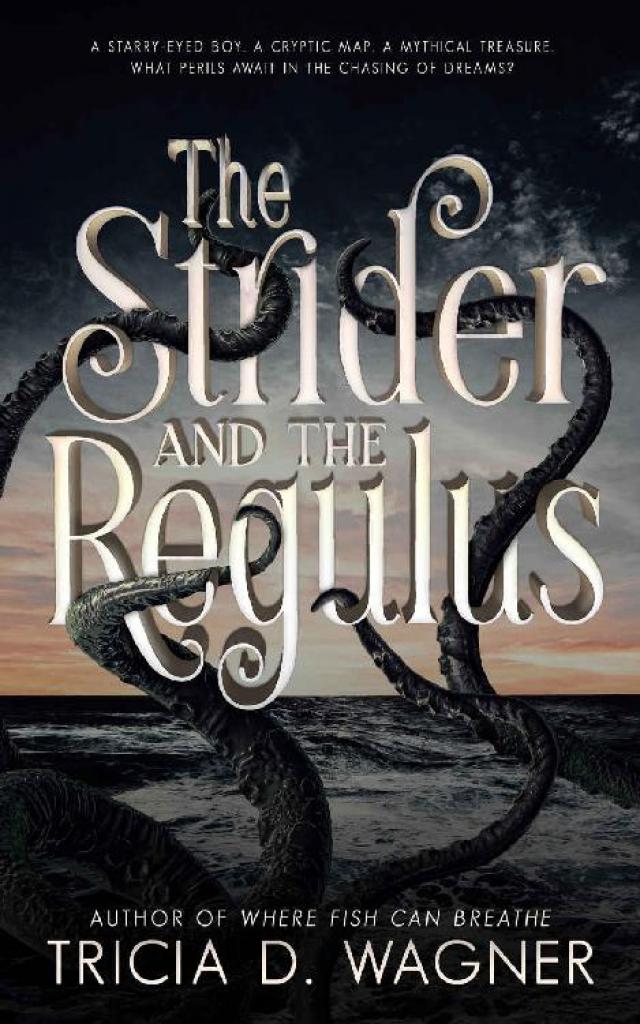
The Strider and the Regulus (The Star of Atlantis Book 1), page 2


“Dealing with injuries on oneself is a far different matter than tending the bodies of others.”
What part of—what if I’m just a young lad—could Justus not understand? Swift cracked the acorn in his fist.
“Lads your age can rarely see beyond their noses,” said Justus. “That’s where fathers come in handy. Will you not let me show you the Swift I can see?”
The Swift whom Justus saw was nothing more than some version of Justus himself.
Caius admitted that he could make out in Swift what Justus believed to see. But Caius also said that, of all the brothers, Swift was the one most like Justus.
Caius was making the same mistake Justus always made—he was confusing similarity for sameness.
“After all, medicine runs in your blood.” Justus looked about them. “This very grove was planted by your great grandfather—a renowned physician in his day.”
Who knew but that Great Grandfather might’ve planted this grove out of some subconscious intuition that his someday-great-grandson would need his solutions—places to hide when chased by a domineering father who overrated him.
From what Swift had read of Great Grandfather’s notes, he seemed to be strongly interested in soothing, not just illness and injury, but fear and pain.
And he never wrote of a case without critically adding what he could’ve done better—he called those parts, “healing the healer.”
It was like he viewed the practice of medicine itself as a puzzle to work at. A craft to refine.
Caius and Justus rarely talked about medicine so plainly in terms of its capacity to evolve. And they talked more of processes and standards than they did about the simple ambition of easing the problem of pain.
“Imagine,” said Justus, “what he might think of having a great grandson such as you—reaching the heights that you very well might.”
If Justus thought Swift was capable of reaching the heights Great Grandfather aspired to, then he certainly couldn’t see Swift. Even thinking of trying to test into the internship—cool though it might be—made Swift feel even littler, even more incompetent, than he normally did.
Being “the Lad,” seemed to mean that he wasn’t just younger than his brothers, lacking “maturity” and “reserve.” It cast him as a different sort of creature entirely.
“I don’t want to talk about this anymore.”
Justus captured his glance. “Don’t you, though?”
Swift eyed the thicket behind Justus.
Great Grandfather’s grove was divided from a vast woodland by a measly fence.
He could run. He could jump the fence and run and keep running.
Justus could follow him, sure. But Swift could wear him out.
Justus, as though sensing the flight on him, moved in. “There’s no future in scampering about, lost to wild games. You must choose a sound path. And selecting one sooner, rather than later, would be to your advantage.”
Swift rested his hand on his pocket. “I already have a sound path.”
Justus lifted a brow.
Swift’s trouser pocket, without fail, contained a wonderful, old book: The Star of Atlantis.
It was the lore of a fabled lost treasure, hidden hundreds of years ago somewhere along the Welsh coast.
This book of sea legends—the best one Swift had ever found—also held the dignified office of being the sole remnant of his collection all but obliterated by Ash.
Justus tuned his eyes to Swift’s pocket. “Let’s have a look at that, shall we?”
Swift hesitated.
Justus held out his hand.
“Alright, have a look.” Swift drew out the book. “Tell me if it’s even possible to hold that book and imagine a path more exciting.”
Justus took it, focusing for a moment on the seven-pointed Celtic star on its cover.
“That star represents what the ancient Celts defined as elemental,” said Swift. “The moon, wind, enchantment, the sea, spirit, Earth’s forests, its sun.”
These felt elemental to Swift himself, too.
Justus opened the book. He studied, as he flipped pages, its hand-inked drawings of coasts and its actual old notes on navigation and weather; its sea chanties and poems; its sketches of mythical sea monsters haunting inked waters; its cryptic strokes, lining the top of each page, looking almost like letters of some ancient, lost language.
His eyes, as he turned pages, widened.
That expression on Justus was the same as what he wore when he used to pretend with Swift. With his face so bright like that, he looked like Caius.
“How can anything—even medicine—compare?” asked Swift. “Those stories are thought to be true, about treasure hidden along the Welsh Coast. And no one’s ever found the Star of Atlantis.”
Justus lowered to a knee before Swift. “Have I ever told you that I had a book similar to this when I was a lad?”
“About lost treasure? About the Star of Atlantis?”
“That’s right,” said Justus. “I, too, looked to the very same legends that have you so entranced.”
“Where’s the book now? Do you still have it?”
“Probably not,” said Justus. “These things, you see… they do fade.”
Thunder rumbled from the edge of a low storm.
Justus handed him back The Star of Atlantis. “The path I can set you on is quite as full of adventure and reward as what lies there. And it’s steadier. You’ll need a sound pathway, and soon. University, for you, is just a few short years away. Will you not lean where I’d have you go?”
It wasn’t that the thought of leaning toward medicine wasn’t intriguing. It truly was. The stories that Caius and Justus came home with—Swift had to admit—were mesmerizing. The idea of all the work it would be, trying to test into the internship—though it did seem daunting, even that wasn’t too off-putting.
The truth was—medicine was riddled with suffering. And death. More than anything, it was that bitterness that seemed to magnify the incompetence Swift felt. He couldn’t bear those dark places that Justus and Caius seemed to handle so effortlessly.
If Justus forced him into medicine, Swift would end up disappointing him. And Caius.
Swift backed away, toward a darkening, tangly stretch of woods.
If he ran now, Justus might feel he’d said plenty and decide not to follow.
“Come. The sky’s bent on storming,” said Justus. “Shall we go explore a legitimate pursuit?”
A large raindrop splashed on Swift’s cheek.
“Quickly now,” said Justus. “Before we’re soaked.”
“You don’t understand,” said Swift. “Treasure hunting, sea histories, sailing adventures, everything that the star on my book represents—these are legitimate, too.”
“It’s not that you can’t cultivate an interest in sea legends,” said Justus. “Think of my dear friend, Elias, so brilliant a psychiatrist—he loves to be out on the sea. And I quite hold him responsible for teaching you to love its wonders and myths. Many doctors, like Elias, harbor quaint hobbies.”
Quaint hobbies.
Justus watched Swift, one brow raised, as though he were reading plain text on Swift’s face. “Edric and Trystan will have arrived from the station by now. Let’s move this discussion inside.”
What was it to Swift if Trystan and Edric had come home for the weekend? They were here to see Justus and Mum and Caius—the only big brother left in Clovelly. They wouldn’t care a bit whether Swift came in or didn’t.
Swift glanced at Ash’s house. “You keep telling me you’ll take me sailing. You say you’ll teach me all about it.”
The sky let down more drops.
They were coming in slow, stuttering bursts, but they were big. This would soon be a hard downpour. Good.
Justus studied Ash’s house. “Is that what all this resistance is about? Are you jealous of Ash?”
Jealous? Jealousy was exactly what Ash wanted from Swift. How could Justus even say that?
“I’m not jealous of anyone.” Raising his voice never helped his case, but he couldn’t help it.
Justus glanced back at their house. “Perhaps you’d value what your brothers have to say about the internship.”
His brothers would no doubt join Justus in his campaign.
Edric, out of all of them, might best understand Swift’s predicament. Edric wasn’t anything close to straight-laced.
It was actually he who, at two years old, latched onto their father’s first name and refused to call him anything besides Justus. Mum and Justus alike found it so endearing, they never corrected him.
And so by Edric’s declaration, what’d once been a father was born as a Justus, and he was Justus to his boys ever since.
They all considered it an act of foresight on Edric’s part, rather than a mere child’s blunder. Their father was more alike to a Thor or an Odin, deific and timeless. And to them, he seemed larger than life, aiming—with god-like determination—to raise them not just to manhood, but to magnificence.
In the end, though, Edric abandoned Justus’s lofty aspirations to make a star athlete of him—and not just because of the injury.
As insightful as Justus was with his sons, Edric dared to claim to know himself better, and he forged his own way.
Now Edric was free as a kite, spending his time however he liked and running his own microbrewery.
But Edric had always enjoyed seeing Swift suffer. If Justus brought Edric into this, he’d only make everything worse.
Trystan always said he wouldn’t trade Justus’s guidance for anything, so he’d be no help. And Caius, though he seemed to care for Swift more than the others did, would say, just like always, that in Swift he saw Justus.
“Even if they agree with you, it doesn’t mean I could follow you,” said Swift. “To everyone, I’m nothing more than a lad.”
“You’re fluency with languages, Swift. You’re the only lad I know who can speak eight of them—and you study more languages, yet—and not just classical ones, but archaic. And, if we were to talk academics, your love of medical topics aside—your adeptness with science and maths—you’ve excelled beyond everyone in your entire school, not to mention the reach of your brothers.”
“Being good at school isn’t the point,” said Swift. “In no way am I anything like my brothers.”
“Perhaps, today, you can’t see your potential in medicine,” said Justus. “But I wager—you will. Why don’t you come inside and ask them for yourself? My bet is that they’ll say so, too.”
“Caius calls treasure hunting ‘great sport,’” said Swift. “Though I doubt he’d admit that to you. Trystan always agrees with whatever you say. And Edric would just tell me to get lost.”
“That’s not fair, not to any of them.” Justus folded his arms tightly, a sure signal that he was losing his cool. “The plan has always been for you to start with a University at sixteen. Any way you look at it, we’re close to that mark. And let me stress, Caius thinks my plan for you is splendid. He’s a bit envious, actually, of your chance to compete to get into a medical internship, so young.”
“That’s easy talk for him,” said Swift. “Caius didn’t have to deal with the threat of all this work, all this gore, at thirteen.”
The wind drove in a sheet of rain.
“We’ll not stand out in this downspout bickering like children on a subject so vital.” Rain coursed off Justus’ short beard. “I need you to hear me. It’s time we take a hard look at the internship.”
Swift already knew all about the internship—he’d stolen a look at the application on Justus’s desk.
If Swift bought in, he’d be taking on a schedule that would smother out every inch of free time. He’d have no hope of cultivating ‘quaint hobbies’ of any kind, much less of finding time to explore what he liked and discover for himself whether medicine was what he wanted.
“It’s a smashing internship.” Justus relaxed his arms in what seemed a last-ditch appeal for Swift to cooperate. To concede. “Once you consider all it includes, I fancy you’ll be quite entranced.” His mouth curled in a hopeful smile. “Perhaps you’ll grow as spellbound with it as you are with that trifle of a book.”
The storm broke. Water fell in sheets, drenching them.
Swift laid his hand on his pocket, keeping safe there The Star of Atlantis—a symbol, a guide, maybe—to the only venture he could see himself in; the venture that might be his if his father could just understand him.
“Lad,” said Justus, letting the water strike and roll off him. “It’s time we move forward.”
Swift launched into a sprint through the dark, pathless woods.
2
Swift scaled his treehouse ladder—
a sequence of wooden bars Caius had long ago nailed to the trunk of the gnarliest oak in their woods.
He heaved himself onto its rough balcony.
From it, he watched Justus rush through the rain and hustle into the house.
Justus looked frustrated, and he probably was. His strategy to make Swift hear the Justus Talk had tanked.
He might come back. This treehouse was no hiding spot—Justus certainly had seen Swift climb. And anyway, it was the first place his family ever looked for him.
But Swift had made his point—how could a lad do anything but fail miserably at the plan Justus had conjured? Justus might leave him alone.
For a while, at least.
The rain lightened, and the clouds lifted some, turning the storm into a sun shower.
Swift backed out of the brightness.
He closed the treehouse door and settled on the floor. He pulled near a stack of books—library books on maritime history.
They weren’t very good books. They were poor substitutes for what Ash had stolen.
But they still felt important and knowledge bearing, musty as they were, damp-feeling with age.
He shuffled the stack into a sprawl around him and rummaged through.
Here lay books on using stars for navigation; on mythical sea adventures and pirate legends; on ancient languages, some spoken by Icelandic pirates who long ago ventured to Welsh waters in their dashing Norse vessels; on the treachery of the North Atlantic and all the ancient ships she’d wrecked.
A couple of books were medical ones on anatomy that included Michelangelo and Da Vinci plates. Those were ghastly and disturbing.
But eye-catching.
It’d felt right to include them in the haul. He mainly got them to show Caius.
In the distance, a creak sounded from the house—the backdoor swinging.
A clatter of cookery in sinks and on stoves rang, and over its clamor peeled his brothers’ strong laughter.
No doubt they were laughing at him. And no doubt Edric was leading the fray.
Swift shifted to the treehouse window.
“Swift?” Mum was leaning out the backdoor. “Your brothers are asking for you.”
Early this morning, Mum counseled Swift that he’d fare better with Edric if he could “show some maturity and reserve.”
Caius, though, had caught Swift’s eye and winked.
Caius never expected anything close to maturity and reserve from Swift. Caius was reasonable. He accepted Swift’s wild play—he even liked it.
Edric and Trystan, though, didn’t.
Well, Trystan might. He liked to play. Sometimes.
But Edric was like Justus—big in the shoulders and furrow-browed, absorbed in more worldly things than sea faring guides or toads found in the forest or legendary treasure or super-gluing models or reading sea adventures very loudly because that was the best way to feel the people in them.
Edric was all moved out, on his own—a capable entrepreneur. And, at twenty-eight, even his hair was the scary salt-and-peppery silver of their father’s. That hair seemed dignified, all by itself, warning off rogue little brothers.
The last time Edric had been home, Swift’s play had gotten too rollicking for Edric’s salty-peppery tolerance. Things ended in a bloody lip on Swift.
Edric apologized right after and said he hadn’t meant to shove Swift so hard.
But how could he not have meant it? Caius had never shoved Swift.
Panicking over retribution, Swift told his parents it happened in a fall out of a tree.
It was believable.
But Edric still blustered out of the house before questions could be asked.
“Breakfast is ready,” Mum shouted.
She’d spent the whole morning cooking a full English breakfast, starting with a crack-of-dawn trip to the farm. It felt callous to reject that, to refuse to go inside. But inside waited Justus.
And Edric.
“I’m not hungry,” Swift shouted back.
She cast him a doubtful look. She was sharp and had certainly put together that he was out here because he wanted to be alone; because he meant to avoid taking something head on.
“I’m staying out,” Swift called. “I’m skipping breakfast.”
Mum glared at him, the text of her expression plain: grow up.
But in his treehouse, all alone, surrounded by his books, growing up was way out of the question.
Swift broke his gaze away from the house with its critical mother and boisterous laughter and moved another stack of books near. He sprawled onto his belly, knocking aside the medical ones, and flipped through compendiums of Old-World sailing maps.
Beneath those lay biographies of Bartholomew Roberts and other actual Welsh pirates. Here, also, were two guides on tying sailing knots, and one holding diagrams of ships.
Just diagrams, though. Skeletal images, bloodless. Windless.
Swift shoved the whole lot of them away and sat up. None of these held any real promise.
He drew from his pocket his own book—most heavy with promise.
It was a small book, compact enough to easily fit in a big jacket or cargo trouser pocket. It was blue gray like whale skin, and its pages were yellow like baleen. The cover was soft as suede with age, and the seven-pointed Celtic star embossed on its cover shone an untarnished silver.
And above it, in crackling, bright letters, scrolled words as good as any pathway: The Star of Atlantis.


