Ida's Awakening, page 1
part #1 of Becoming Middle Earth Series
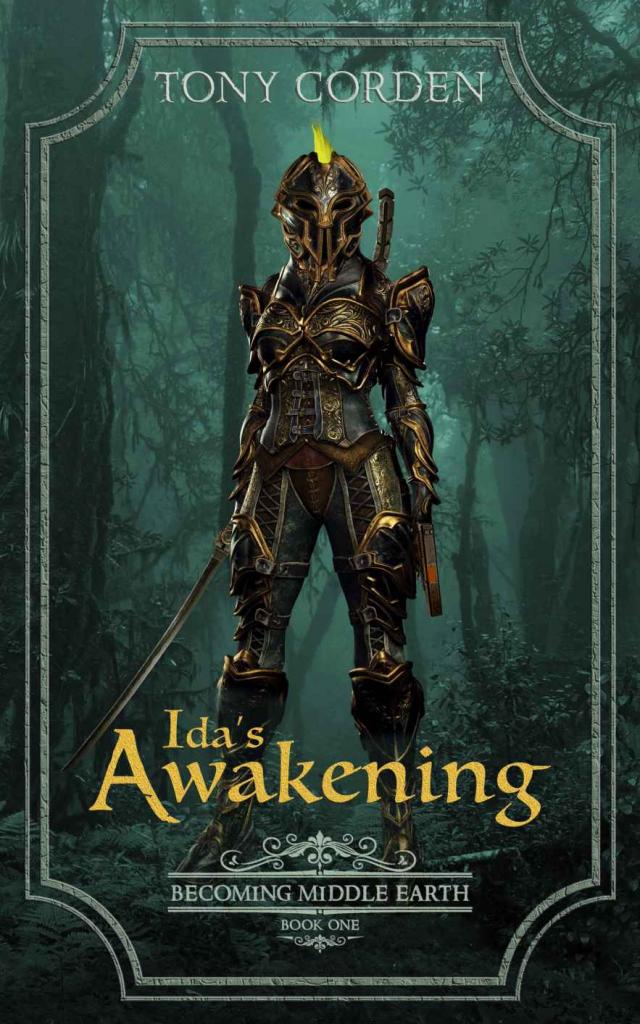


Ida’s Awakening
BECOMING MIDDLE EARTH - BOOK 1
TONY CORDEN
Copyright © 2022 by Tony Corden
Tony Corden owns the content in this book and reserves all his legal ownership rights. ‘Ida’s Awakening’ is published for your personal enjoyment. He allows quotations in book reviews and social media posts. In fact, if they are positive reviews, he encourages their use. If you want to use it for another purpose, email him and get his written permission; if you don’t, you may not reproduce or use it.
ISBN 13: 978-1-922336-80-4 (E-book)
‘Ida’s Awakening’ is fiction. Tony isn’t writing about real people and doesn’t intend in any way to point the finger at anyone. If there is a similarity, then it’s unintentional and a coincidence. Some of the places, nations, corporations, institutions, public figures, books, movies and songs Tony mentions are real. Tony has used them in a made-up story (fiction), i.e., IT ISN’T REAL.
Tony designed the cover using Photoshop. Vellum was used to prepare the e-book.
Published by Tony Corden in 2022
You can find out more at www.tonycorden.com or write to Tony at tony@tonycorden.com.
In memory of my grandmother,
Ida Mary Corden.
She would have made an excellent wizard.
Contents
Chapter 1
Chapter 2
Chapter 3
Chapter 4
Chapter 5
Chapter 6
Chapter 7
Chapter 8
Chapter 9
Chapter 10
Chapter 11
Chapter 12
Chapter 13
Chapter 14
Chapter 15
Chapter 16
Chapter 17
Chapter 18
Chapter 19
Chapter 20
Chapter 21
Chapter 22
Chapter 23
Chapter 24
Chapter 25
Chapter 26
Chapter 27
Chapter 28
Chapter 29
Chapter 30
Chapter 31
Chapter 32
Chapter 33
Chapter 34
Chapter 35
Chapter 36
Chapter 37
Chapter 38
Chapter 39
Characters
Also by Tony Corden
Writing as Ethan Stand
Chapter
One
Everything changed just before ten o’clock on the evening of April 6, 2029, but it took a few weeks for the reality of what had happened to filter down to most people. Even then, they really only understood the particular life and death issue that they had to deal with. I was even slower than most people, and even though I’d witnessed the actual harbinger of our transformation that night, I didn’t realise something was seriously amiss until mid-May.
Being a bit slower to catch on wasn’t that unusual as I was a bit of a recluse and spent most of my time reading or pottering in my small vegetable garden. I’d given up watching or listening to the news fifteen years earlier when they gave as much air time to some airbrushed influencer or flat-earther as they did to someone who was functionally literate. This, coupled with the fact that I lived by myself on ten acres surrounded by small communes of aged want-to-be potters and artists, back-to-nature pot-smoking vegans and others like myself who’d retired too early, or more to the point, with too much optimism.
At the time I didn’t think we were being optimistic; no, I thought we were reaping the benefit of our clean living and wise choices. We’d just turned sixty, we had plenty of superannuation put away, and our two adult children had secure jobs, attentive spouses and had begun to procreate. John and I moved to the hinterlands above the Sunshine Coast, bought acreage that had a pool to entice the grandchildren to visit, and we looked forward to spending time pursuing our hobbies or travelling. By the time COVID-19 had been dealt with, John was finishing his third round of chemotherapy, the children were too busy to visit, and I seriously doubted that any of John’s or my excellent DNA had made it to the following generation, not that I ever got to see them.
That Friday night, I was sitting on the back deck finishing a glass of red wine with my phone in my lap, waiting. The eternal optimist, I’d decided that my loving children had had a busy day and knew I’d still be up late and were waiting for their lives to slow down so they could ring me and wish me a happy eightieth birthday. Looking up, I saw the streaks of fire as a dozen or so small asteroids became meteors and raced across the sky. One seemed to dip toward the earth, and as the others streaked past, it exploded, the airburst spreading space debris far and wide.
From the few pictures taken just before they entered the atmosphere, it turned out that the meteors weren’t your usual bits of rock or ice. They looked like a wrecked and torn apart spaceship or part of one. Whatever it was, and wherever it came from, we’ll never know. What we do know is that something organic was on board and that as each section exploded, those organic bits were spread across the planet. Now, by organic, don’t think of something simple like a strand of DNA. No, whatever this was, it was far more complex and far more resilient.
The aliens’ cells each had a single coiled triple helix which formed a complex spherical polymer with over fifteen trillion nucleotides. Don’t worry, I won’t get into too much of the science, but before I retired, I worked in a university laboratory, and I think it’s important. So, the genetic code dealt with a biochemistry that used both carbon and silicon oligomers and had both glycosylamines and ones using phosphorus. Besides being complex, the small balls of cellar genetic code were hard to destroy. OK, end of the big science words. Either whole or in pieces, the genetic code rained down on the unsuspecting world.
Looking back, I can’t think of anything that hasn’t been changed by those bits of code. Sure, lots of the bits of TSNS became denatured. OK, sorry, but I made up that little acronym, and I’m quite proud of it. It means triple-stranded-nucleotide-spheres. So, those bits which did survive and managed to come in contact with Earth’s biology, they made changes. Some of the changes took months and years to uncover but the most influential, at least for most people, swept across the world within just a few weeks. The TSNS interacted with a whole slew of viruses and bacteria, and these swept across the globe, infecting everything.
By everything, I do mean everything. Within a month, bits of the genetic code were transforming the genetic makeup of insects and leaf litter on the floor of the Amazon jungle and the humpback whales off Tasmania’s coastline. Many of the changes were too drastic for the creature or plant to survive. By mid-April, the news of the devastating pandemics and failing ecosystems filled the airwaves.
I, being an unloved, or maybe an unloving recluse, didn’t hear any of this. The next morning, after ringing my children and kindly, and now that I think about it rather passive-aggressively, reminding them that their aged mother had slipped into her ninth decade, I made my monthly shopping trip into Nambour. The following couple of weeks I was laid low with what I thought was a bad cold. I basically ignored the phone, missing the frantic calls as my children tried to check on me. I didn’t like people leaving messages, so I never heard each of them say goodbye as they headed into the hospital.
Half the world died in those first few months, and over three-quarters of those who survived died in the chaos of the next few years. Those of us who lived, who survived, and maybe even thrived, well, we’re not the same as we were. The changes were hardwired into our DNA. I’ve no idea what the aliens were like, but I figure we were too small to become them. Instead, we took on some of their characteristics, and we didn’t do so uniformly.
Most people were changed when they caught one of the various transformed viruses or bacteria. If they didn’t die, then they were changed in one of three main ways. The most common left them looking pretty much the same as humans had always looked on the outside. They had the same mix of colour and gender, but they’d developed a variety of new organs. Which organs they grew was made evident by a change in either eye or hair colour, and for the more powerful, both.
These organs gave them limited control over the physical world around them; this control was with basic things like light, heat, magnetism, sound, electricity, and gravity. They could light fires, freeze water, hear a heartbeat, lift heavy weights, see in the thermal range and a myriad of other skills they learned to use to help keep themselves alive. They worked best in groups and survived by living in hamlets, towns and small cities. Their basic vulnerabilities were the same as old humans, and they had similar lifespans. The only other difference seemed to be the rate at which they multiplied. Of all the main groups, they were, by far, the most fertile.
Of those that lived, the next biggest group inherited a large group of characteristics that used the silicates and phosphates. Over several years, their bones became larger, harder and more dense to cope with the increased musculature and thick wiry ligaments and tendons. Their skin thickened and gave them added protection without reducing their ability to move, and they could move quickly. No hair grew on their bodies, and new flexible organs that looked like dreadlocks replaced what used to grow on their heads.
Their wide, muscular frames and colourful dreadlocks combined with the ability to shape and move the earth made everyone call them dwarves, although being at least a head taller than most humans kind of gave the word a different meaning. Dwarves came in both genders, and their num bers were slowly increasing, but it was primarily because they were both long-lived and hard to kill. Over time they congregated together and built communities in the mountains where they could mine like the creatures they were named after. Despite the change in their physiology, they had the same intelligence, passion, motivation and dreams as their human forebears.
The third main group were what everybody called the elves. Their bodies were also transformed, but instead of being harder and stronger by adding more, they were given better. Better skin, better muscles, better bones, better eyes, better hearing and the ability to manipulate metal and to control time. OK, that sounds way cooler than it really is. None of them could control all metals, and most needed to be touching the metal to transform it. As for time, at most, they could speed up and slow down their movement to some extent. They couldn’t move back and forth or anything like that.
They were almost as tall as dwarves, and from their hair colour and the shine of their skin, you could make a good guess at what metals they could manipulate. The more powerful elves could use several, and the very best could manipulate some alloys. They were slender, agile and generally, really, really hard to kill. Hard to kill not only because they were tough, but because they all had what John, a psychologist, would have called hyper-competitive disorder. This meant they all had your basic volatile mix of narcissism, neurosis and OCD, combined with a healthy dose of paranoia. They often spent their entire lives improving themselves and ordering everything and everyone around them. For many, this included learning ways to kill and stop being killed.
Dozens of other groups created by the mutated viruses and bacteria littered the countryside, but none had the numbers to challenge any of the main three; yet. They were all given names from the same genre, and there were orcs, goblins, trolls, hobbits, wraiths and so on. It wasn’t just people who were changed, but every single species on the planet had been transformed, and it took time to relearn what would and wouldn’t kill you and what could and couldn’t be eaten. When in doubt, it was a good assumption that it wanted to kill you, could kill you, and was itself probably inedible.
Then, there were the ‘other’, in inverted commas, group of newer beings. These had come in contact with one of the TSNS directly, and there were none of the attenuations that the microscopic intermediary had brought. Their DNA was unravelled and then put back together, cell by cell. Thankfully there weren’t many of these, as while most of these creatures survived, the majority of them, over eighty percent, lost whatever grip on sanity they’d had. With those that had been human, even more lost sight of their humanity. Their range of new abilities covered everything the others had received and more, sometimes much more.
The animals transformed this way were definitely the alpha predators and generally developed a range, and after a few years, most of the humans, dwarves, elves and other transformed humans had either been killed or fled. Those like this who had once been human, both sane and insane, were usually referred to by those names given the most horrible of Morgoth’s peoples, so, Nazgul, Uruk-hai, Balrogs, and Barrow-wights were all represented, and a number of Witch-Kings and Dark-Lords had popped up around the world, shaping the areas around them to whatever sick fantasy was running through their head.
Not many of us transformed this way were still sane. Wow, I slipped that in deftly just in case you were wondering when I was going to get to the point. Yes, this was me. Not only did I have what I considered a reasonably firm grasp on both my intellect and my humanity, but I looked pretty much the same as I had beforehand. Well, way, way beforehand. When I’d been transformed, I was remade cell by cell and had had a complete remodel. I think I looked like a kid, but the reality is I looked like a healthy woman in her mid-twenties.
I was taller than I had been, which was just as well as I was still almost two feet shorter than the average dwarf. Those like me were called wizards, and I dare anyone, anyone, to call me a witch, and while we were either barely tolerated or actively despised, most people kept their opinions to themselves and were very polite around us. I’d missed out on all the physical markings of the new humans and, after a few decades, either wore a wig and some homemade contacts, or I covered up and pretended to be one of them.
The biggest problem was there wasn’t really a great need for wizards that I could see, not sane ones. If we didn’t want to kill everything or rule everything, then there wasn’t all that much for us to do. Even in the literature, they didn’t do all that much except sneak around and meddle. Gandalf, the most famous wizard of all (sorry Harry), wandered around selling fireworks to keep himself in tobacco. Sure, he did save everyone now and again, and he fought the really dangerous bad guys, but most of the time, when he wasn’t visiting his want-to-be girlfriend, Galadriel, or meddling with the lesser races, he was a travelling vagabond.
After the first few centuries, things had sort of settled down, and while I tried not to meddle and had no desire to start smoking, I still liked the occasional glass of wine as I watched the sunset of an evening and preferred a little variety to go with freshly killed game and vegetables from the garden. Often this meant a small trip into one of the local hamlets or towns along the coast. However, at least once every few years, it meant a trip down to what I still occasionally thought of as Brisbane but most recognised as the lands belonging to the elven ruler, High Lady Isabelle.
Chapter
Two
Every second year, in the first two weeks of September, High Lady Isabelle hosted the Grand Market. These brought caravans of merchants from everywhere within a thousand kilometres to sell their wares. I used the market to stock up on essentials, but more importantly, to sell my own wares and provide myself with enough loose change so I didn’t have to go door to door selling fireworks. I’d been attending the market almost religiously in one form or another for nearly two hundred years, and I had built up a very dedicated following.
Now, ‘by one form or another’ was my way of saying that not many people, none that I could think of, were aware that I had the same longevity as the elves and the other Maiar, my name for the various creatures like me. OK, it was Tolkien’s name, but as far as I knew, no one else used the term generically in the same way I did. The point is that I’d been careful to change my name and reintroduce myself to people every forty years or so. Even so, I’d still been able to develop a following by giving the impression that I’d taken over from my master after finishing my apprenticeship.
The deception seemed to work by alternating the two characters for several years before killing myself off or retiring. The downside of the deception was finding a way to explain living by myself in the wilds, as not even the elves did this successfully for any length of time, a week or two at best. In the end, people made up their own stories and most believed I was part of a larger community that remained hidden to protect itself and its resources.
The other necessity had been developing the skills to protect myself without seeming to resort to wizardly abilities. So, while my body was more resilient than either the elves or dwarves, I chose to wear protective armour. Instead of using the additional strength and speed to protect myself, I’d learnt to use all sorts of weapons and trained every day to keep these skills as sharp as I could. This came in handy as it not only gave a reason that I was still alive, but it added value to what I made and sold.
To be clear, I still used the other abilities but had worked to hone them so nobody knew when I manipulated metal to sharpen a sword, or when I stepped a little faster through time to move out of the way of a particularly savage attack. No one could see the superconductive neural pathways or the organs which had more power than any of the similar ones found in the new humans, dwarves or elves. My manipulation of gravity to slow an opponent or the smoothing of the ground under my feet was all hidden away from prying eyes.