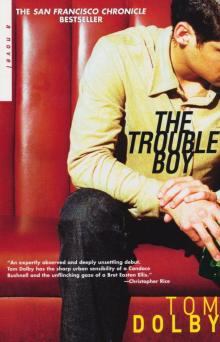
The Trouble Boy, page 4


Cameron’s production company would be the perfect place to pitch the sci-fi drama I was working on. It was a story called Breeders in which most of the world’s population is gay, and a select ten percent of the population—the breeders—has to come out as straight. In an age of mandatory artificial insemination, heterosexual sex is prohibited, so the breeders are forced to copulate behind closed doors. I saw it as a societal commentary along the lines of Planet of the Apes and Soylent Green. When it was released, I would be lauded as a member of the gay cinematic vanguard.
I was on page forty of the screenplay, and had been for the last year and a half.
I was scrolling through more articles about Cameron when Donovan pulled me out of my media-induced daze. “Hey, you want to go to lunch?” he asked. “I’m expensing it. I have to review this new Thai place.”
Thai Me Up was in Chelsea and specialized in nouvelle organic Thai cuisine. The waitstaff were hip Thai kids with eyebrow rings and dyed hair.
“This is so Sonia; I knew she would like this place,” Donovan said as we both sat down. “She’s such a trendoid.”
He turned to a waiter. “Mee krai pood pasa angrit dai bang mai?” Donovan asked.
The waiter responded in Thai and fetched us menus.
I looked at Donovan, surprised.
“I learned it in college. I’m fluent in Thai.”
I was impressed. I had never made it past second year Italian.
“Listen,” he said, “there’s something you should know.”
I felt queasy again. “Yeah?”
“Jamie’s crazy about you. He keeps emailing and calling me about you.” Donovan waved his arms around in imitation of Jamie. “ ‘Oh, my God, he’s so cute! He’s exactly what I’ve been looking for! He’s so WASPy and goyish!’ ”
“ ‘WASPy and goyish?’ That’s such a strange thing to say about someone.” Though many of my friends were Jewish, no one had ever said that about me.
“In addition to not being comfortable with being gay, Jamie secretly wishes he were a WASP,” Donovan explained. “I always tease him that his ideal boyfriend would be some sort of Hitler youth. But he’s willing to settle for you.”
“I’m not interested in him,” I said. “There’s nothing I can do about that. I mean, I like him as a friend.”
“I know,” Donovan said. “And I think he knows it, too. Someday, though, I wish someone would just give the guy a chance.”
After we ordered, Donovan gave me the lowdown on CityStyle. The guy who had founded it two years ago and served as editor-in-chief had been ousted by the site’s investors several months ago after he had been discovered embezzling funds. Sonia had been brought in to refine CityStyle’s editorial focus and bring in national advertisers and strategic partners. So far, she had succeeded, but many had their doubts. Donovan told me who the mysterious high-profile investors were: one was an aging pop star who hadn’t had a hit in years; another was a law firm specializing in high technology. They were not insignificant parties, but they weren’t exactly Madonna or Rupert Murdoch, either.
Though the site was run on a shoestring, it had a healthy public profile. It had been featured two months ago in Rolling Stone, and New York magazine had covered a recent party for its redesign. It had an estimated 70,000 readers each month, which put it right up there with the best of the other sites of its size.
“The problem,” Donovan said, as he cut a piece of mint chicken, “is there’s no real revenue stream. Sure, there’s advertising, but everyone knows that doesn’t work in the long run.
“They used to pay all expenses, for drinks, whatever. The nightlife editor took a car service everywhere, which I think was why he got fired. Now the only person who can expense stuff is me, and even I’m not supposed to order alcohol when I do a restaurant review.”
“The perk of free food is good enough for me,” I said. “Most of the time all I can hope for is a few lousy drink tickets.”
“At least we always get VIP treatment at Ariana’s clubs,” he said. “That’s one of our few benefits for the astronomical rent we pay. Last time we were at Mirror we sat in the booth next to P. Diddy and got free drinks all night.”
Donovan told me that three years ago, Ariana had quit her job at an important boutique PR firm and, armed with their database on a Zip disk, started her own business out of a spare cubicle at her dad’s office. Her last name was actually Rakowski, which she had changed to Richards. With the help of her father, a producer who had worked with everyone from Tom Cruise to Reese Witherspoon, Ariana had put together a formidable client list that was only strengthened by her seven-nights-a-week networking at the city’s plushest nightclubs. Her firm was now one of the top agencies in the city, responsible for film premieres, celebrity representation, nightlife, and corporate products. She had also just scored a major coup by signing on Miles Bradshaw, a notoriously reclusive indie film director, as a client.
Her detractors claimed that while she had a mailing list to kill for, her events involved no creativity whatsoever: she simply threw all her clients together in a room and let the media lap up the carnage. A typical Ariana stunt would be a film premiere attended by her celebrity clients with an after-party at one of her clubs and a gift bag filled with designer fragrances, fashion accessories, and bottled water, all products she represented. Still, everyone attended and wrote up her events because they would be populated with a hip, young, beautiful crowd.
Concurrent with the growth of her business, Ariana herself had become a pseudo-celebrity, often photographed next to her clients as if she were the star. She had been in the headlines most recently after totalling her mother’s Audi while speeding back to the city from East Hampton; while she had emerged unscathed, the luxury car was unsalvageable. The tabloids had a field day over her reckless driving: “PR Princess Learns Speed Doesn’t Pay” was one headline that Donovan gleefully recited to me.
But Ariana’s failures were nothing in light of her successes: she was only twenty-eight years old, and her firm was billing two million dollars a year.
“That’s out of control that she’s doing so well,” I said, leaning back in my chair.
“I know,” Donovan said. “And the bitch didn’t even graduate from college. Dropped out after three semesters.”
“I bet she can’t even put a sentence together.”
“Last month, I was at the office late, and she asked me to proof a press release she had finished. It was so poorly written that I was like, ‘Did you even go to high school?’ Most of the time she just has her assistants do everything.”
“She’s probably the kind of publicist who will read a bad review of her club and then thank you for writing it, because she didn’t understand it anyway.”
“I panned this restaurant she represents and she had an exotic fruit basket sent to me the next day. I feel sorry for her, though. Her dad died last year of a heart attack, and her mom is one of those crazy Scientologists.”
When we got back to the office, Ariana was standing by the front reception desk. The woman she was with looked familiar, but I couldn’t place her.
Donovan nudged me. “It’s Jordan Gardner,” he whispered.
Ariana and her companion glanced at us, then went back to their conversation.
Once we were back at our desks, Donovan reminded me who Jordan Gardner was. She had recently starred in an espionage thriller alongside a famous actor who was twenty years her senior. As the latest British import, her exotic Eurasian looks and mahogany hair with artfully streaked blond highlights had made Jordan a favorite of magazines like Interview and Vanity Fair.
“She’s a hellraiser,” Donovan said. “Ariana had a Fourth of July party at her house in the Hamptons and Jordan got so drunk that she decided to dance on a glass coffee table in the living room. The whole thing shattered.” He shrugged. “It was on Page Six.”
Just at that moment, Ariana came into our office.
“Are you Toby Griffin?” she said to me. “The nightlife guy?” She was about my height, with straightened hair and an obvious nose job.
I nodded.
“It is so good to meet you,” she said, shaking my hand. I hoped she couldn’t detect my hangover. “I heard you were Isabella Griffin’s son. I love her stuff. My mom wears her all the time.”
“Thank you,” I said. “I’m sure she’ll be glad to hear it.”
“Look, if you ever need anything, guest list, comps, whatever, just let me know, okay? I’ve got a few new clubs opening in the next month, and we could definitely use the publicity.”
I thanked her. She was so unassuming. Nice, even.
“She’s never like that,” Donovan hissed at me. “She must be on new meds.”
When I got home that evening, my Powerbook was calling to me, so I popped a frozen dinner in the oven and started writing. I was a page in—my hero had just discovered the breeders living in his basement—when my mind started to wander. I tried to remember which advertising agency Real World Guy said he was working at. I thought it was BMD—Brown Madison Davidson—or was it BMG, like the record company? That didn’t sound right. Even if I did find his number, calling would make me seem like a stalker.
Real World Guy could be a Scooby Snack, or he could be something more. An evening with him was what I wanted, needed, desperately. But I knew he probably wasn’t going to call. Surely he had forgotten me; once he got home, he had decided I was too ugly or boring to be wasting his time.
But I had to believe something might happen.
2
Over the next month, I became a nightlife contender: I completed fifty new club reviews by going out every night. Some places required visits of an hour or less, while others were all-night affairs, calling for extensive documentation of the ambiance, patrons, music, and decor. I tried to stick to the one-drink-per-venue rule, but sometimes the night got away from me. I brought someone along whenever possible, though many of my friends soon grew tired of my specific needs and requirements for each evening’s activity. I became known as a person you could never meet at the same place twice, the nightlife equivalent of a vagrant, a wanderer. The only person who would go anywhere with me, no questions asked, was Jamie; no matter how unfashionable or bizarre the venue—a leather bar in the meatpacking district, a western club in midtown, a Russian mafia hangout in Brighton Beach—Jamie would tag along as my quasi-date. He was starting to grow on me, I had to admit. I enjoyed having an admirer.
When I wasn’t with Jamie, Donovan and I were quickly becoming a reporting team: I would partake in free lunches and dinners, giving opinions on gastronomical matters, and he would accompany me to venues that required a real date and not just a companion like Jamie. Of course, it was only I who pretended Donovan and I were dating; at the end of each evening, we would bid each other goodnight with a friendly kiss on the cheek, and the illusion would be broken. I tried to convince myself our nightlife excursions would lead to something, but in the six weeks I had known him, nothing had happened. Still, he made me happy when we were together. It reminded me of being at boarding school, where I had been in love with a handful of boys, none of whom had the slightest clue about my affections but enjoyed the attention nonetheless.
Sonia liked the work I was doing, as I steadily updated the database of entries the previous editor had let fall by the wayside. She was also buoyed by the Daily News reporter who had come by the office several times in the past week to interview us for a series of articles on the “Dot-Com Survivors,” as we were being called. Any press was good press, she said, and would put us closer to attracting the investment that would take us to the next level.
Even Ariana continued to be friendly to us, which Donovan was convinced was the work of her shrink and not what he called her “true evil self.” On Ariana’s invitation, Donovan and I even attended a small film premiere together, which made Jamie and the boys jealous.
One evening, just as we were about to meet everyone for dinner, I noticed my voice mail light flashing. It was Real World Guy. “Sorry I didn’t call sooner,” his message said. “I was really busy, and then I thought I lost your number and I couldn’t remember the name of your site. Anyway, let’s hang out, maybe go for a drink or something.”
I started getting excited as I realized last month’s fantasy might come to fruition. And even if it didn’t work out, Real World Guy’s attentions might make Donovan realize I wasn’t such a bad catch after all.
When I jotted down Real World Guy’s home number, a 718, I was quickly dragged back down to reality.
Real World Guy didn’t live in Manhattan. That was so, well, real. Dating people who didn’t live in Manhattan meant forty-five-minute subway rides and expensive gypsy cab tabs. For Real World Guy, though, I was willing to give dating a 718 a chance. I saved the message so I could listen to it over the next few days. I knew it was pathetic, but no one had to know.
I told Donovan about the message as we walked down Seventh Avenue, but he seemed indifferent. I hoped I would get a better reaction from everyone else. After all, what was the point of making a hot date with a quasi-celebrity if no one cared?
“He called you back?” shrieked Jamie when Donovan and I arrived for dinner at a bistro in Chelsea. “I can’t believe it!”
“Congratulations!” David said. “You scored!”
Alejandro clapped his hands, and Brett toasted me. It was all a bit embarrassing, as if I were some kind of dating cripple who had miraculously gotten up and walked.
“Look, don’t get too excited. I haven’t scored yet,” I admitted. Despite my false modesty, I had a good feeling about this one. Real World Guy might turn out to be the Real Thing.
I called him back the next day and we made a date to have dinner at Rialto, an Italian restaurant on the Lower East Side that Donovan had recommended. I was running late that evening, since I had wanted to shower and change after work, so I rolled in at ten after eight. I had worn one of my nice outfits: khakis, Polo shirt, Prada loafers I had bought two years ago on deep discount at the Barneys Warehouse Sale. I didn’t want to be dressed like a slob if he showed up in work clothes. I was looking good, except for the blotchy red remains of a pimple on my chin that I had slathered with cover-up. While I was getting dressed, I had flipped on MTV. They were running a marathon of this season’s episodes, and I saw him hanging out in a corner of the impossibly large living room. Compared to his gregarious housemates, he seemed shy, reserved.
He was apparently running late himself, so I gave my name to the maitre d’, ordered a glass of red wine, and sat at the candlelit bar. Ten minutes went by, then twenty, and no sign of him. Had I gotten the date wrong? Or was I being stood up? I was too embarrassed to call Donovan’s cell and find out what the evening’s dinner plans were, so I decided to sit and finish a second glass of wine before leaving, just on the off chance that Real World Guy showed. Since it was Thursday night, the restaurant was filling up with a colorful mix of fashionistas who were grooving to the live DJ at the bar. I felt silly sitting alone, as if I had “stood up” written all over me. I wondered if I could slip out without the maitre d’ noticing.
At 8:45, Real World Guy tapped me on the shoulder.
“I am so incredibly sorry,” he said, and I believed him. “I got stuck on the subway coming from my apartment, and there was no way I could call you.” He gave me a peck on the cheek. He looked as cute as I had remembered him, his hair slightly mussed and his cheeks flushed with the effort of rushing from the train.
“No problem,” I said. “I’ve been enjoying the view.” I knew it was better to feign nonchalance than to confess my paranoia that he wouldn’t show.
Real World Guy, I learned, lived in Queens. Being on The Real World might grant you fame and notoriety—or at least your own fitness video—but the $5,000 stipend the “cast” received would hardly cover the expenses of living in Manhattan for the following year. After his stint on every sixteen-year-old’s favorite show, he had moved to New York and started a job at Brown Madison Davidson Advertising, working in the public service division.
“My job is to write those anti-smoking ads for cigarette companies,” he explained. “They might use one of my concepts for an ad that’s going to run during the Super Bowl. You can’t mention cancer, death, show anyone smoking, or even show a pack of cigarettes. It’s federally regulated that they have to spend a ton of money on it, but the tobacco companies don’t want us to incriminate them at all, so it’s a bit of a Catch-22.”
I was worried he might be offended by my smoking, though I finally gave in to my craving after we finished our salads. “You’re not an anti-smoking Nazi yourself, are you?” I asked, pulling out my pack. Since a large portion of the restaurant’s clientele was European, the owners often waived Manhattan’s stringent anti-smoking laws.
“Oh, no, I don’t care,” he said. “Actually, I’ll have one myself. I usually don’t smoke unless I’m drinking, but, well, I guess I am.” He pointed to the bottle of wine we had put a sizable dent in and grinned as we both lit up.
“I read some of your reviews on that Web site. Pretty cool stuff,” he said. “I hate all those fag bars though.” I had just done a roundup of gay bars in the East Village and Chelsea.
“What do you mean?”
“I just hate the whole scene, the muscle guys, the prissy little queens, the posing. You can get AIDS by hanging out in places like that.”
“Oh, come on!” I said. “Don’t be ridiculous.” I realized I would be banished to the seventh circle of date hell if I continued, so I changed tack. “Look, I know what you mean. A lot of people hate all that stuff. Not everyone is into the superficiality of it all.”
“No, they love it. They love their fucking ghetto-ized lifestyle. They wouldn’t have it any other way. I like places that are mixed. I don’t even go to B Bar that much.”