

Hope Wins, page 1
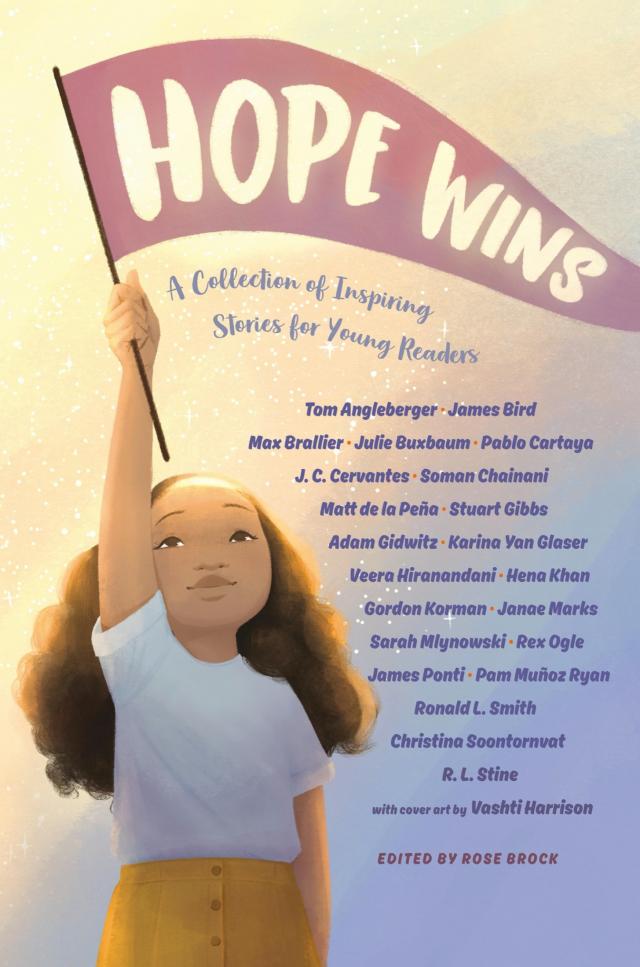


Also edited by Rose Brock
Hope Nation
Philomel Books
An imprint of Penguin Random House LLC, New York
First published in the United States of America by Philomel Books,
an imprint of Penguin Random House LLC, 2022
Collection copyright © 2022 by Rose Brock
“Major Malfunction” copyright © 2022 by Tom Angleberger. “I Am the Greatest” copyright © 2022 by James Bird. “The Day the Hot Dog Truck Came to Town” copyright © 2022 by Max Brallier. “Panic! At the Movies” copyright © 2022 by Julie Buxbaum. “Letter to My Daughter on Her Eighth-Grade Graduation” copyright © 2022 by Pablo Cartaya. “Bones” copyright © 2022 by Jennifer Cervantes. “Victory After Defeat” copyright © 2022 by Soman Chainani. “There’s More to Playin’ Ball Than Just Playin’ Ball” copyright © 2022 by Matt de la Peña. “Helpful Tips for the Worst Week of Your Life” copyright © 2022 by Stuart Gibbs. “The Coolness Equation” copyright © 2022 by Adam Gidwitz. “Hope in the Halls of Catholic School” copyright © 2022 by Karina Yan Glaser. “My Favorite Photograph” copyright © 2022 by Veera Hiranandani. “Sweet Surprise” copyright © 2022 by Hena Khan. “This Can’t Be Happening to Gordon Korman” copyright © 2022 by Gordon Korman. “The Adventures of Me and Supersquirt” copyright © 2022 by Sarah Mlynowski. “On Hopes and Dreams” copyright © 2022 by Janae Marks. “Colors of June” copyright © 2022 by Rex Ogle. “What’s in a Name?” copyright © 2022 by James Ponti. “The Friend Who Changed My Life” copyright © 2022 by Pam Muñoz Ryan. “The Boy in the Back of the Class” copyright © 2022 by Ronald L. Smith. “Everything I Need to Know I Learned in a Thai Restaurant” copyright © 2022 by Christina Soontornvat. “Hope I Don’t See a Ghost” copyright © 2022 by Robert Stine.
Penguin supports copyright. Copyright fuels creativity, encourages diverse voices, promotes free speech, and creates a vibrant culture. Thank you for buying an authorized edition of this book and for complying with copyright laws by not reproducing, scanning, or distributing any part of it in any form without permission. You are supporting writers and allowing Penguin to continue to publish books for every reader.
Philomel Books is a registered trademark of Penguin Random House LLC.
Visit us online at penguinrandomhouse.com.
Library of Congress Cataloging-in-Publication Data is available.
Ebook ISBN 9780593463949
Edited by Jill Santopolo
Cover art ©
Design by Ellice M. Lee, adapted for ebook by Michelle Quintero
The publisher does not have any control over and does not assume any responsibility for author or third-party websites or their content.
pid_prh_6.0_139899378_c0_r0
For my beautiful family.
My joy and hope come from you.
CONTENTS
INTRODUCTION
EVERYTHING I NEED TO KNOW I LEARNED IN A THAI RESTAURANT
by Christina Soontornvat
THE COOLNESS EQUATION
by Adam Gidwitz
THIS CAN’T BE HAPPENING TO GORDON KORMAN
by Gordon Korman
I AM THE GREATEST
by James Bird
BONES
by J.C. Cervantes
THE DAY THE HOT DOG TRUCK CAME TO TOWN
by Max Brallier
SWEET SURPRISE
by Hena Khan
LETTER TO MY DAUGHTER ON HER EIGHTH-GRADE GRADUATION
by Pablo Cartaya
HOPE IN THE HALLS OF CATHOLIC SCHOOL
by Karina Yan Glaser
HELPFUL TIPS FOR THE WORST WEEK OF YOUR LIFE
by Stuart Gibbs
THE ADVENTURES OF ME AND SUPERSQUIRT
by Sarah Mlynowski
PANIC! AT THE MOVIES
by Julie Buxbaum
WHAT’S IN A NAME?
by James Ponti
COLORS OF JUNE
by Rex Ogle
ON HOPES AND DREAMS
by Janae Marks
MAJOR MALFUNCTION
by Tom Angleberger
HOPE I DON’T SEE A GHOST
by R.L. Stine
VICTORY AFTER DEFEAT
by Soman Chainani
MY FAVORITE PHOTOGRAPH
by Veera Hiranandani
THE BOY IN THE BACK OF THE CLASS
by Ronald L. Smith
THE FRIEND WHO CHANGED MY LIFE
by Pam Muñoz Ryan
THERE’S MORE TO PLAYIN’ BALL THAN JUST PLAYIN’ BALL
by Matt de la Peña
ACKNOWLEDGMENTS
INTRODUCTION
Dear Reader,
In 2018, I published a book called Hope Nation, sort of an older sibling of the book you are reading, because I wanted to share stories of hope with the teens in my life who were struggling. Since then, I’ve been lucky enough to visit with young people who have read stories from that collection, and I have gotten to hear about how those stories have helped them through hard times and made them feel a little less alone.
In 2020, the world as we had known it changed. COVID-19 changed the landscape of how we live, look, go to school, and interact with others. The daily reminder of how our own lives can be turned upside down made me realize why it’s so important to hang on to hope. It’s not always an easy thing to do—sometimes, it feels downright impossible—but the thing I know is that difficult times in life come and go; with those experiences, we grow as people. The key is to find ways to motivate and inspire our spirits—stories of hope can do that.
In this collection, I’ve asked some of my very favorite writers and friends to share a true story from their own personal lives. I hope hearing them share their own stories of challenges they’ve faced in life will help you find your own voice. Each of us has a story that’s worth sharing and celebrating.
It’s also worth noting that, like choosing hope, we can choose to do good, and for that reason, Hope Wins is a charitable endeavor. My contributors committed to creating this book with me as a means to support the North Texas Teen Book Festival (NTTBF), an annual book festival that serves thousands of young readers each year. For their willingness to dig into their memory chests and share with everyone, I thank them all and am forever grateful.
For me, making a decision to choose hope is grounded in the love and support I receive from my family and friends, especially my daughters, Madeleine and Olivia, and my husband, Michael. Thanks to each of you for joining me on this journey. It’s not always an easy path, but it’s one worth taking. Remember that no matter what happens, hope wins.
Dr. Rose Brock
Grapevine, Texas
2022
EVERYTHING I NEED TO KNOW I LEARNED IN A THAI RESTAURANT
by Christina Soontornvat
This is not a knock to any of my teachers, but the most important things I’ve learned weren’t taught to me in a classroom. They were taught to me in a restaurant dining room (and the kitchen and the cashier’s station).
When I was three years old, my parents opened a restaurant in the small town of Weatherford, Texas—the first Asian restaurant in the whole county. My dad, an immigrant from Thailand, saw it as an incredible business opportunity. He was right: loyal customers kept our little family restaurant open for nearly forty years.
When I was a kid, I never gave much thought to what it meant to grow up in that environment—it was just my everyday life. If you had asked me then what the best part of spending so much time at the restaurant was, I would have said it was the endless flow of fountain drinks and free spring rolls.
But now I realize that I learned some big, important lessons about people and about life. And now—like a crispy, hot spring roll passed from fryer to plate—I pass these lessons on to you.
* * *
• • •
THE WAY TO A PERSON’S HEART IS THROUGH THEIR TUMMY
Our busiest shift of the week was Sunday lunch. Almost the whole town of Weatherford went to church on Sunday mornings, and then they would show up at our door as soon as the services were over. We’d often have a line that stretched out onto the sidewalk!
Most of the people who lived in our town attended Christian churches. And then they came to eat food prepared for them by people who were mostly Buddhists. When we first opened, we called ourselves a “Chinese restaurant” because at that time (in 1983), people there weren’t familiar with Thai food. Over the years, we gradually introduced more and more Thai cuisine to the menu. And we also introduced more and more people to Thailand and our culture. Some of our customers even took trips to visit Thailand. Sometimes they met up with our family who lived over there! So many connections were made between Thailand and Texas: two places that are on opposite sides of the globe from each other. And it all started with food.
Food is simple and primal. It is unifying. I wish people in this world had more chances to share food with each other. How can you be angry when you’re chowing down on a dish of garlic chicken? How can you judge someone when you’re sharing a plate of dumplings with them?
I’m not goi ng to say something silly, like the solution to world peace is to have political leaders take their meetings at family restaurants. But maybe it wouldn’t hurt? Maybe they would pass better laws if they also passed each other the shrimp fried rice? And maybe they would also realize that everyone, everywhere deserves to eat good, wholesome food in a safe place. Maybe they would realize that it’s not so hard to take care of each other.
Food is love. Food is peace.
And if you don’t believe me, let’s eat some mango and sticky rice together. You’ll come around.
* * *
• • •
GIVE THE DUCKS THEIR DUE
Mmm, duck. Tender, with a crispy skin, and drizzled in a sweet, spicy sauce . . .
Sorry. Where was I?
There is a well-known metaphor that says a good restaurant is like a swimming duck: on the surface everything looks calm and smooth, but underneath, the duck is furiously paddling its little feet to keep moving across the water. This was a pretty accurate description of our restaurant. When customers came in, we wanted them to feel like they could leave their troubles at the door and let us take care of them. Their table would be clean when they sat down. The food would be hot and tasty. Their iced tea glass would be refilled before they could even ask.
Serenity. Air-conditioning. Smooth instrumental pop hits playing on the stereo.
Back in the kitchen, it was a whole other story: crowded, hot, and noisy!
Cooks slinging sizzling food in the woks, rice cookers filling the room with jasmine-scented steam, waiters shouting that they needed that order of pad ka-prao five minutes ago!
“Two century noodles, one with chicken! One with no bean sprouts!”
“Where’s table nine’s appetizers?”
Staff in the back stuffing wontons, crates of dirty dishes being washed, and the clean ones being carted back out to the dining room. Go, go, go!
Seeing what happened behind the scenes was one thing I loved most about growing up in the restaurant. It was like knowing a secret no one else did.
And it showed me that there are so many things in life we take for granted when they go smoothly: our schools, our homes, the businesses we frequent. But there is no one who works harder than the people whose work we take for granted. I try to give those people grace and gratitude because I know that underneath it all, their feet are probably paddling like heck.
* * *
• • •
KEEP CALM AND RESTAURANT ON
As a little girl, my one restaurant dream was to work the cash register. Our cash register was gray, as big as a microwave, and had these brightly colored buttons that made the most satisfying clack when you pressed them.
When I turned twelve, my parents decided that I had finally earned the right to ring up customers. On the big day, I proudly pulled up a stool, put on a big smile, and uttered my first “How was the meal, folks?” as I punched the buttons: clackety, clack, clack.
One woman came up to pay with a credit card. No problem, I had been trained on this procedure. But as I was ringing in her amount, I must have gotten a little too carried away with the clacking, because instead of charging her $50, I charged her $5,000.
Sweat beaded at my temples, and I imagined this woman screaming at me and making a scene. I didn’t really understand financial matters, so I thought that I would have to pay for that $4,950 mistake out of my own allowance!
I smiled at her and said, “Will you excuse me one moment, ma’am? I just need to get an extra roll of receipt paper from the back.”
Be a duck, be a duck, be a duck, I thought as I hurried to the kitchen and told my mom what I did. She came out and was able to miraculously issue the woman a refund without much fuss. I thought my mom would be so mad at me and revoke my cash register privileges. Instead, she was proud that I hadn’t freaked out but had solved the problem quickly and calmly. I felt proud, too. That day, I had earned my duck feet.
* * *
• • •
YOU CAN’T JUDGE A HUMAN BY THEIR HANDBAG
In the service industry, sometimes you hear people say, “The customer is always right,” but actually, sometimes the customer is extremely in the wrong.
One afternoon, my mom was ringing up customers as they paid their bills. Clackety, clack, clack.
Mom greeted the next customer in line: an elegantly dressed middle-aged woman. The woman set her large designer handbag on the counter to free her perfectly manicured hands so she could sign her check. She accidentally bumped her handbag with her elbow, and it tipped over, spilling out multiple sets of our cutlery: knives, spoons, and forks (no chopsticks).
Mom stood there, blinking, trying to figure out a polite way to say, Um, excuse me, ma’am, but are you STEALING OUR SILVERWARE in your four-hundred-dollar purse?
The woman blinked back at her a couple of times, finished paying for lunch, gathered up her bag, and left without a word. She left the silverware, but she did not leave a tip. Which brings me to a related lesson:
* * *
• • •
YOU CAN’T JUDGE A BRO BY THEIR BOOTS
We had this one longtime customer: a great big man who owned a small ranch where he raised horses. He always wore scuffed-up cowboy boots, and he always took his cowboy hat off when he came in to eat. He was a quiet man, a country man, and a real polite person. He was one of our favorites.
Well, one day we heard some wild news: that guy had won the lottery! No kidding, overnight he had gone from humble ranchman to multimillionaire. I wondered how he would be spending his money. A big, fancy mansion? Or a fast sports car? Would he still come in to eat, or would he be served caviar by his butler from now on?
The next weekend, he wore the same scuffed-up cowboy boots, the same cowboy hat. He ordered the exact same thing and sat at the same table. He was still the same quiet, polite person. The only difference was that when he was finished with his meal, he left a hundred-dollar bill on the table as a tip.
I figured that this guy probably knew what it felt like to be a duck and how much work it takes. He could have spent his money on anything in the world, but he chose to use it to show gratitude for people’s hard work. I always thought that was real classy.
* * *
• • •
WHEN THEY GO LOW, WE GO, “HI, WOULD YOU LIKE A TABLE OR BOOTH?”
For the most part, the people who came to eat with us were class acts, and the restaurant was a place of mutual respect and kindness. But not everyone in our town was so kind.
Growing up as one of the only Asian American kids in my school wasn’t easy. Even though I made some of my best memories and strongest friendships in Weatherford, I also dealt with racism and xenophobia. I got told to go back to China numerous times, was called a “China doll,” and was told that “my people” eat dogs.
Sometimes kids would pull the corners of their eyes at me and shout, “Ching chong, bing bong!” Racism is so hurtful and cruel, and it also sounds so, so stupid. Really? Ching chong, bing bong? Yeah, you are really proving your superiority with that one, folks.
Anyway, there was a boy who was one year older than me in school, and he was the worst. He would say these stupid, awful things on a consistent basis. But the boy’s family were regular customers at our restaurant. They were kind of quiet, not overly warm and friendly but not rude, either. (That kid definitely never let a racist word slip out while he was scarfing down our scrumptious chicken satay.)
My dad and I never spoke about racism when I was young. I worried he wouldn’t understand or that it would make him feel bad for moving our family to a town where we were outsiders. But one day I finally decided to tell my dad about this boy. I told him all the mean things the boy said and that surely he was learning this stuff from his parents.


