

AEGIS Tales 2, page 1
part #8 of Airship Daedalus Series


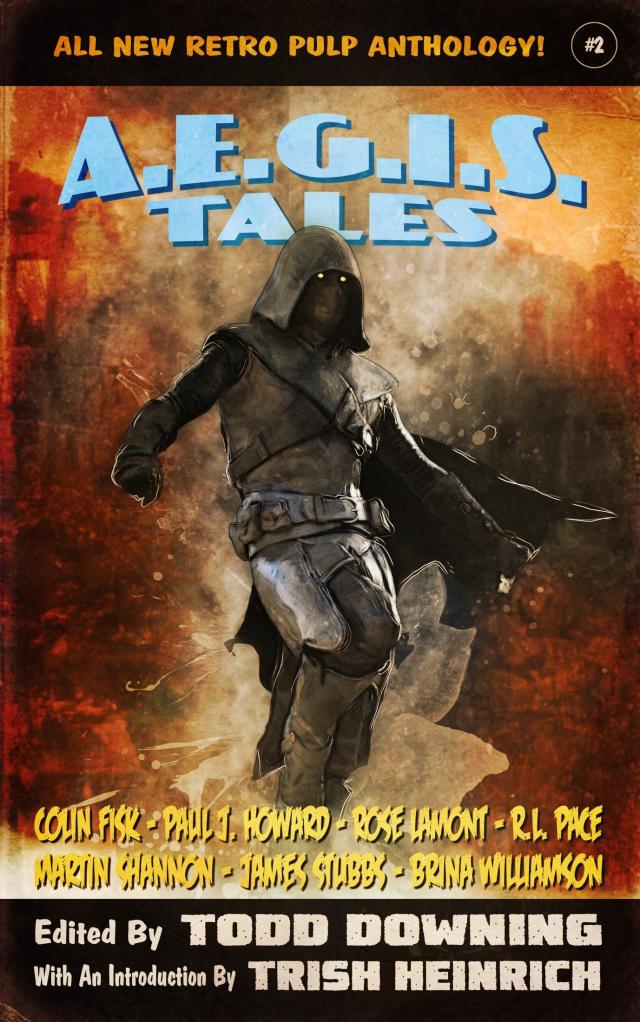
A.E.G.I.S. TALES
A Retro Pulp Anthology Vol. 2
Copyright © 2022 Todd Downing/Deep7 Press/Despot Media LLC
All Rights Reserved Worldwide
FIRST EDITION
Additional Editing by Raechelle Downing
Cover art & design by Todd Downing
Based on the Airship Daedalus / AEGIS Tales setting and characters by Todd Downing and published in various media by Deep7 Press. Airship Daedalus™ and AEGIS Tales™ are trademarks of Deep7 Press. WWW.AIRSHIPDAEDALUS.COM
Deep7 Press is a subsidiary of Despot Media, LLC
1214 Woods Rd SE Port Orchard, WA 98366 USA
WWW.DEEP7.COM
To my fellow authors and creatives— Welcome to the sandbox once again! Let’s have some fun.
- Todd Downing Summer, 2022
Contents
Title Page
Copyright
Dedication
Introduction
Second Sight
Operation Icarus
Lili LaRue and the
Twisted Tracks
Walks with Bones
Rail Rider
The Ghost Gets Around
A Valkyrie in the Desert
As Above, So Below
Timeless
The Hunting Pack
ABOUT THE AUTHORS
Introduction
by Trish Heinrich
I’ll never forget the first time I fell in love with pulp adventure.
I was a little girl, sitting enthralled as the screen before me flashed images of danger, mystery, and adventure. The jungle was thick, humid. I could almost feel it on my skin as I watched the hero trudge through it. I was breathless with anticipation as the daring archaeologist braved booby traps, betrayal, and poison darts to get his treasure. For about two hours, my little brain was soaked to the brim with scenes of fisticuffs, underground tombs, and romance.
Of course, I’m speaking of Indiana Jones.
But when I went to look for more adventure stories, I was more than a little bummed to discover that many of the women in them lacked agency and were treated as damsels in distress and objects of desire. To be fair, Karen Allen set a high and unusual bar for women in pulp adventure stories, but I didn’t realize that at the time. I just lowered my expectation that the genre would offer me the female heroes I was craving.
Then Todd Downing’s AEGIS universe came along. Suddenly, there were women kicking butt and taking names. Women who were evil. Women who were brave. Women who were adventurers and mothers.
Writing in his world I’ve defeated zombies on a farm and saved my lady love from a contagion that would’ve turned her into one of the undead. I’ve slipped through the shadows as a masked vigilante, saving the innocent. I’ve even tunneled to the center of the earth in search of dinosaurs and defeated Nazi cultists.
And that’s because for Todd, it’s not about keeping his toys to himself. The thrill is in the collaboration, building the proverbial sandbox. He’s told the tales of AEGIS through old time radio plays, gorgeous comic books, beautifully designed RPG manuals, gripping novels, and now, with a second anthology of short stories. In all of these endeavors, Todd has sought talented storytellers and artists to work alongside him in various capacities, making each entry into the AEGISverse a complex melding of experiences and points of view. For someone who had trouble finding herself in the genre, this has been a true delight to be a part of.
My hope as you delve once more into the mysterious, sometimes funny, and always fast-paced world of AEGIS Tales, is that no matter your background, race, gender identity or disability, that you will find yourself here, the hero of the story. That you will escape the world for a few hours and become the detective that befriends the Archduke of Hell, as in Rose Lamont’s tale. Perhaps you’d prefer to be a soldier, come back from the dead with spectral powers as in one of Todd’s stories. Or the wunderkind inventor of R.L. Pace’s contributions. Maybe you’d prefer Colin Fisk’s retired Valkyrie, Martin Shannon’s waitress-turned powerful shaman, or Brina Williamson’s lady race car driver and her sleuthy pals. Perhaps James Stubbs’ undead gunslinger, back for another round, or Todd’s dinosaur-hunting heroine in a lost world. Or maybe it’s aliens for you, in which case you’ll want to check out Paul J. Howard’s tale of Martian technology and a rail-riding hobo.
Whatever your particular poison, I wish you well on your journey and remind you: avoid the stepping stones with moss on them, always keep your whip handy, never trust a monkey (no matter how cute), and drinking games are great for distracting silly men who think that you’re just a pretty face.
Second Sight
by Todd Downing
Death does not discriminate. The first thing we learned when we deployed at the Western Front was that the Grim Reaper does not care one jot for a man’s skin color—the only hue to which it shows any preference is the dark crimson pumping through his human veins, until the spark of life slips away and that precious red ceases forever.
The Army back home was still a segregated affair, and would be until after the war. So the makeup of the 369th Infantry was “colored”, meaning mostly black soldiers with some Puerto Ricans (which we used to joke were there “for some spice”). We’d been given the nickname “The Black Rattlers” by The United States Army, and “Men of Bronze” by the French. The Germans called us “The Harlem Hellfighters”, having firsthand experience with our ferocity on the field of battle. Because the US Army wanted little to do with us in a combat capacity, we were loaned out to French command. Our uniforms were American olive drab khaki, but our helmets, rifles and kit were provided by the French.
My unit had already seen action at the Second Battle of the Marne, a shy month of hell. I lost track of my kills after twenty-seven. A particular night raid when we swept a German trench and captured four machine gun emplacements made it pointless to keep a tally of the individual dead. As a reward for our heroism in that campaign, we got sent to the front of the line in the Meuse-Argonne Offensive, and no man would return the same.
We went over the top just before noon on the 26th of September, following a six-hour French artillery barrage, which rendered the land, fortifications, people, and everything in our path the consistency of oatmeal. The first five miles of our advance was through pulverized barbed wire fortifications, where our main enemy was getting stuck in the sundered earth and getting cut on a random shard of metal. We encountered almost no resistance, save for the occasional surrendering prisoners, which we collected and sent back to our lines in small groups. As the sun crested and began its afternoon descent, however, we found the ease of the initial push had been deceptive.
Our objective was the town of Ripont, which lay just beyond a nearly impassible bog. Nonetheless, our spirits were high. Everyone knew the war was nearly over, perhaps especially the Germans. But that only gave them less to lose in the chaos of battle. As Captain Shaw waved us into the muddy bracken, I gripped the Berthier rifle in my calloused hands, checking the slide and making sure there was a round chambered and ready.
Although our French compatriots had shown us how to cut the tails from our wool overcoats so they wouldn’t drag in the water and become weighted down, we were going to get far wetter and dirtier than our usual exposure in the trenches. Some of us opted to shed our coats before we entered, rolling them into our packs.
Two dozen men waded into the bog, bayonets fixed. “Slow going” doesn’t even begin to describe the agonizing approach to the town. Step after herculean step, mere forward progress felt like wading through molasses. And then, as we came upon a copse of alder trees sprouting from a mound of mushy soil, the gates of hell opened and all the Devil’s minions came out to play.
The dappled marshland was suddenly alive with the staccato beat of gunfire and wood splinters. Saplings and men alike were cut in half. Private Coverdale’s head opened like a ripe coconut just to my right, spraying me with blood and viscera. Captain Shaw fell into the muck on my left, screaming at everyone to take cover. The Germans had left a machine gun crew as a rear guard to cover their retreat, supported by a sniper aloft in one of the larger trees. I fell to my belly behind a rotting log, trying to gauge where the fire was originating. I knew the wood was too soft to provide lasting cover—this would be a running fight. As much as one could “run” in knee-deep mud and brackish water.
“Desmond!” Captain Shaw shouted at me as bullets whizzed past, “Push forward to Jones’ position and see if you can get eyes on that MG!” I glanced down and nodded at the bloodied point of an alder branch protruding from the bulk of his right calf, just above his puttee.
“Yessir!” I replied, nodding at the wound. “You better see to that, Captain.”
Then, with a grunt and a splash, I was off. Clutching the Berthier tightly and keeping it above the muck and water, I staggered forward around the log and through the small grove of trees, most of which had been sheared off at about head-height. The sun was hanging red in the afternoon sky, casting long shadows from left to right across the bog. My leg bumped something that felt like a sandbag. Glancing down, I saw a mud-covered hand with the college ring and knew it was Patterson. Half of him, anyway.
Another stream of bullets rocketed from just beyond the riverbank, between the swamp and the bombed-out town that was our battle objective. I hunched over to keep my head low, which made traveling through the mud that much harder. Twenty yards ahead and to the right stood a river boulder anchoring another copse of alder trees. Corporal Jones fired back from behind the big rock, sliding down to a squat to reload a three-round clip from his haversack. His stylish mustache was caked with mud already drying in the afternoon heat.
“Want some company?” I asked, peering through the gap between the rock and the larger of two main alder trunks sprouting from the wet ground.
“Wouldn’t say no,” Jones quipped, loading the metal clip with wet, trembling fingers.
“Captain wants eyes on the MG,” I relayed. “Any thoughts on that?”
Jones nodded. “It’s on the bank, just beyond that bunch of fallen trees, yonder.” He tilted his head back in a general indicator of direction, and I noted the long wall of raw timber he was describing, about thirty yards away.
“What about the sniper?”
Jones shook his head. “That’s another story,” he frowned. “But I’m pretty sure he’s placed somewhere west of here. Low sun is making it hard to pinpoint.” He finished loading the rounds and snapped the bolt forward. “Goddamn Jerries gonna pay for Buzzy.”
I glanced to Jones’ left and realized Burt “Buzzy” Franklin lay face-down and mostly submerged in the water just north of the boulder. He’d gained the moniker from the clippered fade haircut he adopted on our arrival in France. He was a good soldier, a devil at dice, and a genuine laugh when morale was low. He’d be missed.
Another angry hail of bullets rocketed past our position, tearing through the brush and kicking up steaming splatters of mud. Behind the fallen trees, I could make out a small group of German soldiers trudging through the underbrush, one reaching toward his waist—readying a stick grenade.
Taking aim with my Berthier, I sighted right at his jawline and squeezed the trigger, feeling the comfortable recoil into my shoulder as the shot rang out. The lead soldier dropped out of sight in a mist of red, and moments later, amid panicked shouts, the swamp exploded with mud and body parts. A single boot splashed down to my left, jagged shard of leg bone sticking out the top. From my vantage behind the rock and looking upward, I saw a brief glimmer of light from a tall plane tree behind the soldier, right in front of the afternoon sun. It could have been a trick of the light or a spark of ignited fabric from the soldier’s uniform, but it was an equally good bet the sniper was in that tree and the grenade blast had reflected off his scope.
I pulled the bolt back and slapped it forward. Two shots left. For a moment, I considered the F1 grenades I carried in my secondary haversack. I could lob one of the tiny gray pineapples like we used to chuck rocks at crows back on granddaddy’s farm. But the tree itself was more than sixty yards distant. Even in my days as a college outfielder that would have been pushing it. No, the math didn’t add up. I decided on a different tactic.
I took the blue steel Adrian helmet from my head, pulled a wet tree branch from the muck and inserted it, creating a dummy target. Slowly, I raised the helmet so that the crest just cleared the top left corner of our rock. A crack rang out from the woods and I felt the helmet jerk back and fall off the stick. But I wasn’t watching that—my eyes were on the plane tree, about twenty feet up. The muzzle flash had come almost exactly from the location I’d seen the glint in the grenade explosion.
That was my target.
While Jones continued to pop shots at the MG crew, cursing under his breath at the Jerries, I took careful aim at the tree, held my breath, and squeezed the trigger. The Berthier barked, a cry rang out, and something heavy fell, catching in the lower branches.
I reached behind me into the water and grabbed my helmet, checking it over in my left hand. Sure enough, it now carried a tiny depression near the front crest, like a fingerprint in butter. The Adrian helmet was light, and never intended to deflect a direct bullet impact. It was specifically designed to minimize damage from grenade shrapnel and indirect fire. Pulling the strap back over my chin, I flagged Captain Shaw and waved the rest of the unit forward.
Another burst of machine gun fire tore through the wet brush, pulverizing the soggy wood and sending splinters flying every which way. I waited until the gun crew came to the end of the belt, when I would have three to five seconds while they reloaded.
I nudged Jones in the ribs, cocking the slide on my rifle. “Cover me,” I said.
Like a well-choreographed dance, I dashed through the stagnant water and mud twenty yards to the wall of fallen trees, while Captain Shaw and the rest of our unit moved up to the rock by Corporal Jones. Now that the sniper was out of the game, I wouldn’t have to worry about getting caught in a crossfire and hit from above. And the barking fire from ten more rifles at the rock would make an excellent distraction for what I wanted to do.
My new vantage behind the logs was far better to see the machine gun emplacement. It sat behind a ring of sandbags on the upward slope of a dusty hill about thirty yards to the northeast, the last obstacle between our unit and the village that was our objective. The Maxim gun had a crew of three: a gunner, a spotter and a loader. And it sounded like they were having problems with the reload. I could hear swearing and the clank of metal on metal. The gun had either overheated or jammed. Either way, I’d have to act fast.
Reaching into the bag, I grasped a grenade and pulled it free, extracting the pin with my teeth and releasing it in a high, overhand throw. It came down just short of the gun emplacement. The explosion did little but carve out a chunk of riverbank, shrapnel absorbed by the heavy sandbag barricade. I reached for a second grenade and threw with a bit more force, and this time the effort paid off. The metal pineapple came down right behind the machine gun, and the moment I heard it go off, I sprinted into action, slogging up the embankment like a knight and war horse in one. My lance was a long rifle tipped with two additional feet of bayonet, all force focused behind that sharp point. I saw spasms of motion behind the sandbags, and heard terrified cries and angry oaths, all in German. Within moments, I’d cleared the bog, sprinted up the embankment and leaped over the sandbags, landing with the full weight of my body behind the rifle. The German soldier looked up at me in shock, the bayonet protruding halfway from his ribcage. To his left, the machine gun’s back end was chewed to pieces, the gun leaning nose-down over the barricade. The gunner’s body lay flipped on its back, a mostly headless corpse. I turned my attention back to the soldier at the end of my pig-sticker and noticed the third crewman was already scampering up the hill toward the village.
Huffing and straining with the effort, I wrenched the rifle away from the soldier skewered on the end, to no avail. The bayonet had penetrated between the ribs and lodged in the spine. It wasn’t coming out any time soon.
Almost without thinking, I reached down and pulled the dying soldier’s sidearm from its holster, racking back the slide of the broom-handled Mauser and thumbing the safety off. Before I knew it, I’d popped a half-dozen shots into the retreating soldier’s back. He collapsed and lay still in a heap.
Then I heard a voice yelling, “Forward!” and I realized it was mine. “MG is kaput! Let’s go, boys!”
All was chaos as a rumbling, splashing herd of men came screaming through the marsh, swarming up the hill to where I stood, gasping for breath among the dead machine gun crew.
“Good work, private!” It was Shaw, limping up the hill with his leg bandaged as a small unit of my fellow Rattlers pushed up the last few yards to the outskirts of the village. “I’m putting you in for a commendation—you’re a goddamn hero!”
I tossed the pistol aside, not having time to revel in the accomplishment, nor my captain’s praise for the deed.
Suddenly a metallic pop erupted near the corner of an old farmhouse at the town’s edge, someone yelled, “Gas!” and the men who’d advanced on the town scrambled to put on their filters.
“Mask on, Desmond,” Shaw ordered, clapping me on the shoulder. “Let’s go take us a town.” Then he was gone, and I shrugged out of my pack to more easily access the canvas hood and filter we’d been issued, which hung from a cloth handle around my neck. I hated wearing the thing. It was dank and stuffy and smelled of piss—the common way for soldiers to seal the appliance. But better a whiff of pee than lungs full of phosgene or mustard gas. I struggled to get to hood on, and once properly situated, I realized I had no weapon. I picked up the stock of my rifle which was still stuck in the German soldier. Placing a boot on his chest for leverage, I heaved with all my strength, but his bones held the bayonet firmly and the release was bent. I quickly looked around for another weapon as Shaw ordered the advance on the town and the rest of my unit passed me on the hillside. A Mauser carbine lay on the ground just beyond the gun emplacement, but when I picked it up I found the slide was missing completely. Casting the rifle to the ground in disgust, I turned back to the Berthier and realized there was still one round loaded on the clip inside.


