My Time in Space, page 19


As Manager of Inis Meáin Community Co-op, and as a committed promoter of natural resource development aimed at copper fastening a viable and sustainable island community on Inis Meáin, I am happy to be branded as a potential desecrator by the Archangel environmentalist and self-styled protector of the folding landscapes of Connemara and the Aran Islands…. I have come to the conclusion that David Bellamy-like Robinson has a serious problem with the cultural and heritage attitudes as expressed by Connemara people and Aran Islands people…. If he is still hell-bent on depopulating Inis Meáin beyond viability, and if he still wants to frustrate the twenty six years of Comharchumann Inis Meáin Teo to keep the island community alive and vibrant, it would be advisable that he seek a mandate from the islanders for whom he feels such a degree of personal responsibility.
Such rant is easy to reply to, indeed to take advantage of, in the rough-and-tumble genre of Letters to the Editor, but it does find its audience among the ill-informed. Soon after this appeared I happened to visit a remote cottage in Connemara in search of the names of the mountain passes above it, and found that the old farmer who was proud to help me record his fast-fading oral lore was also convinced that I wanted to drive him and his like out of Connemara! But I also heard from several Inis Meáin islanders opposed to the windfarm scheme who were as sad and angry as I am about the degeneration in the look of the island over recent years, and a founder member of the Co-op, Tarlach de Blácam, resigned in protest against its manager’s unauthorized response to my observations and joined the campaign against the proposal. But, knowing the spite that can fester in small isolated communities, I refrained from causing any further divisions in Inis Meáin.
As it happened I visited the island soon afterwards for the opening of the newly restored ‘Synge’s Cottage’, in which, a hundred years ago, Synge, Pearse and other seekers for the true Ireland used to lodge. I reported on my impressions in another letter to the Connacht Tribune:
… The next day some of us strolled down to the deserted south coast of the island. The maze of little fields with its superb backdrop of the Atlantic horizon and the Cliffs of Moher had never looked lovelier. To our delight we saw a sea eagle (the first to be sighted in the Aran Islands?) sailing low over the stone walls, accentuating the wild magnificence of the scene. But then we were heartbroken to find that half a mile or so of the boreen had recently been sprayed with weedkiller and was a strip of brown desert among all this beauty. This particular boreen is to be the access road for the projected windfarm – and I noted that from immediately beyond the windfarm site the rest of the boreen is full of wildflowers: ox-eye daisies, tall spires of yellow agrimony, bloody cranesbill and dozens of other species, among which hundreds of burnet moths were just emerging from their chrysalises. Surely something deeply wrong is going on here, morally wrong in terms of our relationship to a very wonderful natural and cultural landscape. And surely those founders of modern Ireland whose memory we were celebrating at Synge’s Cottage would have been appalled by it! … I hope that the Co-op will turn back from this wrong turning in the history of the island. And I am encouraged in this hope by the Co-op’s contribution to the work on Synge’s Cottage, which has shown its ability to care for the island in the right way.
Neither my emollient remarks about the Co-op nor my appeal to the ghosts of the national ancestors caused a change of heart in the proponents of the scheme, but the neighbouring island of Inis Oírr responded to my open letters by inviting me to address a seminar on forward planning. I accepted with deep misgivings, fearing the occasion might become acrimonious, for the speakers were to include my Connemara politician and the head of the Gal way Alternative Energy Centre, a forceful young man who sniffs breezes appreciatively, saying ‘Ah! Kilowatt-hours!’ But the debate was well chaired, and it gave me an opportunity to amplify my direct appeal to the islanders:
WHAT’S SO SPECIAL ABOUT ARAN?
In making decisions about our own little patches of the Earth’s surface and how we are to live on it, we have to bear in mind a wider background. The Earth’s population has doubled in the lifetime of most of us here today. Every one of us wants more in the way of material goods and such immaterial ones as mobility and choice. Humanity is exerting an immense, unparalleled, pressure on the resources of the earth, including Lebensraum, living-space. But these resources are limited; what we take, other forms of life lose. Hundreds and thousands of plant and animal species are going out of existence because there is no space, no peace, no nature for them to flourish in; we are presiding over and responsible for one of the most rapid mass extinctions in the whole geological history of the planet.
Coming a little closer to home, in Ireland the landscape is changing more rapidly than ever before. Roads, housing estates, forestry, turf extraction, quarrying, are eating up the natural biological surface of the land day by day. And what is left is losing its naturalness. The hilltops have masts on them, the wide spaces of the bogs are rimmed by lines of pylons, the bays are dotted with fish cages. All these things are there to fulfil our demands; we are all implicated. But we should be aware of the cost. In a word, the world is getting smaller and smaller. Each place is becoming more and more like every other place. History is being bulldozed out of the way. Even the most familiar birds – thrushes, skylarks – and the common butterflies, are being poisoned out of existence. Our youngsters probably think that wildlife is a TV show. Technology flourishes and exerts its fascination; the rest of life is becoming less and less interesting and beautiful.
I feel we are reaching the crisis of this stage of humanity’s life cycle, and that perhaps in another generation a more intelligent technology and more caring attitudes to the rest of creation will assert themselves. So what we have to do at this juncture is to hold on to what we still have, and fight to protect it from destruction. The key to rural development is to preserve the best aspects of the rural environment, the features that make it attractive and lovely to live in as compared to the urban environment. If the countryside becomes just a poor imitation of suburbia, people will leave it for the real thing. But I also believe it is a duty, a moral obligation, for people who have the privilege of living in, say, a beautiful old city or a lovely countryside, to conserve and enhance it for the good of the whole of humanity.
Focusing in on the Aran Islands, what we have here is one of the strangest and most interesting places in the world. Humanity and nature working on each other for centuries have brought forth a landscape which is not paralleled anywhere else in the world. Its combination of grandeur of scale in the natural and fineness of detail in the human contribution, is literally unique. So, if Aran is indeed special, it demands special consideration and sensitivity in planning. For instance, the scale and the details of the network of boreens are important. I hesitate to revisit a lot of little corners of the islands that I know so well, in case they are gone, like the lovely Róidín Ard leading out towards Synge’s Chair in Inis Meáin, a loss which I know many islanders deeply regret. Recently I’ve been campaigning against the proposal to site three wind turbines on the south shore of Inis Meáín. The argument for wind power is of course that it is non-polluting, doesn’t contribute to global warming etc. I’m as concerned as anyone about the long-term threats to our environment from fossil fuels. But there is no use saying wind turbines are non-polluting; they are grossly visually polluting, at least in some landscapes. The three relevant features of wind turbines are:
1) the obvious one, that they are very tall and can be seen for miles, especially in an open landscape that is composed of long level horizons like this.
2) that they are always in motion, so they draw the eye and you can’t get away from them.
3) that they are all more or less the same – they are industrial products, and so they tend to reduce all the different landscapes they occur in to the same sort of homogenized uniformity.
Now in the West we have a series of very delicate, very special and very fragile landscapes, which we are likely to lose rather quickly if the present rush to install windfarms persists. Some hard decisions are needed about where they should be put and where not. I’m glad to say that since the Inis Meáin project came up, a national debate on that question has begun. But it doesn’t need a debate to see that Aran is the last place they should be permitted. That would be a rank exploitation of Aran’s environment.
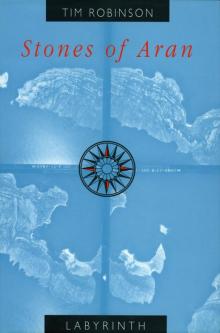
I ended by quoting the ‘Afterwords’ of a little book I’d published to accompany my map of the islands:
Step into one of Aran’s fourteen thousand little fields, and you are back in the nineteenth century. Walk the Atlantic cliffs, and the ramparts of Dún Aonghasa startle by their modernity. Stroll down the boreens, and you go arm in arm with the Atlantic, for their pattern is that of the fissures caused by the forces that separated Europe from America sixty or seventy million years ago. The Aran Islanders are inescapably face-to-face with the elemental and the timelessly recurrent, from the spray of winter storms to the foam of daisies in springtime pastures.
Thus, Aran is one of civilization’s loftiest windows onto its own origins in the past and the natural world. In addition to the economic and social penalties of being marginal to material Europe, the Aran community bears the responsibility of keeping that window crystal clear for ever. Since throughout Europe we have let such windows become blurred and dingy, Aran has the right to call on the wider community, national and international, for whatever support it needs in its priestlike task. Nowadays, with so much of its surface in wreckage and filth, it is the Earth that faces us with moral demands. The spiritual merges once again with the natural, from which, disastrously, it has been separated for some centuries.
However, nobody lives on this glorious, elemental, level all the time; in Aran one is also simply exposed to the elements, that is, rained-on, fogbound, windblown, cut off. Life is tough, opportunities limited. Improvement of the economic basis is the natural and rightful expectation of the people. At the same time, like it or not, a special trust is invested in them. If islands lose their singularity, the world becomes smaller. If Aran, in offering us more and more of the comforts and facilities of the outskirts of Galway, reduces the possibility of escaping from the banalities of suburban life, we are all impoverished, in our relationship to the past, to nature, to the influence of solitude and space. There may be specific developments that in other places would be welcome and proper, and that Aran should forgo. To live on Aran is a rare and demanding privilege; it is to be the inheritor of something both awkward and valuable, like a Stradivarius, or intangible, like a talent that only rewards long commitment.
In concluding this work, the last and best I can do for Aran, I thank the islanders for seconding my efforts over the years, and commend these precious islands to their good sense.
In the old days the islanders had to put up with priests coming out to conduct missions featuring bloodcurdling sermons against making poitín and reading the books of Liam O’Flaherty. I think they forgave the mildly preacherly tone of this appeal addressed not to their faithful souls but to their ‘good sense’; at any rate there was applause and a cry of ‘Hear, hear!’
Since that occasion, the Planning Board has rejected the appeal against the granting of planning permission, dismissing all our patient documentation of the splendours of the island landscape with a phrase to the effect that the development would not interfere with the visual attractions of the place. Their Inspector’s Report included this fatuity on the aesthetics of the question:
On a calm sunny day this area has a wonderful environmental quality with beautiful colours but the reality is that it experiences very frequent rainfall, showers, grey skies and heavy seas. In that context I consider that a small windfarm development might well be considered as being complementary to the character of this landscape in that it would be perceived as utilizing the obviously available wind resource.
So, since the Inis Meáin turbines are regarded as a test case, we can now expect an infestation of these demented clockwork giants throughout the windy West.
*
But what antiques, revenants, freakshows they will be, the little patches such as Aran and Roundstone Bog, if we succeed in saving them while the avalanche of metal and concrete covers all the rest! Everybody will come to admire them, which will wear them to ribbons, or they will be off-limits to all but their custodians. There will certainly be no room for Atlantic hermits like myself; we would be elbow to elbow from the North Cape of Norway to Gibraltar.
Weighing the boxes of documentation generated by these two skirmishes – parochial but exemplary – against the daily headlines on the worldwide advance of destruction, I am not so confident as my words in Inis Oírr suggest, about the survivability of the coming crisis and the caring regime that is to follow. Seen from space our globe shows scars, circular geological features resulting from asteroid impacts; they are called ‘astroblemes’. Most of these are millions of years old; all the more recent blemishes of Earth are due to human trampling. The imagery of the step that has sustained me through so much writing on the Echosphere is becoming uncomfortable; it transmits pain. What might be called anthropoblemes (horrible word for horrible things) can be felt through the soles of one’s feet. But, outside of Gaian fantasies, the Earth itself does not suffer; we are its nerve-cells, its pain is ours. The other creatures of the Earth bear it individually to their varying capacities for suffering, and we humans alone can feel it in its generality, as is only fitting. For our footprint is, in ecological terms, ‘loss of biodiversity’, wearing-thin of the weave of life as one species after another declines into rarity, singularity, and final extinction (which means, for the sentient and sociable among them, some last impoverished life and solitary death). We accomplish this unprecedented massacre of the innocents by interrupting nature’s cycles, denying it space for its patterns, time for its adjustments. And now, if nature has to be subsumed into technics to ensure our own survival, if conservation of the wild is to become mere landscape gardening, then my echopoetry is only nostalgia and I have invested my heart in dandelion fluff.
These are dreadful considerations. They embitter the waters of the West for me; they are in themselves a pollution. I am tempted to retreat from them into the domestic, or take flight into Pascalian infinities.
A HOUSE ON A SMALL CLIFF
The four creatures, as disparate as the corners of a square, who live in this house spend most winter evenings symmetrically disposed about the small wood-burning stove that stands for our hearth. M and I occupy wing-chairs (I was intolerant of their bourgeois solidity when my parents bought them in the fifties, but I appreciate their comfort now), hers facing a glass door into the conservatory that also functions as a front porch, and mine the window, its green-velvet curtains drawn against the north wind tonight, that looks out onto the quayside. The cat and the dog (a fluffy short-legged terrier about the size of the cat) curl up in baskets to right and left of the stove, showing no preferences between them; sometimes there is a little wrangling for the space between the legs of the stove, where the cat in particular relishes very high temperatures but the dog soon begins to pant and has to be ordered out to cool off.
This is our winter-room and library. It is about twelve feet square and disproportionately high, having a coved ceiling with a skylight in the north-east corner. Above the stove is a mantelpiece with a cloisonné vase, midnight blue and peach blossom, which I think must have come from my grandmother’s antique shop, and a fake carriage clock that came free with a purchase from a mailorder catalogue. Between these hangs an oval rosewood mirror which from my chair shows a reflection of the skylight, empty black by night, or star-dotted or streaked with silvery rivulets of rain; as I begin to write this, on midwinter eve, the full moon appears in the mirror, stealing my warmth, instilling a Mallarméean chill. I have never seen the moon in this way before; it must be exceptionally high in the north-eastern sky. The papers say it is nearer the earth tonight than it has been for a century.
The library holds some few thousand books, none of much individual market value but collectively irreplaceable, the product of browsing in bookstalls and jumble-sales. Those shelved on either side of the fireplace have been placed there for appearance; they have a bit of gilt or a pattern on the back, or pleasing titles like She Cometh Up As a Flower and She Might Have Been a Duchess, both from M’s collection of nineteenth-century women’s novels. In a recess to the left are ‘recent acquisitions’, mostly bought from catalogues of remaindered books and astonishingly heterogeneous. Among them at the moment are The Distribution of Prime Numbers, which will join a shelf of mathematics texts and popular science books once I have resigned myself to the fact that it is too advanced for me; a paperback of Cormac McCarthy’s blood-boltered novel about the wolf, abandoned at the point where M could not bear to read on; and all the volumes except the last of Carmichael’s Carmina Gadelica, a trophy of my recent visit to the Hebrides. Over the window is a five-foot-long shelf with a slight sag in the middle; most of it is taken up by books of an environmentalist persuasion, and the rest by a collection of various editions of my own writings; I tend to glance up at this and worry that the row is not longer. The next wall, opposite the fireplace, is largely literature, and roughly in alphabetical order. A browser would soon notice that no women writers are represented, because they have all been commandeered by M for her feminist collection shelved on the fourth wall of the room; we sometimes discuss reintegration, but that would be a major ideological shift and a day’s dusty work.
Leaving the warmth of the library to go to bed, we pass through a corner of the livingroom next to it, which is enormous, impossible to heat for winter use, with wide windows along the north side and another in the eastern gable end, all giving onto the waters and farther shores of Roundstone Bay. We glance down its chilly perspective as we hurry through, or if the night is fine go to the gable window to admire the patterns of moon-ridden wavelets and listen to an oyster-catcher’s lonesome whistle flitting to and fro in the blackness. By day this room is entranced by its views; entertaining guests here on summer evenings we sometimes find that a companionable silence falls, all of us lapsing into reverie over the mountains’ slow rebuilding of themselves out of dusk after having spent their substance in sparkles all day long. There are trays of seedlings on the wide windowledges, and M’s several fancy sorts of fuchsia in pots on the floor. The furniture is heterogeneous and undistinguished, the ornaments are all accidental acquisitions given to us by visiting children or bought to fill an empty minute in a Clifden junkshop, but the general effect is spacious and pleasing, our forté as home-makers, we sometimes think, being the nice arrangement of the nasty. The room has three skylights and the same high board-lined ceiling as the library, which was evidently divided off from it by a thin partition wall at some stage.