The Perfect Host, page 1


Theodore Sturgeon (circa 1960)
eISBN: 978-1-58394-749-4
Copyright © 1998 by the Theodore Sturgeon Literary Trust. Previously published materials copyright © 1948, 1949, 1953 by Theodore Sturgeon and the Theodore Sturgeon Literary Trust. Foreword copyright © 1998 by Larry McCaffery. All rights reserved. No portion of this book, except for brief review, may be reproduced, stored in a retrieval system, or transmitted in any form or by any means—electronic, mechanical, photocopying, recording, or otherwise—without the written permission of the publisher. For information contact North Atlantic Books.
Published by
North Atlantic Books
P.O. Box 12327
Berkeley, California 94712
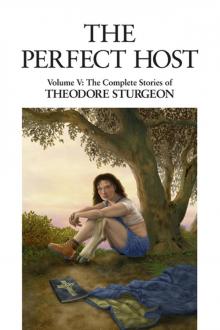
Cover art by Michael Dashow
Cover design by Paula Morrison
The Perfect Host is sponsored by the Society for the Study of Native Arts and Sciences, a nonprofit educational corporation whose goals are to develop an educational and cross-cultural perspective linking various scientific, social, and artistic fields; to nurture a holistic view of arts, sciences, humanities, and healing; and to publish and distribute literature on the relationship of mind, body, and nature.
North Atlantic Books’ publications are available through most bookstores. For further information, visit our website at www.northatlanticbooks.com or call 800-733-3000.
The Library of Congress has cataloged the printed edition as follows:
Sturgeon, Theodore
The perfect host / Theodore Sturgeon : edited by Paul Williams : foreword by Larry McCaffery.
p. cm. — (The complete stories of Theodore Sturgeon. v. 5)
1. Fantastic fiction, American. 2. Science fiction,
American. I. Williams, Paul, 1948–. II. Title. III. Series: Sturgeon, Theodore. Short stories : v. 5.
PS3569.T875A6 1998 vol. 5
813′.54—dc21 98-20023
v3.1
EDITOR’S NOTE
THEODORE HAMILTON STURGEON was born February 26, 1918, and died May 8, 1985. This is the fifth of a series of volumes that will collect all of his short fiction of all types and all lengths shorter than a novel. The volumes and the stories within the volumes are organized chronologically by order of composition (insofar as it can be determined). This fifth volume contains stories written between late 1947 and early 1949. Two are being published here for the first time; and five others have never before appeared in a Sturgeon collection.
Preparation of each of these volumes would not be possible without the hard work and invaluable participation of Noël Sturgeon, Debbie Notkin, and our publishers, Lindy Hough and Richard Grossinger. I would also like to thank, for their significant assistance with this volume, Larry McCaffery, the Theodore Sturgeon Literary Trust, Marion Sturgeon, Jayne Williams, Dorothe Tunstall, Ralph Vicinanza, Dixon Chandler, Gordon Benson, Jr. and Phil Stephensen-Payne, Judith Merril, Tom Whitmore, William F Seabrook, Paula Morrison, Catherine Campaigne, T. V. Reed, Cindy Lee Berryhill, The Other Change of Hobbit Bookstore and all of you who have expressed your interest and support.
BOOKS BY THEODORE STURGEON
Without Sorcery (1948)
The Dreaming Jewels [aka The Synthetic Man] (1950)
More Than Human (1953)
E Pluribus Unicorn (1953)
Caviar (1955)
A Way Home (1955)
The King and Four Queens (1956)
I, Libertine (1956)
A Touch of Strange (1958)
The Cosmic Rape [aka To Marry Medusa] (1958)
Aliens 4 (1959)
Venus Plus X (1960)
Beyond (1960)
Some of Your Blood (1961)
Voyage to the Bottom of the Sea (1961)
The Player on the Other Side (1963)
Sturgeon in Orbit (1964)
Starshine (1966)
The Rare Breed (1966)
Sturgeon Is Alive and Well … (1971)
The Worlds of Theodore Sturgeon (1972)
Sturgeon’s West (with Don Ward) (1973)
Case and the Dreamer (1974)
Visions and Venturers (1978)
Maturity (1979)
The Stars Are the Styx (1979)
The Golden Helix (1979)
Alien Cargo (1984)
Godbody (1986)
A Touch of Sturgeon (1987)
The [Widget], the [Wadget], and Boff (1989)
Argyll (1993)
Star Trek, The Joy Machine (with James Gunn) (1996)
THE COMPLETE STORIES SERIES
1. The Ultimate Egoist (1994)
2. Microcosmic God (1995)
3. Killdozer! (1996)
4. Thunder and Roses (1997)
5. The Perfect Host (1998)
6. Baby Is Three (1999)
7. A Saucer of Loneliness (2000)
8. Bright Segment (2002)
9. And Now the News … (2003)
10. The Man Who Lost the Sea (2005)
11. The Nail and the Oracle (2007)
12. Slow Sculpture (2009)
13. Case and the Dreamer 2010)
CONTENTS
Cover
About the Author
Title Page
Copyright
Editor’s Note
Other Books by This Author
Foreword by Larry McCaffery
Quietly
The Music
Unite and Conquer
The Love of Heaven
Till Death Do Us Join
The Perfect Host
The Martian and the Moron
Die, Maestro, Die!
The Dark Goddess
Scars
Messenger
Minority Report
Prodigy
Farewell to Eden
One Foot and the Grave
What Dead Men Tell
The Hurkle Is a Happy Beast
Story Notes by Paul Williams
Foreword
by Larry McCaffery
I. Preliminary Remarks
“And now, though the idea behind the [Normalcy] program was still the same … a new idea was gaining weight daily—to examine Irregulars always more meticulously, with a view, perhaps to letting one live—one which might benefit all of humanity by his very difference; one who might be a genius, a great artist in some field.… It was the thin end of the wedge for Homo superior, who would, by definition, be an Irregular.”
—Theodore Sturgeon, “Prodigy” (1948)
INNOVATIVE ART THAT really matters—Citizen Kane, Waiting for Godot, the music of Charlie Parker, John Cage, Bob Dylan and Jimi Hendrix, Pynchon’s V., the short fictions of Borges, the collaborations of Brecht and Weil, “The Waste Land,” Picasso’s Guernica, or the works of Warhol and Pollock—always manages to alter fundamentally our notions of what a given genre can do. One of the subsets of innovation that is especially attuned to postmodernism’s spirit of intertextuality, collaboration, and the dismantling of distinctions between high art and popular culture has been the exploration by “serious” artists of commercial genres. These sorts of artistic leaps often have an especially broad impact precisely because the artist is working with, and extending, codes, themes and motifs that a mass audience is already familiar with. When an artist confounds our expectations by exploring and extending the boundaries of a popular genre—the way Dylan did with folk music in his pre-electric albums, and as Sturgeon does with a variety of genres throughout this volume—the reverberations seem larger and more intimate simply because more people are in touch with (and hence can appreciate) the nature of the transformations involved.
II. A Saucer of Loneliness
Don’t talk to me about the Fifties if all you’re going to say are the predictable clichés about Eisenhower, prosperity, conservatism and drive-in movies. There was a lot more going on back then than tail fins, ICBMs, and McCarthyism. Like Ted Sturgeon.
The first time I encountered a work by Theodore Sturgeon was sometime in 1957. I was an eleven-year-old kid growing up in what seems, in retrospect, almost a parody of an alienating environment: living with two alcoholic parents in a hyper-repressive military community on Okinawa. And as with a lot of other alienated kids from that era, science fiction—together with rock ‘n’ roll—provided me with some of my first intimations about the existence of another, alternative world that was totally alien from the limited, limiting world I was living in, and yet utterly exhilarating, exotic, and alive. It was a world in which Robert Sheckley and Elvis Presley, Chuck Berry and Philip K. Dick, Jerry Lee Lewis and Ray Bradbury, Theodore Sturgeon and Little Richard were all equally important.
The writer who was most responsible for creating a bridge between me and that other, more sensuous, more exciting world of open-ended possibilities was Theodore Sturgeon. My introduction to Sturgeon’s work wasn’t through the usual sf magazines or books but through a chance conjunction of a radio and a tape recorder—a couple of those technological devices that were already transforming my world into something that FELT like the sf worlds I was just then reading about for the first time.1 Of course, a lot of kids in those days had radios, but it was the tape recorder I had won one Saturday night at the Harbor View bingo game that really changed my life. This may not seem like much in today’s age, where there’s a Blockbuster Video store on every streetcorner and in which mechanical reproductions of all sorts are as commonplace as the common cold, but for an eleven-year-old kid to personally own a tape recorder in 1957 was a very big deal indeed. For one thing, having a tape recorder meant that I was now freed from having to save up enough money to purchase the latest tunes by Pat Boone, Chuck Berry, Jerry Lee Lewis, the Everly Brothers and Coasters, Patti Page, Dean Martin, Stan Freberg, and, above all, Elvis Presley. Elvis was especially important because my dad disapproved of Elvis so much that my playing “Heartbreak Hotel” on the living room’s hi-fi set would frequently result in him taking me to the barber shop, where I would be relieved of all that unruly excess hair I kept trying (unsuccessfully) to coax into something resembling Elvis’s magnificent ducktail.
The only thing more important to me in those days than being sure I had my tape recorder rolling on Saturday morning for the Top 50 radio broadcast was the ritual I observed each Thursday evening when I would slip under the covers with my radio to listen to (and record) the weekly science fiction broadcast X Minus One. And the first show I ever taped—one I would listen to again and again over the next few years—was “A Saucer of Loneliness” by Theodore Sturgeon.
What struck me then was how different that story seemed from all the others I was reading and listening to. Here was a story that was undeniably sf, but without any of the gadgets or alien invasions or technological extrapolations or other plot devices from that era. In today’s terms, the story might be categorized as “psychological sf,” but what seems most obvious is that the story is pure Sturgeon, a love story warmly and lyrically presented, subtly nuanced in its depiction of two people struggling to connect with other beings. Undeniably science fiction, it was also obviously a story that used its sf motifs as a means of metaphorizing a universal human condition.
III. The Professor’s Teddy Bear
Twenty three years later, I finally met the man responsible for “A Saucer of Loneliness.” Like other literary critics who wind up teaching and writing about science fiction, I had drifted away from the field in my late teens, and only rediscovered it when I decided in middle age to prepare a course (at San Diego State University) in contemporary science fiction. I encountered a number of pleasant surprises while doing background reading for this course, but nothing really prepared me for the shock and amazement I felt when I opened More than Human and read the first page. Not only did that opening passage remind me of a different passage—the opening to Benjy’s section in Faulkner’s The Sound and the Fury2—which had once jolted me out of my plans to pursue a career as a lawyer, but it immediately placed me back in contact with the Sturgeon stories that had so enthralled me as a young boy.
A few months later, when I discovered Sturgeon was living in San Diego, I gave him a call to see if I could entice him into visiting my class, even though I could only offer him a Mexican lunch by way of payment. Ted agreed, and in just a few weeks I was guiding Theodore Sturgeon—who in 1980 looked very much like an impish hippie, with a ponytail and bell-bottoms—to the front of a large lecture hall to answer questions from an overflow crowd of students. The q&a session that followed was one of the most memorable I’ve ever seen or heard. Ted quickly took control of the discussion and directed it to boldly go to realms where none of these kids had ever gone before. Mixing stories about his background and influences together with more specific anecdotes about the writing of More than Human that clarified some of the book’s treatment of para-psychological union, Sturgeon was soon bringing to life a whole slew of issues concerning mankind’s long-term potential, communication, music, sexual identity and so on. The real highlight of the class was an exchange between Ted and a gorgeous 20-year-old red-headed co-ed who somewhat timidly asked Sturgeon if he felt that More than Human’s notion of homo gestalt anticipated the experiments from the 1960s with communes, sexual experimentation, and so on. I’m not sure about the rest of the class, but I was certainly blown away when Ted proceeded to use this occasion to launch into an extended discussion, vividly illustrated by his own experiences, about marriage, jealousy, group sex, homosexuality, and his personal efforts at determining the ideal number of participants in a committed sexual relationship. My only regret about that afternoon is that I can’t remember what that number was.
IV. The Perfect Host: Ted Sturgeon’s Sun Sessions
The Perfect Host—the fifth installment in this grandly ambitious Complete Stories of Theodore Sturgeon series—is a revelation, a gift to be treasured, a mind-blower, a time machine, a stick of literary dynamite, an eye-opener. Or, to borrow an analogy from Sturgeon’s own favorite resource of simile (music), it can probably best be compared to one of the more impressive of the recent “boxed set” compilations on compact disc. Like, say, The Capitol Years: The Best of Frank Sinatra, or Charlie Parker: The Complete Savoy Sessions, The Perfect Host provides enough of a representative sampling of Sturgeon’s “greatest hits” (e.g., such classic Golden [Age] Oldies as “Unite and Conquer,” “Prodigy,” and the volume’s title story) to give the uninitiated a good sense of what all the fuss was about way back when. And at the same time it offers a generous selection of alternate takes, rarities (notably several of Sturgeon’s best forays into other forms of genre writing, such as his wonderfully-rendered cowpoke yarn “Scars” and his jazz-drenched tour de force crime story, “Die, Maestro, Die!”3), and previously unreleased cuts (including one of the volume’s major finds, “Quietly,” which appears to be an early warm-up for More than Human)—which altogether offer even the most knowledgeable Sturgeon fan the chance to gain a more complete picture of the author’s influences and range, and an awareness of patterns of connection and influence that were not so evident in the stories’ original formats (magazines, anthologies, radio dramatizations). Add to this Paul Williams’s informative “liner notes,” and some nifty new packaging, and it becomes obvious (to me) that The Perfect Host deserves to be considered one of the major literary events of the year. Actually, given the transformative impact that the stories from this period of Sturgeon’s career had on the science fiction and fantasy genres, a more accurate comparison would be to boxed sets focused on Elvis Presley’s Sun Sessions or Bob Dylan’s Highway 61 Revisited.
V. Stranger in a Strange Land
As was the case with Presley’s and Dylan’s arrivals on the pop music scenes in their respective eras, it is difficult today to appreciate just how truly out of place—how truly “Irregular”—this totally coolcat Sturgeon dude must have seemed while he was bebopping his way onto the center stage of the commercial sf and fantasy scenes during the late 1940s. It must have been a little as if this long-haired Italian painter named Michaelangelo had showed up as one of the illustrators for Disney back in the ’30s. Indeed, Sturgeon’s anti-intellectualism and mysticism, his fascination with sexual desire and other ecstatic states of human consciousness, his abhorrence for conformity (and frequent suggestion that science was not only potentially dangerous but one of the principal agents of conformity), his experiments with language and metaphor as a means of depicting the inner, irrational lives of characters, and his love of jazz—all these features indicate that the authors from this era with whom Sturgeon shared the deepest affinities were not genre writers of any sort but the Beats.
Of course, by the time Sturgeon was writing the stories included in this volume he was already recognized as one of the leading luminaries of science fiction’s “Golden Age,” a community of writers and a body of work that John Campbell had helped nurture as an influential magazine editor since 1937. But “Golden Age” or not, it’s important to recall that this was still a fairly conservative commercial genre that Sturgeon was trying to earn his livelihood in in the late ’40s. Yes, there were plenty of other talented writers around who found themselves forced to earn a living with the clichés and formula-methods of genre sf. And talented artists nearly always find ways to loosen the corset of genre expectations to give themselves enough room to move around in, personally and artistically, so that they can produce genre works that seem to them fresh and original.
On the other hand, as The Perfect Host demonstrates, truly great writers like Theodore Sturgeon are rarely content with merely loosening these restrictive norms; what they are often after are much more thoroughgoing reconfigurations that will permit them to break on through to an entirely new textual space—an alternate genre world where they can set themselves and their readers down and begin exploring what they really want to write about. In this regard, one thinks of the way Dashiell Hammett recast the elements of the classical detective novel back in the late ’20s to accommodate new themes and character types which contrasted starkly with those that had previously been central to the genre. The end result was the “Hard-boiled” novel, which portrayed a world in which chaos, mystery and depravity were no longer isolatable elements that could be identified, contained and eliminated via the careful application of ratiocination and logic but far more active agents permeating not merely all aspects of society, but the nature of truth and perception.