

Gregory Benford, page 1


“We’re the product of our ancestors, Mr. Tonji, and those ancestors knew terrors we cannot comprehend. The Quarn have worked on a first-class horror for us, and this convoy is to be the carrier.”
“A carrier for a mental disease?” Tonji said contemptuously.
“Yes. But a disorder we’ve never seen before. An amalgam of the fundamental terrors of man. Stop the Jump, Mr. Tonji. And the transmission.”
I noticed that my hand was tightening convulsively on the console at my side. Tonji stood unmoving.
Look for this other TOR book by Gregory Benford
JUPITER PROJECT
This is a work of fiction. All the characters and events portrayed in this book are fictional, and any resemblance to real people or incidents is purely coincidental.
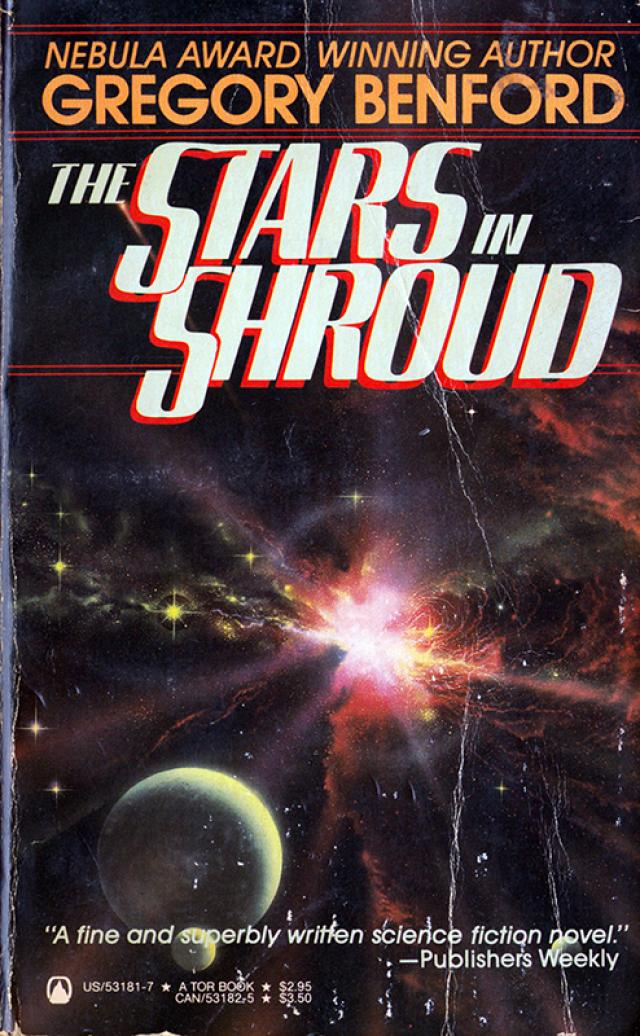
THE STARS IN SHROUD
Copyright © 1978 by Gregory Benford
All rights reserved, including the right to reproduce this book or portions thereof in any form.
A TOR Book
Published by Tom Doherty Associates,
8-10 West 36 Street,
New York, N.Y. 10018
Cover art by Angus McKie
First TOR printing: December 1984
ISBN: 0-812-53181-7
CAN. ED.: 0-812-53182-5
Printed in the United States of America
For my father,
James Alton Benford
“Know thyself?” If I knew myself, I’d run away.
—GOETHE
Don’t follow leaders; watch the parking meters.
—BOB DYLAN
“SUBTERRANEAN HOMESICK BLUES”
Part I
1
THE PLACE TO begin is at the bottom of the trough. How long I had gone through the motions, living days as alike as beads on a konchu wire, I don’t know. We had been in the apartment—such as it was—a long time.
Something happened, about an hour into the morning shift.
Unlike many, I still worked. In the dark corridors no one would notice the red-rimmed crater like an eye at each shoulder and elbow. And who would care? They were too wound up in themselves, by that year, to raise an eyebrow at what had once been a crime.
I drew the line at my waist: no socketing at hips, knees, ankles. Too many and your body won’t restore the tissue, even under sproc treatments. So I labored at our sim board, hooked into distant machines, visions of far-off places tapped through to my opticals. I was immersed in the jerky thrust of an assembly network, swinging raw and fragrant dirt to the side with my right arm, while the left chunked organiform slabs down into quick-molding foundation fluids. My glance rippled over the grid layout. Every jointed nerve nexus commanded a linkage in the assembly net, processing raw ores into impersonal, blank-walled housing. My sockets linked to machines. I was a neural computer, hired by the hour. The buildings were going up halfway around Earth. I bossed the work through satellite comm.
I’m sure it spooked the kids. There was Dad pinned like a zombie to the board, quivering and jerking and muttering for most of the morning. Then I’d collapse and sit, numb and staring, blank-eyed, enough work done for the day to buy us extras.
Their mother would coax them into watching the screen, and they’d leave me be. But this morning—
“Dad-dy, why do we have to watch this old stuff?” Romana said, jerking her head up with a regal look.
“Um?” (Still dazed.)
“None of the other cubes in this block even carry Schoolchannel anymore.”
“Um.”
“And it’s boring,” put in Chark, his thin voice piping. “Everybody knows you can’t learn fast without tapping.”
Romana: “We’re going to turn out to be rennies.”
“Rennies?”
“Renegades, Ling,” Angela said from the kitchen cloister. “It’s the new slang.”
“Schoolchannel makes you a renegade?”
“Well, it really means, you know, out of fashion.”
“Um.”
Angela came into the living room, wiping her hands on a towel, and looked at me with her mouth tightening. I knew what was going to happen.
“Don’t you think they have a point, Ling? Finally?”
“No.”
I looked away from her. Chark dialed the volume down on the screen, and everybody very carefully sat still. I wasn’t going to get away with a quick victory.
“Dad-dy…”
“If you’d seen that counselor at the center, Ling. Tapping is necessary. You were out there yourself. You—”
“Yes. I was out there. And none of you were.”
Romana, who is nine, began reasonably, “The Assembly says tapping is for the common defense…”
“It’s useless. Pointless. Harmful. There’s—”
I stopped. It wasn’t going to do any good. Their faces were closing up, going blank. I couldn’t tell them the guts of what happened out there. That was buried away in a datafile somewhere, sealed against all but high-priority access. Some remnant of Fleet training kept me from talking. That, and a curious inability to focus on that past, a desire to skitter away from it.
Angela broke her silence. I could tell from the brittle edge in her voice that the words had been dammed up for a long time.
“Why do you tell them such things? They—they’ll respect you even less if you try to pretend there’s some big mystery about what you did out there. You were just a shuttle captain, a pickup convoy, to get the survivors off Regeln after the Quarn hit it.”
“Uh huh.”
“And you didn’t even get many off, either.”
“Something happened. Something really happened.”
I got up dumbly and moved toward a cabinet, thinking to get a drink, and when I reached out for balance my hand came down on something on the cabinet. It was the Firetongue Stet. The fifty-centimeter block felt cool and reassuring. Having it here was an outright violation of Fleet regs. Even though it was out of date now, I could conceivably be executed for keeping my Commander’s Stet after I was court-martialed. But I’d substituted a dud, a blank Stet, when the time had come in the official decommissioning ceremonies. To cling to some last bauble of the Fleet officer I had been?
The children were dead silent, not even swinging a foot with nervous energy, the way they get when they sense that the adults have forgotten they’re around and maybe a fight is about to start. Angela and I both noticed it at the same time; the children were our lines of communication now.
“All right. We’ll talk about it later,” I said.
The kids grumbled a bit and went back to their screen lecture. Angela walked into the bedroom. Probably to pout, I thought sourly. One more nick in an eroding marriage.
We would talk. Oh yes, there would be a plentitude of talk. I had been a man who acted. Now I was a mumbler, a parody. I had lost momentum, and Angela’s coming accusations and complaints would sting. But I couldn’t deflect them. Maybe I didn’t care to.
I sat down. I hadn’t really thought about Regeln for a long time. That seemed all buried now, a subtle and somehow faceless past. I had tried to ride the events as they came to me, to swim between the smashing waves, but in the end I had washed up on this barren shore.
To wait.
And while waiting, to be reborn among the dead.
2
IT WAS SUPPOSED to be a quick, daring run: Loop my ship into the Regeln system, drop planetward, scoop up whatever was left before the Quarn returned.
The crew didn’t take it well. Fleet had already lost many ships. A month before they had taken us off a routine run and outfitted our ships with enough extras—blister pods for defense, mostly—to put the convoy on the lowest rung of warship class.
But men take longer to adjust. Most of them were still nervous and edgy about the changes. They were suddenly oraku, warrior status. They didn’t like it—neither did I—but there was nothing to be done. This was an emergency.
I had us roar out of orbital port at full bore, giving the ships that hot crisp gunmetal smell. That perked them up. But maintenance is only maintenance, the hours stretched long, and soon they found the time to think, to wring out self-doubts, to fidget. In a few days the results began to come up through the confessional rings: anxieties, exclusion feelings, loss of phase.
“I told Fleet we’d have this,” I said to Tonji, my Exec. “These are traditional men. They can’t take a sudden change of role.” I let go of the clipboard that held the daily report Stet. I watched it tumble slowly in the weak gravity.
Tonji blinked languidly. “I think they are overreacting to the danger involved. None of us signed for something like this. They aren’t men who hired on to win a medal—a bronzer, as ship’s slang puts it. Give them time.”
“Time? Where am I going to get it? We’re only weeks out from Regeln now. This is a large group, spread over a convoy. We’ll have to reach them quickly.”
He unconsciously stiffened his lips, a gesture he probably associated with being tough-minded. “It will take effort, true. But I suppose you realize there isn’t any choice.”
Was that a hint of defiance in his voice, mingled with his habitual condescending? I paused, let it go. “More Sabal, then. Require all senior officers to attend as well.”
“You’re sure that’s enough, sir?”
“Of course I’m not sure! I haven’t got all the answers in my pocket. This convoy hasn’t had anything but shuttle jobs for years.”
“But we’ve been reassigned…”
“Slapping a sticker on a ship doesn’t change the men inside. The crews don’t know what to do. There isn’t any confidence in the group, because everyone can sense the uncertainty. Nobody knows what’s waiting for us on Regeln. A crewman wouldn’t be human if he didn’t worry about it.”
I looked across the small cabin at my kensdai altar. I knew I was losing control of myself too often and not directing the conversation the way I wanted. I focused on the solid, dark finish of the wood that framed the altar, feeling myself merge with the familiarity of it. Focus down, let the center flow outward.
Tonji flicked an appraising glance at me. “The Quarn were stopped on Regeln. That’s why we’re going.”
“They’ll be back. The colony there beat them off but took a lot of losses. It’s now been twenty-four days since the Quarn left. You heard the signals from the surface—they’re the only ones we got after their satellite link was destroyed. The correct code grouping was there, but the signal strength was down. Then transmission faded. Whoever sent them was working in bad conditions, or didn’t understand the gear, or both.”
“Fleet doesn’t think it’s a trap?” Tonji’s features, Mongol-yellow in the diffused light of my cabin, took on a cool, distant look.
“They don’t know. I don’t, either. But we need information on Quarn tactics and equipment. They’re a race of hermits, individuals, some say—but somehow they cooperate against us. We want to get an idea how.”
“The earlier incidents…”
“They were just that—incidents. Raids. Fleet never got enough coherent information out of the surviving tapes, and what there was they can’t unravel. There were no survivors.”
“But this time the colonists stood off a concentrated attack.”
“Yes. Perhaps there are good records on Regeln.”
Tonji nodded, smiling, and left after proper ceremonies. I was sure he knew most of what I’d told him, through his own sources, but he’d seemed to want to draw the details out of me, to savor them. Why? I could guess: the better the mission, the gaudier the reports, then all the faster would rise the fortunes of Mr. Tonji. A war—the first in three centuries, and the first in deepspace—has the effect of opening the staircases to the top. It relieves a young officer of the necessity for worming his way through the belly of the hierarchy.
I reached out, dialed a starchart of Regeln’s neighbors, studied.
The Quarn had been an insect buzzing just beyond the range of our senses for decades now. Occasional glancing contacts, rumors, stories. Then war.
How? Security didn’t bother to tell lowly convoy captains—probably only a few hundred men anywhere knew. But there had been a cautiously worded bulletin about negotiations in the Quarn home worlds, just before the War. But no one had ever seen one face to face. The Council had tried to establish communal rapport with some segment of Quarn society. It had worked before, with the Phalanx and Angras.
Among the intellectual circles I knew—such as they were—it was holy dogma. Sense of community was the glue that held a culture together. Given time and correct Phase, it could bind even alien societies. In two cases it already had.
And it wove a universe for us. A world of soft dissonances muting into harmonies, tranquil hues of waterprints fading together.
To it the Quarn were a violet slash of strangeness. Hermitlike, they offered little and accepted less. Privacy extended to everything for them; we still had no clear idea of their physical appearances. Their meetings with us had been conducted with only a few individual negotiators.
Into this the Council had moved. Perhaps a taboo was ignored, a trifle overlooked. Perhaps, It seemed the mistake was too great for the Quarn to pass; they came jabbing into the edge of the human community. Regeln was one of their first targets.
“First Sabal call,” Tonji’s voice came over the inboard. “You asked me to remind you, sir.”
It was ironic that Tonji, with all his ancestors citizens of Old Nippon, should be calling a Sabal game to be led by me, a half-breed Caucasian—and I was sure it wasn’t totally lost on him. My mother was a Polynesian and my father a truly rare specimen: one of the last pure Americans, born of the descendants of the few who had survived the Riot War. That placed me far down in the caste lots, even below Australians.
When I was a teenager it was still socially permissible to call us ofkaipan, a term roughly analogous to nigger in the early days of the American Republic. But since then had come the Edicts of Harmony. I imagine the Edicts are still ignored in the Offislands, but with my professional status it would be a grave breach of protocol if the word ever reached my ears. I’d seen it often enough, mouthed wordlessly by an orderlyman who’d just received punishment, or an officer who couldn’t forget the color of my skin. But never aloud.
I sighed and got up, almost wishing there was another of us aboard so I wouldn’t have moments of complete loneliness like this. But we were rare in Fleet, and almost extinct on Earth itself.
I uncased my formal Sabal robes and admired their delicate sheen a moment before putting them on. The subtle reds and violets caught the eye and played tricks with vision. They were the usual lint-free polyester that shed no fine particles into the ship’s air, but everything possible had been done to give them texture and depth beyond the ordinary uniform. They were part of the show, just like the bals and chants.
During the dressing I made the ritual passes as my hands chanced to pass diagonally across my body, to induce emotions of wholeness, peace. The vague fears I had let slip into my thoughts would be in the minds of the crew as well.
The murmur in our assemblyroom slackened as I appeared, I greeted them, took my place in the hexagon of men, and began the abdominal exercises, sitting erect. I breathed deeply, slowly, and made hand passes. At the top of the last arc the power was with me and, breathing out, I came down into focus, outward-feeling, kodakani.
I slowed the juggling of the gamebals, sensing the mood of the hexagon. The bals and beads caught the light in their counter-cadences, glancing tones of red and blue off the walls as they tumbled. The familiar dance calmed us and we moved our legs to counter-position, for meditation.
My sing-chant faded slowly in the softened acoustics of the room. I began the Game.
First draw was across the figure, a crewman fidgeting with his Sabal leafs. He chose a passage from the Quest and presented it as overture. It was a complex beginning—the Courier was endowed with subtleties of character and mission. Play moved on. The outline of our problem was inked in by the others as they read their own quotations from the leaves into the Game structure.
For the Royal Courier rode down from the hills, and being he of thirst, hunger, and weariness, he sought aid in the town. Such was his Mission that the opinion he gained here of the inhabitants of the village, their customs, honesty, and justice (not only to the Courier, but to themselves), would be relayed to the Royal Presence as well. And then, it is said, to Heaven. Having such items to barter, he went from house to house…
After most entries were made, the problem maze established had dark undertones of fear and dread. And rippling them slowly through my fingers, began the second portion of Sabal: proposing of solution. Again the draw danced among the players.
It comes to this:
You are one of two players. There are only two choices for you to make—say, red and black. The other player is hidden, and only his decisions are reported to you.
If both of you pick red, you gain a measure each. If both are black, a measure is lost. But if you choose red and your opponent (fellow; mate; planet-sharer) votes black, he wins two measures, and you lose two.
He who cooperates in spirit, he who senses the Total, wins.
Sabal is infinitely more complex than this description, but contains the same elements. The problems set by the men ran dark with subtle streams of anguish, insecurity.
But now the play returned to me. I watched the solution as it formed around the hexagon. Rejoiced in harmony of spirit. Indicated slight displeasure when divergent modes were attempted. Rebuked personal gain. And drew closer to my men.
“Free yourself from all bonds,” I chanted, “and bring to rest the ten thousand things. The way is near, but we seek it afar.”


