Tiffany Aching Complete Collection, page 49


Later she had gone up to the Feegles’ mound and slid down the hole. She’d thought about this for some time and had gone prepared—with clean torn-up handkerchiefs and some soapwort shampoo made from a recipe Miss Level had given her. She had a feeling that Jeannie would have a use for these. Miss Level always visited new mothers. It was what you did.
Jeannie had been pleased to see her. Lying on her stomach so that she could get part of her body into the kelda’s chamber, Tiffany had been allowed to hold all eight of what she kept thinking of as the Roblets, born at the same time as the lambs. Seven of them were bawling and fighting one another. The eighth lay quietly, biding her time. The future happened.
It wasn’t only Jeannie who thought of her differently. News had got around. The people of the Chalk didn’t like witches. They had always come from outside. They had always come as strangers. But there was our Tiffany, birthing the lambs like her granny did, and they say she’s been learning witchery in the mountains! Ah, but that’s still our Tiffany, that is. Okay, I’ll grant you that she’s wearing a hat with big stars on it, but she makes good cheese and she knows about lambing and she’s Granny Aching’s granddaughter, right? And they’d tap their noses knowingly. Granny Aching’s granddaughter. Remember what the old woman could do? So if witch she be, then she’s our witch. She knows about sheep, she does. Hah, and I heard they had a big sort of trial for witches up in them mountains and our Tiffany showed ’em what a girl from the Chalk can do. It’s modern times, right? We got a witch now, and she’s better’n anyone else’s! No one’s throwing Granny Aching’s granddaughter in a pond!
Tomorrow she’d go back to the mountains again. It had been a busy three weeks, quite apart from the lambing. Roland had invited her to tea at the castle. It had been a bit awkward, as these things are, but it was funny how, in a couple of years, he’d gone from a lumbering oaf to a nervous young man who forgot what he was talking about when she smiled at him. And they had books in the castle!
He’d shyly presented her with a Dictionary of Amazingly Uncommon Words, and she had been prepared enough to bring him a hunting knife made by Zakzak Stronginthearm, who was excellent at blades even if he was rubbish at magic. The hat wasn’t mentioned, very carefully. And when she’d got home, she’d found a bookmark in the P section and a faint pencil underline under the word plongeon: “a small curtsy, about one third as deep as the traditional one. No longer used.” Alone in her bedroom, she’d blushed. It’s always surprising to be reminded that while you’re watching and thinking about people, all knowing and superior, they’re watching and thinking about you, right back at you.
She’d written it down in her diary, which was a lot thicker now, what with all the pressed herbs and extra notes and bookmarks. It had been trodden on by cows, struck by lightning, and dropped in tea. And it didn’t have an eye on it. An eye would have got knocked off on day one. It was a real witch’s diary.
Tiffany had stopped wearing the hat, except in public, because it kept getting bent by low doorways and completely crushed by her bedroom ceiling. She was wearing it today, though, clutching it occasionally whenever a gust tried to snatch it off her head.
She reached the place where four rusty iron wheels were half buried in the turf and a potbellied stove stood up from the grass. It made a useful seat.
Silence spread out around Tiffany, a living silence, while the sheep danced with their lambs and the world turned.
Why do you go away? So that you can come back. So that you can see the place you came from with new eyes and extra colors. And the people there see you differently, too. Coming back to where you started is not the same as never leaving.
The words ran through Tiffany’s mind as she watched the sheep, and she found herself filling up with joy—at the new lambs, at life, at everything. Joy is to fun what the deep sea is to a puddle. It’s a feeling inside that can hardly be contained.
“I’ve come back!” she announced to the hills. “Better than I went!”
She snatched off the hat with stars on it. It wasn’t a bad hat, for show, although the stars made it look like a toy. But it was never her hat. It couldn’t be. The only hat worth wearing was the one you made for yourself, not one you bought, not one you were given. Your own hat, for your own head. Your own future, not someone else’s.
She hurled the starry hat up as high as she could. The wind there caught it neatly. It tumbled for a moment and then was lifted by a gust and, swooping and spinning, sailed away across the downs and vanished forever.
Then Tiffany made a hat out of the sky and sat on the old potbellied stove, listening to the wind around the horizons while the sun went down.
As the shadows lengthened, many small shapes crept out of the nearby mound and joined her in the sacred place, to watch.
The sun set, which is everyday magic, and warm night came.
The hat filled up with stars. . . .
AUTHOR’S NOTE
The Doctrine of Signatures mentioned here really exists in this world, although now it’s better known by historians than doctors. For hundreds of years, perhaps thousands, people believed that God, who of course had made everything, had “signed” each thing in a way that showed humanity what it could be used for. For example, goldenrod is yellow and so “must” be good for jaundice, which turns the skin yellow. (A certain amount of guesswork was involved, but sometimes patients survived.)
By an amazing coincidence, the Horse carved on the Chalk is remarkably similar to the Uffington White Horse, which in this world is carved on the downlands near the village of Uffington in southwest Oxfordshire. It’s 374 feet long, several thousand years old, and carved on the hill in such a way that you can only see all of it in one go from the air. This suggests that a) it was carved for the gods to see or b) flying was invented a lot earlier that we thought or c) people used to be much, much taller.
Oh, and this world had Witch Trials, too. They were not fun.
A HAT FULL OF SKY
The Book That Demanded to Be Written
Talking with Terry Pratchett
Welcome to Discworld
. . . and more!
To the Reader:
I HAD TO WRITE this book. In fact, other projects had to go on hold to let it past.
This was because certain scenes and characters just turned up and camped in my head and wouldn’t go away. When Miss Level said, “I left my long-distance spectacles on my other nose,” I knew I had to write more about this woman. I wanted to find out what Tiffany would do next. I wanted to see what the Nac Mac Feegles would try this time. I wanted to do the “dancing with bees” scene. And writing The Wee Free Men had been fun.
You can’t start on your next planned book when another one is bumping gently but insistently against your brain.
This is it.
I’ve had a lot of mail (actually, mostly e-mail—we’re bringing up a generation that can type with its thumbs) about The Wee Free Men. Kids liked it. Adults wrote and asked if it was really a children’s book. The children didn’t. That struck me as . . . interesting. A lot of girls thanked me for writing about a real girl; a lot of boys (and some of their parents) asked if the Nac Mac Feegle really swear that much. (No, they don’t—their mixture of Old Scots and modern Glaswegian slang is pretty innocent when translated. Truly.)
I know there’s going to be at least one more book about Tiffany because I know the title and some of the scenes. But it can wait . . . I hope.
Terry Pratchett
Talking with Terry Pratchett
Tiffany Aching has decided she wants to be a witch when she grows up. What did you want to be when you were Tiffany’s age?
When I was Tiffany’s age, I wanted to be an astronomer. I never succeeded in my ambition, because astronomers have to be good at math, and I’ve never been very good at math. I thought astronomy was a really cool job, because you got to stay up late at night. But I have to say I’m very pleased that now, because of the success of my writing, I’ve built my own observatory.
Tiffany read the dictionary straight through because no one had told her she wasn’t supposed to. Did you ever read the dictionary straight through?
Ha! Yes, I did it when I was a kid. I read dictionaries all the way through: dictionaries, thesauruses, dictionaries of slang, all that sort of thing, for the sheer fun of doing it. I think I was a rather weird kid, to be frank.
Tiffany is also an expert cheesemaker. Have you ever made cheese?
Yep. Goat’s cheese. We used to keep goats, which are really just like sheep, but a lot more intelligent and much, much more bad-tempered. I was pretty good at goat cheese, I have to say. I could make goat cheese again if someone wanted me to.
The landscape Tiffany grew up in is clearly based on the English chalk country—you’ve said there is amazingly little you had to make up about her home. What can you tell us about this part of England?
A large area of southern England is on the chalk; in fact, the White Cliffs of Dover are chalk. I live on the chalk, about twelve miles from Stonehenge. I even own about forty acres of the chalk. You always see sheep on the chalk, it tends to be very high country, and you don’t see too many trees. It’s really the center of all our mythologies in England. There’s Stonehenge there, and strange ancient carvings, and the burial mounds of dead chieftains. Back in the days when the valleys were just all flooded and swampy, the chalk uplands were how people moved around, and, in the heart of it all, was Stonehenge.
Is Tiffany’s family in any way based on your own?
Well, I grew up on the chalk. I was born in the Chiltern Hills, which is another chalk outcrop. And a lot of the things that Tiffany thinks and sees, in fact, I thought and saw when I was her age; a lot of the way Tiffany comprehends the landscape is based on my own experiences. I don’t come from a farming family, but I spent a lot of time among farmers and their families when I was a kid. I’m the actual archetypal example of an only child, so I had plenty of time to myself. My paternal grandmother has a very special place in my heart, just as Tiffany’s grandmother does, because when I was a kid I was allowed to read from her bookshelf. It was a very short bookshelf, but it contained every book you really ought to read, like the complete short stories of H. G. Wells, and the complete short stories of Sir Arthur Conan Doyle. I just worked my way along my granny’s bookshelf and didn’t realize that I was getting an education.
In Tiffany’s world, being a witch means, in part, to have certain duties and responsibilities. How did you decide to include these obligations as part of your definition of witchcraft?
Certainly witchcraft for Tiffany has very little to do with magic as people generally understand it. It has an awful lot to do with taking responsibility for yourself and taking responsibility also for the less able people and, up to a certain point, guarding your society. This is based on how witchcraft really was, I suspect. The witch was the village herbalist, the midwife, the person who knew things. She would sit up with the dying, lay out the corpses, deliver the newborn. Witches tended to be needed when human beings were meeting the dangerous edges of their lives, the places where there is no map. They don’t mess around with tinkly spells; they get their hands dirty.
And then there are the Nac Mac Feegle. They’re the most feared of all the fairy races, and yet they’re also loyal, strong, and very funny. How did you come up with the Nac Mac Feegle?
I thought it very strange, and very sad, that the fairy kingdom largely appears to be English. I thought it was time for some regional representation. And the Nac Mac Feegle are, well, they’re like tiny little Scottish Smurfs who have seen Braveheart altogether too many times. They speak a mixture of Gaelic, Old Scots, Glaswegian, and gibberish. And they’re extremely brave, and they’re extremely small, and extremely strong, and there’s hundreds and hundreds of them, and they just are automatically funny. You can’t help but love them, at a distance.
What happens to get you to sit down at your desk and write the opening words of a new novel?
I’m not sure. I start with a handful of semiformed ideas and play around with them until they seem to make some sense. Actually typing is important to me—it kind of tricks my brain into gear. I’ve got a pack-rat mind, like most writers, and once I starting thinking hard about a new project all kinds of odd facts and recollections shuffle forward to get a place on the bus.
Do you know where a story is going when you start writing, or do you let the story take control and see where it takes you?
This answer deserves one sentence or an essay! I’ll try to summarize it like this: writing, for me, is a little like wood carving. You find the lump of tree (the big central theme that gets you started) and you start cutting the shape that you think you want it to be. But you find, if you do it right, that the wood has a grain of its own (characters develop and present new insights, concentrated thinking about the story opens new avenues). If you’re sensible, you work with the grain and, if you come across a knot hole, you incorporate that into the design. This is not the same as “making it up as you go along”; it’s a very careful process of control.
The fantasy genre is often thought of as escapism, but is it escapism with a firm root in reality?
Fantasy IS escapism, but wait . . . why is this wrong? What are you escaping from, and where are you escaping to? Is the story opening windows or slamming doors? The British author G. K. Chesterton summarized the role of fantasy very well. He said its purpose was to take the everyday, commonplace world and lift it up and turn it around and show it to us from a different perspective, so that once again we see it for the first time and realize how marvelous it is. Fantasy—the ability to envisage this world in many different ways—is one of the skills that makes us human.
Your Discworld novels are fantastically successful. Now you’re writing Discworld novels specifically for younger readers. Why?
I think my heart has always been in writing for children. My first book was written for children, and a few years ago I realized that if I wrote a few books for younger readers I could approach Discworld in a different way. There’s a lot of difference between writing for children and writing for adults, and it’s almost impossible to tell you what it is, but I know it when I’m doing it. You have more fun, and I have to say, it’s a little bit harder, especially if you do it right.
Welcome to Discworld
DISCWORLD IS A FLAT, circular planet that rests on the backs of four elephants, which in turn are standing on the back of a giant turtle. Don’t ask what the turtle stands on; you might as well ask what sound yellow makes. This is the backdrop for an intricate and delightful world where every aspect of life—modern and ancient, sacred and profane—is both celebrated and satirized, from religion and Christmas to vampires, opera, war, and everything in between. Reading Terry Pratchett is the literary equivalent to doing a cha-cha. It’s exciting, it’s invigorating, and those more rhythmically inclined say it’s got a good beat and you can dance to it. Best of all, it’s fun!
Terry Pratchett Adds:
Discworld is a fantasy series for adults or, at least, taller people. There are about thirty books in the series—but don’t worry, you don’t have to read them all (actually, you don’t have to read any of them, but I’d be happy if you did). A Hat Full of Sky, The Wee Free Men, and The Amazing Maurice and His Educated Rodents are set on the same world in a series that runs side by side with the adult one.
It certainly isn’t that the Discworld books for young readers are more simply written; I’m not very good at complicated writing in any case. Personally, I’m pretty proud of the writing in the young reader books. They win awards. The adult books just make me lots of money, and who wants that? The biggest difference is that the young reader books have younger main characters, though they do share some characters with the adult series. Death, the Death of Rats, Granny Weatherwax, and Mrs. Ogg have had major roles in some of the adult books. But you don’t need to know this to appreciate the young reader books.
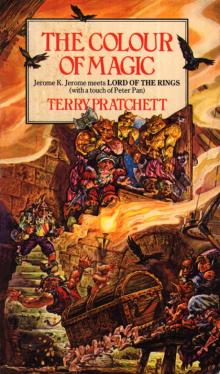
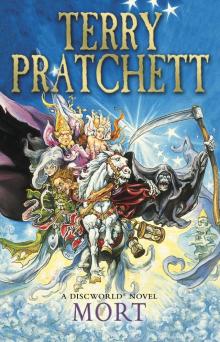
I’m often asked where a reader should start, if they want to read more Discworld stories. A good question. They could start at the very beginning, with The Color of Magic, but many people reckon Mort and Wyrd Sisters are good “starters.”
There are adults who read the young reader books, and kids age nine who read the adult Discworld books (I know because I get mail from them). That’s the nice thing about fantasy—it’s open to anyone who can read.
It’s a series, not a serial. The books can be enjoyed in any order, but there are repeating characters whose stories form “mini series” within Discworld, such as Granny Weatherwax; the “wizard” Rincewind; Death and his adopted granddaughter, Susan; and Sam Vimes—head of the Watch in the Disc’s biggest city: Ankh-Morpork.
The Color of Magic
Introducing the wild and wonderful Discworld—witnessed through the four eyes of the tourist Twoflower and his inept guide, Rincewind, the world’s least competent wizard.
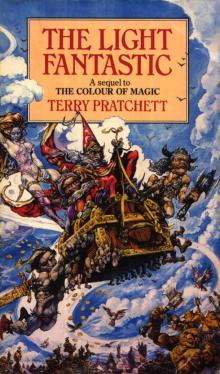
The Light Fantastic
A red star finds itself in Discworld’s way, and it appears that Rincewind is all that stands between the world and Doomsday.
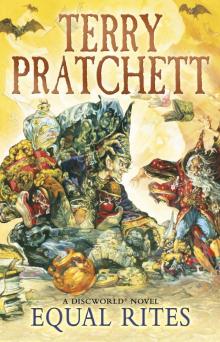
Equal Rites
Women have never been wizards; wizards have always been men. But when Granny Weatherwax plays the midwife, who’s to say a baby girl can’t grow up to be a wizard?