

Jack Williamson, page 30


Could Pepe be there? As much as I hated its empty stillness and all the riddles of its death, I had nowhere else to look. It had been a city in itself, the main street a great, high-arched hall. Black darkness faced me as I entered, but hieroglyphic signs flashed to greet me and the ceilings began to glow. Section by section, they lit my way past dark doorways and across darker intersections, until I came out again on that high balcony that looked down into the vast black chamber at the city’s core.
Vertigo froze me. Waiting for those strange constellations to light the dome above, I had to fight a sudden mad impulse to jump the railing. Had Pepe chosen that escape? I could hardly blame him if he had, but I wasn’t ready to die.
Shivering from the chill of panic, I swayed against the railing, feeling suddenly so weak that I thought I might topple over it in spite of myself. I gripped it till I got my balance back, pushed myself away, and stumbled off the balcony before there was light enough to let me look for his body on the distant floor.
Back in the lighted corridor, I leaned against a wall, breathing hard and gulping against a sour nausea, till at last I found the will to move along. With no hope left of finding Pepe or his body, or anything at all, I blundered on though an endless maze that always lit to greet me and fell dark again behind me.
The lights around me were suddenly red, so dim I felt blinded. Sign were fainter, stranger. Shop windows held nothing I could recognize. The icy air had a strange, bitter bite that troubled my stomach again, and a sudden gust sent a shudder through me.
I had strayed into a sector whose people had come from some colder star. Lost from anything I knew, with no sense of where I was or how to find myself, I was paralyzed with a senseless terror. I was left with no interest in who they had been or how they had died. All I wanted was to get out. All sense of direction was gone; I stood there, sick and shivering, till a noiseless robot loomed out of the red shadows.
It had the shape and grace of the white humanoids in our quarters, but bright black scales covered it, instead of simulated skin. It stood motionless before me, speaking, perhaps, in some electronic language I did not hear. Its blind lenses unnerved me. When I tried to move aside, it glided to block my path again.
I turned to run. It caught my arm and held me with an iron grip until a more familiar white robot came at last to guide me back to our apartments. Another stood waiting to serve me dinner. I left the meal untasted, drank all the wine it offered, and finally let it assist me to bed. I lay there, hopelessly mourning all I had lost and feeling that I would never sleep, till I heard Pepe calling me.
I thought it was another dream.
Dunk?” His anxious shout came through a rattle of static, as if from somewhere far away. “Dunk, can you hear me now?”
Groggily, I tried to answer.
“Dunk!” His voice was suddenly loud, near me in the dark. “Are you okay?”
I sat up on the side of the bed, fumbling for the light switch. The room lit before I found it, something shining from the door. A little cloud of milk-white mist, it glowed with swirling points of many-colored frost. It drifted around the room as if searching and finally paused to hang near my face. I reached out to see if it could be real. A hot spark from it stung my hand.
“Don’t!” It spoke sharply. “Por favor! That hurt. Don’t try to touch me.”
“Pepe?” Searching for him, I scanned the empty floor, peered into the empty corners of the room, blinked into the empty air around the cloud. “Is this you?”
“Verdad. Soy su compadre, Pepe Navarro.”
“Pepe?” The voice was his own, but I cringed away from the cloud. “I was afraid—” I had to gasp for my breath. “Where have you been?”
“Everywhere. Or nowhere. If I can make you understand.”
I sat there on the edge of the bed, shivering and trying to see some shape in the cloud, perhaps Pepe’s face. It was almost the size of his head, but all I found was the dance and swirl of those diamond sparks. They made a faint frying hiss.
“How?” I whispered. “What is there to understand?”
“The microbots,” he said. “They’ve simply learned to reprogram themselves.”
I leaned closer, listening. The cloud drew back.
“Cuidado! Not too near. The atmosphere is smothering me. Even your breath gives me a twinge.”
“I thought—” This was nothing I could understand. “I was afraid you were dead.”
“Estoy vivio.” The voice had Pepe’s slight Spanish accent, but edged with a faint electronic hum, and now I began to catch something of Sandor’s dry precision. “More alive than ever.”
The cloud dimmed suddenly and darted away, toward the far corner of the room.
“Sir?” A white robot was calling from the doorway. Another came behind it. “Have you trouble? May we assist you?”
“Get them out!” The voice had weakened. “Pronto!”
“No trouble,” I called to the robots. “Please leave the room.”
“Sir, you should be sleeping.” They glided on to seize my arms and lift me off the bed. “Are you in pain?”
The cloud had dimmed till I could hardly see it.
“Now!” Pepe’s voice came faintly. “Their radiation! It’s killing—”
“I’m okay.” I wrestled free. “I need no help.”
“Sir, you seem—”
“Get out!” I waved them away. “Now!”
They looked at the flickering cloud, swung to face each other, and finally glided out of the room. I sat back on the bed and watched the cloud brighten and drift back to me.
“Gracias. Their radio spectrum interferes with mine.”
“Can you—?” I tried to swallow the rasp in my throat. “Can you tell me what happened to you?”
“I come—come to do that.” He spoke in brief phrases, as if each took an effort. “Not easy. Hurts like hell. But had to let you know what I can.”
“If you’re real.” I had to shake my head. “If you can.”
“I’ll try. But Earth’s alien now. Hard to push through to you. I can’t—can’t last—”
The cloud dimmed and sank toward the floor.
“Pepe?” I leaned closer, groping for anything I could believe. “Come back! Tell me where you are.”
“Out in space.” The cloud brightened and the voice came faintly back. “With Casey and Mona and all the others. Sandor tried to explain how we came up. More than I understand.”
I leaned closer, trying to hear. It darted back.
“Not too close. I don’t belong here.”
I drew back and heard Pepe laugh.
“Compadre mío! If you could see your face. Remember all the times you frowned when I crossed myself or spoke of fantasmas? Life after death was only superstition, you said, born when primitive people tried to explain the dead loved ones they saw in their dreams? Maybe it was, but we are alive.”
I did remember.
“If Sandor explained—” I shivered and swallowed again. “What did he say?”
The diamond flakes spun faster.
“The microbots?”
“You know their history.” The voice spoke slowly but more clearly. “They were microscopic robots, created to assist our bodies and our brains with everything we did. They were self-replicating, half mechanical, half alive. They depended, as we did, on biochemical processes, yet their energies were always electronic. Sandor says they evolved as we carried them out to space, till they could do more for us. Do it better, finally do it all. Our bodies were no longer necessary.”
I shrank from the cloud.
“Still the skeptic, Dunk?” I heard Pepe chuckle. The diamond atoms burned brighter and his words flowed more freely. “Sandor says their silicon and diamond and gold were never more than vehicles for complexes of electromagnetic energy. Sandor thinks the evolutionary jump took place in the bodies of people dying in space. The microbots adapted and lived on, in the charged particles and magnetic forces in the interstellar clouds of dust and gas. They feed on sunlight, sense through hyperspace.”
“If they were doing all that—” I thought of the dead Earth, the ghostly emptiness of the Crown, the mummies we had found at the satellite station. “Why didn’t somebody tell us what was killing all the planets?”
“Nobody knew.” The dance of light slowed for a moment and spun fast again. “The microbots were designed to be part of us, Sandor says, but never a conscious part. Never with a voice to tell us anything. One by one, flowing with the cells in our blood or working in our brains, they were nearly nothing. All their strength came from their unity. They had to act in unison to make the change, and never in any conscious way.”
The diamond sparks dimmed a little as he paused.
“So they killed you?” I tried to believe. “Killed everybody? And you like it?”
“They’ve set us free!” His voice quickened. “You should see Casey and Mona! They are splendid! Larger than they were on Earth, with no air drowning them. Changing shape as their feelings change. Spreading wings of light that shine like rainbows. I was with them when they found little Leonardo. You remember little Leo, their son who was cut down too soon? He sang to them. They all glowed with love, and they long for you to join us.”
I pinched my arm and felt the twinge of pain.
“You will, Dunk.” The spinning sparks had paled, his urgent voice speaking faster. “You will believe when you get here. When you find your new senses, test your new perceptions. You can look out to the edge of the universe and back through time to the big bang that made it. You can feel space expanding.”
The cloud was hard to see.
“I felt your shock and sadness.” His fading voice was hard to hear. “I had to try. To tell you what I can. To ease your pain if I can. I’ve stayed too long. Hasta su muerte.”
“Until I die?”
“Till you live again.” The bright mist contracted, the diamond sparks only a fading point at its heart. “Adiós, compadre.” His voice died into a crackle of static as I caught his last words. “Vaya bien.”
The cloud was gone, like a blown-out candle.
42
That glowing cloudlet still haunts me. I hated to believe that the microscopic machines in my blood were destined to kill me, but the sting of the spark and the crackle of static had been too real to doubt. Wrestling with dread of it for the rest of that night, I felt desolate. Life all alone was no life, yet I wasn’t ready to die.
A sleek white robot was standing by the bed when I woke, silently ready to massage me, to watch me through the exercises our own ungainly Robos had taught us in the big centrifuge on the Moon, to hand me a heated towel when I came out of the shower. Another was waiting in the dining room to pull out my chair and offer a breakfast I failed to enjoy.
I felt glad to get out of the building, even into the ruins around it, relieved to feel the morning sun and hear live birds chirping in the trees. I needed the company of anything alive. On my way out to the prairie dog town, I clambered again through that water-worn gap in the pavement and stopped to watch a sparrow flying with a twig to its nest. I felt a faint pleasure in the shimmer of the rising sun on the clean curves of the slider pod, even if there was nowhere for it to take me. I sat a long time at the table beside it, watching the tiny dogs. They had barked and hidden from me, but soon they were back again, sometimes standing up to watch me, but most of them scurrying about their business in the grass. I envied them.
My time goes on, even though I have no calendar or clock to keep account of it, nor any reason to. I live alone in this magnificent monument to human achievement, now the tomb of its builders. The white robots tend me well. Thanks to the microbots flowing in my blood, my health is excellent. Pepe keeps calling in my dreams, begging me to follow him into a finer paradise than any of the old religions ever promised. He says he is rejoicing in the wonders of new sciences, new arts, new philosophies, though I can seldom grasp anything he says about them.
He says his own senses are still expanding with his growing grasp of space and time. He has seen his parents alive and watched his own birth. He speaks of Casey and Mona, of Sandor and Lo, of multitudes of happy friends he found.
He says we’ll all of us be merging with one another in the vast cosmic mind, which will have a place for every intelligence that ever existed, anywhere. That prospect frightens me, but he laughs at my alarm. He says we have no loss to dread, says everything that ever lived is still alive, eternal, says we will still be ourselves, keeping our own conscious identities, our individual freedoms of thought and action.
Perhaps. I want to deny it, but he insists that my own Sagittarian microbots will grow to convince me. He urges me to hasten the time when I can tell him I am ready. If that is left to me, I want to live forever. Though a desperate loneliness still haunts me, life is far too precious to be surrendered for any dream of endless enchantment somewhere off in the sky.
I enjoy the birds and squirrels that are old friends now, the little dogs barking around me, the little owls that live with us in our little town. The larger animals seem wary of the ruins, but sometimes on good days I walk out to watch the elephants and impala and zebras trailing toward the water hole. A sleepy lion is often watching from some high place. A leopard or a cheetah now and then dashes out of cover in pursuit of its next meal, but they all ignore me. Perhaps the microbots somehow protect me.
Though the immensity and the strangeness of the building is still overwhelming, I have set out to explore the Earth sector, mapping it as I go. I have begun to learn the simple oral talk of the robots. Electronic speech still baffles me, but now and then a street hieroglyph reveals itself, inviting me to visit a gallery of interstellar art, a lecture on galactic history, a sale of prehistoric antiquities, a symposium on the future of nanobiology. My own microbots may finally teach me their electronic language. The great building is a world of wonders I can never exhaust. Lonely as I am, I should never be bored.
I have a small telescope I found in a science museum. Sometimes on a clear night I take it outside. When I see the stars of Sagittarius, I find it hard to believe that I have been there among them, and skipped a millennium of time. More often I wait for moonlight for another look at Tycho and the rays spread around it.
I know the station is still there; we saw the mirrored dome on the crater rim from Sandor’s slider pod. It is now dormant, but I know its instruments are still scanning the Earth for evidences of human life. When they warn the master computer that the Earth is empty, we may be cloned once more, to repeople it again.
If that takes place, I may be alive to greet my own clone sibling, arriving from the Moon. Though I feel a certain unease in the contemplation of that possible event, I expect to make him welcome. From the beginning, my own clone brothers have been the station historians. I am leaving this narrative for his information.
It must wait here for his arrival. I have no radio that can reach the Moon. Even preparing this manuscript has been a problem. People in instant contact and endowed with permanent memories have little need for paper or pens. I had to search a vanished artist’s studio for pencils and drawing paper. I will leave the finished document in my room, with the robots instructed to show it to anybody who enters the building. I believe they have understood me.
Living in my own fading recollections, I know Tanya has been dead these thousand years, buried under the gray moondust down below the Tycho wall, along with all our other siblings who have died there, and dogs I used to own. Yet I don’t forget her tears, her tight embrace, our last passionate kiss when we had to say good-bye. Sometimes in my dreams she has been cloned again, and returned to Earth again, as fresh and bright and lovely as she always was.
Life has always been uncertain, but it renews itself.
Or so I dream.
About the Author
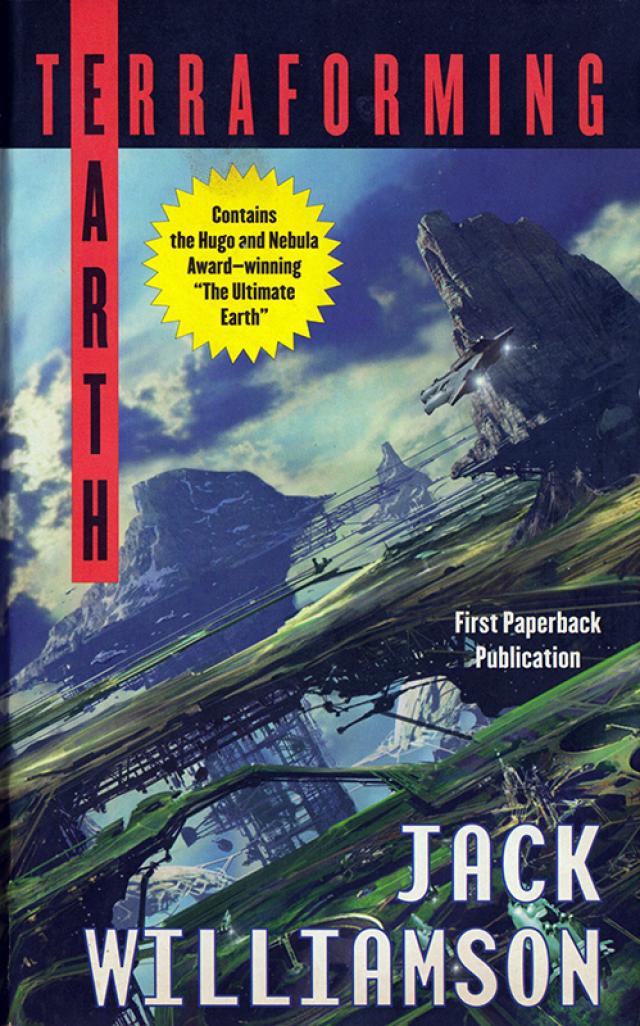
Jack Williamson has been in the forefront of science fiction since his first published story appeared in 1928. Now in his seventy-third year as a published author, Williamson is the acclaimed author of such trailblazing science fiction as The Humanoids and The Legion of Time. Williamson won the Hugo and the Nebula awards for Best Novella for “Ultimate Earth,” a section of his novel Terraforming Earth. The novel itself won the John W. Campbell Memorial Award for Best Science Fiction Novel of the year. Williamson’s memoir, Wonder’s Child, also won him a Hugo Award, for Best Non-Fiction Book Relating to Science Fiction. The Oxford English Dictionary credits Williamson with inventing the terms genetic engineering (in Dragon’s Island) and terraforming (in Seetee Ship). His novel Darker than You Think was a seminal work of fiction dealing with shape-changing, and still ranks as a great achievement in horror. This and other horror works garnered Williamson a Bram Stoker Award for Life Achievement. He was the second science fiction author (after Robert A. Heinlein) to be named Grand Master by the Science Fiction Writers of America. His recent works include The Silicon Dagger and The Black Sun.
Williamson also has been active academically. A pioneer in the field of teaching science fiction as part of a university curriculum, Williamson has taught since the 1950s and is professor emeritus at Eastern New Mexico University. He lives and works in Portales, New Mexico.
JACK WILLIAMSON published his first short story in 1928, and he’s been producing entertaining, thought-provoking science fiction ever since. Williamson won the Hugo and the Nebula awards for Best Novella for “The Ultimate Earth,” a section of his novel Terraforming Earth. The novel itself won the John W. Campbell Memorial Award for Best Science Fiction Novel of the Year. Williamson’s memoir, Wonder’s Child, also won him a Hugo Award, for Best Non-Fiction Book Relating to Science Fiction. The second person named Grand Master by the Science Fiction Writers of America—the first was Robert A. Heinlein—Williamson has always been in the forefront of the field, being the first to write fiction about genetic engineering (he invented the term), antimatter, and other cutting-edge science. A renaissance man, Williamson is a master of fantasy and horror as well as science fiction. He lives in Portales, New Mexico.


