

Sea Hawke, page 1


OTHER TITLES BY TED BELL
THE ALEX HAWKE SERIES
Dragonfire
Overkill
Patriot
Warriors
Phantom
Warlord
Tsar
Spy
Pirate
Assassin
Hawke
NOVELLAS
White Death
What Comes Around
Crash Dive
YOUNG ADULT NOVELS
The Time Pirate
Nick of Time
BERKLEY
An imprint of Penguin Random House LLC
penguinrandomhouse.com
Copyright © 2021 by Theodore A. Bell
Penguin Random House supports copyright. Copyright fuels creativity, encourages diverse voices, promotes free speech, and creates a vibrant culture. Thank you for buying an authorized edition of this book and for complying with copyright laws by not reproducing, scanning, or distributing any part of it in any form without permission. You are supporting writers and allowing Penguin Random House to continue to publish books for every reader.
BERKLEY and the BERKLEY & B colophon are registered trademarks of Penguin Random House LLC.
Library of Congress Cataloging-in-Publication Data
Names: Bell, Ted, author.
Title: Sea Hawke / Ted Bell.
Description: New York : Berkley, [2021] | Series: An Alex Hawke novel
Identifiers: LCCN 2021026571 (print) | LCCN 2021026572 (ebook) | ISBN 9780593101230 (hardcover) | ISBN 9780593101254 (ebook)
Subjects: GSAFD: Spy stories. | Suspense fiction.
Classification: LCC PS3602.E6455 S43 2021 (print) | LCC PS3602.E6455 (ebook) | DDC 813/.6—dc23
LC record available at https://lccn.loc.gov/2021026571
LC ebook record available at https://lccn.loc.gov/2021026572
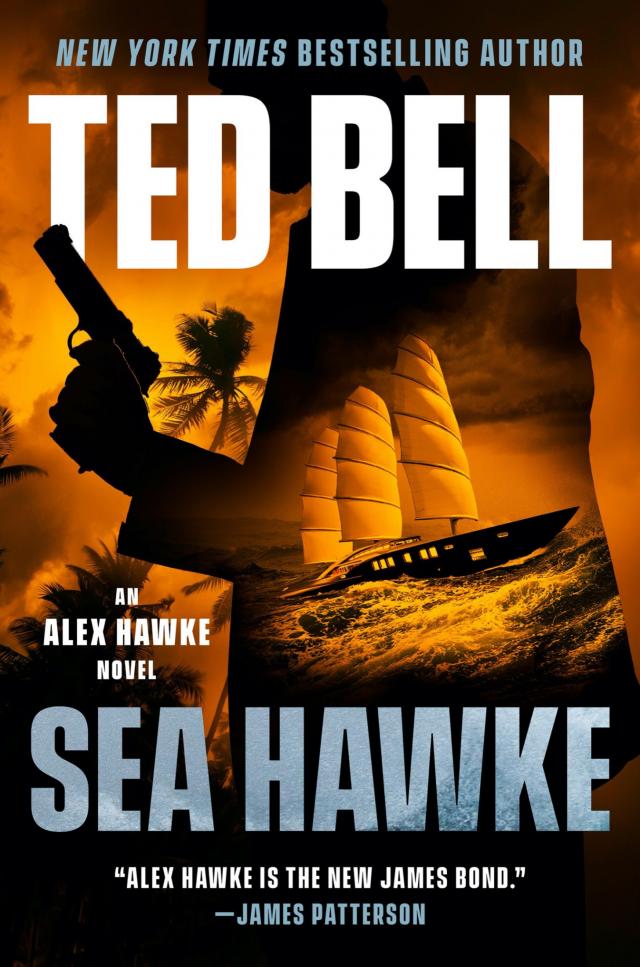
Cover silhouette of a man © Derek Adams / Arcangel Images
Book design by Laura K. Corless, adapted for ebook by Kelly Brennan
This book is a work of fiction. References to real people, events, establishments, organizations, or locales are intended only to provide a sense of authenticity, and are used fictitiously. All other characters and all incidents and dialogue are drawn from the author’s imagination and are not to be construed as real.
pid_prh_5.8.0_c0_r0
CONTENTS
Cover
Other Titles by Ted Bell
Title Page
Copyright
Dedication
Epigraph
Prologue
Chapter 1
Chapter 2
Chapter 3
Chapter 4
Chapter 5
Chapter 6
Chapter 7
Chapter 8
Chapter 9
Chapter 10
Chapter 11
Chapter 12
Chapter 13
Chapter 14
Chapter 15
Chapter 16
Chapter 17
Chapter 18
Chapter 19
Chapter 20
Chapter 21
Chapter 22
Chapter 23
Chapter 24
Chapter 25
Chapter 26
Chapter 27
Chapter 28
Chapter 29
Chapter 30
Chapter 31
Chapter 32
Chapter 33
Chapter 34
Chapter 35
Chapter 36
Chapter 37
Chapter 38
Chapter 39
Chapter 40
Chapter 41
Chapter 42
Chapter 43
Chapter 44
Chapter 45
Chapter 46
Chapter 47
Chapter 48
Epilogue
Acknowledgments
About the Author
I would dearly love to thank the love of my life for her unwavering support, her keen intellect and love of good storytelling, her megawatt smile, her unfailing good humor, her style, her gracious demeanor, her keen wit, and the way she laughs, as cheery as church bells on a sunny Sunday morning! God love you, girl, because I know I do!
THE VOYAGE
’Tis not too late to seek a newer world.
Push off, and sitting well in order smite
The sounding furrows; for my purpose holds
To sail beyond the sunset, and the baths
Of all the western stars, until I die.
It may be that the gulfs will wash us down;
It may be we shall touch the Happy Isles,
And see the great Achilles whom we knew.
Though much is taken, much abides; and though
We are not now that strength which in old days
Moved earth and heaven; that which we are, we are;
One equal temper of heroic hearts,
Made weak by time and fate but strong in will,
To strive, to see, to find, and not to yield.
—Alfred, Lord Tennyson
PROLOGUE
Mayfair, London
Present Day
Lord Alexander Hawke, a tall and rather attractive chap in his midthirties, a bit of a dandy, was, on this particular evening, even somewhat resplendent in his regal purple Chinese silk pajamas, his bare feet clad in Chinese red leather slippers. Lord Hawke—or simply call him Alex, as he vastly preferred not to be addressed by his title—was alone at last.
You were most likely to find him in the library of his comfortable two-hundred-year-old gated manse in the heart of London’s Mayfair. He looked about this gracious high-ceilinged room, his eye alighting on treasured mementos from the course of his rather dramatic life. And, naturally, the splendid portrait of his late, beloved mother, Katherine, known as Kitty Hawke. He was a bit surprised to suddenly find himself more content than any man had a right to be. And what was his lordship’s plan for the evening stretching out ahead?
That remained to be seen.
The weather outside was hellish, and, having walked all the way to Mayfair from his office, MI6 HQ at 85 Albert Embankment, he was now soaked to the skin and chilled to the bone. His usually curly black hair was plastered on his forehead, and he felt very much like the proverbial drowned rat.
Upon reaching his front door and entering the warmth of the foyer, he’d breathed a sigh of relief, as he was only just now thawing out. He’d kept his permafrosted hands jammed deep into the lambswool-lined pockets of his trench coat all the way home.
It had gotten so bad out, he’d momentarily considered popping round the corner to the Duke of York, his trusted neighborhood pub, for a pint or three or four of the best bitters before heading for home. But, upon consideration, he had thought better of it. His new plan?
Straightforward enough. It was to simply sit here in the quietude of his book-filled library before the crackling fire on this cold, windy, and rainy night whilst nursing a smallish tumbler of Haig Pinch whiskey. He sank down suddenly into his favorite chair—a large red leather club chair, which Pelham had thoughtfully tucked in close to the hearth. It was well worn to the point that it now fit him like a glove.
The fragrances of numberless very old leather-bound books cheered him considerably. How he loved the hours spent alone with his books. He had once been widely quoted in an article about men’s libraries in the Sunday Times Lifestyles section as saying, “The gods do not deduct from the allotted span of men’s lives the hours spent in reading.”
Also in the air tonight was the scent of spilled brandy from a distant century on the faded rose-pink cushions of the Queen Anne sofa just inside the bay window that overlooked the lush, now sodden, back gardens.
Other scent memories rushed in: sunrise camping at the foot of Mount Kilimanjaro; lush vineyards on a hillside on the isle of Madeira; a beloved parent, holding a mug with steam gently rising while he snuggled deep within the folds of his blanket; a fresh apple pie, still warm, now cooling on the windowsill of some busy matron’s kitchen in Kensington Mews; the early-evening streets of Istanbul; the clouds of cherry blossoms bursting forth in full bloom in at the Shinjuku Gyoen garden in Tokyo.
All these, and countless more images and pungent olfactory sense memories, cascading and never-ending as the recollection of fragrances, suddenly brought the whole world into focus, and into him.
The warmth of the fire made him drowsy, and he was happy to allow sleep to overtake him. It had been an extraordinarily rough day. Two of his trusted colleagues, intelligence officers at MI6, had turned up dead in a back alley in Beijing early that morning.
He dozed off, apparently, but upon waking to the howling wind ratcheting up to a still keener pitch, now whistling around the eaves and chimneys, with the rain, steadily turning to ice, pricking and clacking, clacking, clacking at the paned windows, he leaned forward and eagerly picked up the prize he’d treated himself to that very afternoon: an exceedingly rare book he’d stumbled upon at his go-to Piccadilly bookseller, Pimms & Co.
The Haig Pinch tasted delicious, but to get the full effect, he lit a cigarette. Not Morlands, mind you, which had created a secret tobacco blend just for him code-named “Hawkeye,” but his new br and, Marlboros. He looked at the glowing tip in his left hand and shrugged his shoulders.
He had, after all, never smoked because he thought it was good for him. And if cancer had any fancy ideas about killing him, it would just have to take its place at the back of the queue and wait its turn, goddammit.
* * *
—
Earlier today, haunting the tiny bookshop in Shepherd Market, with its low ceilings and tightly spaced aisles, for an hour and then spying the familiar name of a well-known Chinese historian on the cover of these old and rare diaries, he could scarcely credit his astounding good fortune!
A seemingly original work by the master Han Xin? Detailing the decades-long and bloody history of the infamous Tang Dynasty! In very, very good condition? It was a miracle. And now it was all his for the perusing!
Bloody hell. This was one phenomenal find! The newest mission of his friend and superior at MI6 entailed learning everything he could about the Tangs, the villainous twins he’d battled with in the Bahamas the previous year—and then circling the globe to root them out wherever they should be found.
Tommy and Tiger Tang!
If ever there’d been an enemy worthy of Hawke’s keen attention, his tradecraft, his knowledge of the Great Game, his formidable warrior skills on the ground, in the air, and on the sea, and his full-throated roar of courage as the battle raged, it was this pair of full-blown sociopaths (and Tang Twins, no less, twice the criminal for the price of one!).
He’d been engaged in a study of the history, past and present, of the Tang Triad, one of the oldest and most powerful of the Chinese crime dynasties. As he and his wingman, one Stokely Jones, Jr., had discovered in the Bahamas on a personal mission for Her Majesty the Queen, the Tangs’ worldwide criminal empire now stretched around the world and back again.
A monstrous enterprise it was, too.
He’d recently gone to Washington for a meeting at the CIA with his old friend CIA director Patrick Brickhouse Kelly, or “Brick,” as he was known, as well as senior members of Hawke’s own counterespionage team at MI6, London. The meetings were all about bringing that empire down and thereby saving the fabric of society in the multiplicity of nations where they operated.
The subject of Han Xin’s battered, dusty old tome was none other than General Deng Xi Tang himself!—the mysterious and shadowy ancestor of the venerable Tang Dynasty and father of the Tang Twins. The Tangs’ origins dated back five hundred years and more. Hawke, since the joint task force meetings in Washington, had learned a good deal about the intricacies of the Tangs’ worldwide operations. The Tangs, whilst never publicly acknowledged by the powers that be in Beijing, basically operated with both immunity and impunity and were wholly outside the law as the de facto criminal arm of the CCP, the Chinese Communist Party.
As Lord Alex Hawke was soon to embark upon a lengthy navigation of the globe with his young son, Alexei, he’d spent the preceding weeks in Tang-oriented briefings, noting the locations of their strongholds throughout the far-flung corners of the earth. Now, in both Washington and London, he was gathering as much information as he possibly could before he set sail.
Hawke turned the thin, crumbling pages with a delicate hand and began to read the general’s musings, philosophic meanderings, and crystal clear observations. He’d struck gold, all right . . . God only knew what pearls of wisdom he might find here . . . When Hawke saw that the title page of the book was headed “Shanghai Diaries of the Tang Dynasty, 1932. By General Han Xin,” he almost screamed for joy at his jolly good fortune.
The Tangs, he thought, it’s about the bloody Tangs, for heaven’s sake! Talk about a massive stroke of luck . . .
He paid for his prize, raced out into bustling Oxford Street where Pelham was waiting with the “Locomotive,” his 1953 Bentley Continental. He yanked open the rear door and jumped into the backseat, where he could start thumbing through the pages.
“Whistles and whirligigs, m’lord!” Pelham exclaimed, peering back over his shoulder at his employer. “Lobsters and lollipops! Celery and soup bowls!”
Hawke looked up from his book. “What’s that you said? Something about whistles? Lobsters? Celery?”
“Ah, that. You see, I’ve started reading C. S. Lewis again. Starting with the Chronicles of Narnia.”
“And?”
“One of my favorite characters is always spouting off things like that. I find it terribly cheery. Don’t quite know why, for the life of me. Loopholes and lariats, indeed!”
“Well,” Hawke said, glancing up from his much-prized book, “try not to make a habit out of it, won’t you, dear fellow? There is a limit, you know, to one’s eccentricities.”
* * *
—
“Ah, here we are, m’lord,” Pelham said twenty minutes later whilst easing the Locomotive to a stop in front of 28 Ashburton Place in Mayfair close to Green Park. “Spot of rain, I’m afraid. I’ll let you off here at the entrance door and—” But Hawke had already bolted and flown inside the house, racing down the corridor to his library with his prized possession clutched tightly in his grasp. He collapsed into his deep red leather chair by the fire, his pulse racing as he began to read . . . the pages seemingly afire.
And so, although he did not yet know it, another violent and storied chapter in the epic saga of one Alexander, Lord Hawke, versus the Evil Empire of China would now commence. Hawke, as he sipped his watery whiskey, the rain beating against the windowpanes, the reassurance of a crackling fire beside him, was almost giddy as he began to read in earnest. He turned the page . . .
* * *
—
“As is always the case at this season,” the first entry in Han Xin’s diary began, and Hawke was off to the races. He began soaking up the tale, knowing the information within would yield countless clues to help him safely navigate the dangerous waters ahead. Perusing this remarkable volume was like having the other side’s playbook well in hand ahead of the football championship matches.
“Cool evening breezes,” Hawke read, “are drawn over the city from the sea, moving onto the warm landmass of China; here, where in old Shanghai, embroidered yellow silk draperies billow out from the glass French doors of the veranda of large house on Avenue Joffre in the French Concession. For the last few centuries or so, the great house has remained the sacred home of the Tang family. Tang is a known quantity here. The centuries-old Tang Triad Society still strikes fear into the heart of the populace, now, then, and forevermore, as it has always done. The violence, when it erupts, is terrible to behold, grievous to fall victim to.”
But as Hawke had now read in some detail, the current chieftain of the clan was not a man prone to torture, rape, and murder. No, no. The man was a retired military officer, a mild-mannered fellow vastly more likely to be found here at home, reading Proust in his book-filled library, playing Chopin preludes on his Steinway grand, but spending the preponderance of allotted time left to him in the study and maintaining these diaries, and, of course, absorbing modern applications of future military strategies in the ancient Chinese board game known as Go.
CHAPTER 1
Hawke, lighting yet another Marlboro, lay back with his curly black head resting against the red leather cushion, pausing to digest what he’d read so far. He closed his eyes and allowed himself to fantasize about that first meeting coming up. The one wherein all the MI6 lads from the third floor would be summoned to C’s conference room to be debriefed on all the available intel on the Tang Dynasty known to man. And when they’d wrapped it all up, Hawke, ever the hero to the rescue, would arise at the table and, smiling, would begin to debrief the lads from the third floor!
He read on, deep into the rainy night. And deep into the murky mists of times long past.
* * *
—
Now General Deng Xi Tang withdrew a white stone from his lacquered Go ke and held it lightly twixt the tip of his middle finger and the nail of his index. Passing strange how cool to the touch the smooth stones always felt. Some minutes passed in silence, but his concentration was not on the game, which, in its 176th gesture, had begun to concrete toward the inevitable. The general’s dark and deep-set eyes came to rest on his handsome young opponent, who, for his part, was completely absorbed by the patterns of black-and-white stones on the pale yellow board.


