When You Trap a Tiger, page 18
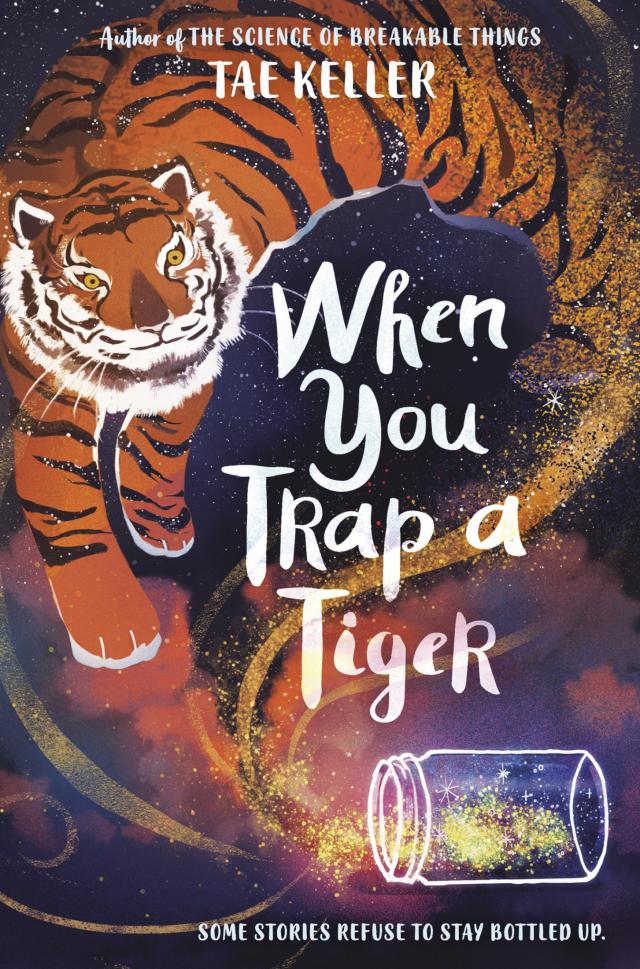


Even the gods make mistakes, but as it turned out, the mistake hadn’t been the tiger-girl at all.
The mistake was making her choose. The mistake was creating a world where she had to hide—where she was afraid to be everything at once, fierce and kind, soft and strong.
But that was an old god, with old ways, and the new god recognized her family—her great-granddaughters.
So she dropped a staircase for Little Egg. And a rope for Unya.
Come, said the new sky god. There is something I want you to see.
* * *
In the hospital room, I taste salt, and I realize I’m crying. I look up and see Sam. I feel Mom’s touch on my back.
Beneath my fingertips, Halmoni’s pulse gets weaker, fading away.
“Keep going,” Sam whispers.
The seconds swell. I take a breath. There are so many endings to choose from. And I find mine.
* * *
Together, the two sisters climbed up and up, and when they reached the sky god, a sky tiger, she showed them a galaxy filled with jars. Some jars had been carried across the world, long hidden. Others had traveled across the sea, to a flea market by the coast, hoping to find their family. And all of these jars released the truth and longing and love.
Open them, the tiger said.
The girls were scared, but they were brave, too. They believed in hope. They opened the jars and stories. Some were scary, some were sad, but the girls only felt proud, because this was the story of their family—generations of women who’d fought for their hearts. Women who could be everything and anything.
Now you can tell your own star stories, the sky tiger told them, her voice skritching like coarse fabric against their ears. Light is not limited.
So the sisters began to speak. They told stories of their halmoni, who always wore sequins, and always saw her granddaughters. Who risked everything for happiness, and did anything to protect her family. Who believed in invisible things—like spirits and magic and love.
The girls talked about their halmoni, who’d taught them to see the world, and to see themselves.
As they spoke, they filled the sky with stars. The sisters lit the world.
And in the light, they found their way back home.
In the light, they saw: They were not alone.
When I finish my story, Halmoni is smiling. Her eyes are closed and her pulse flutters, barely anything anymore.
“I love you,” I tell her.
I squeeze one of Halmoni’s hands. Sam squeezes the other. Mom strokes her hair.
This is the end. But it doesn’t happen right away, not like in the movies.
Over the next few hours, her breath becomes softer and softer. We watch as she fades.
“The stories were supposed to save her,” I say in a small voice.
Mom makes a noise, and when I look at her, there are tears in her eyes. “They did save her, Lily. They reminded her that the world is big. That she could be anything. That she was everything to us.”
Halmoni looks so pale, lying on the bed. So helpless.
“I’m scared,” I say.
“I know,” Mom says, “but you’re not alone.”
Sam reaches up to unclasp the pendant. She takes it in her palm, presses it into mine, and intertwines our fingers.
Together we hold our little piece of magic—our piece of Halmoni.
“It’s okay,” I whisper, leaning so close to Halmoni that my lips brush her ear. I close my eyes and breathe. Sometimes, the bravest thing is to stop running. “It’s okay if you go. We will be all right.”
I don’t know, for sure, if she hears me. But I think she does. The room seems to sigh in relief.
I look up, and the world outside is dark, but through the window, two small spots of light blink back at me. It’s hard to see. It’s hard to know for sure. It could be the reflection of the machines inside, or it could be tiger eyes, staring back at me.
I watch them, my heart clenching tight like a little fist. And then they disappear, blinking closed. Something opens up inside me, a hole that wasn’t there before. An emptiness and a loss, but also…space. An open jar, a release.
I lean my head against Halmoni’s heart, and I sit in that small room with my family.
When Halmoni finally does go, I know she’s ready. She has always been brave.
The basement is flooded.
The first night, after we return to Halmoni’s house, Mom throws the basement door open and shakes her head. Water laps at the steps. The boxes that Ricky and I worked so hard to stack slowly disintegrate into mush. Mom stares at the water for a long, long time before calling someone to get it fixed.
The second night, Mom decides to sleep in Halmoni’s room. Sam lies awake, biting her fingernails. And the rest of the house goes quiet. The floorboards don’t whine beneath my feet. The doors don’t sing. Without Halmoni, the house is just a house. A too-quiet, too-empty house that none of us know how to live in.
The days pass quietly. The hours go blurry.
Ricky texts me a continuous stream of his favorite foods, trying to cheer me up. And on the seventh night, after one official week, he texts: rice cakes.
When I read the words, the threat of tears burns behind my eyes. I almost turn my phone off and hide beneath my covers.
But his text reminds me of something. An important date rattles around in my head. On my phone, I check the calendar, and I see: tomorrow is the bake sale.
I have an idea, and for the first time all week, the heaviness in my chest lifts a little. I tell Ricky my plan, then text Jensen before throwing my blankets back.
I run down the attic steps, not bothering with invisibility. Banging around the kitchen, gathering pots and pans, I fill our home with noise. The house begins to wake.
Mom comes into the kitchen, with Sam trailing her.
“What are you doing?” Sam blinks.
“Rice cakes. For the bake sale.”
Sam’s confused, but Mom doesn’t question it. She walks over to me and starts pulling ingredients off the shelf—a jar of mochi flour, a box of sugar, adzuki bean paste.
Sam says, “We don’t have to do the bake sale.”
“We don’t have to,” I say, looking between her and Mom. “But…maybe we should. All that food. All those people. It’ll be like…”
Understanding settles on Sam’s face, and her eyes ache with grief. “Like a kosa.”
“At the library,” Mom says. For a moment, she looks too pained to speak, but she does. “The library was one of Halmoni’s projects, so many years ago. She painted it bright colors and added cheesy posters. She always wanted it to be a special place.”
I stare at her, wondering how, all this time, I never knew.
But I don’t have much time to process that, because Sam asks Mom, “Do you know how to make the rice cakes?”
Mom nods, but a bit of panic slips into her voice. “Uh, I think. Maybe. Vaguely.” And then, softer, “I never thought to ask.”
I think of the time when I asked Halmoni for her recipe—she said later. And now it’s too late.
But Mom looks hopeful, and I take a breath.
“It’s okay,” I say. “Even if things aren’t perfect, they can still be good.”
Mom squeezes my shoulder, and we begin, measuring flour and coconut milk based on what feels right. And cooking together, mashing our hands into mochi batter—that feels right.
Ricky and Jensen have spread the word. Nearly the whole town comes to the library for Halmoni’s kosa. Halmoni’s friends fill the room with food and stories. People come up to us, tell us how sorry they are, how much they loved her—people we don’t even know, people Halmoni helped or healed.
Joe finds me, and at first I apologize. He isn’t charging for the bake-sale-turned-kosa, of course. So the whole plan to save the library is ruined. “I know we were supposed to raise money,” I say.
Joe shakes his head. “This wasn’t for money. This was for community. Though maybe later we can discuss the break-in.”
My cheeks get hot. “How’d you know about that?”
“Intuition,” he replies. “And the kid-sized muddy footprints everywhere.”
“Oh.” I kind of forgot about that.
But his mustache twitches, and he smiles softly. “Heartbreak is often messy.” He hands me a cookie, and I thank him.
Across the library, Mom talks to a few adults I don’t recognize, and Sam finds her way to Jensen. Jensen takes Sam in her arms and kisses the top of her head, and Sam leans against Jensen’s neck. There’s a love between them that confuses me for a moment.
And suddenly it all makes sense. Sam’s weirdness when she first saw Jensen. The nervousness when Sam asked me about her later. The way Jensen helped Sam scatter rice, the way Sam tried to call her for help.
They’re a couple.
I’m stunned, even though now it seems obvious. They’re a good match. Jensen is nice, and Sam is soft with her, and they fit.
On the other side of the library, I see Ricky with his friends. They all wave to me, and Ricky abandons them for a moment, walking up to me with a wicker basket in his arms. He’s wearing a black bowler hat today, a glamorous one that Halmoni would have loved.
“Chocolate muffins,” he explains. “Joe gave me his recipe.” And then, with a tilted smile: “I promise, no mud.”
He holds out the basket, the great-grandson of a tiger hunter offering baked goods to the great-granddaughter of a tiger god.
I accept it, and warmth spreads up my fingertips and through my body. A small part of me perks up, smiles. And I’m not sure the smile reaches my face, but maybe this is how healing starts—small bits of happiness waking up inside you, until maybe one day it spreads through your whole self.
“I passed my language arts test,” he says. “So we’ll be in the same grade in the fall.”
I smile, for real this time. “That’s great, Ricky.”
He grins, and when I excuse myself, he gets it. He knows I’m not ready for a full conversation yet.
I slip out the heavy front doors and sit on the steps, cradling the muffins on my lap.
I think about our conversation before, about learning who you are, even in not-you situations. I’ve been doing that, pushing back the edges of me—trying to find the borders—and I’m realizing that I’m so much more than I thought. Right now, I feel infinite.
I take a bite of a muffin—and then cough, spitting it into my palm. Salt. Ricky must have mixed the sugar up with the salt.
The unexpected flavor shocks a laugh out of me.
“Can I sit?” someone asks.
At first, I think the voice is the tiger’s. I keep expecting to hear her, or catch a glimpse of her out of the corner of my eye. But I also know, deep down—she’s gone.
When I turn, I see Sam, who sits down next to me without waiting for a response. She reaches into the basket, grabbing a muffin without asking.
“I wouldn’t—” I say, but it’s too late. Sam’s already choking on her bite, spitting her own mouthful into her palm. She stares at me, and I laugh, and she laughs—
And then we stop, abruptly, dumping the chewed-up muffins back into the basket.
It feels wrong, to be happy right now.
“Does it get easier?” I ask. “Does the sadness go away?”
Sam stares ahead. “The sadness fades, yeah. Eventually. But the missing…I don’t know if that ever does.”
I press my thumb against my palm, and when I close my eyes, I can almost imagine it’s Halmoni, tracing my life line, telling me everything is going to be okay. The evening air heats my skin. It finally feels like August, and I fill my lungs with warmth.
Sam scoots closer, until our arms touch. In the sky, the sun is setting, and the moon peeks over the trees. “Will you tell me another story?” she asks.
I breathe in. The seconds swell. I find my voice.
“Long, long ago…,” I begin.
I don’t yet know the ending, but I will face my story as it changes and grows. Because of Halmoni, I can be brave. I can be anything.
I am a girl who sees invisible things, but I am not invisible.
When I was little, my halmoni told me stories.
My younger sister and I would curl up in bed with her, and as she spoke of ghosts and tigers, our world filled with magic. In those moments, I would have sworn I heard tigers outside the bedroom, their sharp claws skritching against the wood floors. I could practically see their shadows seeping under the door.
On those nights, I felt connected to a line of Korean women I’d never known—as if their stories still lived in my blood. When I listened to Halmoni, I wasn’t part white, part Asian, one-quarter Korean, mixed. I was just full me, and I knew it in my bones.
Years later, when I left Hawaii for college, I abandoned the stories—not intentionally, just by accident, as though they’d slid under my bed and gathered dust. Before long, I forgot they were missing.
I didn’t know how much I needed them until late in college, when somebody asked if I was Korean.
Just a quarter, I answered. The words felt wrong as soon as I spoke them. The answer, quite simply, has always been yes. But somewhere along the way, I’d started dividing my blood into parts.
Wanting to be whole again, I turned back to the stories, reading old fairy tales and searching the internet—but they were different now. These were not my halmoni’s stories. Somehow they had shape-shifted. Maybe they had changed. Maybe I couldn’t find them. Maybe my halmoni had told different versions, and invented some entirely.
When I asked her to recall her stories, she waved her hand. Oh, so long ago, she said. I don’t know what I say.
So, with nowhere else to turn, I wrote my own story.
I started with my favorite: two siblings run from a tiger, escaping into the sky to become the sun and the moon. It’s a popular story, with many variations, but I always felt like the story was hiding something—and I wanted to know its secrets.
The tiger in that story is clever and determined. It dresses up as the children’s grandmother. It hunts them down. It attempts to trick them, and when that doesn’t work, it chases them far and wide. It tries to chase them into the sky.
The tiger is ceaseless in its pursuit, and I always wondered, what does it want? Nothing so crass as meat; this felt like more. What could be so important, so powerful, that the tiger would chase these children across the world?
I wrote a dozen drafts in search of the answer, but it did not come easily. It was as if I had to prove I was trustworthy before the story would reveal its secrets.
So I worked for it. I dug back through my family history and the history of Korea.
I read about colonialism and oppression, about a hidden language and forgotten stories, about comfort women and imposed silence. But in this dark history, I found strength, too. Korean people—Korean women, in particular—are fierce and resilient, and as I worked, I understood my halmoni and myself better.
My research revealed strange coincidences. In an early draft, I’d written about star jars full of magic, without really knowing why. The idea had seemed to come out of nowhere.
Later, I discovered Chilseong, or the Seven Stars—a deity that watches over children and is often honored by the setting out of bowls or jars.
Similarly, in my story I’d invented a small Korean island where the sea parts once a year. While poring over a map of Korea, trying to find a place for my fictional village, I learned that it already exists—Jindo, a seaside island where once a year, due to a combination of tides and maybe just a bit of magic, the ocean really does part.
I worked like this, alternating between writing and research, treating these coincidences as clues, as if I were piecing together a story that had already been told long, long ago and I only had to bridge the gaps.
I worked my way through history, all the way back to the Korean origin myth. And there I found the biggest coincidence.
Before my research, I’d had a vague understanding of the origin myth, but for some reason, my halmoni had never told us this one. It goes like this:
Long, long ago, there was a heavenly prince who ruled over Earth. His job was easy enough until a bear and a tiger, tired of their wild lives, asked him to turn them human.
He said that if they lived in a cave for one hundred days and ate only mugwort and garlic, they would become women.
The bear succeeded, and the god rewarded her with a human body. Together, they created the Korean people.
But the tiger was impatient. She wouldn’t deal with those conditions. She ran out of the cave and was doomed to a life of stalking through the forest as a beast, alone.
I’d known about the bear-woman, but until then I’d never heard about the tiger. And yet in my draft, I’d written about a tiger-girl who asks a sky god to turn her human. The words had felt right when I wrote them, though I didn’t quite understand them.
Now, this felt like more than a coincidence.
Yes—maybe I’d heard the story before, and it had burrowed, long forgotten, in my subconscious. But all the same, I felt connected to something bigger. I felt the way I had so many years earlier, as if these stories lived in my blood, even the ones I’d never heard before.
I dug deeper into the myth and found a critical essay called “Begetting the Nation,” by Seungsook Moon. According to Moon, “the transformation of a bear into a woman carries the deep social meaning of womanhood epitomized by patience to endure suffering and ordeal.”*
And with that, my story finally fell into place.