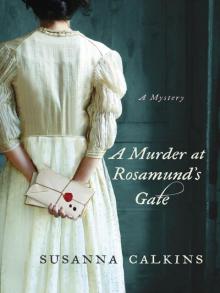
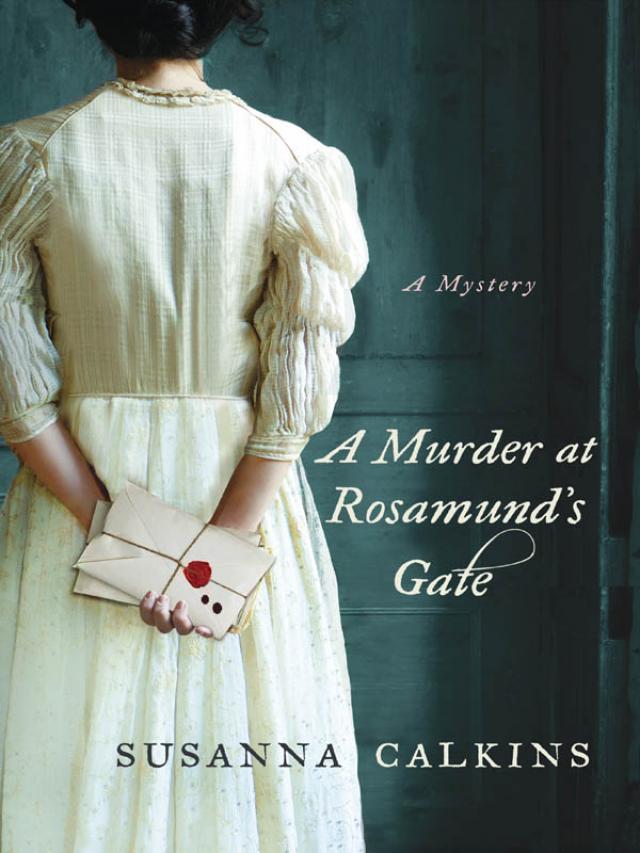
A Murder at Rosamund’s Gate, page 12


Taking a deep breath, Lucy read only the first few lines before swearing. “That rat Janey! This is her swill!”
Nearly every word was a lie, including the same rubbish about Bessie having received a letter from an unidentified lover, who had persuaded the “heartless trollop” to meet him at Rosamund’s Gate with the magistrate’s silver. Much of the piece focused on how Bessie had brought ruin on the magistrate’s household. Even worse, it contained several passages suggesting that her lover had been someone much closer—someone known to, or even part of, the magistrate’s own family.
Chilled, Lucy compared the woodcut account to the ballad, which was much shorter but also mentioned the lover’s note. “All lies,” she repeated to herself.
Tossing the woodcuts aside, Lucy looked back at the discarded pile, the four pieces she could not quite decipher. They had no pictures, and the text was much smaller and harder to read. Although the words were in English, their meaning escaped her, especially in her current tired state. The papers looked like legal documents and could have been in a strange language for all the sense she could make of them.
The last of the pieces looked like a petition to the king, and try as she might, she could make no headway. It seemed unrelated to the deaths of the three girls. Perhaps Master Aubrey had included it by mistake. Lucy was too tired to ponder it anymore. Blowing out the candle, she laid down her head and quickly fell into a dreamless, but troubled, sleep.
11
In the morning, Lucy found Lawrence cleaning out the hearth. His face blackened by soot, he still grinned at her. “Morning, ma’am,” he said.
“Just Lucy, Lawrence,” she corrected him gently. “Did you get enough to eat?” she asked, although the telltale signs of porridge and jam were well in evidence on his collar and cuff.
“Yes, ma’am. I mean, Miss Lucy,” he said, returning to work.
Lucy moved into the kitchen, where she found Annie sitting close and trusting beside Cook, her small hands busily scrubbing vegetables for the midday meal.
“I guess you can get back to giving yourself airs now, as a lady’s maid,” Cook said, her voice gruff but kind. “I guess my Annie here can do your work just fine, though she be a bit peaked.”
“Fair enough,” Lucy said, sliding onto the hard kitchen bench. Using the long wooden ladle, she spooned a few bites of porridge into her bowl. Her stomach grumbled happily as the food slid, warm and delicious, down her throat. After swallowing, she added, “I just wish I could sew half as fine as Bessie, or it will be back to the slops for me.”
“Never!” Cook declared. “The master is pleased he could move you up, I think. Have a smart one, like you, to tend the mistress. Now, Annie,” she said, turning to her young ward, “let’s leave Lucy to finish her breakfast in peace. I shall show you around the house myself; goodness knows I knew the ins and outs of chamber pots and hearths in my day. Lucy can give you the particulars later.”
The kitchen unexpectedly empty, Lucy sat down, resting her head on her elbow. Trying to read through the penny pieces the night before had given her a headache, and she had not slept well. She was nearly dozing off when a low voice from behind her caused her to start, her heart beating painfully.
“I believe you have something of mine?” Adam asked, appearing in the kitchen doorway. “Let’s have it.”
“Oh!” Lucy blushed.
Unlike Lucas, who often came sniffing around for a bit of pudding or a piece of treacle tart, Adam, like his father, was not a common sight in the Hargrave kitchen. His dark hair was pushed back from his face, and he looked like he had been out getting some exercise. For a moment, she wondered what he did when he was not studying. Fencing, perhaps, or even sparring? Of course, the gentry didn’t dirty themselves as the boys back home would; they would use special gloves and padding. Will and his lot would have a good laugh.
Adam repeated his question in a tone that brooked little humor.
“I don’t know what you mean,” she stammered, trying not to recoil.
“Come, Lucy. You know exactly what I mean. Did you think Aubrey would not tell me about your request? Did you want me to seem a fool before my friend?” Adam tapped his foot. “Make haste, if you will. It would not be seemly for me to enter a chambermaid’s bedroom, but by God, I’ll go right up there and search your things to find what is mine. Your honor be damned.”
“Lady’s maid,” Lucy muttered without thinking.
He folded his arms, his frown deepening. “What?”
“I’m a lady’s maid. Your mother is a lady, is she not? And I’m her servant, am I not? Then I’m a lady’s maid, sir, and not a chambermaid.”
“Of all the damndest—”
Pushing past him, Lucy added, “I shall retrieve what you request shortly. You may meet me in the drawing room.”
His raised brow made her think she might have gone too far. “Sir,” she added hastily.
Racing to the drawing room, she quickly unwrapped the scarves that crossed her bodice, pulling the papers out. Making a snap decision, she kept “A Murder at Rosamund’s Gate” hidden. Adam walked in a few moments later, just as she was refastening her dress.
He looked at the small pile of papers on the table and then back at her. “You were wearing all of that under your skirts?” he asked, incredulous.
Lucy smirked. “Under my bodice, actually.” Suppressing an inner groan, she bit her lip. Why on earth had she mentioned her bodice? She talked quickly then, to cover her embarrassment. Putting her hand on the papers, she said, “I paid for these, you know. A crown. My money,” she emphasized, in case he didn’t get it.
“The price of using my name, I’m afraid.” Adam held up a hand to quell her protest. “Now, I am interested, however, in knowing what my mother’s charming little lady’s maid wanted with these nasty, sordid pieces.” He eased one of the flimsy sheets from under her hands.
Despite the great show he was putting on, Lucy had the feeling he knew exactly what they all were.
“Yes, I see. Bessie’s murder, of course.” He looked at the others. “Hmm … and Jane Hardewick’s, and even little Effie Caruthers’s. Tut tut. Dreadful business all, to be sure. What is going on in that silly little head of yours?”
Lucy shook her head.
“Oh, come now; it’s easy to see what you’re thinking. A connection between them. Tell me your reasoning.” His voice was lazy but commanding. “Really, I insist.”
Although she remained standing, Lucy leaned against the table. “Well,” she began, “I found it hard to piece it together, truth be told. I thought Dr. Larimer had said that the two girls, Jane and Effie, had both been killed the same way. Yet this one”—she picked up a pamphlet and in a halting manner read, “‘The True Account of a Most Treacherous Murder,’ says Effie was killed by a passing woodcutter. This makes no sense at all.” Lucy laid the sheet down on the table. “It seems odd that Effie had left the house with her satchel of clothes, planning to run off with someone, then she just happens to have the ill fortune to be set upon—what? Why are you laughing? ’Tis not a humorous event!”
“No indeed,” Adam said, the mocking grin disappearing for an instant. “Her murder is no laughing matter. I think you know she was not hacked to pieces by, what did you call him? A passing woodcutter?”
“But,” Lucy reasoned, “why would the picture here show it like this? It makes no sense.”
“For that confusion, you may blame Master Aubrey. He will simply select woodcuts that he had used for other texts, a common practice among printers. See, he’ll use that woodcut whenever the crime seems to suit. However, there may be some truth here, even if the author may have made up other details to better sell the story.”
“Did Master Aubrey write this story, then? About Bessie?”
“Not likely. He probably just bought this from a Grub Street hack, put it in his press, and sold it as new. None would be the wiser, and it’s even less likely that anyone would care.”
Lucy picked up another ballad. “‘Murder Will Out!’” she read. “This is the one some crier was selling at Bessie’s funeral. ’Twas quite disturbing for her family, you know. And it had nothing to do with Bessie. This murder happened twenty years ago!”
Adam looked pained. “Yes, well, this one was not from Aubrey’s shop. See here, a different bookseller and printer are listed below the woodcut. He probably just traded it for one of his own,” he explained. “Booksellers often trade their wares. As for why this particular one was sold at Bessie’s funeral, would you care to speculate?” His gaze was hard.
Sidestepping the question, she sought to change the topic with a question of her own. “How do you know so much about this, sir? About what booksellers do?”
Adam shuffled through the papers but would not be baited. “I know something about the booksellers’ trade, I suppose.” He rapped the table with his knuckles. “Come, Lucy,” he continued. “Show me why my father sets store by a lady’s maid’s intellect.” Again he stressed “lady’s maid” in a slightly mocking way. “Look beyond the woodcut image. Look beyond the barbarous words. Those are just meant to tantalize, to seduce. Does anything strike you as true? What can we learn here about these murders?”
Lucy thought for a moment. “Well, all the girls were similar. Each was young, alone, unmarried, a servant. Pretty.”
Adam sniffed, unimpressed. “That could describe a goodly portion of all the lasses in England, at least of a certain class, including you. Go on, what else?”
Lucy tried again, attempting to hide her irritation. “Well, each had received a letter—”
“Yes, that is the more interesting question.” Adam tapped his fingers on the table. “What does the presence of these letters tell us? How foolish these girls were? ‘Dear Jane, meet me at midnight. Do not tell anyone, for I plan to kill you when I see you.’ Does this make any sense?”
“Well, no, not when you put it that way.”
“Thus, there are at least two questions here. Did such letters indeed exist? If so, were they used to lure these girls to their eventual fate? That is, did the alleged lover intend to kill them, or were they killed by a third party?”
Now Lucy was getting annoyed. “You seem to have already worked this out, sir. Perhaps you would care to explain? I have not your experience with such things.”
“I should say not. Master Aubrey—a good man, indeed. Certainly not a liar in our everyday world. He wouldn’t cheat the baker, or fib to a clergyman, or spread stories about a friend. However, he might see fit to find ways to sell a few more papers with more, shall we say, embellished true stories.”
“Everyone loves a good murder,” Lucy said, frowning. “Master Aubrey told me so.”
“Yes, exactly,” Adam said. “A good murder sells penny pieces, and crimes of passion make good reading. Not to mention good profits.”
“How can we know the truth?” Her voice caught a little. Tears were close, but she blinked them away.
“There’s the rub. Let’s see what else you have.”
She showed him the more official-looking folios. The petition he merely glanced at and put in his pocket.
“What was the petition for? It said to get someone out of jail? Is it the killer?”
“No, that’s nothing. Something our good printer friend may have included for my, er, amusement. No bearing on this case.” Adam tapped the other papers. “What about these? What do you make of them?”
“Testimonies, I think. Are they? Am I right? I couldn’t make out head or tail.”
“I had not seen these,” he said, skimming them with skillful eyes. “These are different types of court records and are not publicly circulated or sold. Generally they pass only between judges and magistrates, so that they can be kept informed of changes in the law or updated about recent events. They are supposed to stay with the court. I do not know how Aubrey got hold of them.”
“What do they say?” she persisted. “Please tell me.”
“This one is a deposition, where two witnesses recorded their testimony before the Effie Caruthers trial. And this one is the sworn statement of Robert Preswell, who swears he was nowhere near Jane Hardewick when she was murdered, although neighbors suggest otherwise. He does admit to fathering her baby, which may be enough to condemn him.” He snorted. “In themselves, I’m not sure they add more to what we already know. And, really, Lucy, what do you hope to accomplish here? It’s all rather unseemly stuff for a lass such as you.”
“I have to know the truth,” she cried. “Can you not see that?”
“The truth can be painful, have you thought about that?” he countered. “I’m afraid—”
She never knew what he was going to say, for she heard Cook calling for her. “The mistress must want me,” Lucy said.
“Indeed. And Lucy,” he said, as she started out the door. He held a coin. “A half-crown for your troubles, for bringing me my package and for so closely, ahem, guarding it on your person. But not a word, if you will. It’s best not to talk about Bessie’s death. We shan’t want to upset anyone. Don’t you agree?”
After he walked out, she had the feeling he had been about to say something else but then changed his mind. She did think, though, he was warning her. She looked at the last penny piece that had stayed hidden under her skirts. Like the others, it insisted “Murder will out” and described how Bessie’s arm did willingly and truly move on her own and did, with the will of God, then point to her killer. Lucy read the passage again: “‘After her body was found, a crowd gathered to see her. Then, her eyes did open of their own accord and her finger did point to a certain young gentleman studying law at the Inns of Court who most certainly did live in the same household as the comely wench—”
“I thought you were hiding one more from me.”
Lucy whirled around. Adam had doubled back, moving so stealthily she had not heard him.
“Give it to me.”
She shook her head dumbly. “‘Tis nothing, sir.”
“Oh, my dear Lucy. As if I am not well aware that there was one that accused me so directly. And I can see by your rapid pulse that you believe every word of it. Or, at least, the part that has to do with me.”
“No, sir, I don’t. It’s full of lies.” Her protest was weak, and they both knew it.
“It is quite true, I’m afraid.” Adam laughed at her shocked expression. “I was indeed there, and her arm did drop and look to point at me. I was as surprised as anyone, although perhaps more surprised that the silly tale has gotten about.” He frowned. “Tell me, Lucy. Why would I want to kill Bessie, a girl I scarce had a single conversation with? I wish someone could tell me.” He stood close to Lucy, his eyes fixed on her face. “Do you, Lucy, really think I could have killed her?”
The image of Adam stumbling up the front walk, covered with blood and feverish, the morning after Bessie’s disappearance flooded Lucy’s mind. She blanched at the memory and stepped back from him.
For a moment, he looked hurt and puzzled, then his familiar mocking gaze returned. “I guess I have my answer. The scullery maid thinks I’m a murderer. I should just like to know my motive.” He reached over and picked a tendril of hair from her shoulder. She stood, frozen, as he rolled the lock between his fingers. A final tug and he let it go. “Best have a care, then. Living with a murderer under your roof may not be so good for your health.” She heard his scornful laugh all the way down the hallway, and she sat down hard on her bench.
* * *
Lucy was still mulling over what she had pieced together from the penny pieces as she walked home from market the next day. She remembered what Avery had said about the witches taking the clothes off a dead woman’s body. She reread the passage about Jane having last been seen with a red sash.
Could the gypsies have had something to do with Jane Hardewick’s death? she wondered. Not that she’d ever dare ask Maraid such a thing. She couldn’t anyway, because she’d heard the gypsies had cleared out and were off to who knew where. Besides, according to Avery, Jane had already been dead when the witches removed her clothes, so they may not have been the ones who killed her.
None of it made any sense. Lost in thought, it took Lucy a moment before she realized that an older man she did not know had fallen in step beside her. Uneasy, she began to walk more quickly, not nearly as carefree as she had been before Bessie’s death. She looked about; a few other people were walking back from market, but none that she knew.
“Hey there, young lady,” the man called. She began to walk faster. The man tried again. “Lass, please wait. Thee dost work in the house of Adam Hargrave, dost thee not?”
Hearing the peculiar form of address and the mention of Adam, Lucy stopped and turned warily around. Breathing heavily, she regarded the man. He was dressed in sober woolen clothes, a nondescript gray. His beard was neatly shaved in a good somber fashion, shading a careworn face. She thought he was likely about forty years old, but his gaunt frame aged his body even more. He looked and sounded for all the world like a Quaker. His next words seemed to confirm her guess.
He held up both hands. “I have no wish to harm thee. I am a Friend. ’Tis Lucy, is it not?” Seeing her surprise that he knew her name, the man smiled, looking years younger. “Adam Hargrave said thee art a good and loyal lass, and that thee could be trusted, should I ever need to send him a message.”
Flattered by the unexpected compliment, Lucy held out her hand for a note. “What is the message, sir?”
He shook his head. “’Tis not a message I dare write down. Pray tell Adam that we are set for tonight. When the moon is high. By Jamison’s paddock. Will thee remember that?”
Lucy repeated the words dutifully. “I’ll remember to tell him, sir.”
“And Lucy?”
Something about the man’s grave and humble stance commanded her respect. “Yes, sir?”