Blood Covenent, page 1


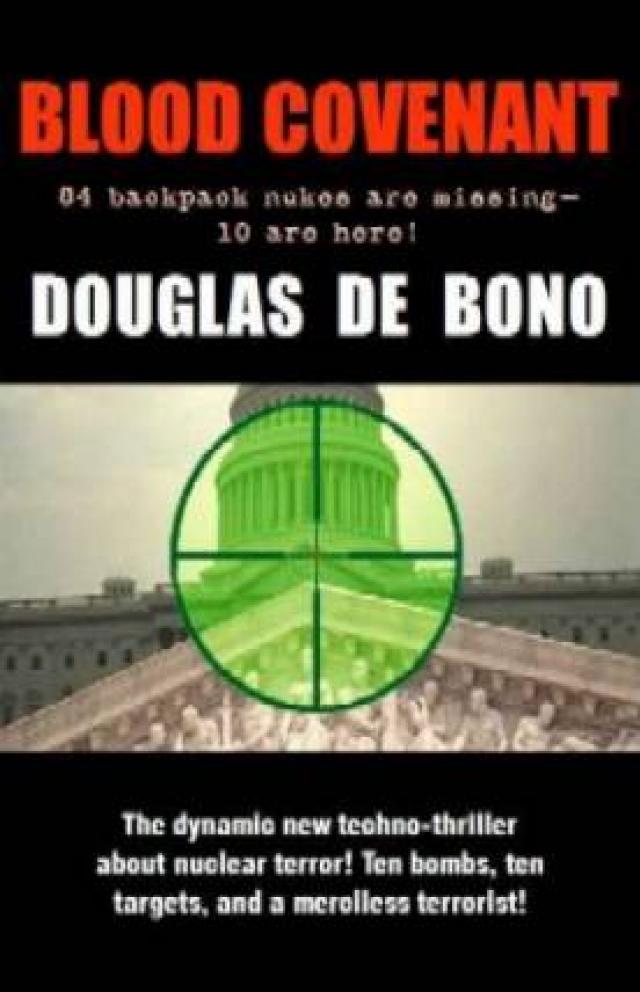
BLOOD COVENANT
Douglas De Bono
BLOOD COVENANT
By
DOUGLAS DE BONO
An Eagle One Media E-Publication.
All Rights Reserved.
March 2003
ISBN 0-9714785-7-0
Novel Copyright © 2001 Douglas De Bono
TOWLE
Cover art used with permission by
Metropolis Ink.
Digital Version Publication Copyright 2003 by Eagle One Media, Inc.
The digital version of this novel is intended for the sole use by the individual who has downloaded this publication. Additional transmission, duplication, distribution, or printing of this novel, once downloaded by the individual, is strictly prohibited.
Eagle One Media, Inc.
www.eagleonemedia.com
Dedication
This one is for my parents
Charles & Lu De Bono
Two of my biggest fans
PROLOGUE
Russell Office Building, Washington, D.C.
March 16, 1998
The five senators arranged themselves along one side of a green maize table. Each had a walnut nameplate, microphone and high-backed chair. Two aides with top-secret clearance sat behind each man, with the exception of the subcommittee chairman who brought five aides. There were glass pitchers arranged along the table and trays of eight-ounce tumblers.
The heavy oak doors leading into the committee room were closed and two uniformed Capitol Hill Policemen sat outside. Glass doors cordoned off the corridor leading to the committee room and additional policemen wearing white blouses and black trousers were posted. It was not an unusual sight for the fourth floor where a number of sensitive committee hearings took place away from the probing press and wandering tourists.
Seated across from the five senators was General Oleksei Kolokol dressed in a deep blue business suit. He resembled a mound of bricks covered by fabric. His head rested atop his shoulders with no evidence of a neck, and the closely cropped hair bristled without a hat to cover his scalp. A single microphone was placed before him and water had been provided. He came at the direction of his masters, but recoiled at the thought that his country failed to defeat this decadent civilization.
General Kolokol was the supreme commander of the Russian Federation’s Strategic Rocket Forces—RVSN. The last vestige of a superpower remained under his control. He fought Japanese bankers for hard currency, and fended off the other armed services for precious resources. His manpower continued to decline and American inspectors monitored the relentless destruction ofhis arsenal.
He rarely consulted the fact book prepared by his staff. He knew his force structure, and no one need remind him of its decline. Currently, his missiles were targeted against the Atlantic and Pacific Oceans. It was part of the fiction both sides enjoyed. With one phone call, the entire ICBM force could be re-targeted against American cities in less than five minutes.It was one of the few things that let him sleep at night.
Besides the senators and general, another set of eyes and ears observed the committee room. General Kolokol’s microphone was wired to a machine down the corridor. A voice/stress analyzer program, running on a desktop PC, gauged every word spoken. In the darkened room, three men watched the computer’s screen and Kolokol’s image via a fiber optic camera.
Louis Edwards had convinced one of the two democratic senators to pose his question. The senator did not trust anyone from the intelligence community. He was a skeptic, after two tours in Vietnam, with an artificial hip and the Medal of Honor hanging in his office. Louis appealed to the man’s innate patriotism. It was a closed hearing. Reporters would not be present and the question was a serious one. Ultimately, the senator acceded to Louis’s request because the question intrigued him.
Jonas Benjamin tapped Louis on the arm and said, “Our boy’s up next.”
Louis focused on the screen and pulled the headphones over his ears.
“General Kolokol, there are rumors in the media concerning the existence of suitcase-size nuclear weapons. To be specific, it was reported that 132 were produced for the former KGB and that 84 are unaccounted for. What can you do to clear this matter up for us?”
Kolokol might have paled when asked the question. He was a man who spent his life in underground command bunkers, and the absence of blood in his jowls went unnoticed. “Senator, these are the claims of a disenfranchised GRU Officer who is selling a book I believe.” TheGlavnoye Razvedyvarelnoye Upravlenie (GRU) was Russia’s Military Intelligence service, and in Kolokol’s mind, not made up of real soldiers.
The voice/stress analyzer bar measuring truthfulness remained green. Below the horizontal bar on the screen was the jagged line recording Kolokol’s voiceprint.
“There are no suitcase-style, or, as we termed the weapon, man portable devices, in the Russian arsenal.”
The green bar edged into the amber region. It was the first time during the entire session that the machine indicated anything but truthfulness on the general’s part.
“Nuclear weapons are strictly maintained under stringent controls, and we continue to make strides in accounting for each weapon as required by the START Treaty.” The Strategic Arms Reduction Treaty goaded Kolokol. It was nothing more than the terms of his country’s surrender.
The bar danced between green and amber. The analyst running the machine jotted some notes down on a legal pad, and recorded the time stamp running in the lower right-hand corner of the screen.
“Such a weapon would require the Russian Federation to violate the fourth protocol regarding the placement of offensive nuclear weapons outside of Russian control and onto the territory of a NATO or SEATO treaty member.”
The bar retreated into the green zone.
“Under our system, the Strategic Rocket Forces maintains control overall nuclear weapons.”
The bar leaped across the screen into the red zone.
Jonas whispered in the hushed anteroom, “I wonder who has the rest?”
Good question.Wondered Louis.
“We would never have sanctioned the construction of nuclear weapons for the KGB or any other non-military or paramilitary branch.”
The bar retreated back to the green and amber scale.
“So you’re saying this rumor is designed to sell books?” asked the incredulous senator.
Kolokol gave them a rare smile. It was mostly teeth and had all the warmth of a Siberian winter. “It’s working. I understand his book has made it to the bestseller list.People will believe anything. ”
The hearing moved on to other matters.
Jonas turned to Louis and asked, “What do you think?”
Louis looked at the PC screen. Kolokol’s answers remained green. “I think he’s not sure. I think he’s heard some of these rumors and he is giving us the Kremlin’s line.”
APMarch 19, 1998—A former Soviet intelligence officer asserted on FOX News Channel’s morning show that he is certain suitcase-size nuclear weapons were built for the KGB in the 1970s and 1980s. Both Washington and Moscow have dismissed these claims. In a prepared statement, both governments said they had looked into the matter last year and found nothing.
APJune 5, 1998—It was reported today that in 1996 Chechen fighters gained access to a suitcase-size nuclear weapon and had threatened to detonate the weapon in the heart of Moscow. The Kremlin denounced the story, stating categorically that all Russian nuclear weapons are kept under tight control.
PART 1
SAMSON
“For behold you shall conceive and give birth to a son… And he shall deliver Israel from the hands of the Phillistines.”
Judges 13:5
CHAPTER 1
Arzamas-16, USSR
August 18, 1978
Major Yevgeny Yarovitsin drove up to the checkpoint leading towards Arzamas-16. It was a tangle of ugly looking concertina wire, guard dogs, and watchtowers with heavy machine gun emplacements. The machine guns pointed outwards towards a barren wilderness, and inwards to intimidate their own residents. A dual corridor of barbed wire fencing, twelve feet high and six feet wide, marched away from the paved road into the dense forest and swamps.
The ground was cleared on either side of the barbed wire corridor for fifty yards, creating an effective kill zone. Believers, Jews and Muslims provided the forced labor, usually at the cost of their health and sometimes their very lives. The thirsty ground soaked up their blood and toil. Construction was an angry time filled with shouts, whips, and beatings. More than one grave lay in the murky mosquito filled swamps or hastily dug graves. No one who worked on the perimeter security for Arzamas-16 ever returned to society. Their anguished cries and terrible sorrows became mere echoes on the wind, forever hidden.
A prisoner assigned duty at Azamas-16 would be better off dead, and all of them eventually did die. The prison camp was fifty kilometers deeper into the wilderness than Arzamas-16. Slave labor enabled the Soviet Union to build the great fence around a city once known as Sarova, located in the Nizhni Novogrod Oblast.
Arzamas-16 was designated a closed city and officially ceased to exist. In 1946, Soviet mapmakers erased the city located at latitude 55.23 north, longitude 43.50 east. The map symbols for road, rail, and town vanished beneath the state’s powerful attention. Similarly, the same happened to Chelyabinsk-70, located some twenty kilometers north of Kasli in the Urals. Again, Soviet mapmakers erased all evidence at latitude 56.05 north, longitude 60.44 east.
The All-Russian
Never again would the Russian Bear be forced to back down before the American Eagle as had happened in 1946 over Iran. The one-time ally, America, became a mortal enemy and shook a mighty nuclear saber. The years of craziness known as the cold war began, and the manic death dance between the eagle and the bear commenced.
Stalinist Russia overcame its lack of industrial capacity with loathsome five-year plans and a plentiful supply of slave labor. The extinction of Hitler’s Germany provided several thousand German prisoners of war who were never repatriated. Jews, Christians, Gypsies, and Muslims were rounded up for their beliefs and differences. Pogroms simply took on a different form to fit the requirements of the new Czars living in the Kremlin.
Slaves built the long fence around Arzamas-16. They took saws and axes into the woods to cut down and form the wood poles where the machine guns now perched. Rocks and stumps were pulled from the ground with nothing more than heavy chains and brute strength. Men and women, who had little more than a ration of watery soup and a scrap of stale bread to sustain them, cleared the fifty-yard kill zone. In this way, closed cities were created.
Major Yevgeny Yarovitsin produced his papers identifying him as a member of theKomitet Gosudarstvennoi Bezopasnosti —Committee for State Security—KGB, and his travel documents providing him a visa to enter and exit Arzamas-16. Rules regarding closed cities were extraordinarily strict. Access was heavily restricted. The schedules for orbiting American satellites tightly monitored. Once assigned to Arzamas-16, few left.
Yevgeny waited quietly in his car. A BTR-60 armored fighting vehicle blocked the road inside the gate. The 7.62 mm machine gun held the aiming reticle painted on Yevgeny’s chest. The soldier stood ready in the AFV for any sign of treachery. Penetration of the VNIIEF facilities would not be tolerated.
The soldier returned from the wooden guard shack. It was little more than rotting timbers, a wood burning stove, and a field radio. Yevgeny’s visa was checked against the book. If his visa was not properly registered in the book, Yevgeny would have been told to exit his vehicle. The slightest miscue would have beckoned the heavy machine gun to life. The soldier handed Yevgeny his papers.
“Comrade Major. Please proceed to Building 70. You are cleared for three hours. Please do not be late,” he responded with a sharp salute.
Yevgeny waved a sloppy hand back to the soldier. The BTR-60 blocking the road clattered to life and pulled back into the weeds. He gunned the car forward, driving slowly down the paved road towards the box like, three-story warehouse buildings. He breathed out deeply and checked again the heavy case on the back seat. He had been shepherding this cargo for weeks.
Inside the barbed wire perimeter were additional buildings that had their own dogs and guard towers. Some buildings seemed to be half buried into the ground, and a few hid their dealings behind heavy blast doors. The ground around these buildings was plowed and denuded of foliage.
On these very streets, Andre Sakarov built the Soviet hydrogen bomb. In 1946, chief designer Yuli Khariton began the long journey towards making the Soviet Union a credible nuclear power. Arzamas-16 is the Soviet Los Alamos.
Yevgeny parked the car next to a rack of bicycles along the front of Building 70. Beyond the squat row like buildings, Sarov’s ancient bell tower could be seen. The trees were a brilliant green, acting as a border between concrete slab like buildings and the ancient monastery for St. Seraphim Serovsky. He squinted in the bright afternoon sunlight and reached into the back seat to retrieve the heavy black case.
The case contained little pieces of silicon in special static-free bags, and a machine called a PROM burner to encode the chips. Everything was secured inside an egg carton set of foam rubber pads and wrapped tightly in heavy static-free black plastic. The case was certainly heavier than the contents. A great effort had been made to secure the materials.
He hefted the case using the side straps and awkwardly moved towards the door. An armed militiaman moved from his kiosk next to the entrance and opened the door leading into the building. Yevgeny went through the door and found a cart next to the ancient elevator. He wondered idly whether it would work today, or if he would have to struggle up the steps to the second floor.
He settled the case on the floor and stabbed the round up-arrow button. It was time to see theJew again. Dr. David Kudrik was a man gifted with an intellect rare in any circles. He had doctorates in plasma physics, mathematics, and theoretical engineering. At forty-one, he lived a comfortable life within the confines of Arzamas-16. The State sponsored commissary provided western goods. They ensured that his parents had a working Moscow apartment and a sufficient pension for their retirement years. His sister, her husband, and their children lived comfortably along the Black Sea.
David’s family was permitted to practice their religious beliefs without interference from the Supreme Soviet. Even the children were permitted religious training in a government that refused to acknowledge God. They lived a privileged life in a land identified by Ezekiel as Gog and Magog—future purveyors of a Great War against Israel. In a land of persecution for Jews and Believers alike, no one worried about prophecies three thousand years old.
The Supreme Soviet’s largess came with a price. The price was David. His mind, his brilliance, his intuitive ability to make connections where others stumbled, was the payment for their lifestyle and protection. David Kudrik was not merely brilliant; he was a once-in-a-century genius. His genius brought him to the gilded cage called Arzamas-16.
David stood next to a workbench examining a stainless steel cylinder. He held a metal caliper as he took measurements at various angles and wrote the results in a notebook. There were several blackboards plastered with incongruous equations using radicals, powers, and roots. One board had a giant red “X” scrawled across the entire calculation. The shelves were littered with various technical manuals and journals, some written in Russian, but most in English and French. Several issues ofByte magazine lay opened or marked on another counter.
A black polished chemistry table with a sink, test tubes, and eight ports for Bunsen burners was in the center of the lab. Hasty notes were scribbled in several loose-leaf binders next to jars with cryptic labels. No one questioned the mess or attempted to organize his notes. David produced things no one else even dreamed of creating. On a final workbench were the dissected remains of an Altair microcomputer. A spiral notebook filled with notes lay next to a soldering iron and Ohmmeter.
Once someone had intruded upon David’s chaos, intent on straightening things out. That person vanished the next day. In a place where guards patrol a barbed wire perimeter and internal security soldiers patrol a broader soft zone, David established one place where he ruled. TheChekists read his mail and filtered his phone calls. They examined his technical journals and supplied whatever he asked for. They searched his apartment and monitored his comings and goings, butno oneviolated his lab. In the ultimate worker’s state, David ruled because he produced.
Yevgeny stood in the doorway with the black case on a cart. He knocked and waited for theJew to acknowledge his presence. Their relationship held a healthy dose of animosity and silence. Yevgeny maintained a careful watch on David’s relatives, always taking the opportunity to suggest that their welfare depended on his effort, and David assured the KGB Major his rank relied on David’s satisfaction with his procurement of Western components. It was not unlike the doctrine of Mutually Assured Destruction practiced between the superpowers—a doctrine with the apt acronym MAD.
David examined his jailer. He remained silent regarding the injustice he felt about not being allowed to leave Arzamas-16’s ten square kilometers for the last fifteen years. Nor did he express anger at the annual telephone calls he was permitted to his parents and sister. Their pictures were tacked to the plaster wall above one of his benches. He could barely remember their voices these days, and without the photographs, he had trouble visualizing their faces. In some ways, they were dead to David, but he had yet to grieve their passing.