The Atonement Tango, page 3
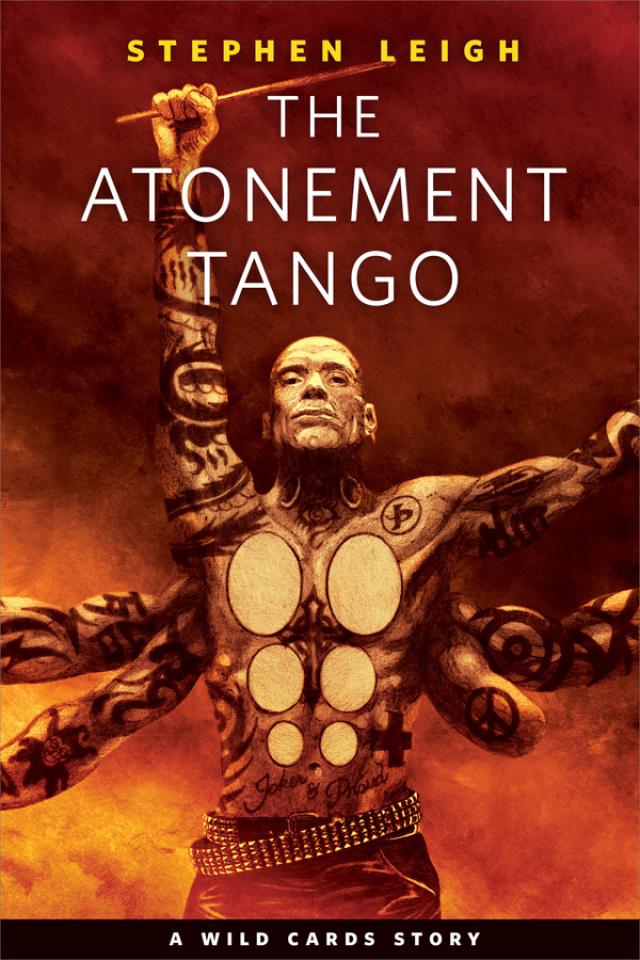


Michael grunted. With his lower right hand, he tapped the bass membrane and flexed the throat opening on that side. A low, resonant doom answered, reverberating in the room. “Ouch,” Michael said, grimacing. “That fucking hurts.”
“Good,” Finn told him. “That’ll keep you from using them too much. Sounded decent, though.”
“I guess,” Michael said. “Hurt like a sonofabitch, though.” Michael rubbed carefully around the ridged outline of the membrane, sliding a finger over the knobby ridge of healing skin. The remnants of his missing left arm flexed, as if it wanted to strike the drumhead closest to it, though it was far too short for that.
“All right,” Finn said. “Let me get Troll to fit you in the walking cast and splint. And I’ll see you again in a week.”
“Whatever you say, doc.”
Finn walked out of the examining room, his tail sweeping around as he turned. Michael’s phone buzzed; he fished it from his pants pocket and looked at the screen, staring at the name there for several seconds before he stabbed the Accept Call button with a forefinger. “Babel?”
“No, this is Juliet,” a woman’s voice answered. “Ink. I’m Barbara’s assistant now.”
“Hey, Ink,” Michael said. “Good to hear your voice again. What’s up? Let me talk to Babel.”
There was a dry laugh from the other side of the receiver. “Mizz Baden asked me to call for you,” she said “She said Rusty told her that the two of you are playing detective.”
“Rusty’s the one who wants to play detective, not me,” Michael answered. “I just want to make sure the bastard’s dead, that we know who it is, and that if he had help, we get those assholes too. So I take that the Committee’s been involved in the investigation?”
“It landed on Mizz Baden’s desk, briefly. She and Jayewardene decided it wasn’t in the Committee’s purview.”
“What?” Michael’s voice rose. “Why’d the Committee pass on the bombing?”
Michael could hear Ink take another breath, as if she were deciding how much to say. “It’s a matter of priorities and importance, DB. Mizz Baden said you wouldn’t understand that. She’s sorry about what happened with your band. But you’ve no idea of what we’ve…”
“Are you telling me that the bombing in Jokertown isn’t important enough, Ink? Is that what you’re saying? People died. People I’ve known for decades.” Michael wondered at his own careful choice of words: “people,” not “friends.”
There was a sigh from the other end of the line. “You don’t understand, DB. You can’t. I’ve given you all I was told. Mizz Baden thought that since Rusty asked, you deserved that much, but I don’t have any more information than that. Sorry. I hope your recovery’s going well. I’ll tell her I talked to you.”
“No, no. Hang on, Ink. Give me some help here. Jesus…”
“DB, the bombing was a local issue,” Ink said, “not an international one.”
Michael couldn’t quite decipher what he was hearing in that statement, what Ink was saying or not saying. “OK … So the person responsible’s here in the States? I already figured that out.”
Another pause. “Mizz Baden … she believes the bomber was even more local than that. That’s really all I can tell you.”
“Are you saying the guy’s here in New York?”
There was nothing but silence on the other side of the line. Then: “Mizz Baden wanted me to call you because Rusty asked and she cares very much for him and all he’s done. He’s a good person, a kind one. I did, though, as Mizz Baden’s assistant, see the files on the bombing. Let me ask you a hypothetical question, DB. What if the person who did this isn’t so different from you? How many people have we hurt in the pursuit of what we think’s right? For that matter, what is ‘right’? Who has the most reason to hate jokers, DB? Who?”
“Riddles and questions? That’s all you got for me? Damn it, Ink…”
“I’ve told you all I can,” she answered. “Mizz Baden said to tell you she wishes you luck. Now, I have other work I need to do. Goodbye, DB.” And with that, Ink was gone.
“Yeah? Well, fuck you too!” Michael shouted into the dead phone, startling Troll, the nurse, who was walking into the examination room with an assortment of equipment in his arms. The giant’s eyes widened.
“Not you, Troll,” Michael said. “Just the world in general.”
* * *
The scene at the Jerusha Carter Childhood Development Institute was chaotic. Once past the courtyard with its huge, spreading baobab tree, looking like someone had planted a tree upside down, Michael entered a large, open room. The armless, legless trunk of an infant floated past Michael’s face as he opened the door, the eyes in a mouthless head large and plaintive, with dark pupils that moved to track on Michael’s own gaze as it floated silently past him; the slits that served as nostrils flexed, as if the child were sniffing him. There were joker children seemingly everywhere in the single large room, of all conceivable twisted and distorted shapes, with an army of attendants, mostly jokers themselves, moving among them.
One was a young boy who looked perfectly normal except that he seemed to have the hiccups; with each spasm, he exhaled a blast of flame. An attendant stood alongside him with an asbestos blanket and a fire extinguisher, but otherwise didn’t touch the boy.
A slug-like body with a human head tracked a slimy path over the tiles, pulling itself along with rail-thin arms. One young girl’s body was covered in putrescent boils, the smell coming from her like that of days-dead animal. A boy who looked to be about five started to cry, then suddenly dissolved into a puddle of brown sludge, his clothing lying on top of the pile; one of the attendants came over with a bucket, a snow shovel, and broom and began scooping up the mess. “Sorry,” she said. “He does that when he gets upset…”
“Hey, fella!” Rusty’s boisterous voice called out, and a metallic hand clapped him hard on his upper shoulders. Michael staggered forward under the blow. “Sorry—didn’t mean to hit yah so hard. But look, you’re outa your cast and into a boot, and your arms, too … That’s great. Betcha feel a lot better.”
“Yeah, I do,” Michael told him. “I thought I’d let you know that Ink, Babel’s assistant, called me, so thanks for reaching out to her.”
Rusty grinned, his steam-shovel jaw opening. “So did she have anything good to tell us?”
Michael heard the “us” and ignored it; he wasn’t going to encourage Rusty to keep playing detective. “Not really. The Committee passed on the investigation. Otherwise, she just talked in circles without saying much.” Michael shook his head. “Thanks for trying, anyway. So this is where you spend all your time now instead of running around with the Committee? These are all orphans like Ghost?”
Rusty grunted. “You betcha. These are the kids nobody wants. Me and you—we both saw what happens to kids like this in Iraq, and I saw lots worse than that in Africa when me and Jerusha were there. Cripes, the same thing happens here, too—it’s just that no one ever wants to talk about it. There are parents can’t handle a kid once their card turns, or maybe they died too, or…” Rusty’s voice trailed off again as Ghost came running toward them. “Hey, Uncle DB,” she said. Her voice still had the lilt of Africa in it. “You came to visit?”
“Yeah,” Michael said, wrapping his good left arm and two right ones around her and lifting her up. The scars on his chest protested; he ignored that beyond a grimace. “I haven’t seen you in way too long. Look at you—you’re getting so big.”
“I’ll be bigger than you or Wally one day.”
“Maybe you will,” Michael told her, laughing. “But not if I squeeze you real tight.” He started to tighten his arms around her; Ghost simply went insubstantial and dropped away from him. She grinned up at him, and glided off toward the rear of the room. “She’s growing up fast,” he told Rusty. “Is she still…?”
“The episodes? Yeah, they come and go. Most of the time she’s just a little girl, but she still has problems being with the other kids, especially if she gets frustrated. And sometimes the dreams and memories get to her, and she’s the child soldier who wanted to kill me. But it’s getting better.”
Michael looked around the room, at all the joker kids. “Do any of them ever get adopted?”
“Not enough. We’ve had a few of ’em adopted, mostly by other jokers. Cripes, these kids are the really damaged ones, the ones that are the most difficult to handle, sometimes even dangerous. That poor kid over there…” Rusty pointed his chin to the boy who hiccuped flame. “That’s Moto; the kid’s already been bounced from four foster homes, and he’s nearly burnt down this place a few times besides. Who wants a child who can set his bed on fire because he has an upset tummy, or gets too excited or frightened?” Rusty shook his large head dolefully. “Hopefully he’ll eventually learn to control the response, but maybe he won’t. Some of these kids will just … well, age out of the Institute at eighteen. Or die before then. The virus ain’t kind to most of ’em. Not like it was to us. But I’ll tell you what; we really appreciate the money you’ve sent us every year. That means a lot.”
“It’s the least I can do,” Michael answered. And that’s true. All I’ve done is the very least, and that’s all I’ve done for a long time …
Then change that, he thought, but it was a resolution he’d had a few thousand times before, and one he’d never kept. Change that.
Michael noticed that Rusty was looking down at the floor. The legless slug-child had dragged himself over to Rusty; he was crying, and Rusty crouched down to pat him, ribbons of slime clinging to Rusty’s fingers and pulling away from the kid as he did so. “Y’know, fella, some of these kids hate themselves, hate what they’ve been turned into. They can’t stand the pain or the abuse they’ve received. What kind of way is that for anyone to live? How do they get through it? That’s what I worry about with them all. I wish there was more I could do, but…”
Rusty was still talking, but Michael had stopped listening.
Some of the kids hate themselves … Who has the most reason to hate jokers, DB…? All jokers will inevitably be purified in the cleansing fires of hell, and I will purify myself with them …
The words Rusty had just spoken, the question Ink had asked him, the bomber’s manifesto …
As he left the Institute later, Michael pulled his smartphone from his pants pocket and hit a button. The call went nearly immediately to voice mail. “Hey, Grady,” he said after the beep. “It’s DB. Look, I know you’ve always kept this shit away from us, but could you send me any nasty mail—either e-mail or snail mail—that came in for me just prior to the Roosevelt Park show? Maybe up to three days beforehand? Send it to me, would you?—envelopes and all if it was snail mail, and with the full headers if they’re e-mail. I appreciate it. I’ll touch base with you later, man.”
* * *
Grady ended up sending a couple dozen pieces to Michael: mostly e-mails and a few actual letters.
Michael read and re-read the missives over the next day, pondering what to do with them. It was a depressing read. As manager, Grady had always passed along to the band the complimentary fan mail they received; he held back “the crazy stuff.” The vitriol, the anger, the insanity that Michael glimpsed in the missives was saddening. Some of it was simply former fans ranting that the band’s new music sucked, that they’d lost their edge—those were the least offensive. However, even with the nastier notes, most didn’t use the language that had been in the bomber’s manifesto. The tone might be ugly and mean, but there were no threats against life.
Except for four: three e-mails and one letter.
Those four were far more visceral and ugly: written by people who claimed to hate them for the jokers they were and the people they represented, who believed (as the bomber evidently had) that they were somehow cursed by God, that they were abominations or sinners being punished or symbols of humankind’s downfall, that they should all be purged and eliminated: “smears of ugly shit that need to be wiped off the ass of the Earth forever,“ as one of the writers put it.
Michael had experienced, viscerally at times, the hatred and bigotry toward jokers elsewhere in the world, but had been rather more insulated from it in the countries where Joker Plague had been popular. This was a blatant reminder that here, too, there were many people who shared the bomber’s view of those who’d been altered by the wild card virus, who believed that those infected had somehow made a choice about how the virus had affected them, and that the deformities given them were a reflection of inward flaws or sins.
For those people, jokerhood was a divine punishment. For them, that punishment alone didn’t seem to be enough. Michael forced himself to read the words, but they burned inside him.
You deserve to die. God has placed the irrevocable sign of your sins and your parents’ sins on your very body. I’ll force you to crawl on your belly with those arms or yours, like an wretched spider, then I’ll rip off each one of your spider arms, slowly, and listen to you screaming and begging for me to stop. I take your drumsticks and ram then like stakes into those drums on your chest. I’ll watch you writhe and bleed and curl up and die. Satan will come and take your soul to hell and eternal torment and I’ll laugh …
The unsigned letter had been posted from the Jokertown post office. Michael passed on the e-mails to the tech who maintained the Joker Plague website, asking him to see if he could figure out from the IP addresses in the header whether any of them came from New York City and especially from Jokertown: one did, and his tech had tracked down the street address.
Michael decided it was time to ditch his Fort Freak shadows. That was easy enough to accomplish; Beastie and Sal, as well as the other teams assigned to the task, habitually stationed themselves near the front entrance to Michael’s apartment building. There was a dock entrance to the rear of the building which led out onto another street. It was simple enough to call for an Uber cab to meet him there. He gave the somewhat startled Uber driver the address and sat back in the seat, wondering what he was going to say if someone was there. He tapped one of his healing drums gently, the slow and painful beat stoking the anger.
The address was an apartment building just off Chatham Square; Michael watched the garish, unlit neon sign of a naked, four-breasted joker slide by: the facade of Freakers nightclub, now long past its prime (if it had ever had one). The entire neighborhood had seen better days; the Uber driver, a nat, was distinctly uncomfortable with Michael’s request to wait for him, but a fifty-dollar bill elicited a promise that he’d stay for fifteen minutes. Michael got out and walked up the cracked concrete steps to the front door; it opened when he turned the knob—not locked. The address the tech had discovered gave the apartment number as 2B; Michael took the stairs up and found the door of 2B at the rear of the building.
He stood outside for a moment, taking a long breath. The hallway smelled like a stale diaper, and the walls appeared to have been last painted back in Jetboy’s day. Michael knocked on the door, holding the thumb of another hand over the glass peephole.
“Who is it?” a thin, high voice called from inside.
“Drummer Boy,” Michael answered.
“Yeah, sure,” the muffled voice answered, “and I’m Curveball.” The door cracked open, and Michael was staring at a hairless face that appeared to have been molded from wet beach sand by clumsy fingers. Pebbly eyes widened in the gritty face, and small crystalline specks drifted down like tan, sparkling dandruff.
“Oh, fuck,” the joker said. The door started to close, and Michael pushed it open again with three hands. The door crashed hard against its hinges, and Michael entered the apartment to see the sandy, naked, and evidently male figure starting to run toward a back room. Michael lunged forward, stiff-legged in the walking cast, and grabbed at the joker’s arm with his good left one. His fingers closed around the joker’s arm.
The arm crumbled and broke like a dry sandcastle where Michael had clutched at it. Sand crystals drizzled through Michael’s fingers; the hand and forearm hit the wooden floor and shattered. “Shit!” Michael shouted as the joker clutched at the remnants of the arm. A thin liquid—not blood, but clear—dripped sluggishly from where the arm had broken off. Behind him, Michael could see another room illuminated by the glow of a computer monitor. He also noticed that the floor everywhere in the apartment was gritty with sand crystals, drifted into piles in the corners.
“Fuck!” the joker screamed. “Look what you’ve done. It’ll take me a week to grow that back. You asshole sonofabitch! Damn, that hurt!”
“I just wanted to talk to you…” Michael began, but then the anger surged again, and with it a sense of despair. Not dead. The bomber said he was going to blow himself up. The concussion of a blast would destroy this guy. Michael pulled out the folded paper on which he’d printed out the e-mail and shoved it close to the joker’s face. “Did you write this?”
The joker glanced at the paper. “Yeah. So what? All I did was tell you what half of your old fans are thinking. You’re a washed-up hack and your new music sucks. Deal with it.” He spoke without bravado or heat, his high-pitched voice sounding more apologetic than angry.
“Did you set the bomb at Roosevelt Park?”
“What?” The joker’s voice was a piercing shriek. “You think I did that? I … God, are you insane?”