

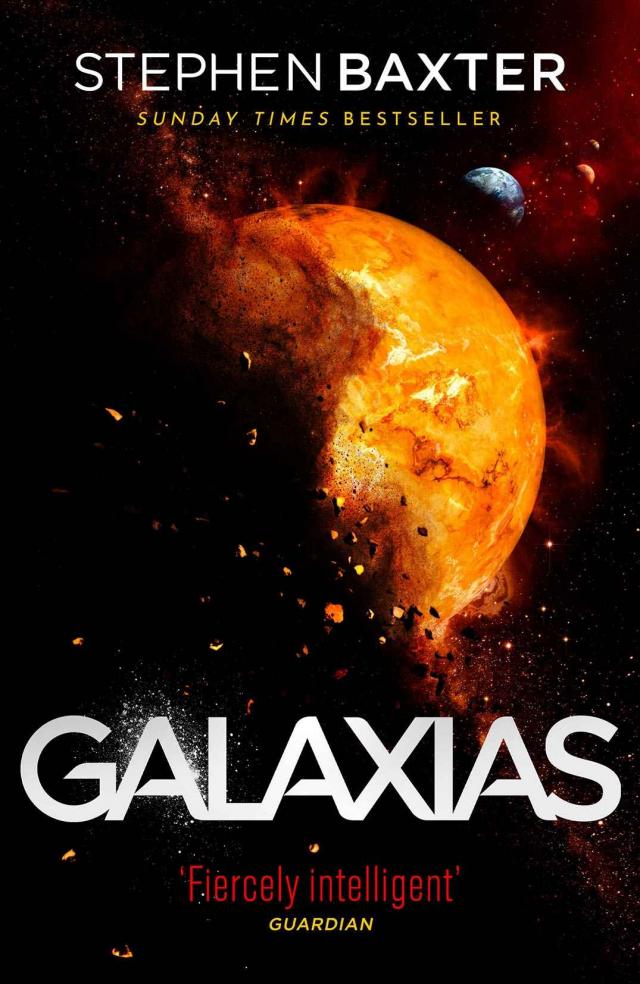
Galaxias, page 46


Mark Wolverton’s The Depths of Space (Joseph Henry Press, 2004) is a useful reference on NASA’s Pioneer missions. A study on the feasibility of airships using vacuum-lift balloons was recently published by Benjamin E. Jenett et al. (‘Discrete Lattice Material Vacuum Airship’, AIAA 2019-0815, published online on 6 January 2019). My depiction of a Skylon spaceplane was informed by a visit to Reaction Engines Ltd at Culham, Oxfordshire, UK, in February 2020, where a team led by Alan Bond made a party of science fiction authors very welcome.
The Lodestone was inspired by an Earth-umbra station design by Stephen D. Gunn, FBIS (to be published). The concept of a ‘statite’ was patented in 1993 by Robert L. Forward (US Patent 5,183,225). The magsail details are derived from papers by one of the concept’s originators, Robert Zubrin (‘The Magnetic Sail: Final Report to the NASA Institute of Advanced Concepts (NIAC)’, 7 January 2000). The concept of a magnetic radiation shield has been explored in another academic study (‘Modular Space Vehicle Architecture for Human Exploration of Mars using Artificial Gravity and Mini-Magnetosphere Crew Radiation Shield’, Mark G. Benton, Sr et al., AIAA 2012-0633, 2012).
The use of self-replicating technology on the Moon has been studied at least as far back as 1981 (R. Freitas et al., ‘A Self-replicating, Growing Lunar Factory’, in Proceedings of the Fifth Princeton/AIAA Conference May 18–21, 1981, edited by J. Grey and L. Hamdan, American Institute of Aeronautics and Astronautics). There are many more recent references. Dark energy was considered as a candidate basis for exotic propulsion in NASA’s Breakthrough Propulsion Physics Project from 1996 onwards (see M. Millis et al., Frontiers of Propulsion Physics, AIAA, 2009, p. 20). The Jones drive depicted here is my own irresponsible speculation, written up as ‘The Wormship: A Dark Energy Ramjet’, Journal of the British Interplanetary Society, vol. 74, pp. 56–63, 2021. A useful introduction to negative matter, with further references, was given in Indistinguishable from Magic (Baen Books, 1995) by Robert L. Forward, who originated the idea of negative matter propulsion.
The idea of using the Sun’s own solar wind as a rocket was proposed by Martyn J. Fogg (‘Solar exchange as a means of ensuring the long-term habitability of the Earth’, Speculations in Science and Technology, vol. 12, pp. 153–7, 1989). This in turn was based on an earlier proposal to modify stars by removing some mass to extend their longevity (by D. R. Criswell in Interstellar Migration and the Human Experience, Ben Finney and Eric Jones, eds, University of California Press, 1985). Of more recent designs of ‘stellar engine’, M. E. Caplan (Acta Astronautica, vol. 165, pp. 96–104, 2019) would use an enhanced solar wind to fuel a fusion rocket that would in turn push the Sun.
Of the exoplanets, 55 Cancri f is an authentic observation, though the presence of an oceanic moon is speculative. My depictions of the (fully revealed) planetary systems of Altair and Barnard’s Star are largely fictitious. No exoplanets have been found at Altair at time of writing. Barnard’s Star has one known exoplanet (Barnard’s b). For speculation that Barnard’s b could be a habitable water world, see ‘Barnard’s Star Planet May Not Be Too Cold for Life after All’, posted on Space.com by N. Redd on 10 January 2019. The Jovians depicted here reflect earlier apparent discoveries, later discredited (Piet van de Kamp, Astronomical Journal, vol. 74, pp. 757–9, 1969, and see The Lost Planets by John Wenz, MIT Press, 2019).
Regarding theories of extraterrestrial life, useful summaries of the nature of water worlds, among other planetary types, are given by James Trefil and Michael Summers in Imagined Life (Smithsonian Books, 2019). The (hypothetical) planetary oceanic brain of Galaxias is my own speculation.
A useful recent survey of SETI, the Search for Extraterrestrial Intelligence, is M. Cirkovic’s The Great Silence (Oxford University Press, 2018). The idea of universal (i.e. beyond human) systems of ethics has been explored by Clement Vidal (The Beginning and the End, Springer, 2016).
The idea of using ‘lurkers’ – patient, long-lived space probes – to search for life and intelligence in space was first suggested by Ronald Bracewell in 1960 (‘Communications from Superior Galactic Communities’, Nature, vol. 186, pp. 670–1). A more recent paper on searching for such probes was by J. Gertz, ‘ET Probes: Looking Here as Well as There’, Journal of the British Interplanetary Society, vol. 69, pp. 88–91, 2016. On the search for probes on the Moon, see A. V. Arkhipov and F. G. Graham, ‘Lunar SETI: A Justification’, SPIE, vol. 2704, pp. 150–4, 1996. The idea of an ET nodal system of communications was described by J. Gertz, ‘Nodes: A Proposed Solution to Fermi’s Paradox’, Journal of the British Interplanetary Society, vol. 70, pp. 454–7, 2017.
The Kardashev scale, a classification of hypothetical alien civilisations based on their energy usage, was first published in 1964 (N. S. Kardashev, ‘Transmission of Information by Extraterrestrial Civilisations’, Soviet Astronomy-AJ, vol. 8, p. 17, 1964). Soviet astronomer Nikolai Kardashev died in 2019, aged 87. Concerning the lack of visible K-III cultures in other galaxies, see M. Garrett, ‘The Application of the mid-IR radio correlation to the G-Hat sample and the search for advanced extraterrestrial civilisations’, Astronomy and Astrophysics, vol. 581, id L5, 2015. The idea of galactic colonisation by a slow ‘diffusion’ was suggested by W. Newman and C. Sagan in 1985 (‘Nonlinear Diffusion and Population Dynamics’, in Ben Finney and Eric Jones, eds, Interstellar Migration and the Human Experience, University of California Press), and more recently revisited by J. Haqq-Misra and S. D. Baum in 2009 (‘The Sustainability Solution to the Fermi Paradox’, Journal of the British Interplanetary Society, vol. 62, pp. 47–51, 2009). The problem of the ‘lightspeed cage’ limit to fast interstellar expansion was first set out by S. von Hoerner in 1975 (‘Population Explosion and Interstellar Expansion’, Journal of the British Interplanetary Society, vol. 28, pp. 691–712).
A study of star cluster M-12 is ‘How to Steal a Million Stars’, ESO press release, http://www.eso.org/outreach/press-rel/pr-2006/pr-04-06.html. A recent study of the habitability of globular clusters was reported in Nature news, 6 January 2016 (‘Alien life could thrive in ancient star clusters’ by Alexandra Witze, doi:10.1038/nature.2016.19124).
An annular solar eclipse has been put forward as a tentative explanation for the Sun ‘standing still’ in the sky over Canaan, as reported in the Old Testament Book of Joshua (10: 12–13), by Colin Humphreys and W. Graeme Waddington (Astronomy and Geophysics, vol. 58, pp. 5.39–5.42, 2017).
All errors and misapprehensions are of course my sole responsibility.
Stephen Baxter
Northumberland
July 2021
Credits
Stephen Baxter and Gollancz would like to thank everyone at Orion and beyond who worked on the publication of Galaxias in the UK.
Editorial
Marcus Gipps
Brendan Durkin
Copy editor
Elizabeth Dobson
Proof reader
Jane Howard
Audio
Paul Stark
Contracts
Anne Goddard
Paul Bulos
Jake Alderson
Design
Joanna Ridley
Nick May
Editorial Management
Charlie Panayiotou
Jane Hughes
Finance
Jennifer Muchan
Jasdip Nandra
Afeera Ahmed
Elizabeth Beaumont
Sue Baker
Marketing
Tanjiah Islam
Production
Paul Hussey
Publicity
Will O’Mullane
Operations
Jo Jacobs
Sharon Willis
Lisa Pryde
Sales
Jen Wilson
Esther Waters
Victoria Laws
Rachael Hum
Anna Egelstaff
Frances Doyle
Georgina Cutler
Also By Stephen Baxter from Gollancz:
NON-FICTION
Deep Future
The Science of Avatar
FICTION
Mammoth
Longtusk
Icebones
Behemoth
Reality Dust
Evolution
Flood
Ark
Proxima
Ultima
Obelisk
Xeelee: An Omnibus
Xeelee: Endurance
Xeelee: Vengeance
Xeelee: Redemption
NORTHLAND
Stone Spring
Bronze Summer
Iron Winter
THE WEB
Gulliverzone
Webcrash
DESTINY’S CHILDREN
Coalescent
Exultant
Transcendent
Resplendent
A TIME ODYSSEY (with Arthur C. Clarke)
Time’s Eye
Sunstorm
Firstborn
TIME’S TAPESTRY
Emperor
Conqueror
Navigator
Weaver
WORLD ENGINES
Destroyer
Creator
Galaxias
The Medusa Chronicles
(with Alastair Reynolds)
The Massacre of Mankind
Copyright
First published in Great Britain in 2021 by Gollancz
an imprint of The Orion Publishing Group Ltd
Carmelite House, 50 Victoria Embankment
London EC4Y 0DZ
An Hachette UK Company
Copyright © Stephen Baxter 2021
The moral right of Stephen Baxter to be identified as the author of this work has been asserted in accordance with the Copyright, Designs and Patents Act of 1988.
All rights reserved. No part of this publication may be reproduced, stored in a retrieval system, or transmitted in any form or by any means, electronic, mechanical, photocopying, recording, or otherwise, without the prior permission of both the copyright owner and the above publisher of this book.
All the characters in this book are fictitious, and any resemblance to actual persons, living or dead, is purely coincidental.
A CIP catalogue record for this book is available from the British Library.
ISBN (eBook) 978 1 473 22888 7
Typeset by Input Data Services Ltd, Somerset
www.gollancz.co.uk
Stephen Baxter, Galaxias


