Britannia, page 14
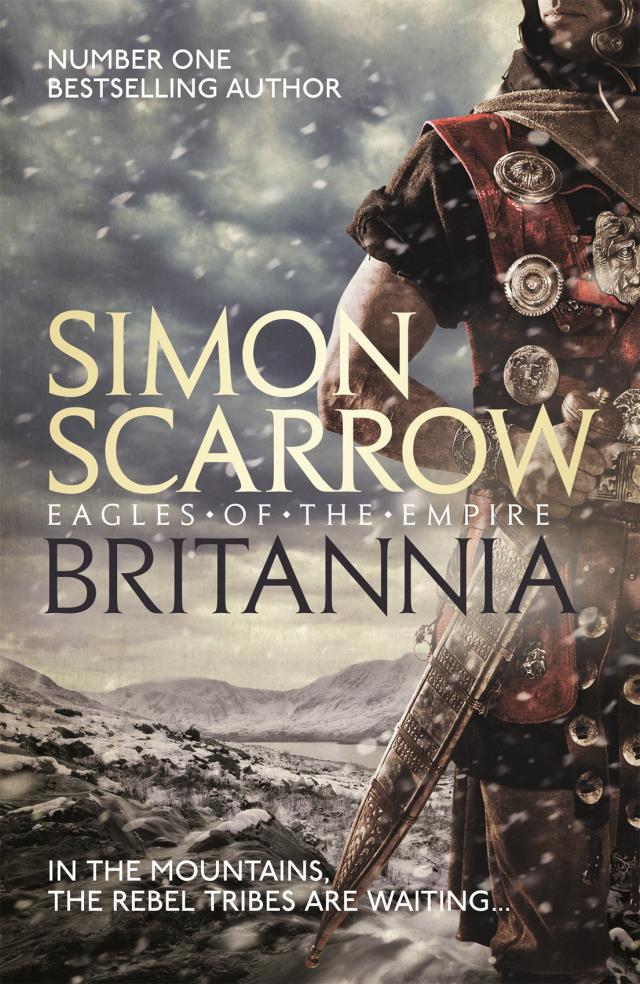


The man facing Cato lowered himself into a crouch, watching intently as he waited for his opponent to make a move. The prefect smiled grimly, recognising that the initiative had passed to him, then stepped forward quickly, leading with his left boot and pushing his shield forward, forcing his enemy to strike out with his sword in order to stand his ground. Cato let his shield absorb the blow before he struck back. Up came the blade, knocking the short sword aside. As the man’s arm swung out after the sword, Cato rushed forward into his body. At the last moment, he lowered the brim of his helmet and savagely butted the reinforced brow guard into the warrior’s face. The blow was hard and jarred Cato’s neck, but the unexpected attack did its job and the man staggered back, dazed. Too dazed to save himself as Cato stabbed his sword up into the tribesman’s throat and ripped it free in a welter of blood. The warrior dropped his sword and clasped his hand to his throat as he slumped to his knees, gurgling horribly.
Cato swept past him and looked for another foe. About him the men of both sides were mostly locked in one-to-one duels. Here and there the odds were less even, and some took advantage of the chaos to strike at the enemy’s back when they caught a man facing the other way. There was none of the etiquette of the arena: just kill or be killed. Cato caught the gaze of a tall, darkly featured warrior whose hair had been tied back by a leather thong. He carried a long-handled axe in both hands and swung it in an arc as he glared at Cato. His muscled arms strained as the axe flew faster and faster, then he launched himself at the prefect with a loud shout ripping from his lungs.
Cato had seen how much damage such an axe could do, and crouched as he threw his shield up to block the blow. An instant later the top of the shield exploded in a welter of splinters, shattered bronze trim and strips of leather. The impact tore at his grip, but his fist was tightly clenched and he held on. Then the axe head whirled away, and he seized his chance, thrusting his sword into his opponent’s thigh, then hacking down at the soft leather and straps of his boot, shattering the bones there. The warrior let out a cry of agony and rage as he staggered backwards. His weapon had lost its momentum and he could only swing it weakly this time, so that Cato’s shield easily absorbed the blow. He punched forward, driving the man on to his wounded foot. There was a gasp and a pained groan, and the warrior fell on to his back, the axe slipping from his fingers and clattering to the rocks.
Cato kept his damaged shield and sword up as he glanced round. The Blood Crows were more than holding their own: only three men were down, as against several more of the enemy. Beyond, on the crags on the far side of the gorge, he could see the other group of warriors starting to hurl their first rocks down on the leading testudo. He hissed a curse. Where the hell were Harpex and his men?
He spotted an older, thickset man in a helmet shouting orders and encouragement to his comrades. The enemy leader pushed his way to the front and raised his sword to strike at the auxiliary in front of him. The soldier instinctively raised his shield, and the tribesman grinned ferociously as he grasped the rim with his spare hand and wrenched it aside before striking down with his sword. The heavy blade shattered the Thracian’s bronze helmet and smashed through his skull right down to his jaw. The tribesman wrenched the blade free, then kicked the body away, roaring a triumphant battle cry and shaking his bloodied sword high where his followers could see it.
Swallowing his fear, Cato stepped forward and spoke calmly and loudly enough for his men to hear. ‘You are nothing but a fat pile of shit, old man, and I am going to cut you down. I am Prefect Marcus Licinius Cato, of the Blood Crows.’ He repeated the name of the cohort again in the fragments of the Silurian dialect he had picked up from the native traders who had come to the fort. He felt a flicker of satisfaction as he saw the man’s eyes widen briefly at the name of the unit whose bloody raids deep into enemy territory had earned them a fearsome reputation amongst the mountain tribes to the south.
It took a moment for the tribesman to recover his poise, and he snarled back at Cato, the contempt behind his words clear to the Roman soldiers. His comrades cheered him even as some of them continued exchanging blows with the Thracians. By unspoken consent, a space opened out around the two leaders, and they warily approached to within striking distance and weighed each other up. Cato saw that his foe was past the prime of life but that there was plenty of muscle there, along with the evidence of good living. Blue tattooed patterns swirled down each bare arm, and stretches of white scar tissue spoke of the many battles he had fought.
Cato advanced his shield, looking over the splintered ruin at the top, and raised his sword to chin height, aiming the point directly at the man’s face. It was as much a gesture of defiance as a threat, and the veteran warrior’s lip curled in disdain as he raised his longsword and gave the shield a hard poke. At once Cato pressed forward, battering at the sword with his shield and trying to get inside the man’s reach to stab him with his shorter weapon. But the tribesman was more agile than he appeared and kept his distance, even opening it enough after three paces to turn the attack back on Cato, hacking viciously at the splintered top of the shield so that Cato had little chance to strike back as he struggled to block the attacks. Each blow carved a fresh chunk out of the oval shield, and opened a split that weakened it further. At the same time, the prefect concentrated on working his opponent round so that his back was towards the cliff and he would have nowhere to retreat when Cato made his next rush forward.
The warrior paused to breathe, his chest heaving with exertion as he kept his eyes fixed on Cato and his sword moving slowly from side to side. A sudden break in the clouds bathed the valley in bright sunshine, and the man blinked at the glare. Cato rushed forward, this time alternating between shield and sword as he smashed aside each attempt to block his attacks. His opponent’s concentration was so fixed on fending off the blows that he did not realise until the last moment that he had been driven back to the edge of the crags. One of his men shouted a warning and the leader snatched a backward glance, then Cato struck, thrusting forward behind his shield, driving it into the warrior’s body and knocking him off balance. As his heel slipped over the edge, the tribesman dropped his sword, snatched at the sides of Cato’s shield and pulled with all his might. Cato, caught off guard, felt himself lurch forward, but released his hold on the shield’s handle and pushed himself back just in time. The shield fell away and the man toppled back with a desperate cry that was snatched away as he bounced off a protruding rock and cartwheeled to the foot of the cliff in silence, like a child’s corn doll.
His followers froze in shock. Before they could recover their resolve, Cato called out to his men. ‘Disengage! Now!’
The Blood Crows drew back cautiously, and Cato turned to the enemy and addressed them with authority. ‘Drop your weapons! Do it!’ He pointed to his own sword and stabbed a finger at the ground. ‘Now.’
There were at least ten still standing, and at first none of them moved, although Cato could see that they were unsure and afraid. He sheathed his blade and approached the nearest of them, a youth holding a wavering spear in both hands. He slowly walked round the point and took the shaft away from the boy.
‘Sit.’
The native nodded and dropped to the ground swiftly. There was a brief pause before the others did the same, setting their weapons down in front of them. Cato turned to Corvinus. ‘Leave five of your men to gather up their weapons and throw them over the cliff before they stand guard on the prisoners. If there’s any trouble, they’re to send ’em the same way as their leader.’
‘Yes, sir.’
Leaving Corvinus to assign the guards, Cato led the others across to the edge of the cliff overlooking the gorge. As they picked their way over the uneven surface, a cry of alarm sounded from the crags opposite, and Cato saw that Harpex and his men had reached the top and were fanning out to form a skirmish line to take on the other party of enemy warriors. There was nothing he could do to help, so he made his way to the edge, where small piles of unused rocks remained. He peered over and saw that the first testudo was breaking up as it reached the barricade, the men starting to climb it to get at the defenders. Several more legionaries had been struck down before Cato’s intervention had stopped the bombardment of his men. The second testudo was passing just beneath him, as yet unaware that the crags had been seized by the Blood Crows.
Cato had a clear view of the defenders behind the barricade and saw that there were more of them than he had thought: as many as four hundred warriors, closed up and ready to defend the gorge. In amongst them he picked out some figures in dark robes and cloaks, waving their arms, shouting encouragement at their men and hurling curses at the Romans. Druids, he realised. The enemy would be sure to put up a good fight and hold the line for a while yet.
Then he smiled to himself and turned quickly to the men who had followed him to the cliff’s edge. ‘Sheathe your swords and down shields!’ Once they had done as he had ordered, he pointed to the rocks. ‘Let’s pay those bastards back in kind. Help yourselves, lads.’
He picked up a rock half the size of a melon and carried it along the crag until he was past the barricade, then heaved it over the edge. He watched it tumble through the air, shrinking to a dot, then saw it glance off a shield and strike the ground. He growled with frustration and turned back to fetch another rock as the Thracians began to throw their missiles down on the enemy, letting out shouts of glee or disappointment as they struck down the natives or missed. Cato’s next rock was aimed, as best he could, at the place where the enemy ranks were most tightly packed, and this time he was rewarded with a strike squarely on the top of a warrior’s head. The man went down as though he had been hammered into the ground. Some of those around him looked up, their faces white specks surrounded by dark hair. As soon as they saw the auxiliaries far above, they began to point and shout warnings to their comrades. More were crushed under falling rocks, and soon the tribesmen were swirling around as they tried to dodge the bombardment, their attention drawn away from the struggle along the barricade.
Cato saw one of the Druids rush forward, thrusting his fighters towards the attacking legionaries. He had rallied several of the men before he too was struck down, his skull crushed and his body laid out, arms and legs splayed below the bloody ruin that had been his head. The sight of the dead Druid badly unnerved the tribesmen, who began to break ranks and retreat down the gorge to the open ground beyond, where they would be safe from the falling rocks. The panic was infectious, and soon only a handful of defenders remained, desperately fighting an uneven battle along the length of the barricade. Outnumbered and outfought by soldiers who had been trained and equipped to fight as effectively as any man in the known world, the tribesmen began to give ground, forced away from the barricade as the first of the Romans climbed over and pressed forward.
Turning to his men, Cato called out, ‘That’s enough, lads! Put those rocks down before you do any mischief to the legionaries.’
Having been delighted at the chance to turn the tables on their enemy, the Thracians reluctantly set the rocks aside and watched as the men of the First Century created a gap in the barricade wide enough for men to stream through and join the fight. The result was no longer in doubt, and a short time later, a native horn blasted three times. At once the remaining fighters broke away from the legionaries and ran back to join their comrades beyond the gorge. One of the surviving Druids pointed towards the side of the valley, and the Deceanglians began to stream up the slope. Seeing their retreat, Cato hurried back to the crags overlooking the Roman column and cupped his hands to his mouth.
‘Miro! Decurion Miro!’
The men of the rearguard looked up towards him, and a cheer rose from their throats at the sight of the prefect who had taken the enemy’s position. Cato spotted the legate and his staff, and then picked out Miro close to the leading squadron of Thracian horsemen.
‘Miro! Mount the men and start the pursuit! Ride ’em down before they can get away.’
If the decurion acknowledged the order, Cato never heard him, but a moment later he was relieved to see Miro vault into his saddle and lead the Blood Crows into the gorge at a trot. They passed through the barricade and fanned out on the far side, their longer cavalry swords drawn, ready to cut down any of the enemy they encountered. Those who had been injured and were slowly making their way to safety were the first to be dispatched without mercy. The rest had started up the slope, and now Cato could readily understand why their leaders had picked such difficult ground over which to make their escape. The inclination of the valley side and the runs of scree made it impossible for mounted men to follow them, and he realised that there would be no effective pursuit of the fleeing tribesmen. It was bitterly frustrating, but he reminded himself that at least the path before the advancing army had been cleared and the column could continue on its way. Or at least it might have done had it been earlier in the day. Looking up at the low angle of the sun, Cato saw that it was a scant few hours before dusk. Quintatus would have to give the order to halt the army soon to allow the men time to construct their marching camp.
The enemy had achieved their goal, Cato mused as he watched them make their escape. It had been a classic delaying action. They had held up the Roman advance for half a day and inflicted a number of casualties. More importantly, they had bought themselves time for whatever plans they had to counter the advance. He felt an icy tingle in the back of his neck at the possibility that the Druids and their Deceanglian allies were plotting something and Quintatus was unwittingly playing into their hands. Then he smiled bitterly at himself. Of course they would try to delay the Romans. This was their land, their home, and for the Druids, Mona was their most sacred soil. They would take every chance to keep the Romans from it. There would be more attempts to delay them long enough for the onset of winter to force Quintatus to withdraw from the mountains. It would be a hard-fought campaign, Cato knew. Contested every step of the way. This afternoon’s brutal action was only the first taste of what was to come.
The warmth of the late-afternoon sunlight was causing vapour to rise from the tunics of those around him so that they seemed to be smouldering. As they noticed it, the soldiers began laughing at each other, as men will gladly seize on anything light-spirited after a desperate action against the enemy. Despite his sombre mood, Cato indulged them. Once again the Blood Crows had proved themselves, and they deserved the brief moment of respite.
CHAPTER TWELVE
‘Hey, Optio!’ one of the men called out. ‘Since they’re handing out promotions to the rank and file, do you think you could put in a word for me? I’m sick of staring at your horse’s arse at the head of the line.’
The other men of the patrol laughed loudly, and Pandarus shifted in his saddle to look back down the narrow track.
‘Diomedes, if they ever promote you, then the rest of the rankers will be hard pressed to tell you from the back end of your horse. The army could not afford such confusion.’
The men laughed again, this time at their comrade’s expense, and after the briefest of delays, Diomedes joined in, anxious to be seen to take it as well as he dished it out.
It had been a month since Optio Pandarus had been elevated to his new rank, and yet he was still being ribbed by his comrades. And mightily wearing it was becoming too, he mused with a flick of the reins. He was leading the patrol along the forest track that angled up the side of the valley towards a prominent ridge. In the last few days the sky had been mostly clear. But the change in weather had been accompanied by a sharp drop in temperature, and the morning frosts had been bitter indeed. It was close to noon, yet the sun was still low in the sky and gave off little warmth.
The clouds and mists had dissipated, and Pandarus hoped to gain a clear view over the surrounding landscape from the top of the ridge. It would be good to have something of note to report back to the centurion when the patrol returned to the fort at the end of the day – rather than the usual run of fleeing shepherd boys and abandoned villages that had greeted their approach. Occasionally they had seen women and children disappearing into the forests, but there had been no sign of any men. And that was concerning Pandarus and the fort’s commander, since it implied only one thing: that the men had gone off to fight somewhere. Perhaps against rival tribes, or, more worrying, they might be gathering to cause grief to the nearest Roman outposts.
Still, he reflected, there had been no sign of any problems yet, and no attempt to make trouble for the garrison at the fort. Which was just as well given the poor state of the Illyrian auxiliaries sent to replace the Blood Crows and the cohort from the Fourteenth Legion. Although they had been drilled hard over recent days, they would only be able to mount a token resistance against a determined enemy attack. Pandarus wondered if they were typical of the reserve formations called forward to garrison the frontier forts stripped of good fighting men to fill out the ranks of the army advancing deep into the mountains. If that was the case, then the first line of defence of the new province was very delicate indeed.
Despite his lowly rank, Pandarus had a sound grasp of the perennial problem afflicting every Roman commander since the invasion of Britannia had begun. Namely that in order to claim new territory, or to meet a threat, it was necessary to concentrate all available forces, but to maintain control over territory it was necessary to disperse forces. Either way, the initiative passed to the enemy, who could harass the frontier defences and then retreat into the mountains at the first sign of a larger Roman force, only to emerge again and continue their harassment once the danger had passed. It was the kind of warfare that the Deceanglians and their allies excelled at, resulting in the long years of attrition as the frontier rippled forward and ebbed back. The tribes’ only weakness lay in the occasional desire of their leaders to quench their thirst for glory by meeting the Romans in battle. It had been the undoing of Caratacus, and in time it would be the same for those that succeeded him. At least that was what the Roman high command was depending on, thought Pandarus.