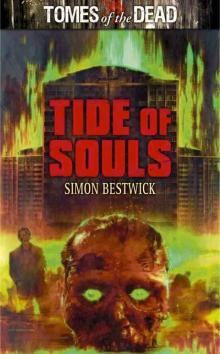
Tide of Souls, page 29


It's dark. They move forward.
It's like a TV set picking up a thousand different channels. And someone's got the remote control, flicking from channel to channel to channel to channel to channel to -
The gate gives way. Ged goes down. McTarn - poor bastard, red and black rising across his face as the infection spreads- falls. They don't touch him, because he's one of them now. And even as he realises it, his heart stops. I feel his death. Because I know him, perhaps, the cameras zoom in, to get it from every angle - his mind dying, swallowed up in rage and terror that's sucked into the Deep Brain to make it stronger - strength then funnelled into McTarn's corpse to make it rise and walk. He leaves his gun behind. He doesn't need it anymore.
Guns firing, little spots and flickers of distant light. Now and again, a camera goes blank as a bullet hits home. But still they advance.
Jo, Katja and Mleczko taking charge, getting the remaining defenders to round the survivors up. There's only one place to go now.
Can't see. Have to aim down, hoping I'm still on course. Swim and swim. Ignore the pain. Please let me be right. Please.
Hendry refusing to leave the Chinook, standing guard, firing his last bullets into the attackers before they pull him down. They swarm over the Chinook till it rocks and falls, rotors breaking on the ground.
The survivors back up the hillside, firing. The steps that lead up Pendle. So steep. The dead are climbing too. Slow. But relentless. The dead don't get tired or out of breath. And so they steadily gain.
Parkes holding position, firing down the steps, buying time for other survivors to get past. But the dead get closer, closer - and suddenly leap in one of their terrible flurries of motion. Parkes has no chance; she has time for a single scream before they pull her down. Nearly a dozen of them fall upon her. In their hunger, they tear her apart.
People fall behind, collapsing - but no-one can go back for them, can't slow down the group to save one. So the too-old, the too-young, the weak, the sick - they're left where they've fallen, begging for help - till dead hands seize them and dead jaws tear the flesh from their bones.
The lucky ones, if there's time, might get a bullet in the head, to spare them.
My hands plough into something soft. My body is alive with pain, one long wire of it. I open my eyes and I can see properly. My fingers are buried in silt, lying thick over grass that comes loose in my hands, drowned and dead, the earth it's rooted in turning to slurry.
The house is in front of me. I swim for it.
I know I won't last much longer.
There's a door, and it's open. I swim down a flooded hallway, past a living room where a seat-cushion, bleached and bloated from its long immersion, drifts past.
"Down here, Ben. I'm here."
It's from the end of the hallway. Here's a door, ajar. I swim to it and push it wide.
The windows are shattered; drifts of silt and debris are piled everywhere. Cooker and microwave, washing machine and dishwasher, over there in the corner.
Ellen Vannin sits at a table in the centre of the room, in her long black dress. Her black hair drifts wild in the current. Her head rises. Her face is a grey, howling mask like perished rubber, fretted and holed, blackened teeth bared by fish-eaten lips.
I stopped finning and settle, let my feet touch the floor.
Her eye sockets blaze.
Her mouth tries to form a smile. "You came."
Yes. In the end.
"Thank you." She rises from the table. "You're sure about this?"
Yes.
She steps towards me. "The girl? Katja? You love her?"
I loved you too. And I can again.
She holds out her arms to me.
I unfasten the aqualung and let it fall, slipping the mouthpiece from my lips. A long stream of silver bubbles flies upward. I kick off the flippers and step into her embrace, lower my living mouth to her dead mouth, and breathe in.
And on top of Pendle Hill, Katja, Mleczko, Jo, Hassan and twenty or thirty other men and women can see out over half of what was Lancashire, for all the good it does as the dead swarm up it from all sides. Katja checks her pistol. Six rounds remain. She raises the gun and fires, hitting a dead thing between the eyes, thinking, four shots left. She hasn't miscounted. The four shots are for the dead, but this time, she knows who the last one's for.
***
It's over quite quickly, without pain. I/we watch my body and the body I/we knew as Ellen Vannin topples and drifts to the floor.
Then I/we turn my gaze outwards, out through the eyes of the myriad dead.
The survivors have huddled into a knot around the trig point on the summit. The dead are all around them.
In me/us there boils so much rage. The rage and the terror of all the dead. But now there is more. Now the Deep Brain is... a whole mind. At last. I am... not Ben Stiles anymore. But I am... was... him. Enough to know it is time to stop.
And so I reach out and I halt the dead in their tracks.
On the summit of Pendle Hill, a stillness falls.
Katja Wencewska, two bullets in her gun and only one for the dead things, freezes, looking sidelong at Jo, Mleczko, the others. Guns are held ready; axes, clubs, makeshift spears. All used and blooded. A steel baseball bat, buckled out of shape.
The dead surround them, unmoving.
All save one. One figure, shouldering through the ranks. At a first glance, you might almost think he was still alive. If his eyes didn't glow.
The body of Robert McTarn approaches; Katja aims at his face, finger tightening on the trigger.
The dead don't need to breathe anymore, but it's necessary for speech. I work McTarn's lungs to force out the words. Would he appreciate me using his corpse like this? Is anything of McTarn left, apart from the traces and echoes absorbed into the Deep Brain? Even I can't answer that.
"Katja, it's me. It's Ben."
It's not really, not anymore, but I have to put it into terms that can be understood.
I tell her that it worked. That now I am the Deep Brain. And it is me.
That the dead are mine to command. That I will return them to the depths.
That the war is over.
But.
I warn her because I must. Because there are aeons worth of fury in the deep. I warn her because I cannot promise that I will remain in control forever. Because one day the rage might overwhelm me and the dead might walk again.
I will try to decommission my weapons. To let them die and decay. Most of them. But the Brain craves form, physicality, and I must give it that.
I tell her to be watchful, and to remember. I tell her to remember me.
And I cannot kiss her now, because the only lips I have the living would flinch from, but I kiss her in another way. Mind to mind.
Whispering, as I do: forgive me.
And then I turn the dead round and march them back, down the Hill. Back to the sea.
Until only the body of a man called Robert McTarn remains.
"I love you," I say through him, and then he too begins the long walk home.
And as he goes, I hear, above the keening of the wind and the wild laughter and rejoicing of those who have, at the last moment, been spared, the weeping of the woman I will always love.
EPILOGUE
Storm Warning - Ocean Rising
Ancient ocean, your waters are bitter.
Lautremont, Les Chants De Maldoror.
Katja
My name is Katja Mleczko. Today I am 43, making me the oldest person in the Pendle Islands.
When I was born, most people lived to at least 70. Even older. There were people more than 100 years old. Impossible to imagine that now, after the Flood and the Rising. Even to the ones alive before them, like me, it seems unreal, a dream. Our children, with little or no memory of the world as it was - for them, I think, it's easier.
This life ages us fast. My generation took it all for granted; spoilt. Now we're where our ancestors were two, maybe three hundred years before. If that. Our only medicines are the ones we make ourselves. There are folk remedies - a piece of mouldy bread on a wound makes a crude antibiotic, they used it for centuries before penicillin - but still, illnesses that would have been nothing when I was a child claim more lives each year.
I've had nine children. The first came eighteen months after the dead things went back into the sea. The last, eight years ago, almost killed me. After that, I took precautions, although I was widowed soon after. I have had no lovers since; I'm past that now.
I married Danny Mleczko. He took charge after the dead things went away, and I soon saw he was interested in me. He was still a boy, in most respects, but he was sweet, beneath his brashness. We became lovers; when I fell pregnant, we married. It wasn't much of a ceremony - there was no priest - but Hassan did his best. He was the next most senior soldier present, so he officiated.
The Chinook never flew again. Any other survivors we met we reached by boat, or they found us. The strangest were a small group from Manchester, who drifted to us on makeshift rafts. They were workers from the CIS tower, led by a bright young woman called Vicky. They'd survived on the roof of the building. Somehow she'd kept them going, fighting off the attacks, downing passing birds with lumps of stone. She set them 'targets' for the day (she was in sales.) When the dead things stopped attacking and the food got scarce, she made them build rafts from flotsam and jetsam. She was a natural planner and organiser; I remember her fiancé had survived, too, and no sooner had they got to Pendle than she started organising her wedding. I was one of the bridesmaids. Vicky's still alive. She's the second oldest person round here now. We've become good friends.
There's nothing much left to scavenge from the old world. We have what survival skills we've learned the hard way, or from books we salvaged. A few generations ago, my family would've known all this. Now we're learning it all again.
We rear sheep, raise crops, and farm fish. The waters are full of them now. We collect driftwood, cut peat, fell trees for fuel and to build small boats to commute between islands.
We survive.
We tried to raise Windhoven afterwards, in the hope the miracle might have come in time for them too, but we heard nothing. We never heard from anyone else. Perhaps we're the last humans of all... but I can't believe that. Or simply don't wish to.
Danny became a fisherman; one day he went out in one of the boats and didn't come back. It happened; still does. I married him out of necessity - we had to survive, raise children, make homes and communities - but I loved him in the end. But never as I loved Ben Stiles. I wish I could've; he deserved it. But such things are not a matter of choice.
Three of my children were stillborn. A fourth died in infancy - pneumonia - and another died in a stupid accident, running on a fell. He fell, broke his neck. He looked very like Danny. Bad luck in the Mleczko genes, perhaps. I don't know.
It hurts to remember these things, even now. But I must.
I have three sons still, and a daughter. Our population is growing slowly, but it grows, repopulating the islands.
We're nearly all gone now, the ones who were there at the start. Some have lasted longer than others. Jo died only a couple of years after that last battle; she never really recovered from losing Chas. Strange how, with so much changed, someone can still die of a broken heart.
Hassan died last winter. He was the last of the soldiers. He passed on all he could in the years before. The Islands have four healers now, carrying on what he taught them. My daughter is one of them.
She looks somewhat like my mother.
I called her Marta. The skies are always grey. I can't remember the last time we saw the sun, and it's almost always cold. The winters are bleak and killing, often claiming the old and very young. This winter may be my last.
But, little by little, the waters are relinquishing the ground they claimed, yielding new lands, thick with silt and richly fertile. Grass soon covers them.
I remember old nature documentaries from my childhood, of baby turtles hatching and scrambling down the beach to get to the sea. So few of them made it. Birds and crabs picked most of them off long before they reached the water. Darwinism in action. I am haunted, I suppose, by all the ones who never reached the sea. It's the price paid for having survived.
I suppose the regret will be bred out of us soon enough.
I wrote an account of the flood and my journey to Pendle shortly after arriving, in what little free time I had, so that at least other survivors would know what we'd gone through. It's the least you can do, for the dead.
Other than a bullet between the eyes, if that's what it takes to give them rest.
Not that we have any bullets left. Now it's back to bows and arrows, spears, crude swords and knives. With so much machinery obsolete from lack of fuel or ammunition, there's no shortage of metal...
Robert and Ben left their accounts too; I've put our stories together here. There are some parts of their stories I've written in myself.
When Ben died, he touched my mind, somehow. A last kiss, of sorts, I supposed at the time. But I saw - experienced - his death. And not just his: Robert's as well. Perhaps because Ben was speaking through the corpse, perhaps because Robert loved me. I'm not sure. I wrote down all that I could remember afterwards.
I thought long and hard about including them here, but in the end I decided to.
Writing materials are hard to come by, and we improvise. Parchment made from sheep's hide, ink from sloes gathered from blackthorn bushes. I've gathered the old, scribbled notes and transcribed them over the years. The ink is fading on them, the paper starting to crumble or become mildewed. It's important they be remembered, Robert and Ben. Between them, they helped save us all.
I played my part, of course; I saved lives and, without me, Ben wouldn't have found the strength to do what he did. But still, I've often felt like a witness rather than a participant.
Although that may be about to change.
There's a small island, one of the furthest out from us to be settled. One of our fishing boats made landfall there last week. There were half a dozen dwellings on the island, small stone and wood huts dotted round the slopes. All empty.
They found blood on the walls of one house. Most of the sheep were still there. A few had stampeded off one of the steep edges of the fell and had drowned, their bloated, bedraggled bodies floating in the shallows.
That last touch of Ben's mind when he died. Forgive me. At the time, I thought he meant for leaving me, for dying. But Ben knew that his remedy might not be permanent. Another reason for putting this record together.
If one day Ben started to lose control, if the Deep Brain's rage and fury began to surface again, the only chance to control it would be to take another mind into it as his had been taken. Strengthen the mix. The Deep Brain had forged a link with his mind. Ben would've had to do the same.
Forgive me.
I hope I am wrong.
Not just for my sake. If it's true, what happens when my control begins to slip? I'll have to forge the same link with someone else, to follow me when the time comes. Someone I loved. As Ben loved me. Someone with the strength to do what must be done.
And I think of my daughter, the healer, my best-loved child.
In ancient times, they made sacrifice to the sea gods. Is that our future? Have we come full circle?
I don't want to believe it. But sometimes, when I sleep, I think I can hear the sea. Even when I know it's calm and silent. I hear voices where there are none, can be none, because there's no-one there.
And... there is something else. That is why I am writing this last piece.
Last night, at dusk, I walked along the old Pendle Row, past the Inn's ruins to the bridge, overlooking the bay. It's receded in the last few years, but there's still deep waters out there. I saw movement down in the shallows, so I looked.
They were only there briefly, for a moment. Then the moon hid behind a cloud; when it came out again, they were gone.
There were three of them. One was small and lean, wiry and quick. Another was tall and gangly. And the third seemed to have long, wild hair, and when it - he - moved, it was with a limp.
The men in my life, taken by the sea.
They beckoned me.
And their eyes glowed green.
Simon Bestwick was born in 1974. He writes horror fiction and the odd bit of crime, and wonders, in spare moments, if there's any connection to the fact that he lives in Lancashire. His short fiction has popped up all over the place, in the UK and the States, and is collected in A Hazy Shade Of Winter (Ash Tree Press, 2004, www.ash-tree.bc.ca) and Pictures Of The Dark (Gray Friar Press, 2009, www.grayfriarpress.com.) He's also written some decidedly off-the-wall stuff for radio, mostly comedy, which you can check out at www.darksmile.co.uk. He's worked as a fast food operative, drama teacher, typist, insurance salesman (which taught him a lot about the dark side of human nature) and a call centre operator. Ideally he'd like to con somebody into paying him to write for a living, as it's so much better than a proper job. Find out more about Simon at http://simon-bestwick.blogspot.com
Acknowledgements
'Lady' Andrea Power provided, in addition to her kindness, friendship and support, her extensive knowledge of narrowboats. Her extensive knowledge of real ale also came in useful, if not for the present novel.
To Simon C, former Army medic, I owe a debt of thanks beyond mere words; without his advice on barotrauma, military procedure and mindset, Tide Of Souls would be a far poorer piece of work. That he found the time to help me during what was a period of great personal difficulty for him only makes the debt greater. Cheers, Four-Eyes, from The Bearded Lunatic.
Anything I've got right about the relevant subjects is due in no small part to these two; any errors are entirely my own. Likewise, I'm responsible for any liberties taken with the geography of Lancashire. The flooding that occurs in the novel is a scenario entirely of my own invention, and is not based on any theoretical models that I'm aware of. Unless there's a global warning 'nightmare scenario' that also features zombies...